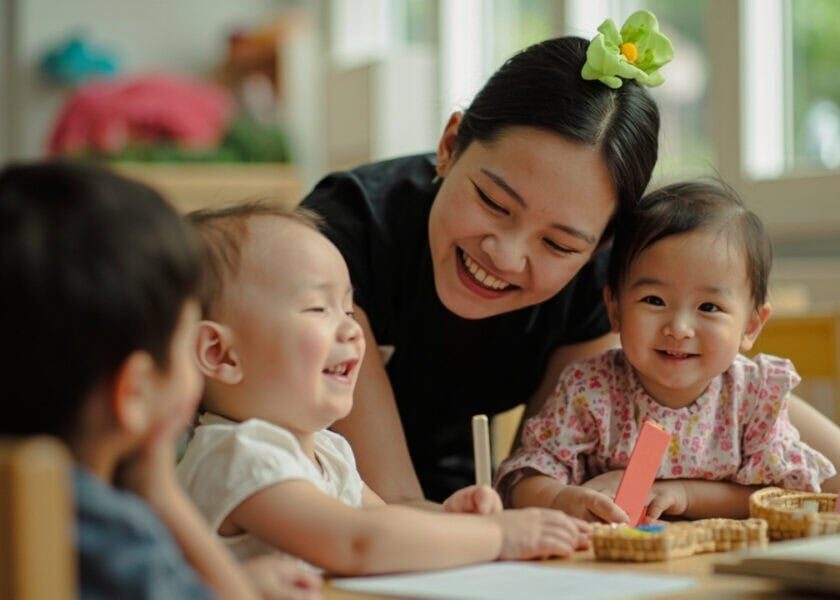
The Village Singapore Parents Are Choosing to Build Instead
The Quiet That Every Singapore Parent Knows
There is a particular kind of quiet that comes over a Singapore housing estate on a weekday morning. The young families who once filled it have dispersed into office towers, into malls, into the relentless machinery of a city that runs on dual incomes.
The grandparents, where they exist at all, are hours away by car or plane, growing older in hometowns that feel like different countries. The neighbours who might once have been trusted to look in, to nod across a clothesline, to be part of the ordinary village of raising children — they are strangers on the other side of the lift lobby door.
A new parent stands in their flat, or their rental, or their studio apartment in central Singapore. They hold a child they love completely. And they feel, with a sharpness that surprises them, that something is missing. Not something they can name easily. Not something they learned to talk about. But something that older generations would have called the village.
This is the absence you have probably felt. You may not have had the words for it. But you have felt it — in the quiet of your flat when the door closes behind the last visitor, in the relief that surprises you when someone else holds your child, in the guilt that sometimes follows that relief.
This article is about that absence, and about what can be done about it.
What the Village Actually Was
The village was never sentimental. It was not a place of perfect parents or perfect children. It was functional.
It was the auntie next door who knew your four-year-old was afraid of dogs before you did, because she had seen the way he flinched when the delivery man came with his motorcycle. It was the uncle at the coffee shop who kept an extra packet of biscuits behind the counter and somehow always knew when your child needed one. It was grandparents, yes, but also cousins, and neighbours, and the woman who sold economy rice and remembered that your daughter was allergic to shellfish.
The village was a web of consistent human attention, distributed across many adults, accumulated over years of small interactions. It was the social environment in which children learned, without ever being taught, that they belonged to something larger than their immediate family.
And the village was, perhaps more importantly, a structure of relief for parents. Not the abstract relief of knowing theoretically that someone else could help — but the lived relief of handing your child to someone who already knew them. Who knew they liked their milk slightly warm. Who knew they needed to be picked up from the left side because their right ear was still sensitive after the infection last month. Who knew their moods, their rhythms, their small and specific ways.
The village meant that raising a child was not a solo performance but a chorus. It meant that the weight was distributed. That no single person carried it all.
What Modern Singapore Families Have Lost
What replaced the village was a structure of radical individual responsibility. Two working parents, one child or two, no grandparents nearby, no neighbours who stay long enough to become familiar, no one who knows your child except the people you pay to know them.
This is not a weakness. It is a structural fact of modern Singapore parenting. And yet we have built an entire industry of childcare around pretending it is not there — offering parents evidence of safety, lists of credentials, accreditations and ratios and curriculum frameworks, as though what they are really asking for is reassurance that their child will not be harmed.
But that is not what parents are asking for at the deepest level. What parents are asking for, when they spend hours researching childcare options, when they visit centres and walk away feeling vaguely unsettled, when they lie awake at night wondering if they are making the right choice — what they are asking for is the village.
They are asking for someone to know their child. They are asking for a community that will hold their child the way a village holds a child. They are asking, without quite knowing how to say it, to stop being alone.
What Children Lose When the Village Is Not There
Children are social beings. This is not a theory. It is visible in the way a toddler will offer a biscuit to another toddler, not because anyone taught them to share, but because they are already looking for a way to connect.
Children are wired to belong. They are wired to look for the village. And when the village is not there — when every weekday morning means being handed to a stranger, or to a sequence of rotating caregivers, or to a place where the faces change so often that no one can quite be said to know you — children adapt. They learn to be portable. They learn to perform trust rather than feel it. They learn that the adults in charge are interchangeable, that attachment is conditional on presence, that the safest way to be is to need no one very much.
This is not catastrophic. Children are resilient, and they will find other ways to connect. But it is a loss, and we should name it as such.
The social development that a village makes possible — the slow, patient building of belonging, the consistent modelling of what it means to be known and to know others, the gradual expansion of a child’s social world from family to community — this development requires a stable, warm, predictable social environment. Not a perfect one. Not one without conflict or disappointment or the ordinary friction of human relationship. But a consistent one. One where the faces are the same faces, where trust can accumulate over months and years, where a child can say “my teacher” and mean a specific person, not a title.
What EduNanny Has Been Built to Provide
This is what EduNanny has been built to provide. Not as a marketing promise. Not as a sentimental framing. But as a deliberate, structural commitment to what we call intentional village-building.
Home-Based Childminding: Where Your Child Is Not the Visitor
EduNanny operates under the ECDA Childminding Pilot, which means we are part of a regulated framework designed specifically to support families who need more than casual childcare and less than institutional centre-based care.
We offer home-based childminding, where a trained caregiver comes to your home and cares for your child in your child’s own environment. This sounds simple, but it is actually profound, because it means your child is not the visitor. Your child is at home, in familiar surroundings, with a caregiver who becomes a consistent presence in that space over time.
We also offer community-based and centre-based pathways where appropriate, giving families options that suit their circumstances without losing the thread of what matters: consistency, relationship, the slow building of a village.
Infant Ratios That Honour Small Children
Our infant ratios are structured around the recognition that small children need more individual attention, not less. We maintain ratios of up to one to three for infants — one caregiver for every three infants — which is not a bureaucratic requirement we comply with but a philosophy we believe in.
It means that when your nine-month-old is having a difficult morning, when the separation anxiety has hit hard and the tears are real, there is time to hold them. There is time to be patient. There is time to wait until they are ready to engage, rather than moving on to the next activity because four other children also need attention.
The village, we believe, should never be so crowded that it cannot hold each child individually.
Caregivers Who Are Selected, Not Assigned
Our caregivers are not randomly assigned. They are selected, trained, and matched with families in a process that takes seriously the significance of what we are asking parents to trust.
These are people who understand that they are entering not just a household but a relationship — the most important relationship, in many ways, that a family has beyond the family itself. They are trained not only in the technical competencies of infant care but in the observational skills that allow them to notice, over time, the small changes in a child’s mood, the emerging preferences, the social patterns that will eventually become the foundation of who this child is becoming.
Over weeks and months, this knowing accumulates. Parents begin to receive updates not as checklist reports — “child ate lunch, child napped, child had diaper change” — but as small narratives.
“She was very interested in the ants today and pointed at them for a long time before she tried to touch one. I let her, and she was surprised by the movement.”
“He asked for the blue cup today without being prompted. He remembered which one it was.”
These updates are possible because our caregivers have time, and consistency, and the kind of attention that only comes from not being stretched across too many children. They are possible because EduNanny is not a turnover business. We invest in our caregivers because we believe the village should not keep changing.
What EduNanny Is Not — And What It Is
We want to be honest about what EduNanny is. We are not a replacement for family. We are not suggesting that childcare can do what grandparents do, or what a village of neighbours does. We are not minimising the grief of that absence, the grief of raising children far from kin, in a city where the neighbourhood does not know your name. We carry that grief with you, because we see it every day.
What we offer is not a cure for that grief. What we offer is a structure that holds within it the functions that matter: consistent attention, known caregivers, a community for your child that builds over time rather than resetting every few months, a communication channel that keeps you connected to who your child is becoming during the hours you are apart.
EduNanny operates within the ECDA Childminding Pilot framework, which means our fee structures are designed to be accessible. Monday to Friday care blocks are available for families who need full-week support, recognizing that the modern working week does not pause for the realities of childcare. CDA and Baby Bonus funds can be utilized, which means the financial architecture that Singapore has built to support families is available to you here.
This is the difference between supervision and community. Supervision is watching. Community is knowing.
What This Means for You as a Parent
You were raised with a village. Your parents, or your parents’ parents, had grandparents and cousins and neighbours and the ordinary infrastructure of community that made raising children not a solo act but a collective one.
And then something happened. The cities grew. The families scattered. The neighbourhoods that once held generations in close proximity became transient, anonymous, optimized for individual privacy rather than collective care.
This is not your failure. This is the structural condition of modern Singapore parenting, and we should stop pretending otherwise. We should stop building childcare marketing around the assumption that parents are anxious because they are bad parents who need reassurance.
Parents are anxious because they are doing something genuinely difficult without the support that previous generations took for granted. They are anxious because they have been told that bonding with your child in the first thousand days is crucial, and then they have been sent back to work at twelve weeks. They are anxious because they know, in their bones, that children need a village, and they cannot figure out where to find one.
EduNanny is where you find one. Not because we have invented something magical. But because we have recognized what was lost and built a structure designed to restore it — not identically, because the village of the past cannot be replicated in a modern city, but functionally. With intention. With the recognition that what children need is not the same childcare centre where they are one of thirty and the teacher changes every three months, but a community where they are known. Where the adults are consistent. Where the relationships are allowed to deepen over time.
And for you — for the parent standing in the doorway, watching someone else hold your child, feeling the strange mix of gratitude and grief that is the signature emotion of modern working parenthood — we offer something else. We offer the village for yourself.
Not just for your child, but for you. A trusted circle. A place where your child is held not as a task to be completed but as a person to be known. A caregiver who will text you a photo at an unexpected moment, not because it is required, but because she thought you would want to see it. A weekly update that goes beyond the logistics to tell you who your child is becoming. A relationship with people who are invested, not just in the hours they spend with your child, but in the outcome — in who your child grows up to be.
The Moment Everything Changes
There is a moment that happens, sometimes, in the months after a family joins EduNanny. It is not dramatic. It is not a transformation. But parents describe it, when they describe it, in similar ways.
They describe a morning when they dropped their child off and there was no crying — not because the child does not love them, but because the child trusts the transition. Because the child knows the caregiver’s name. Because there is a place that is safe, and it is not home, but it is village.
They describe an evening when they received a message that said not “child was fine today” but “child did something extraordinary today, and I wanted you to know.”
They describe the slow accumulation of trust, not just in the caregiver, but in the arrangement itself. The realization that this can work. That the village can be rebuilt. That they do not have to do this alone.
Choosing a Village: A Practical Guide for Parents Researching Infant Care
If you are reading this, you are probably somewhere in the middle of making one of the most significant decisions of your early family years. You are comparing options. You are visiting centres. You are asking questions and receiving answers that feel, somehow, incomplete.
Here is what we would encourage you to look for, beyond the credentials and the ratios and the curriculum frameworks:
- Consistency of faces. Will your child see the same caregivers week after week, month after month? Or will they learn, early, that adults come and go?
- Quality of attention. Are the caregiver-to-child ratios designed to serve the children’s needs, or to serve the centre’s economics? Is there time to notice the small things — the emerging fears, the new preferences, the way a child’s face lights up when they discover something new?
- Communication that builds trust. Do you receive updates that feel relational, or transactional? Do you feel like you are receiving surveillance reports, or letters from someone who knows your child and wants you to know them too?
- The feeling of being known. Do the caregivers ask about your child as a specific person, with a specific temperament, specific fears, specific joys? Or does your child feel like one of many?
- Whether the arrangement is designed for you, or for them. A good childcare arrangement should feel like a partnership, not a service transaction. You should feel supported, not managed.
The Village You Choose
We are not the village your great-grandparents had. We are not even the village your parents had. But we are a village. A chosen one. A built one. A village where your child is known, and your family is supported, and the weight is shared.
If you have been feeling the absence of it, you are not imagining it. It is real, and it is a loss, and you are allowed to grieve it even as you move forward.
But you are also allowed to build something in its place. You are allowed to choose a village.
And we are here, ready, to be the one you choose — not because we have all the answers, but because we have seen what you are carrying, and we believe that no parent should have to carry it alone.
This is what EduNanny is for. This is why we exist. And this is why, for as long as there are families in Singapore who need a village, we will be here — building it, holding it, and keeping it for the children who deserve to belong.
If you are ready to explore what this could look like for your family, we would welcome the conversation. Reach out to us — no pressure, no hard sell, just an honest discussion about what you need and whether we might be the right fit.
Learn more about who we are and what we offer.