What Your Child Learns While You’re Apart: A Singapore Parent’s Guide
The World Your Child Builds While You Are Apart
There is a moment, somewhere between the car seat buckle and the classroom door, that every working parent in Singapore knows.
It happens in the morning, when the light comes in slant and warm through HDB windows. When your child’s hand reaches back for you even as they are already looking ahead. It happens at the drop-off point, in that small pause where you are both learning to let go of something you never quite knew you were holding.
And then it happens again, hours later, when you return and your child runs toward you not with a story, but with a feeling. The unmistakable evidence that they have been somewhere that mattered. That they have been someone while you were away.
What happens in those hours? What does your child actually experience, learn, and feel while you are building the career, managing the household, or simply being the responsible adult that someone has to be?
These are not small questions. They are, I would argue, some of the most important questions any parent can ask. And yet they are questions that we often do not let ourselves voice aloud, because voicing them feels like an admission—as if wondering about your child’s day is the same as doubting your choice.
But I want to suggest something different. The question of what happens in the hours apart is not a question born of doubt. It is a question born of love. And when you ask it—when you let yourself really wonder about your child’s world while you are away—you are not exposing a gap in your parenting. You are acknowledging something profound about childhood itself: that it is a world that expands, that grows, that becomes more than any one person could ever offer alone.
What a Quality Childcare Day Actually Looks Like
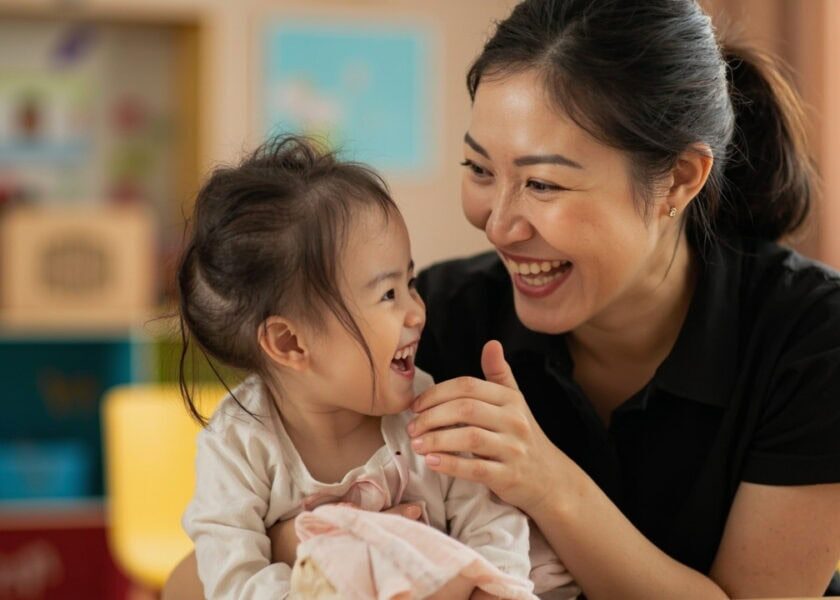
You drop your child off at eight in the morning. The caregiver greets you both by name—not a polite, rehearsed greeting, but a real recognition. She knows that your daughter is currently fascinated by anything that stacks. That she is recovering from a mild cold. That yesterday she finally let go of the rail and walked across the room on her own, and you both almost cried about it.
This knowledge is not incidental. It is the architecture of attentive care.
What does a quality childcare day actually look like? Not the version written in brochures, but the real version—the one made of small moments and specific observations.
It looks like a morning circle where the caregiver sings a song your child has been requesting for three days straight, and your child lights up with the recognition that someone remembered. It looks like snack time becoming a lesson in patience, in turn-taking, in the simple dignity of waiting your turn and knowing that what you are waiting for will come.
It looks like a caregiver who notices, mid-morning, that your child is rubbing her eyes, and who responds not with alarm but with quiet, warm direction. A nap. A rest. A small reprieve in a darkened room where the ceiling fan makes a rhythmic sound and your child falls asleep knowing that someone is nearby.
This is not supervision. This is intentional developmental engagement, and the difference between the two is everything.
Reading the Child: Why Training and Attention Matter
Supervision is what happens when a person is present in a room and responsible for keeping children safe. It is necessary. It is foundational. But it is not, by itself, what children need to thrive.
What children need—what the first thousand days of their lives require—is the experience of being known. Of being responded to. Of having their cues read and honored by someone who has been trained to see them.
A trained caregiver does not just watch your child. She interprets your child.
She understands that the flapping hands of a ten-month-old are not restlessness but excitement. That the silence of a new arrival is not disinterest but careful observation. That a toddler’s insistence on pouring water from cup to cup to cup is not a waste of time but a dissertation on gravity, persistence, and the pleasure of mastering something that seemed impossible last week.
Something also happens in a quality childcare setting that often surprises parents to learn: the degree to which children learn from each other. Peer interaction is where a different kind of intelligence begins to form. Social intelligence. The kind that cannot be taught by adults alone, because it requires peers.
Watch two toddlers in a quality setting, and you will see something remarkable. You will see a child offer a block to another child, and then look back to see if the gift was received. You will see the confusion and the recovery, the second attempt and the success. You will see a three-year-old negotiate over a toy not with the vocabulary of diplomacy but with the raw, brilliant, clumsy tools of early social thinking—and you will see the other child respond, adjust, find a solution.
This is not a simulation of the real world. This is the real world, happening at exactly the pace and scale that a young child can absorb it.
Language unfolds differently in a quality setting too. Not because children are drilled or tested, but because language is modelled.
A caregiver narrates the morning: “We are washing our hands now. Feel the water? It is warm.” She names emotions that a child has not yet learned to name: “You are feeling frustrated because the puzzle piece does not fit. That is okay. We can try again.” She sings songs that your child will later sing to you in the car, and you will not know where they learned them.
And then there is the play. Unhurried, exploratory play, where the highest purpose is not to achieve a goal but to discover that there are things worth pursuing. Where a child spends twenty minutes moving a truck back and forth not because they are not clever enough to do something else, but because they are discovering something essential about motion, about cause and effect, about the pleasure of repetition and mastery.
Where the caregiver does not interrupt this work, does not redirect it, does not hurry it along—but stands nearby, present, available, understanding that this is the work.
This is what a quality childcare day looks like. Not a series of activities designed to impress. But a series of moments designed to meet your child exactly where they are.
The Hours Apart Are Not a Void
I want to pause here, because I know that what I am describing may feel, to some of you, almost too good to be true. The world I am painting is warm. It is attentive. It is full of small recognitions and intentional moments.
But I also know what you are thinking. You are thinking: what about the other times? The crying at drop-off that I cannot witness? The nap that I cannot oversee? The meal that I cannot see them eat? What about the hours when I am not there to know?
This is the tension that lives at the center of every working parent’s experience, and it would be dishonest to pretend it away.
The hours apart are real. The not-knowing is real. The guilt—and I want to name this honestly, because parents in Singapore carry so much silent guilt—the guilt is real too.
But here is what I have learned, working alongside families across this island: the not-knowing does not have to be a void. It can be a door.
And the quality of your child’s childcare experience should not be measured by how much you are able to witness, but by how much you are able to trust.
Trust Is Built on Transparency
At EduNanny Singapore, we have built our practice around a simple, non-negotiable principle: that you should never have to wonder what your child’s day looks like.
When your child is in our care under the ECDA Childminding Pilot, you receive regular updates—not the vague “had a good day” that leaves you guessing, but real, specific, observable updates about what your child did, how they responded, what they discovered.
We believe that communication is not a courtesy we extend to parents. It is a core part of the service. Because when you know what your child’s day looked like, something shifts. The separation changes. It becomes not an absence, but a story—a story that continues, that has texture, that you can enter into when your child comes home.
When your child comes home, pay attention. Pay attention to the songs they sing that you have never taught them. Pay attention to the games they invent that have the logic of other children behind them. Pay attention to the way they name their emotions, because they have been in a place where emotions are named and honored. Pay attention to the small, ordinary miracles of a child who has spent the day becoming more themselves.
That is what quality care produces. Not a child who needed you less. A child who has been given more.
Built for Singapore Families
The landscape of childcare in Singapore is unlike anywhere else. We are a country that works. Our parents return from maternity leave with four months of bonding time behind them and a career that does not pause.
Our government has built structures—CDA accounts, Baby Bonus schemes, subsidies that attempt to make quality care accessible—to support families in this reality. And still, the question of affordability haunts every parent making decisions about childcare.
EduNanny Singapore operates within the ECDA Childminding Pilot, which means our fee structures are designed to be affordable for families committed to quality care. We know that asking parents to choose between their financial reality and their child’s development is a false choice. It is a choice that no family should have to make.
That is why we have built pathways—home-based care, community and centre-based options—that allow families to find the arrangement that fits their lives, their budget, and their child. Monday through Friday. The hours you need. The care your child deserves.
What EduNanny Singapore Actually Offers
- A place where your child’s day is so meaningful that it deserves to be understood
- Trained caregivers who have been equipped not just to supervise but to engage
- Communication and transparency so that the not-knowing becomes a knowing
- Ratios that allow for individual attention—up to one to three infants, because the youngest children need the most responsive care
- Pathways that respect the reality of Singapore families: their schedules, their budgets, their need for Monday to Friday consistency
We are not offering perfection, because no human institution can promise that. But we are offering intention. We are offering a practice built on the belief that every moment of your child’s day matters, and that the hours apart are not a gap to be survived, but a world to be explored.
There is a way of understanding that morning moment of separation that I want to offer you, not as a platitude, but as a reframing that I have seen change how parents feel about their choices.
Your child does not experience your absence the way you experience it. When you walk out the door, you carry the weight of the choice, the guilt, the second-guessing. But your child—who lives more fully in the present than any adult ever can—your child experiences the drop-off as a threshold.
On one side is home. On the other side is another world. And the other world has people who are waiting, who are ready, who have prepared a space for exactly the child who is arriving.
This is not abandonment. This is expansion.
Every child deserves a world that is larger than one person, one place, one relationship. Not because parents are insufficient—never that—but because children are vast, and their capacity for connection, for learning, for becoming is wider than any single setting can contain.
What You Can Do Today
If you are a parent in Singapore researching infant care or childminding, here are practical steps you can take to feel more connected to your child’s childcare experience—even before you make a decision:
- Ask specific questions. When evaluating a childcare provider, ask not just “What will my child do today?” but “How will you know if my child is tired? Frustrated? Overstimulated?” The quality of the answer reveals the quality of attention.
- Ask about communication. What updates will you receive? How often? In what detail? Providers who take communication seriously will have systems in place—not just for emergencies, but for daily connection.
- Observe at pickup. When you collect your child, notice what they are like. Are they calm? Engaged? Watch for the songs, the games, the small behaviors that tell you where they have been.
- Ask your child. “What did you do today?” You may not get a coherent answer, but pay attention to what they reach for first. That is where their world is.
- Trust your instincts. If something feels off—if your questions are met with vague reassurances rather than specific answers—that is information. Quality care welcomes scrutiny because it has nothing to hide.
Your Child’s World, Waiting to Be Known
Somewhere, right now, a parent in Singapore is sitting at their desk, thinking about their child. Wondering what they are doing. Hoping they are okay. Carrying the quiet, persistent question: what does their day actually look like?
To that parent, I want to say: your question is not a weakness. It is your love, asking to be satisfied.
And to answer it—to answer it with specifics, with warmth, with the kind of transparency that builds real trust—this is what EduNanny Singapore is for.
We do not ask you to stop wondering. We ask you to bring your wondering to us, and to let us show you.
Show you the morning circle. Show you the blocks stacking higher than they did last week. Show you the caregiver who reads your child’s cues the way you do—because she has been trained to see what you see, and to honor it.
Show you the nap that your child fell into with the ceiling fan humming and a small hand nearby. Show you the snack that was eaten, the song that was sung, the moment when a child who had never played alongside others finally reached out a hand and made a friend.
This is what we do. This is what the hours apart are for.
When you pick your child up tonight, ask them. Ask them what they did. Watch their face. Watch the remembering happen. And then know—know in your bones, with the kind of certainty that only comes from understanding—that your child’s world has been expanding, even while you were away.
That is not a loss. That is everything.
That is the world your child is building, one hour at a time. And it is a world worth knowing about.
If you are ready to learn more about how EduNanny Singapore’s ECDA Childminding Pilot can support your family—with trained caregivers, transparent communication, and a commitment to making quality care accessible—reach out to us today. Your child’s world is waiting to be explored.
Learn more about the ECDA Childminding Pilot, who we are, or get in touch to begin a conversation about what your family needs.