The Evidence Singapore Parents Receive Every Evening
Why Parents Feel They Cannot Know
Singapore parents are navigating something genuinely difficult. You are making decisions about your child’s earliest years during a period of extraordinary pressure — the cost of living, the demands of work, the complexity of choosing care for a child who cannot yet tell you in words what they need.
You want your child to be safe. You want them to be happy. You want them, if possible, to be growing. And you are being asked to make this choice based on limited information, in a landscape of options that all sound broadly similar.
This is the tension that sits beneath every parent choosing childcare. You cannot be there during the hours that matter most. You cannot see what happens when your child encounters their first conflict with a peer, or when they meet a new concept, or when they are tired and overwhelmed and need to be gently brought back to equilibrium.
You have to trust. And trust, as every parent knows, is not a feeling. It is a leap.
Our culture has taught us to look for evidence in places that are easy to measure. Certificates on walls. Teacher introductions. The brightness of a classroom on a tour. The reassuring phrases in a welcome pack. These things feel like evidence because they are visible, shareable, comparable.
But the most important evidence you will ever receive about your child’s care is not in any of those places. It is the evidence that arrives home with your child every single evening. It is the conversation at the dinner table. It is what your child narrates, initiates, questions, and attempts after a day away from you.
That evidence is not supplementary. It is the report card that actually matters.
What Your Child Actually Brings Home
Think about what a child is doing when they come home and tell you about their day. They are not reciting a curriculum. They are not performing for you. They are revealing what caught their attention, what troubled them, what delighted them, what they tried and whether it worked.
A child who comes home and tells you about a butterfly they saw in the garden — complete with the specific questions they asked the caregiver — that is language development. That is curiosity in action.
A child who comes home and, for the first time, uses words to describe how they feel instead of crying — that is emotional literacy.
A child who comes home and immediately recreates a game they invented with another child, talking through it as they play, is showing you social intelligence being formed.
These are not small things. These are the foundations of everything that comes later.
Here is what I mean when I say the dinner table is the real report card: what childcare produces will find its way into your home. It cannot be hidden. It will not stay inside the centre. The child who is genuinely engaged, genuinely curious, genuinely developing will bring that development home.
The child who is simply being watched, simply being kept safe, will come home without that momentum. They will not be damaged. But they will not be growing in the same way either.
Supervision or Nurturing: A Fundamental Difference
Not all childcare is the same. There is a fundamental distinction between two approaches.
One I will call supervision-based care. Children are kept safe. Diapers are changed. Meals are served. Schedules are followed. Children are watched.
The other I will call observation-informed care. This approach starts from a different question: what is happening inside this child right now? What are they working on — in their language, in their social development, in their emotional regulation, in their physical confidence? Observation-informed care does not simply watch children. It builds a picture of each one over time.
In a supervised environment, a child encounters a puzzle they cannot solve and becomes frustrated. The toy is taken away. The child is distracted. The frustration passes.
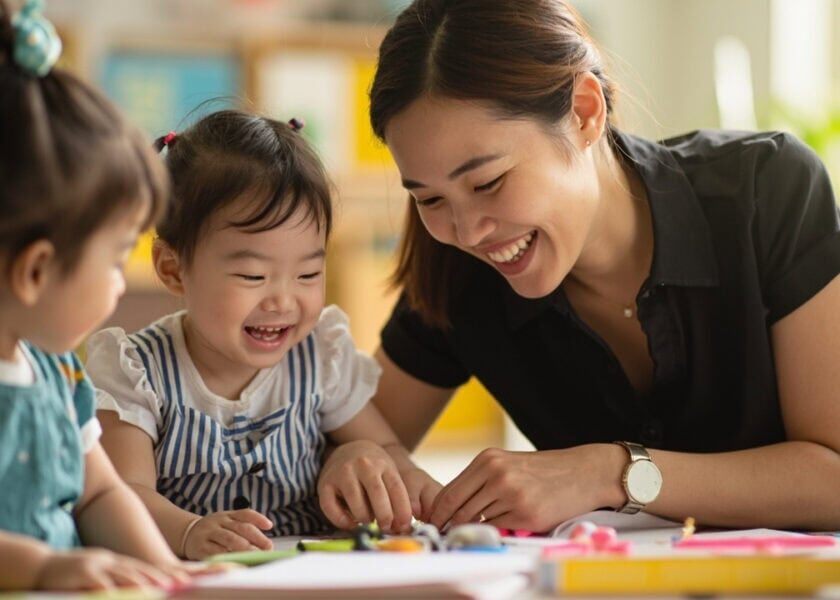
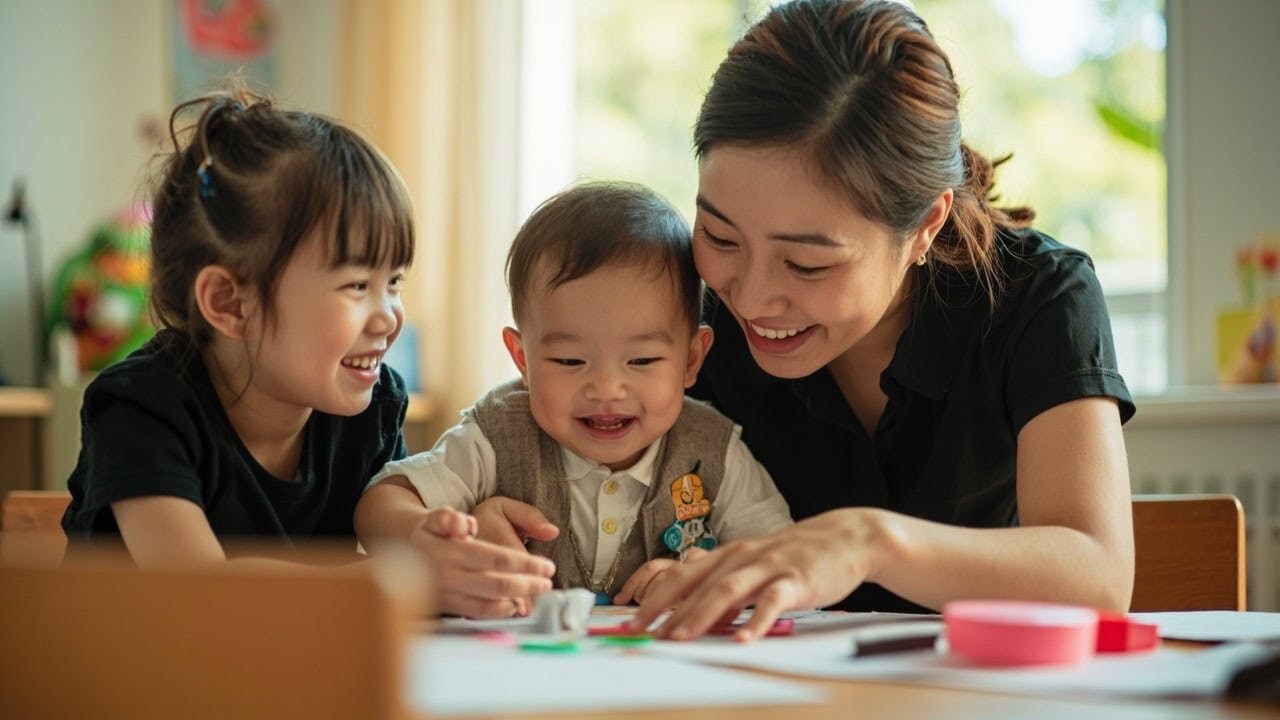
In an observation-informed environment, the caregiver notices the frustration and what precedes it. They wait. They offer a small prompt, not a solution. They name what the child might be feeling. They stay close.
Perhaps the child tries again, differently. Perhaps they ask for help in a way they could not articulate last week. Perhaps they set the puzzle aside and move to something else — and that too is meaningful, because the child is learning their own rhythms, learning that stepping back is not failure.
That evening, the parent receives something. It might be a note. It might be a verbal update during pickup. It might be visible in the child’s behavior at home — a patience they did not have before, a willingness to try that has arrived without being taught.
The report comes home because the observation came first.
What EduNanny Was Built to Produce
EduNanny operates as part of the ECDA Childminding Pilot, and this matters not just as a designation but as a philosophy. The pilot reflects a belief that childcare is not a single model. Children develop differently. Families need different pathways.
At EduNanny, we offer both community-based and centre-based pathways, because we know that the right environment for a child depends on the child, the family, and the rhythm of their lives.
What connects these pathways is our understanding that observation is not a passive act. When a caregiver observes a child, they are building a picture. They are tracking language acquisition, social curiosity, emotional regulation, physical confidence. They are noticing what excites a child, what frustrates them, what they reach for and what they retreat from.
The caregiver ratios we maintain reflect this. For infants, we maintain up to a one-to-three ratio. One caregiver for three infants. That is not a compliance figure. That is a configuration designed to allow genuine attention — to allow a caregiver to know each child well enough to notice when something shifts.
To respond not just to hunger or tiredness, but to the subtle signals that precede frustration, or the small gestures that indicate a new skill is emerging and wants to be noticed.
The role of the childminder is often misunderstood. It is seen as a practical role, a logistical solution to who watches your child while you work. And it is that. But it is also something more.
The childminder is the person who spends hours with your child during the period when their brain is forming faster than it ever will again. The childminder is the person who witnesses the moment your child says a word correctly for the first time, or shares a toy for the first time, or laughs at a joke they finally understand.
These are not small moments. These are the moments that shape a lifetime.
At EduNanny, we choose the word caregiver deliberately. Because to care for a child is to be present with them. To notice them. To remember what they like, what they fear, what makes them laugh, what they are working on right now in terms of their development.
How Transparency Works in Practice
I want to speak directly to something that sits in the background of every parent’s mind when choosing care: how will I know? How will I really know that my child is okay? That they are more than okay?
This is not an unreasonable fear. It is a completely rational response to a situation that contains genuine vulnerability. And the childcare industry has, for decades, responded to this fear by offering more — more information, more documentation, more reassurance, more tours, more certificates.
Here is what we have learned: more information does not produce more certainty. It produces more noise.
What produces genuine peace of mind is not the volume of evidence available to you — it is the quality of attention your child is receiving during the hours you are apart.
At EduNanny, we have built transparency into our model in practical and honest ways. We use communication tools that allow caregivers to share what they observe. Where CCTV is deployed, parents have access. Where notes and updates are written, they are specific rather than generic.
“Your child had a good day” is not an update. “Your child tried a new approach to the block tower today and showed real persistence before asking for help” is an update.
We want parents to receive the kind of information that lets them see their own child more clearly — not just confirms that the day passed without incident. Parents are the people who know their children best. When they are given real information, they can read it. They can connect what happens in care to what they see at home. They can trust their own observations because they have been confirmed by someone who was also watching.
What to Look For After You Begin
If you are currently researching childcare options in Singapore, here is a practical question to ask during your visits — and after:
When your child comes home this evening, what will they tell you?
Not what the welcome pack says. Not what the tour covered. Not what the teacher introduction promised. What will your child actually show you?
Look for these signs in the weeks after you begin with a new childcare arrangement:
- Language that surprises you. New words, new phrases, new ways of describing things. Language does not appear from nowhere. It is absorbed from environments where children are spoken to, listened to, and engaged with genuinely.
- Emotional vocabulary. Children who are helped to name their feelings develop the ability to express them in words before they resort to tears or tantrums. Notice whether your child is gaining this capacity.
- Curiosity about their own day. Children who are engaged and stimulated come home wanting to tell you about their day. Children who are merely supervised often cannot tell you much at all.
- New ways of playing. A child who has been in a rich learning environment will often recreate games, scenarios, or discoveries from their day. A child who has been safely watched may simply be tired.
- Settledness at pickup. Watch your child’s face when you arrive. Not just whether they are happy to see you — though that matters — but how they leave. Do they wave? Is there trust in the routine?
These are not scientific metrics. They are real indicators of whether your child is being watched or noticed, supervised or nurtured, kept safe or helped to grow.
The Reframe You Can Carry With You
You are already receiving reports from your childcare. You have been receiving them every evening.
They arrive not in the form of documents or certificates or orientation presentations. They arrive in the form of your child’s questions, your child’s stories, your child’s behavior, your child’s growth.
The dinner table conversation is not a bonus update. It is the primary evidence. It is the data that tells you whether your child is simply spending time safely, or whether they are spending time growing.
If what you see at home is a child who is curious, who is language-rich, who is emotionally responsive, who is growing in confidence and connection — then you are already seeing what quality care produces. You are already reading the evidence. You simply may not have known what you were looking at.
We do not promise to keep your child safe. Every childcare promises that. We do not promise to be caring or loving or professional, though we are all of those things.
We promise something more specific, and more measurable, because it can be seen: we promise that your child will come home changed. Not just tired. Changed. Ready to tell you about their day in ways they could not tell you last week. Ready to try something new. Ready to show you who they are becoming.
That is what EduNanny is for. That is why we do this work.
And that is what I want you to carry with you when you sit down to dinner with your child tonight.
Listen to them. Watch them. You already have the evidence. You have been reading it all along.
EduNanny by BUTLER offers observation-informed infant care and childminding through both home-based and centre-based pathways. We are part of the ECDA Childminding Pilot, with caregiver ratios designed for genuine attention.
EduNanny works with CDA and Baby Bonus where applicable. Care operates Monday to Friday, in blocks designed to align with the rhythms of working families. Speak with our team to learn whether EduNanny is the right fit for your family.