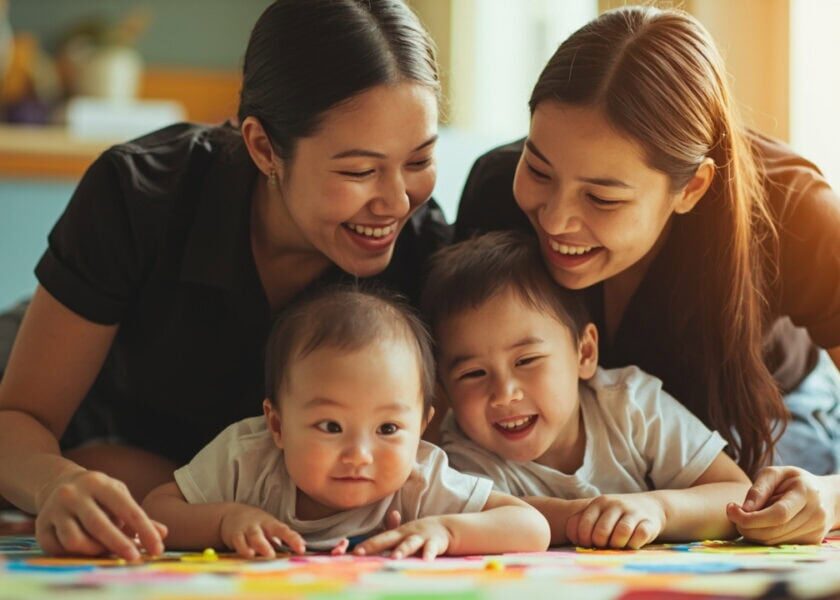
Beyond Supervision: The Hidden Hours That Build Your Child
The Hours You Cannot See: What Quality Childcare Actually Builds in Your Child
There is a particular kind of wondering that happens after you drop your child at childcare. It surfaces while you are in a meeting, on the MRT, or finishing a task you finally have space to complete: What is my child doing right now? Are they okay? Are they happy? Are they learning anything, or just being kept?
You are not alone in this wondering. Every parent who entrusts their child to care carries some version of it. And yet, this wondering remains largely unspoken in public conversations about childcare. We talk about safety. We talk about trust. We talk about finding the right fit. What we rarely talk about is what actually unfolds during those hours you cannot see—and why those unseen hours might be some of the most consequential in your child’s development.
Quick Summary: What Your Child Is Really Learning in Quality Childcare
- Social confidence: Learning to navigate relationships with peers—sharing, negotiating, and forming connections without you nearby
- Language growth: Thousands more words absorbed daily through rich, responsive conversation with trained caregivers
- Emotional resilience: Building the inner certainty that they can manage, adapt, and recover from small frustrations
- Hidden talents: Discovering interests and inclinations that might never surface in a home environment shaped primarily by family routines
- Independence: Internalizing the message that they are capable—often before parents witness this breakthrough at home
The Architecture of Early Childhood: Why These Years Matter Differently
The first years of life are not a waiting period before school begins. They are a foundational architecture being built in real time. Neural connections form at a pace that will never be matched again. Language emerges from babbling to sentences. Motor skills evolve from reaching to running. Social instincts awaken that will shape how a child relates to others for the rest of their life.
Children are not merely growing—they are constructing themselves. And much of this construction happens not in your presence, but in spaces you cannot enter. In the group, in the rhythm of a classroom, in the small daily negotiations of childhood.
A peer builds a tower, and suddenly the watching child wants to try. A peer drops a spoon, and the sound is funny, and both children laugh. A child learns to share a toy while you are across town at work. They ask for help from a caregiver instead of you. They laugh at a peer’s joke and try to make it happen again.
This is the invisible curriculum of quality childcare. And it is anything but passive.
The Difference Between Supervision and Developmental Care
Consider what happens when a young child enters a well-designed group setting for the first time. There is initial hesitation—that is expected and normal. But within days or weeks, something shifts. The child begins to notice others. Other children become interesting. They become resources.
In a quality childcare environment, these peer interactions are observed, supported, and gently guided by trained caregivers who understand what they are witnessing. They understand that when a two-year-old hands a block to a peer instead of grabbing, that is not a small thing. It is the early scaffolding of generosity, of reciprocity, of the understanding that other people have needs too. It is the beginning of empathy.
Passive supervision keeps children safe. It ensures they are fed, rested, and prevented from harm. That matters, and it should never be taken for granted.
Active developmental care does more. It reads the small moments—the hesitation, the breakthrough, the burst of curiosity, the emerging skill—and responds to them. It creates conditions for learning rather than simply preventing failure.
It notices the child who keeps gravitating toward music and asks whether there is more music to offer. It sees the child who asks constant questions and asks whether there are more questions to answer.
The question is not only whether your child is safe, though of course they must be. The question is whether your child is in an environment that sees them as a whole person—a learner, a discoverer, a social being—and responds accordingly.
What Children Actually Build in Quality Care
Beyond safety and social skill, quality childcare produces something quieter and more profound. When a child learns to navigate the world without a parent nearby—even for a few hours—they are learning that they can manage. That they can ask for help and receive it. That the world contains other reliable people. That they themselves are capable of more than they knew.
A child who has been supported to climb a ladder they were unsure about does not forget that feeling. A child who has been comforted by a caregiver and emerged from tears to play again does not forget that either. These experiences are internalized. They become part of the child’s internal working model of the world: I am capable. People help me. I can try again.
Language development accelerates in these environments too. In quality childcare, children are spoken to constantly—not in baby talk, not in commands, but in full, warm, conversational language that signals respect for their developing minds. Caregivers narrate what is happening. They name things. They ask questions and wait for answers, even when those answers are not yet words.
If a child points and says “dog,” the caregiver responds, “Yes, that is a big brown dog. He has floppy ears. What do you think he is doing?” This back-and-forth is the oxygen of language development. It happens throughout the day, not in isolated lessons but in the ordinary texture of being together.
And then there is the matter of discovery. Every child arrives with inclinations—little sparks of interest that, if supported, can become lifelong passions. A child who notices patterns. A child drawn to water. A child who hums along to music. These sparks are easy to miss at home, where the day’s rhythm is shaped by the family’s needs. But in a quality childcare environment, where observation is part of the practice, these sparks can be seen. And when they are seen, they can be nurtured. Not forced—never forced—but noticed, welcomed, and given room to grow.
Parents often notice this showing up at home in unexpected ways. The child who is more independent, more willing to try, more resilient in the face of small frustrations. Parents sometimes wonder where this came from, not realizing that it was being built in the hours they could not see.
Reframing Absence: Why Your Working Hours Are Not a Loss
Let us speak to something that matters deeply. In many cultures and family conversations, there is an undercurrent of guilt that follows parents who use childcare. The sense that being away from your child is, in some fundamental way, a failure. That if you were a good enough parent, you would be there.
We want to gently push back on this—not to dismiss the feeling, but to reframe what absence actually means.
Children do not need their parents to be present every waking moment in order to thrive. What they need is secure attachment: a deep, trusting bond with their primary caregivers, and then a broader world that is warm, consistent, and responsive. When children have that foundation, they can venture out. They can form secondary attachments. They can learn from other adults who are skilled and kind. They can discover themselves in new contexts.
This is not a threat to the parent-child bond. It is an extension of it.
Absence, in this frame, is not distance. It is space. Space for your child to become.
For Singapore Families: Understanding Your Options
Singapore parents face real pressures. The cost of living, the demands of careers, the complexity of raising children in a society that moves fast. Many families need childcare—not as a preference, but as a practical necessity. For those families, the question is not whether to use childcare, but what kind will serve their child well.
This is where initiatives like the ECDA Childminding Pilot become important. The pilot was designed with an understanding that families need options—options that are not only safe and affordable, but that actually support child development. EduNanny participates in this pilot, offering families a pathway to quality childminding that meets ECDA standards. The pilot fee structures are designed to be accessible. And the framework recognises something that too many childcare conversations overlook: that childminders are not simply substitutes for parental presence. They are early childhood professionals who, when trained and supported well, can be significant figures in a child’s developmental life.
What Quality Childcare Looks Like in Practice
- Responsive interaction: Caregivers speak to children in full sentences, narrate activities, ask open questions, and wait for responses. There is genuine conversation, not just commands and corrections.
- Intentional observation: Caregivers notice patterns—what a child gravitates toward, what frustrates them, what makes them laugh. This observation informs how they respond and what they offer.
- Supported peer interaction: Rather than allowing conflicts to escalate or ignoring them entirely, caregivers guide children through social negotiations in ways that build skills.
- Respect for individual rhythm: Each child has their own pace. Quality care adapts to the child, not the other way around.
- Consistency and warmth: Children thrive when caregivers are stable, reliable, and emotionally present.
How EduNanny Approaches Childcare
EduNanny’s approach reflects a clear understanding that quality matters more than convenience. With small ratios—sometimes up to one caregiver for every three infants in certain settings—children receive responsive attention rather than diffused oversight.
Care is not delivered in isolation. It is structured around developmental awareness. Whether through home-based arrangements, community pathways, or centre-based settings, the commitment is to create environments where children are seen, where learning is embedded in daily life, and where families feel genuinely connected to what is happening.
For families navigating the practicalities, EduNanny integrates with Singapore’s existing support structures. Child Development Accounts can be used. Baby Bonus provisions apply. Care arrangements operate Monday through Friday, in blocks designed to align with real working lives.
Where deployed, communication measures and even CCTV provisions help parents feel connected to their child’s day. Not because cameras substitute for trust, but because visibility supports confidence. When you can see a moment from your child’s morning—a flash of concentration, a burst of laughter, a small triumph—you carry that with you through your day.
Choosing Quality: What to Look For and How to Know It’s Working
If you are currently researching infant care or childminding options in Singapore, here is what we recommend looking for:
- Visit more than once. A single observation may not capture the full picture. Return at different times of day if possible.
- Watch how caregivers speak to children. Are they narrating, asking questions, responding warmly? Or are they primarily redirecting and correcting?
- Notice the ratio. Fewer children per caregiver means more individual attention. Ask specifically about infant-to-caregiver ratios.
- Ask about observation and assessment. Quality caregivers track development. Ask how they document progress and share it with parents.
- Inquire about transitions and settling. How does the programme support children new to care? A thoughtful settling process matters enormously.
- Trust your instincts. If something feels off, it probably is. You know your child best.
You will not always see the evidence of quality care immediately. Developmental growth does not always announce itself with obvious milestones. But over time, you will notice things:
- Language enthusiasm: Your child comes home using words you have not taught them, or strings sentences together with newfound complexity.
- Social ease: Your child navigates peer interactions with growing confidence, shares willingly, shows interest in other children.
- Quiet resilience: Your child recovers from small disappointments or frustrations more quickly than before.
- Initiative and curiosity: Your child wants to try things themselves, asks questions, explores without waiting for permission.
- Genuine happiness at pickup: Your child is glad to see you, but also glad to have been where they were. There is no trauma in the transition.
If you are seeing these signs, the hours you cannot see are working. Your child is building.
The Answer to the Question You Carry
Let us return to that wondering. The question that surfaces after drop-off. What is my child doing right now?
The answer, if your child is in quality care, is something remarkable. They are learning. They are playing. They are building neural pathways and social instincts and the foundations of language and the confidence that comes from mastering small challenges. They are making friends in their own small, emerging way. They are discovering what interests them. They are being responded to by attentive adults who notice them and value them.
They are, in short, becoming.
And when you pick them up at the end of the day, that becoming does not stop. It comes home with them. It shows up in ways you will notice and ways you will not. It compounds over months and years. It becomes part of who they are.
Perhaps you will notice it when your child comes home and uses a word you did not teach them. Perhaps you will notice it when they navigate a disagreement with a sibling with unexpected skill. Perhaps you will notice it when they wave goodbye at the door with a smile, confident in the knowledge that they are going somewhere good.
What EduNanny Stands For
EduNanny stands for the understanding that quality matters more than convenience. We believe that every child who walks through our doors deserves to be seen as a person with potential, with preferences, with a unique trajectory of development that deserves to be understood and respected.
We believe that the work of early childhood care is not lesser than formal education—it is the foundation on which all education rests. And we believe that parents who invest in quality childcare are not choosing convenience. They are choosing to give their child more. More experiences, more support, more opportunities to learn and grow in a rich, intentional environment.
You are not choosing between your career and your child. You are choosing to find the right village to help raise your child—and in Singapore, that village can include us.
You chose quality. You chose to invest in your child’s early years, knowing that what happens now matters. That choice is not a compromise. It is a commitment.
And it deserves to be met with excellence.
We are here to meet it.
Ready to Learn More About EduNanny’s Childminding Services?
If you are researching quality infant care or childminding options in Singapore, we invite you to explore what EduNanny by BUTLER offers. Our approach is built on the understanding that every child deserves to be seen, and every family deserves to feel confident in their care choice. Connect with us today to learn how we can support your child’s earliest, most important years.