Why Quality Childcare Is Your Child’s First Classroom
The Question Worth Asking
You deserve to ask this question honestly, without guilt, and with the full expectation that you will receive a real answer rather than reassurance.
Here is that answer: Yes, your child can be okay. More than okay, they can flourish. But only if the care environment is designed around their development as a whole person, not just their supervision.
Children are not passive in childcare. They are not blank slates waiting to be filled, or small beings merely being kept safe until a parent returns. From the earliest months, children are active participants in their own development. They are meaning-makers. They are building. Every single day.
Understanding this shifts the question from “Will my child be okay without me?” to something more precise: What is my child’s experience when I am not there? And is the environment supporting that experience in the way they deserve?
Consider what happens in a warm, attentive care environment. You cannot see it from the outside, but something significant is unfolding.
A nine-month-old is on the mat, watching another child attempt to stack blocks. The blocks fall. The other child laughs. The nine-month-old watches. And in that watching, something is being catalogued. Social information. The texture of failure and laughter together. The understanding that things do not always work, and that not working is survivable, and that there is joy even in the falling apart. This is the early architecture of resilience.
A toddler is offered a cup of water and asked if she would like more. She shakes her head, then changes her mind, then points. The caregiver nods, acknowledges the change, and pours. In this small exchange, a child is learning the power of communication, the dignity of being heard even in inconsistency, the comfort of a world that bends to include her preferences. This is the building of voice.
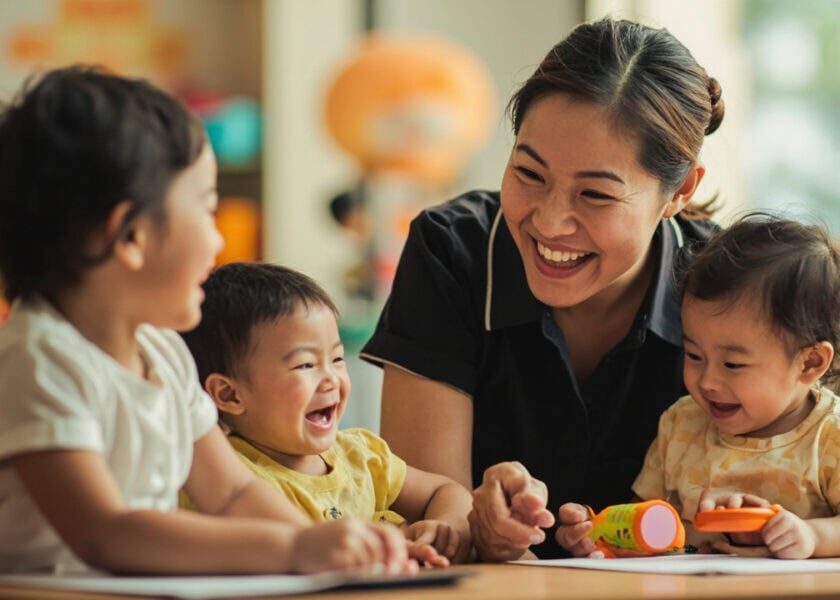
An eighteen-month-old is handed a musical toy. He shakes it. The sound emerges. He looks up at the caregiver. The caregiver smiles. He shakes it again, looking again. This is a dance. This is the earliest form of shared joy, of play as connection, of learning that his actions ripple outward and bring pleasure to others. In this moment, the child is learning that he matters to someone outside his family. He is building the foundations of social trust.
These moments seem small because they are small. But that is precisely what makes them profound. Development happens in the accumulation of thousands of tiny experiences that together form a child’s sense of self, their understanding of the world, and their capacity to navigate relationships, challenges, and joys.
Reading Your Child: What Pickup Really Tells You
You may wonder: how can I know what is really happening in those hours when I am not there? The answer is simpler than you might expect. Your child is telling you. Every day, in ways that are available to any parent who knows how to listen, your child is giving you a window into their experience.
Watch them at pickup. Not just whether they are crying or calm, though that matters. Watch the quality of their engagement. Watch how they move through the space. Watch whether they look toward the caregiver when they leave, or whether they wave, or whether they are already moving ahead with the confidence of someone who knows exactly where they are going and trusts that you will follow.
These are not just behaviors. They are communications. They are your child’s report from the inside.
Signs That Care Is Working
- Your child comes home curious and eager, wanting to show you something from the day
- They speak of the caregiver with familiarity rather than fear
- They play out interactions from the care space with their dolls or toys
- They settle into sleep more easily because the day was structured and warm
- They mention peers by name or reenact sharing moments
- They demonstrate new words, skills, or attempts at independence
This child is telling you something important: they felt safe enough to explore, engaged enough to grow, seen enough to come home full rather than empty.
Signs That Something May Not Be Working
- Your child comes home consistently flat, inconsolable, or withdrawn
- They show regressive behaviors that persist beyond a brief settling-in period
- They do not mention peers or caregivers at all
- They resist going to care in the morning with escalating intensity
- Sleep disruptions or appetite changes that persist
A child who shows these signs is also telling you something. They are telling you that something in the environment did not meet them, that they spent the day managing distress rather than building competence, that the ratio was too high or the attunement too low or the routine too chaotic to provide the predictability they needed to thrive.
Children are profoundly honest creatures, and their behavior after care is data. It is the most honest data you will ever get about whether the care is truly working.
Supervision Versus Genuine Engagement
The difference between a child merely surviving the day and a child flourishing in it comes down to one question: is the environment designed around them as a whole person, or around the convenience of adults?
This difference does not happen by accident. It happens when caregivers have the capacity to attune, to notice, to respond, to see each child as a distinct individual with their own rhythms, preferences, and pace of growth.
Why Caregiver Ratios Matter
When an infant is in a space where one caregiver is responsible for three infants at most, that caregiver can notice the subtle shift from contentment to hunger, from curiosity to overwhelm, from play to the need for rest. They can intervene before a small distress becomes a large one. They can offer comfort that feels personal rather than procedural. They can read the thousand tiny signals that a baby sends and respond in ways that teach the baby something essential: that you are heard, that you are known, that the world responds to you with care.
In a room where one caregiver faces eight infants, or ten, or more, those signals become noise. The child who is crying may be fed, but the child who is quietly withdrawing may be missed. The child who is on the verge of a developmental leap may have no one close enough to notice and scaffold that leap.
The difference is not just numerical. It is architectural. It determines what is possible.
The Value of Peer Relationships
There is another dimension to quality care that is often overlooked. Children in quality care are building something that families alone, despite all their love, cannot fully provide: the experience of navigating a world alongside peers.
Siblings offer siblings. Parents offer parents. But peers offer something different. Peers offer mirrors. Peers offer challenges. Peers offer the first experiences of negotiating, sharing, resolving conflict, understanding perspective, learning that another child has wants too, and that the world does not revolve solely around one’s own needs.
In a warm, well-structured care environment, toddlers learn to play beside each other before they can play together. They learn that the same toy can be wanted by two children, and that this is not a crisis but a problem to solve. They learn that a caregiver’s attention is not a fixed pie that shrinks when shared, but a well that replenishes when poured.
This is developmental gold. It cannot be replicated by screens or by adult-led activities alone. It requires proximity to other children, a safe space to practice, and caregivers who model what respectful interaction looks like.
What Quality Childminding Looks Like in Practice
Understanding what to look for is the first step toward making a confident choice. Here is what separates quality care from adequate care, explained in terms of what you can observe and what you can ask about.
Physical Environment
- Spaces that are clean but not sterile, warm but not chaotic
- Age-appropriate materials that invite exploration
- Clear sightlines that allow caregivers to see all children
- Designated areas for rest, play, and feeding that feel secure
Relational Environment
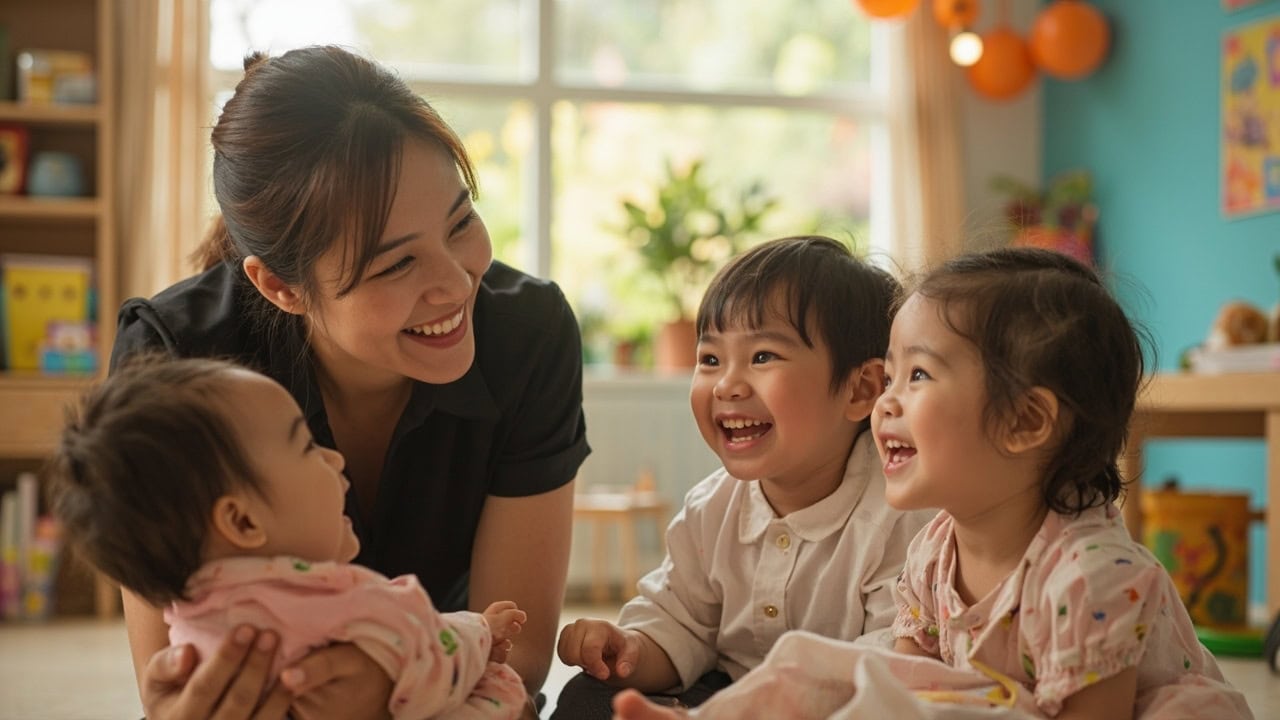
- Caregivers who kneel or sit at the child’s level rather than loom over them
- Voices that are warm even during transitions
- Children who move freely but with visible caregiver awareness
- Interactions initiated by the child as often as by the caregiver
Rhythmic Environment
- Predictable routines that children can anticipate and trust
- Flexibility within structure, so the child’s cues can guide the day
- Clear transitions between activities that prepare children rather than surprise them
Questions to Ask a Potential Caregiver or Centre
- What is the caregiver-to-child ratio, especially for infants?
- How would you describe your approach when a child is distressed?
- What does a typical day look like from the child’s perspective?
- How do you communicate with parents about their child’s day?
- How do you handle feeding, sleeping, and toilet learning in ways that respect the child’s pace?
- What training or experience do your caregivers have in early childhood development?
EduNanny Singapore: An Approach Built Around the Child
Understanding child development as something active, relational, and profoundly important is the foundation of how EduNanny Singapore approaches infant and toddler care.
Part of the ECDA Childminding Pilot, EduNanny operates within a framework that keeps infant ratios at a level where attunement is achievable, where each child can be truly known rather than merely managed. This is not a marketing feature. It is a commitment to the child’s experience, to the understanding that flourishing requires space, attention, and time.
EduNanny offers pathways that recognize how varied Singapore families are. For some families, a home-based arrangement feels right: intimate, familiar, a natural extension of family life. For others, a community or centre-based environment offers the richness of peer interaction that a home setting cannot replicate. Both pathways share the same commitment: that every child deserves to be known, to be seen, to be supported in becoming who they are.
Structure and Accessibility
The care operates within structured blocks, Monday through Friday, offering the predictability that children crave and the reliability that parents need. Fee structures within the pilot are designed to be accessible, and families can access government support including Child Development Accounts and Baby Bonus funding. This means quality care is a realistic possibility rather than a privilege reserved for those with wider means.
Communication and Trust
Communication is woven into the experience, not as an afterthought but as a practice. Transparency measures allow parents to feel connected to their child’s day without intrusion, offering updates and glimpses that ease the quiet anxiety of the hours apart.
CCTV measures, where implemented, are not there to surveil but to assure. They create a foundation of trust between families and caregivers that allows everyone to breathe a little easier.
Support for Parents Too
Modern parenting is complex, and questions arise at odd hours. The need for guidance does not always arrive on a schedule. The Thomas AI Chatbot, available to parents engaged with EduNanny, offers a resource for common questions, for quick reassurance, for the small uncertainties that do not warrant a call but deserve an answer. It is not a replacement for human connection. It is an acknowledgment that parents need support too, and that support should be accessible when and where it is needed.
Growing Into the World
Choosing quality childcare is not an act of absence. It is an act of provision.
When you walk away at the gate, you are not leaving your child in a void. You are placing them in an environment that you have assessed, that you trust, and that is actively building the person they are becoming. Your love and that care environment are not in competition. They are partners. They are teaching your child the same essential lesson from different angles: that the world can be safe, that people can be trusted, that growth is possible, and that they are not alone.
When you return at pickup, you will see evidence of this. Watch the way they run to you, then pause, then wave to the caregiver, then turn back. Watch the new word they say, or the new skill they attempt, or the new friend they mention by name. Watch the contentedness that settles over them as evening comes, the sense of a day well spent, of a world that is good, of a self that is capable.
This is what quality care gives your child. Not just supervision. Not just safety. But the daily practice of growing up, in the company of attentive adults and curious peers, in a space that has been shaped around their needs rather than around the convenience of adults.
If you are exploring infant care or childminding options in Singapore, you are already asking the right questions. You are wondering not just about logistics but about your child’s experience. You are looking for a place where they will be known, not just kept. You are seeking a partner in your child’s development, not just a service.
EduNanny Singapore is here to walk that journey with you. Not to replace you. Not to suggest that what you do is not enough. But to stand beside you in the work of raising a child, to provide the environment your child needs to become fully themselves, and to walk with your family through these years with transparency, warmth, and an unwavering commitment to the child’s experience as the measure of everything we do.
You are not leaving your child. You are giving them a world.
And that world, when it is the right one, will love them back.
If you would like to learn more about EduNanny Singapore’s approach to infant care and childminding, or to explore whether our pathways might be right for your family, we welcome the conversation.