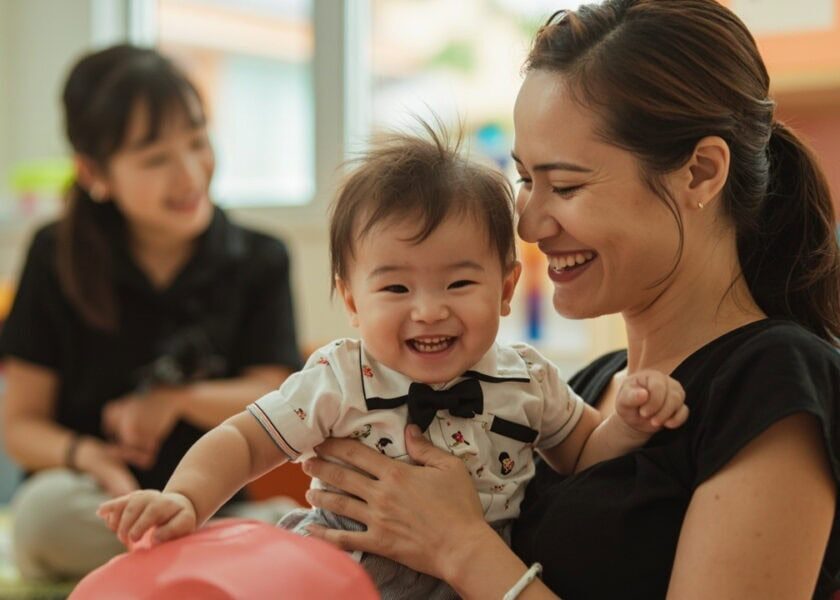
The Partnership That Changes Everything About Childcare
The Moment Every Singapore Parent Knows
There is a moment every parent in Singapore knows, though we rarely speak of it with the honesty it deserves. It happens on a Tuesday morning, perhaps, or a rainy Thursday. You hand your child to another adult. You say something like “she had a rough night” or “he’s been working on a new word” or simply “take care of her.” And then you leave.
You go to work, to meetings, or to the quiet of your own adult thoughts. And in that leaving, something shifts inside you that no childcare brochure can describe.
We talk so much about choosing the right school, the right centre, the right programme. We write lists. We visit campuses. We ask about curriculum frameworks and teacher qualifications and safety protocols. All of that matters.
But here is the counterintuitive truth that most parenting conversations miss: the decision of who will care for your child is not the hardest part. The harder part—far harder—is what comes after. It is the ongoing, daily, emotionally complex work of building and sustaining a real relationship with the person who knows your child almost as intimately as you do.
That relationship is the hidden variable. It is the thing that determines whether your child thrives in care, whether you sleep well at night, whether your family feels whole even when you are apart.
Partnership vs Transaction: The Distinction That Changes Everything
We live in a city that has somehow made childcare into a logistics problem. Enrollment timelines. Subsidy applications. Centre capacity. Infant ratios. These are real and important considerations.
But somewhere between the CPF calculations and the centre tours, we have lost sight of something fundamental: when you enrol your child in care, you are not simply purchasing a service. You are entering into a relationship that will shape your child’s sense of security, their understanding of the world, their capacity to trust and be trusted.
The caregiver is not interchangeable. She is a specific human being who will learn your child’s favourite songs, who will notice when his behaviour shifts before a fever arrives, who will witness his triumphs and his tantrums each day.
And yet we often treat this relationship as though it can be managed with weekly emails and annual reviews.
Trust Is Built in Micro-Moments
Trust is not a document you sign. It is not a policy you read. Trust is built in micro-moments.
It is built in the way your caregiver texts you a photo unprompted on a difficult day. It is built in how she tells you about your child’s morning—not as a data dump, but as a story, with context and warmth. It is built in the questions she asks that show she has been paying attention, not just to your child’s schedule, but to who he is becoming.
It is built in you, too—in how you share what matters, in how you communicate not just concerns but observations, in how you show up as a partner rather than a manager.
This is what distinguishes a professional care partnership from a transaction.
A transaction is exchange: I give you money; you give me childcare. A partnership is relational: I trust you with my child’s emotional world; you trust me to be present and honest. We are both working toward the same thing—the flourishing of a specific, irreplaceable human being.
That flourishing does not happen because of curriculum or facilities or even ratios, though those things create conditions for it. It happens because a child feels secure. And a child feels secure when the adults in her life are connected, communicating, and aligned.
The Invisible Infrastructure of Trust
Trust is not binary. Trust is a living thing—it grows or erodes, and it needs attention and intention. It is built not in the grand moments, but in the small, daily, almost invisible exchanges that make up a care relationship.
Consider these moments:
- When your caregiver tells you your child refused lunch today, what happens inside you? Do you feel defensive? Dismissive? Do you immediately problem-solve, or do you pause and ask more?
- When your child comes home upset and you cannot quite understand why, do you trust your caregiver to tell you the truth, even if it is not easy to hear?
- When there is a mismatch in style—perhaps she is more reserved than you, or she handles transitions differently—do you address it, or do you let it accumulate into distance?
These are the moments where trust is forged or fractured. Most parents have been given checklists for evaluating centres, but no framework for cultivating a relationship that can actually carry the weight of what we need it to carry.
Honouring the Emotional Reality
When you leave your child with another adult, you are doing something brave and necessary, and at times, profoundly vulnerable. You are trusting someone else with your child’s emotional world—their fears, their joys, their in-between moments that define who they are becoming.
You are trusting someone else with the sound of their laughter, with the cadence of their sleep, with the texture of their days. That is not a small thing. It is not a logistical decision. It is a relational act of trust that deserves to be named and honoured as such.
And yet, so many parents experience this vulnerability in silence. They feel the weight of it but do not have language for it. They may oscillate between over-involvement—hovering, over-communicating, trying to control every variable—and under-involvement—staying at a distance, keeping conversations surface-level, protecting themselves from the discomfort of genuine partnership.
Both are understandable responses to a genuine tension. But neither leads to the kind of trust relationship that actually serves your child.
The Sustainable Path
The sustainable path is something different. It is a posture of intentional partnership—not a checklist, but a disposition.
It means showing up as someone who is genuinely curious about what happens in your child’s day, not just compliant with a daily report. It means sharing what matters about your child, not just what is required.
It means asking questions that go beneath the surface: not just “did she eat” but “how was she when she ate”—because children eat differently when they are content than when they are anxious, and your caregiver knows that.
It means being willing to receive difficult news, and trusting that the person delivering it is on your side. This kind of partnership does not happen by accident. It is cultivated. And it requires something from you as a parent: a willingness to be known, to be honest, to be present even when you are not physically there.
Cultural Contexts Worth Acknowledging
In the Singapore context, there are dynamics that deserve honest conversation. Many parents navigate multi-generational dynamics—grandparents who have strong opinions about childcare, extended family members who are involved in ways that are both supportive and complicated.
There are also cultural dynamics around hierarchy, communication, and deference that can complicate how parents relate to caregivers. Some parents hesitate to raise concerns because they do not want to seem demanding. Some caregivers hesitate to share difficulties because they do not want to seem incapable.
In that mutual hesitation, small issues can grow into real distance. The answer is not to ignore these dynamics or pretend they do not exist. It is to name them, and to build a relationship culture that makes honest communication possible.
This is what professional, intentional care looks like. It is not the absence of friction—it is the presence of a framework for navigating friction with care and respect.
What Quality Childminding Actually Looks Like
How do you know when things are working? Beyond the ratios and the reviews, there are qualities that distinguish genuine care from adequate supervision.
In the caregiver, you might notice:
- She shares observations, not just schedules. She tells you about your child’s mood, not just what they ate.
- She asks questions about your child’s home life and listens to the answers with genuine interest.
- She tells you difficult things with care, not defensiveness or blame.
- She knows your child’s rhythms—the time of day they get cranky, the songs that calm them, the moments that matter to them.
- She communicates in ways that invite partnership, not just reporting.
In yourself, you might notice:
- You share more than the necessary information—you share who your child is becoming.
- You ask questions that go beneath surface-level updates.
- You feel comfortable raising concerns and equally comfortable receiving difficult news.
- You trust yourself to notice when something feels off, and you trust your caregiver to work with you on it.
- You can be honest about your own struggles without feeling judged.
These qualities cannot be manufactured in an interview. They are cultivated over time, in the accumulation of small moments. And they require a care setting that makes space for relationship, not just supervision.
Signs Your Partnership May Need Attention
Sometimes things drift. Here are signs worth paying attention to:
- When the relationship has cooled. You may notice that you have stopped asking questions. That conversations with your caregiver have become routine, transactional, efficient. That you are receiving updates but not really knowing your child in the way you wish you did. This is a sign that you have both retreated into comfortable distance.
- When trust has become one-directional. You may notice the opposite: that you are spending too much energy managing, checking, monitoring. That every message from your caregiver triggers anxiety or hypervigilance. That you cannot relax even when you are away from your child. This is a sign that you are carrying all the weight of the relationship alone.
- When information stops at the surface. Inconsistencies between what you hear and what you observe. Your child reacting to care in ways that suggest something is not quite aligned. These are worth paying attention to—not with panic, but with curiosity.
The good news is this: trust can be rebuilt. It can be recalibrated. It does not require starting over—it requires returning to the fundamentals.
Honest communication. Mutual respect. Genuine curiosity about your child. A willingness to address what is not working before it becomes something larger. The best care arrangements are not the ones where everything goes smoothly—they are the ones where both parties have the capacity and the commitment to navigate difficulty together.
The EduNanny Approach: Built on Partnership
EduNanny by BUTLER was built on a simple but radical premise: that the relationship between parent and caregiver is not a peripheral feature of childcare—it is the core. Everything else is infrastructure. Everything else exists to support the relationship that actually determines whether your child thrives.
EduNanny is part of the ECDA Childminding Pilot, operating within a framework that allows us to maintain the kind of personal attention that larger centre-based settings cannot always provide. We offer home-based care pathways, where your child is cared for in a familiar, nurturing environment, with ratios that allow for genuine connection.
In all our pathways, we maintain infant ratios of up to one to three, because we believe depth of care cannot exist without the time and attention that lower ratios allow. Our fee structures are designed to make professional, relationship-centred care accessible to families across Singapore, and we support the use of CDA and Baby Bonus funds where applicable.
A Culture, Not Just a Service
Beyond the logistics, what EduNanny offers is a culture.
- A culture where communication is not a feature but a practice.
- A culture where transparency is built into the relationship, including measures like CCTV where deployed, so that you can trust what you can see.
- A culture where caregivers are not interchangeable employees but professionals with genuine investment in your child’s development.
- A culture where parents are not clients but partners.
We believe that the caregiver you choose is not just someone who watches your child. She is someone who teaches your child what trust looks like, who shows your child that adults can cooperate and communicate and care together. She is part of your family’s village, even if she is not related to you by blood.
This is why we train our caregivers not just in developmental milestones and safety protocols—though those matter—but in the relational dimensions of care. How to communicate with parents in ways that build trust. How to receive difficult feedback without defensiveness. How to share a child’s struggles without making a parent feel blamed. How to see each child as a whole person, not a set of needs to be met.
And this is why we support parents, too. Because partnership is something you learn, not something you instinctively know. Our Thomas AI Chatbot is available to help you navigate the questions and concerns that arise between conversations with your caregiver—not to replace human relationship, but to serve as a trusted resource in the everyday moments where you need guidance.
Questions Worth Asking Before You Choose
As you navigate your options, here are questions that go beyond the brochure—questions that can help you sense whether a care arrangement will support the kind of partnership you are looking for.
- Can I imagine having a difficult conversation with this caregiver? Not just a polite exchange, but an honest one. Because difficult conversations will come. The question is whether the relationship can hold them.
- Do I feel curious about what happens in my child’s day here? Not anxious, not obligated—just genuinely curious. Curiosity is a sign of healthy engagement.
- Do I feel seen as a parent? Not just as a client or a source of instructions, but as someone with genuine knowledge of their own child.
- Does this setting make space for the relationship I want to build? Or is it structured in ways that make partnership difficult to sustain?
- Am I choosing this because it checks boxes—or because I can imagine this caregiver knowing my child?
The Truth About What You Are Really Choosing
The relationship with your caregiver is not a compromise you make when you return to work. It is not a necessary evil, not a logistical workaround, not something to be managed until your child is old enough to not need it. It is an act of parental intentionality. It is a reflection of your values. It is one of the most important relationships you will build in your child’s early years—and it is one that most parents are never taught to think about with the seriousness it deserves.
When you choose to build a genuine, sustainable, trusting partnership with your caregiver, you are not just securing childcare. You are teaching your child something profound about human connection.
You are showing her that adults can work together across difference. That trust can be built and maintained. That relationships require tending but are worth the effort. You are giving her a foundation of security that will carry her forward into every other relationship she will ever have.
That is not a small thing. That is everything.
So as you navigate the decisions ahead—and there will be many—may you do so with clarity about what actually matters. Not just which centre has the better facilities, or which programme aligns with the academic track you hope for someday. But which caregiver you can imagine building a real relationship with. Which arrangement will allow trust to grow. Which partner will see your child as she truly is and help you see her too.
Thank you for reading. And for trusting, even when it is hard. That trust, too, is something worth tending.
If you are exploring childcare options in Singapore and would like to learn more about a partnership approach to care, we welcome you to connect with EduNanny. You can also read more about our approach and what we believe about the parent-caregiver relationship.