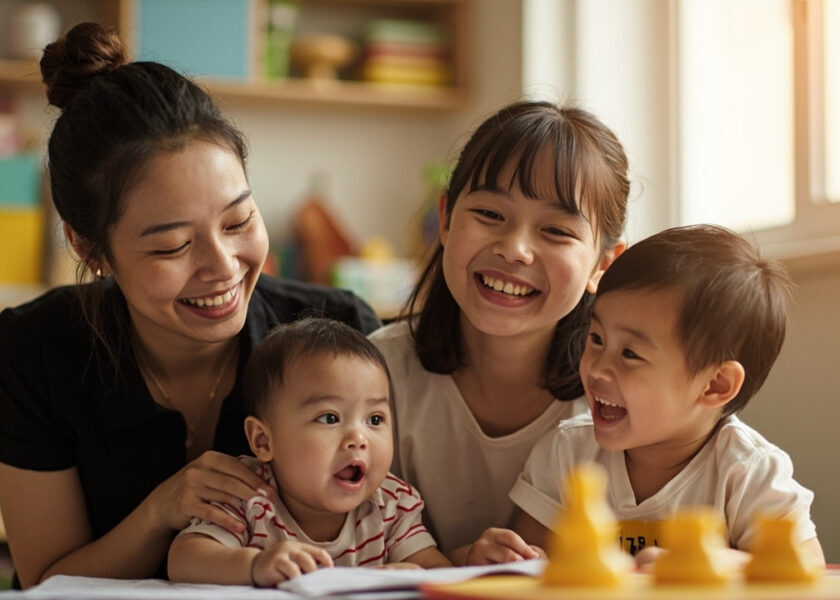
The Readiness That Lasts: Beyond Early Academics in Childcare
The Short Version: What Research Tells Us
If you are reading this between feedings or after a sleepless night, here is what matters most:
- Academic skills are learnable. Reading, multiplication, and literacy can be taught in school. What school cannot teach are the foundational skills that determine whether a child thrives or merely survives those critical early years.
- Self-regulation is the most predictive skill. The ability to manage emotions, focus attention, and recover from frustration develops through secure, responsive relationships—not worksheets.
- Singapore’s best schools are looking for more than academics. Social competence, cognitive flexibility, language richness, and physical confidence matter. These are built through quality developmental care.
- You do not have to choose. The foundations that make a child emotionally whole are the same foundations that make them genuinely school-ready.
Why You Do Not Have to Choose
Every parent in Singapore knows the anxiety. It starts earlier than it should. Somewhere between playdates where other children are already enrolled in enrichment classes and conversations that subtly compare milestones, a narrative takes hold.
The narrative says: readiness means literacy. Preparation means worksheets. If your child is not reading by four, they will arrive at Primary One behind.
Here is what twenty years of developmental research tells us—and what every experienced teacher will quietly confirm when the official curriculum talk is over. Academic skills are learnable.
A child who arrives at Primary One not yet reading will learn to read. A child who arrives without multiplication tables mastered will master them. These are skills that will be taught, because that is what school is for.
But there are other skills—skills that cannot be drilled into a child in the months before school starts—that determine whether a child thrives or merely survives. These are the skills that quality developmental care builds naturally, day by day, through meaningful engagement and warm relationships.
The pressure is real. The expectations are real. The anxiety you feel is not imagined, and the sacrifices you make are not small. Singapore parents work extraordinarily hard, and they do so out of love.
There is nothing wrong with wanting your child to succeed academically. There is nothing wrong with wanting them to be prepared. But the anxiety has amplified a narrative that is not serving you—a narrative that says preparation means drilling, that says readiness means early literacy, that says if you are not doing worksheets with your three-year-old, you are somehow failing them.
The children who truly thrive in Singapore’s schools are almost never the ones who arrived with the most academic knowledge. They are the ones who arrived with the foundations described below. With self-regulation. With social competence. With cognitive flexibility. With language richness. With physical confidence.
These children adapt. They learn the literacy when it is taught. They learn the numeracy when it is taught. But what they do not need to learn is how to be a learner. How to focus. How to persist. How to connect with others. How to make meaning.
The Five Pillars of Genuine School Readiness
Research consistently identifies five foundational capacities that predict not just early school success, but long-term academic resilience. These are not soft skills or nice-to-haves. They are the architecture upon which all learning rests.
1. Self-Regulation: The Most Predictive Skill
The single most predictive skill for early school success is not literacy. It is not numeracy. It is self-regulation—the ability to manage your emotions, to calm yourself when frustrated, to focus attention even when something more interesting is happening across the room, to follow a sequence of instructions even when you would rather do something else.
Children who arrive at Primary One with strong self-regulation do not just behave better in class. They learn better. They retain more. They grow into students who can manage their own learning, who do not need constant external motivation, who develop the stamina for the long academic journey ahead.
What you may not know: Self-regulation is not a trait you are born with. It is a capacity that develops best in the context of secure, responsive relationships. When a caregiver notices a child beginning to escalate and gently offers co-regulation—being the calm that the child can borrow until they find their own—something profound happens. Neural pathways for self-control strengthen. The child learns, through hundreds of small moments like this, that big feelings are survivable.
2. Social Competence: Navigating the Classroom Community
Singapore’s schools are social environments. More social than many parents expect. A child who cannot navigate peer relationships, who does not know how to join a group, who lacks the skills to resolve small conflicts without adult intervention—these children struggle, and their struggle is often misread as a learning problem when it is actually a social one.
Social competence is built through guided peer interaction. It is built when a skilled caregiver notices two children in conflict and uses the moment as a teaching opportunity—not by solving the problem, but by asking questions, modeling language, helping each child articulate their experience and find a path forward together.
Quality care environments are rich with these opportunities. They are not afterthoughts. They are the curriculum of care—deliberate, thoughtful, informed by a deep understanding of child development. Children who have this experience arrive at Primary One with the confidence to be part of a community. They know how to make friends. They know how to stay friends. They know that relationships require effort and that effort is worthwhile.
3. Cognitive Flexibility: Adapting to the Unexpected
This one is harder to name but essential to understand. Cognitive flexibility is the ability to think about more than one thing at once, to adapt when plans change, to approach a problem from multiple angles, to hold two ideas in mind simultaneously and see how they relate.
A child with strong cognitive flexibility can transition from one activity to another without melting down. They can accept that the sandbox is closed today and find joy in something else. They can understand that the same object can be a phone and a steering wheel and a microphone, depending on the game. They can sit with uncertainty and not need an immediate answer.
This capacity is increasingly recognized by educators as central to academic success—not just in primary school, but through secondary school, through university, through life. The children who struggle most in school are often not the ones who lack knowledge. They are the ones who cannot adapt. Who shut down when something is hard or different. Who need everything to be predictable because uncertainty feels unbearable.
Cognitive flexibility develops in environments that are predictable in their structure but flexible in their possibilities. Where children know what to expect each day—the rhythm of meals, of rest, of outdoor time—but also encounter novelty, variation, new challenges. Where caregivers introduce just enough surprise to stretch thinking without triggering overwhelm.
4. Language Richness: Beyond Vocabulary Lists
Language richness is not the number of vocabulary words a child can identify on a flashcard. It is the depth and complexity of their language environment. The amount of back-and-forth conversation they experience each day. The quality of language directed at them—not baby talk, not simplified commands, but real, rich, responsive conversation.
Children who grow up in language-rich environments—who are talked with, not just talked to, who are asked questions and given time to answer, who hear complex sentences and learn to follow complex narratives, who are read to in ways that invite participation and prediction—these children arrive at school with something remarkable.
They arrive with language as a tool for thinking, not just communicating. They can express their ideas. They can understand instructions. They can engage with the intellectual content of school rather than being held back by the linguistic demands of it.
This, too, is built through everyday interaction. Through the caregiver who narrates what she is doing and invites the child to help. Through the caregiver who responds to a child’s babble with real words, building the exchange further. Through the caregiver who reads a story not as a way to fill time, but as a way to create a shared world of imagination where language is the bridge between minds.
5. Physical Confidence: Learning Through the Body
Children learn through their bodies. Every parent knows this in their bones. The toddler who needs to touch everything, who cannot resist climbing the highest thing in sight, who runs when they should walk and jumps before they look—this is not misbehavior. This is development in action.
Physical confidence—the awareness of one’s body in space, the coordination that allows a child to run and climb and balance and manipulate objects with increasing precision—is foundational to everything else. It is connected to cognitive development in ways we are still discovering. Children who move well think well. Children who have confidence in their physical selves have confidence in their intellectual selves.
Quality care environments prioritize outdoor play, gross motor development, the freedom to move and explore and take appropriate risks. They do not over-schedule children into sedentary activities. They understand that the body is the child’s first laboratory, and that its development cannot be rushed or skipped.
What to Look for at Home
You do not need a classroom to recognize these foundations taking hold. Here are the markers of genuine readiness—observable in everyday moments, built through relationships and play, not worksheets and drills.
- Can your child wait? Not perfectly, not always, but increasingly. Can they tolerate some frustration without falling apart? Can they recover from big feelings?
- Can your child play with others? Not perfectly, not without conflict, but with increasing sophistication. Do they negotiate? Do they cooperate? Do they show the first signs of genuine friendship, of caring about what another child wants or feels?
- Does your child ask questions? Not just questions about facts—how many, what colour, where did it go—but questions about why, about how things work, about what happens next. Is their curiosity alive?
- Does your child express themselves? Not just their needs—I want water, I need a diaper—but their ideas, their feelings, their interpretations of the world. Can they tell you a story?
- Does your child move with confidence? Do they climb and run and balance and explore without constant fear? Do they trust their bodies?
These are the markers of readiness. And they are not built through worksheets. They are built through relationships, through play, through the ordinary days of a child who is seen, heard, supported, and challenged by someone who loves them.
How EduNanny Builds These Foundations
EduNanny was founded on a simple belief: the years from infancy through the early school years are not just a time to be managed. They are a time to be honored. A time when the architecture of a human being is being built, piece by piece, moment by moment, interaction by interaction.
We believe that parents deserve support that is worthy of this moment. Support that does not ask them to choose between their child’s happiness and their child’s future. Support that understands that these are not in conflict—that the very foundations that make a child emotionally whole are the foundations that make them genuinely school-ready.
As part of the ECDA Childminding Pilot, we are committed to standards grounded in developmental science and responsive to the real needs of Singapore families. This commitment shapes everything we do.
Small ratios, big impact. Our caregiver-to-child ratios mean that every child receives the attention they need. Every cry is heard. Every moment of curiosity can be followed. Every act of co-regulation, every instance of language building, every opportunity for social learning has room to happen.
Pathways designed for real families. We offer both home-based and centre-based options, because families are different and their needs are different.
Accessible by design. Our fee structures are designed to make quality care accessible. CDA and Baby Bonus can be used, which means that for many families, the financial barriers to premium care are lower than the narrative suggests.
Structure that serves children. Our care operates Monday through Friday, in structured blocks that give families the consistency they need while honoring the rhythms of a child’s day. Predictability in structure, flexibility in possibilities—the precise calibration that developing brains need.
Communication you can trust. Transparent, regular communication informed by real observational data means that parents are never wondering what their child is doing. They are part of it.
Support that travels with you. Thomas, our AI chatbot, provides parents with the information and guidance they need at the moment they need it—not by replacing human connection, but by offering a resource that can help navigate the questions and decisions that arise in the ordinary days of raising a child.
We are not a replacement for family. We are not a factory for academic achievement. We are not promising that your child will be first in their class or that they will never face challenges.
What we are promising is this: that your child will be known. Seen by caregivers who understand child development, who are trained and supported, who bring both expertise and heart to the work of caring for your child. That your child will be in an environment that is safe—physically, emotionally, developmentally safe. That your child will play, and learn through play, and be challenged in ways that stretch without overwhelming.
Questions to Ask When Choosing Infant Care
If you are evaluating childcare options, here are the questions that matter most:
- Do caregivers notice and respond to children’s emotional states, or is the focus primarily on activities and schedules?
- Are there opportunities for guided peer interaction—conflict as a teaching moment, not something to be avoided or immediately resolved?
- Is outdoor play and physical exploration prioritized, or are children primarily in sedentary activities?
- Do caregivers speak with children in rich, responsive language—not just commands, but conversation, narration, and story?
- Is the environment predictable in structure but flexible in possibilities—routine without rigidity?
- Are ratios low enough that every child can be truly seen?
- Can you see yourself and your child in how this place describes what it does?
The answers to these questions will tell you more than any brochure or website. Because the readiness that matters is not built through curriculum or worksheets. It is built through the quality of human attention your child receives.
The Readiness That Lasts
In a few years, your child will walk into a classroom for the first time. They will sit at a desk. They will face a teacher who is responsible for twenty-five other children. They will encounter a curriculum designed to teach them reading and mathematics and science and all the things that schools teach.
In that moment, the question will not be whether they can already read. It will not be whether they know their times tables. It will not be whether they completed more worksheets than the child next to them.
The question will be: are they ready to learn?
Not to perform. Not to recite. To learn.
Are they ready to focus when focusing is hard? Are they ready to try when trying is scary? Are they ready to ask for help when they need it? Are they ready to fail and try again? Are they ready to be part of a community of learners?
This is the readiness that EduNanny builds. This is the readiness that lasts.
You have already given your child so much. Your love. Your attention. Your worry, which is just love in another form. You are doing something extraordinary—raising a human being in a world that is complicated and demanding and full of messages that say you are not enough.
You are enough. And your child is ready, in ways that no worksheet can measure and no drill can replicate. They are ready because they are developing. Because they are safe. Because they are known.
If you are looking for a partner in that work—someone who shares your belief that your child’s early years matter, who will honor the trust you place in them, who will see your child not as a project to be managed but as a person to be nurtured—EduNanny is here.
Not as a solution to every challenge. Not as a guarantee. But as a commitment. A commitment to your child. To the years that matter most. To the foundations that will carry them not just through Primary One, but through primary school, through secondary school, through university, through life.
Your child does not need to read early to thrive in school. They need to be ready to learn. And readiness—real readiness—is what we build together.
Ready to explore how EduNanny can support your child’s development?
Learn more about who we are, or reach out to begin a conversation about your family’s childcare and childminding needs in Singapore.