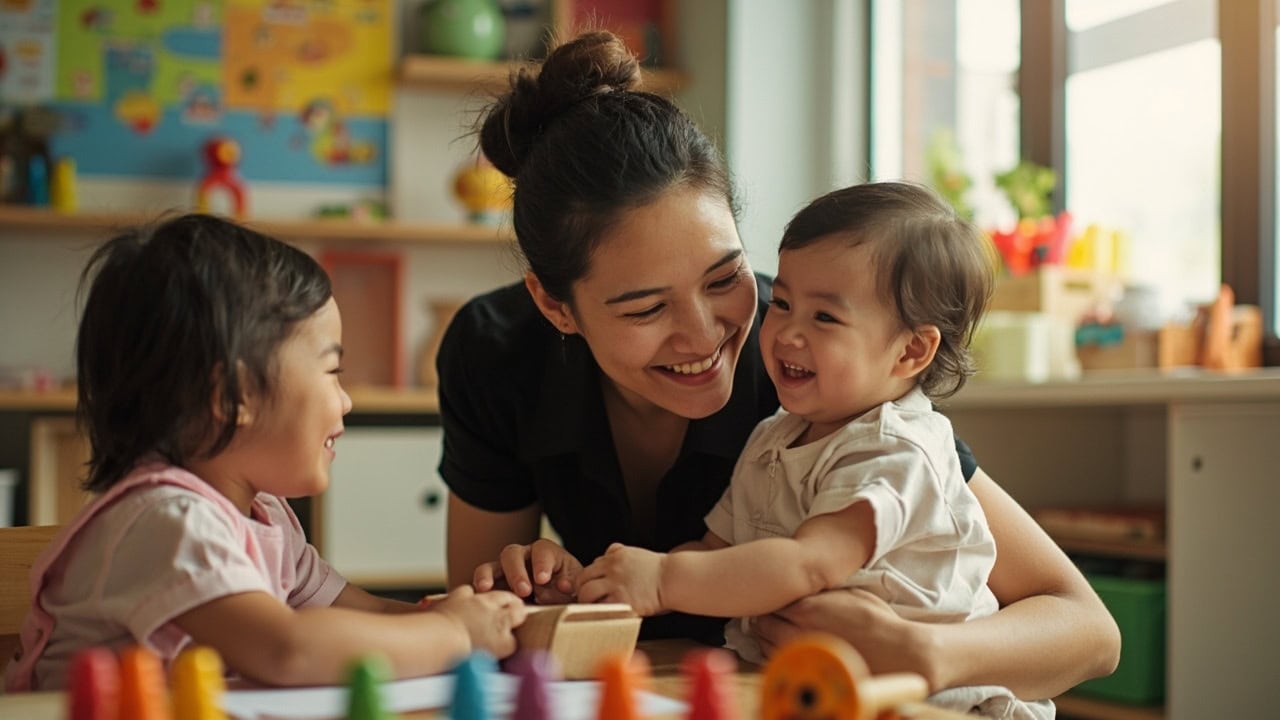
How Your Child’s Behavior Shows You the Quality of Their Childcare
The Observable Evidence: How Quality Childcare Shows Up in Your Child’s Behavior, Confidence, and Connection at Home
There is a particular kind of quiet that settles over a Singapore home in the late afternoon, in the hour before your child returns. The kitchen is still. The silence has a texture. And somewhere between responding to an unread message and starting dinner, a thought surfaces — uninvited, familiar, impossible to fully silence: What kind of day did they have?
It is not a dramatic thought. It simply waits there, beneath the ordinary rhythms of your afternoon, a small, persistent wondering that every parent who has entrusted their child’s hours to someone else understands intimately.
You chose the care. You vetted the centre or the caregiver. You walked through the doors, read the reports, asked the questions. But the hours in between — the hours when your child is out in the world, forming impressions, building connections, learning how to feel safe away from you — those hours remain, in some fundamental way, a mystery.
This is not a failure of trust. It is the nature of love.
Here is what we want to offer you today: not a sales proposition, but an observation gathered from years of watching children grow — the kind of observation that shifts something, once you see it clearly. Quality childcare does not merely supervise your child. It builds your child in ways that travel home with them.
What This Article Will Show You
- How quality childcare produces observable, traceable evidence in your child’s everyday life
- Why the hours after pickup reveal more than the hours during care
- The specific signs of emotional regulation, language growth, social confidence, and secure attachment you can learn to recognize
- How to distinguish between a child who is simply supervised and a child who is genuinely building
- What the ECDA Childminding Pilot means for families seeking accountable, evidence-based care in Singapore
The Signs of Quality Care: What Actually Shows Up at Home
In the first thousand days — and we use that phrase not as a slogan but as a reminder that the window is real and its edges are closer than you think — a child’s brain is forming connections at a speed it will never match again. Every interaction, every consistent response, every moment where a caregiver meets a child’s need before the child has to escalate in order to be heard, lays a neural pathway that will govern how that child regulates emotion for the rest of their life.
But today, we are not here to talk about the science. We are here to talk about what the science looks like when it walks through your front door.
The Hours After Pickup: Where Quality Care Becomes Visible
Consider, for a moment, what actually happens in the hours after pickup.
Your child steps out of the centre or the caregiver’s arms, and into the car or the stroller or the MRT link. For a few minutes, something is different. Maybe they are quieter than usual, in a way that feels thoughtful rather than withdrawn. Maybe they reach for your hand with a new kind of ease — not the desperate grip of a child who has been anxious all day, but the calm, deliberate reach of a child who is simply glad to be with you, and confident that you are glad too.
Maybe they climb into your lap at the end of the day and rest their head against your shoulder, and you feel something settle in both of you — a reconnection that happens not because you have to work for it, but because the day built the foundation for it.
These are not coincidences. These are the signatures of a child who has had a secure day.
Emotional Regulation: What It Actually Looks Like
Emotional regulation — that capacity to move through big feelings without losing yourself — is one of the most visible products of quality care. And it does not show up in a single afternoon. It shows up in a pattern.
You will notice it first in the way your child handles small disappointments:
- The dropped spoon at dinner that used to trigger tears, now met with a shrug and a quiet “oh no”
- The toy that a sibling took, resolved with words instead of screaming
- The moment when the answer is no and the sky does not fall
If you are seeing something that looks like resilience — something that looks like a child who is learning that hard feelings pass — that is the evidence. That is what quality care produces.
The Language That Sneaks Home
Language is one of the most staggering places where evidence becomes visible — and one of the places where parents most often miss what they are seeing. Because language does not arrive all at once. It seeps in: a word here, a phrase there, a new sound that sounds strangely like a song from the centre, a reference to something you have never talked about at home.
Your child comes home one afternoon and says something — a complete sentence, a question, a little observation about the world — and you freeze, because you did not teach them that. You could not have taught them that, because the environment that produced it was somewhere else, in the care of someone who has been speaking to your child with intention all day long.
This is what curiosity sounds like when it is being tended:
- A child who asks why about things that have always been the way they are
- A child who points at a caterpillar on a walk and wants to know everything, immediately
- A child who, in the bath one evening, says something so unexpected, so precise, that you have to sit down on the edge of the tub and just listen
These are not miracles. They are the natural output of a child who has spent their day in an environment rich with language, interaction, and the gentle, patient attention of an adult who is genuinely interested in what they are noticing.
Social Confidence and Physical Growth
Watch also for the ways your child is becoming more confident in the world:
- Does your child engage with other children with growing ease?
- Do they show signs of empathy — noticing when another child is upset, offering comfort?
- Is your child becoming more confident in their body — climbing, balancing, pouring, dressing?
- Do they show pride in physical achievements, however small?
These too are evidence of an environment that had the capacity, the staffing, the attention, to let your child unfold.
Why Consistency Is the Mechanism, Not the Bonus
Here is what is important to understand: it does not happen in isolation. It happens because of consistency. Because of the same faces, the same voices, the same rhythms day after day after day.
When a caregiver knows your child — really knows them, not just their schedule but their temperament, their fears, the things that make them light up — that caregiver can respond with a precision that matters enormously to a child.
- A child who is consistently met with understanding does not have to shout to be heard
- A child who trusts that their signals will be read does not have to escalate
- A child who does not have to escalate is a child who is free — free to notice the world, free to ask questions, free to be curious instead of just being defended
This is why the caregiver-to-child ratio matters, even when it feels like an abstract number. In infant care, ratios of up to 1:3 are not bureaucratic specifications. They are a guarantee that your child is not one of fifteen faces in a room. They are the difference between a child who is managed and a child who is known.
And the difference is visible. You will see it in your child’s willingness to engage, to explore, to return to you at the end of the day with something to show you — a drawing, a song, a new word, a story about a friend.
The Bridge Between Care and Home
Something often goes unspoken, because it is harder to articulate: the quality of the connection you have with your child at home is shaped by the quality of the connections your child is forming in your absence.
This is not a guilt sentence. It is an invitation to reframe what childcare is doing for your family.
When your child spends their day in a secure, consistent, responsive environment, they are not just being cared for. They are building an internal working model of what relationships feel like — what it means to be valued, to be heard, to be held in someone’s attention.
And when they come home to you at the end of that day, they bring that model with them.
- The child who runs to you, laughing, is a child who has learned that people are safe
- The child who is calm at the door is a child who has learned that goodbye is not abandonment
- The child who sits down to dinner and tells you about their morning is a child who has learned that their experiences matter, that someone wants to hear them — because they have been heard all day
The gap between what happens at childcare and what happens at home is not really a gap at all. It is a bridge.
Quality childcare builds that bridge every single day — not with architecture, but with attention. With the steady, patient, unglamorous work of a caregiver who shows up, who remembers, who notices when your child is tired before your child knows it themselves, who adapts to the child’s rhythm instead of demanding the child adapt to theirs.
What Quality Childminding Looks Like in Practice
In Singapore’s childcare landscape, parents have meaningful choices — each with its own strengths. Understanding what distinguishes quality from adequacy can help you feel more confident in whatever arrangement you choose.
| Indicator | What It Looks Like in Practice | Why It Matters |
|---|---|---|
| Consistent caregiver relationships | Same primary caregiver most days; few staff changes over time | Children build trust and security with familiar faces |
| Appropriate ratios | 1:3 for infants; 1:8 for older toddlers as baseline | Each child can be known, not just looked after |
| Language-rich environment | Caregivers narrate actions, ask questions, respond to babbling with words | Vocabulary and communication develop through consistent interaction |
| Responsive care | Caregiver notices early signs of hunger, tiredness, frustration | Child learns their signals matter; learns to self-regulate |
| Predictable routines | Similar rhythm of day: nap, feed, play, transition home | Children feel secure when they know what comes next |
Addressing the Real Concerns Singapore Parents Carry
We know that Singapore parents carry more than their share of mental load. The logistics of childcare — navigating CDA and Baby Bonus structures, understanding subsidy eligibility, managing the administrative weight alongside a career — these things are real, and they are heavy.
You may also be carrying quieter worries:
- “Am I missing something during the day?” The gap between what you know and what you don’t know can feel unbearable. Quality care addresses this through consistent communication — not surveillance, but genuine transparency about your child’s day.
- “Is this actually helping my child’s development?” Watch for evidence. Not the dramatic kind, but the quiet accumulation of growth that shows up in everyday behavior over weeks and months.
- “What if the caregiver doesn’t really know my child?” Knowing a child — their temperament, their triggers, the things that make them light up — is the mechanism through which all other quality happens.
- “Is the cost justified?” This is a legitimate question. The answer is not in the brochure — it is in your child.
EduNanny by BUTLER: Where Evidence Is the Practice
EduNanny has built its practice around not an abstract philosophy, but a daily, deliberate commitment to the observable evidence we have been describing.
We are proud to be part of the ECDA Childminding Pilot, working within a framework designed to raise the standard of home-based and community-based care across Singapore. This matters because it means the care we offer is not operating in isolation. It is connected to a national conversation about what quality childminding looks like — a conversation that includes the ratios, the training, the oversight, and the accountability that give you, the parent, something you cannot get from a brochure: a reason to trust the system behind the care.
Within that framework, we have made specific choices because we believe they make the greatest difference in observable outcomes:
- Monday through Friday care blocks, built around the rhythms of working families, because consistency is not a bonus — it is the mechanism through which everything else happens
- Infant ratios that allow your child to be known, not just looked after
- Fee structures designed to be accessible within the pilot’s provisions, so that the economics of choosing quality care do not force a family to settle
- Communication measures that keep you connected to your child’s day — not because surveillance is care, but because when you know what is happening, you are better equipped to read what comes home
We have also integrated tools like Thomas, our AI chatbot, into the experience — not to replace the human relationship, but to remove friction from the parts of the process that do not need to be hard. To answer the questions that keep you up at night. To help you understand your options, your eligibility, and your child’s development in plain, practical language.
Because the last thing a parent needs is more complexity. What they need is clarity, and the confidence that comes from knowing someone is on their side.
The Evidence Is Your Child
After years of walking alongside families in this city, we have come to believe something important: the anxiety you feel about childcare is not a sign that you are doing something wrong. It is a sign that you care enormously, and that the stakes feel enormous — because they are.
The decision to entrust your child’s hours to someone else is one of the most intimate decisions a parent makes. It is an act of faith — faith in the caregiver, faith in the system, faith in your own judgment, and faith in the capacity of your child to thrive in your absence and in your return.
But faith is not the same as blindness. Quality care — the kind that is consistent, attentive, responsive, and grounded in genuine understanding of early childhood development — does not ask you to have faith alone. It asks you to look. It invites you to watch for the evidence. And then it gives you evidence that is so real, so present, so woven into your child’s everyday life, that the wondering begins to quiet.
Not completely. Not forever. But enough.
Enough that you can sit down to dinner with your child and just be there, without the background hum of is this working, is this right, am I doing enough.
Watch for it. Notice what they bring home — not just the artwork and the daily notes, but the quieter things:
- The ease in their body
- The openness in their face
- The way they reach for you and the way they let you go
- The laugh that is easier than it was six months ago
- The sentence that is longer
- The conflict resolution that requires less intervention
- The bedtime that is a little less fraught
- The morning goodbye that has become — against all expectation — almost easy
The evidence is your child. The evidence is the way they come home.
We built EduNanny because we believe that every family in Singapore deserves to see this evidence in their own child — deserves to have the wondering replaced by knowing, even just a little, even just enough. We believe that the childminder — the person who holds your child in your absence, who shapes the hours you cannot be there for, who becomes a quiet but significant figure in your child’s story — deserves to be seen as what they are: not a service provider in the transactional sense, but a partner in your child’s development. Someone whose work matters. Someone whose consistency is doing something profound.
Your child is already showing you the evidence. We are here to help you see it clearly.
If this article has resonated with you, we would be glad to continue the conversation. At EduNanny, we work with families across Singapore who are looking for childcare and childminding that meets the highest standards of developmental care — the kind where the evidence is visible, and the trust is earned.
You are welcome to reach out to us directly with any questions, or explore more about what the ECDA Childminding Pilot means for your family. To learn more about who we are and the standards we hold ourselves to, visit our About Us page.
Every family deserves the kind of care that leaves them with fewer questions and more quiet evenings — the kind where you can simply be with your child, and trust that the days in between are in good hands.