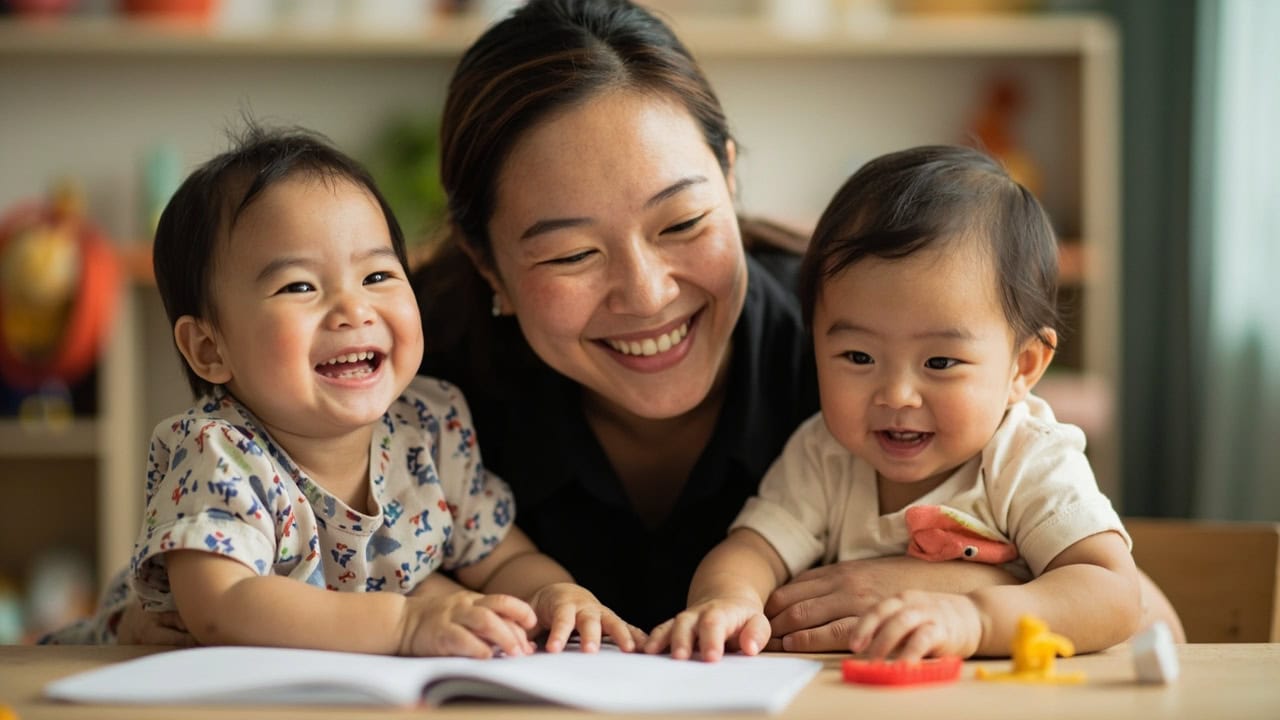
Finding Childcare That Nurtures Your Child’s Heart
The Question That Matters Most
When you ask parents what they want for their children, the answer is almost never academic. It is not primarily about grades or achievements or even school readiness, though those things have their place.
What parents want, when they are most honest and most vulnerable, is to raise good people. Kind people. People who know how to be gentle and how to be strong, how to share and how to stand firm, how to feel deeply and how to regulate those feelings. People who will walk into the world and make it a little better than they found it.
This is the real childcare question. And it is the one that most childcare marketing fails to touch, because it requires a kind of honesty that is uncomfortable in a commercial context. It is easier to talk about ratios and routines, to show the facilities and the curriculum, to make the case for qualified teachers and stimulating environments.
The whole story is about character. And character is not built in lesson plans. It is built in moments.
Character Is Built in Moments, Not Lessons
The first thing to understand is that character development does not happen in the big dramatic moments we imagine when we think about raising children. It does not happen in the lectures we give or the values we recite at bedtime.
Character is built in the small moments, the ordinary Tuesday afternoons, the way a caregiver responds when a child is frustrated, the language they use when someone is struggling, the modeling of patience and warmth when things do not go as planned.
These moments are so frequent in quality infant and childcare settings that they accumulate into something profound. By the time a child is three, they have lived thousands of these micro-moments, and each one is teaching them something about how to be human.
The Difference Between Supervision and Nurturing
Supervision keeps a child safe. It ensures they are fed and rested and protected from harm. It is necessary, but it is not sufficient.
Nurturing goes further. It teaches a child that their feelings are valid and that they can learn to manage them. It teaches them that other children have feelings too, and that kindness is a choice available to them in every interaction.
Nurturing teaches them that adults can be trusted, that asking for help is a sign of strength, and that the world is a place where they belong and are valued. These lessons happen in the texture of daily care, in the tone of voice a caregiver uses, in the way conflicts are mediated, in the moments of quiet connection that happen between the planned activities.
The Singapore Context: Why Values Matter Here
For Singapore parents, this is not an abstract concern. Singapore is a place where values matter deeply, where family is central, where there is a genuine cultural commitment to raising children who contribute to community and nation.
Singapore parents often carry a sophisticated understanding of what they want for their children, shaped by their own education, their own values, and their own observations of what creates a meaningful life. They are not looking for a babysitting service. They are looking for partners in raising their children.
And this is precisely why the values question is so urgent, and why it is so difficult to answer. Almost every childcare centre you visit will tell you that they value kindness, empathy, and character development. These words appear on websites and in brochures, in mission statements and in parent handbooks.
But how do you know if these values are alive in the daily culture, or merely written on a wall? How do you know if the stated philosophy matches the actual experience of the children who spend their days there?
How to Spot Values-Aligned Care
The signs of values-aligned care are not hidden. They are observable, if you know what to look for.
Watch the Unscripted Moments
Watch how caregivers speak to children when no parent is present. Watch their faces when a child is upset. Watch how they handle the transition moments, the arrivals and departures, the times when children are most vulnerable and most themselves.
These are the moments that reveal whether the philosophy is genuine or performed.
Look for Emotional Attunement
Emotional attunement is a clinical term for something very simple: the caregiver notices what your child is feeling and responds in a way that makes the child feel seen and understood.
It means that when a child is frustrated, the caregiver does not just redirect them or silence them, but helps them name and navigate the feeling. It means that when a child is proud of something, the caregiver celebrates with them in a way that registers as genuine.
These are not complicated techniques. They are the natural expressions of a caregiver who truly cares, who sees your child as a whole person with an inner life that deserves respect.
Ask the Questions That Expose the Truth
- How do caregivers respond when a child has a meltdown? The answer will tell you whether they see emotional distress as a problem to be solved quickly or a learning opportunity to be supported.
- How do they support children who are struggling to share or take turns? Look for answers that involve teaching and modeling, not just enforcement.
- How do they communicate with parents about social and emotional development? Beyond milestones and meals, do they share observations about your child’s growing empathy, their developing resilience, their capacity for connection?
- Can you describe a moment when a child’s character showed itself? When something small revealed something big? These questions require reflection and specificity. They expose whether the adults have truly thought about who they are shaping.
Look for Real Resilience
Understand what resilience means for a young child. It does not mean pushing through or being tough.
It means learning that mistakes are survivable, that failure is not catastrophic, and that trying again is always possible. It means developing the confidence that comes from being allowed to struggle productively, with a trusted adult nearby.
What Quality Childminding Actually Looks Like
In Singapore’s evolving childcare landscape, parents have more options than ever — from centre-based care to home-based arrangements. Each model has its strengths, but the principles of quality remain constant regardless of setting.
Ratio matters. Sufficient caregiver-to-child ratios mean that no child is invisible. It means that when your child is frustrated or struggling, there is someone available to notice, to respond, to support.
Training matters. Caregivers who understand child development — not just how to keep children safe, but how to support emotional growth — make a measurable difference in the daily experience of the children in their care.
Communication matters. Parents need to know what is happening in their child’s day, not just what was eaten and when they slept, but how they engaged with others, how they handled frustration, what moments of connection or growth occurred.
Consistency matters. Children thrive when they can predict and trust their environment. Consistent caregivers who build real relationships with children create the security that makes exploration and learning possible.
EduNanny Singapore: A Partnership in Character-Building
This is the work that EduNanny Singapore has taken seriously from the beginning. As part of the ECDA Childminding Pilot, EduNanny has been built on the conviction that childcare is not merely a service to be delivered but a partnership to be honored.
The caregivers at EduNanny understand that they are not just keeping children safe. They are participating in the formation of character, one moment at a time, and they carry that responsibility with the gravity it deserves.
The EduNanny Approach
The approach at EduNanny is grounded in what matters most: ratios that allow for genuine attention, training that equips caregivers to support emotional development, and a culture of communication that keeps parents informed and involved.
Whether care is delivered in a home-based setting or within a centre environment, the standards are the same. Every child deserves a caregiver who sees them, who responds to them with warmth and intelligence, who is present enough to catch the small moments and intentional enough to shape them well.
Practical Support for Singapore Families
EduNanny maintains the ratios necessary for real attunement, including up to one-to-three care for infants where appropriate under the pilot framework. Fee structures are designed to make quality care accessible, and families can utilize CDA and Baby Bonus funds to support their arrangements.
Monday to Friday care blocks give parents the consistency they need and the peace of mind they deserve. Transparency measures, including communication practices and where deployed, CCTV access, build the trust that parents need when they cannot be present.
The Choice That Shapes Everything
Choosing childcare is not merely a logistical challenge, a problem of scheduling and budgeting and convenience. It is a values decision. It is an expression of who you want your child to become and who you trust to help you get them there.
The child who learns to regulate their emotions in a supportive environment carries that capacity into school, into relationships, into the challenges of adult life. The child who learns that they are worthy of kindness and that others are worthy too carries that conviction into every interaction they will ever have.
The child who learns that asking for help is safe and that mistakes are learning opportunities carries that resilience into every risk they will ever take. These are not small things. These are everything.
The right childcare choice does not replace what parents do. It amplifies it. It provides the consistent, loving, values-aligned environment that reinforces what parents are teaching at home, that fills in the gaps, that catches the moments when parents cannot be present and ensures that those moments are still shaping character for the good.
You are already shaping your child’s character, whether you are intentional about it or not. Every interaction, every response, every moment of presence or distraction is teaching them something about the world and their place in it.
The question is not whether you are shaping them. The question is whether you are shaping them well.
Common Questions, Considered Honestly
Will my child really be seen as an individual?
Quality care requires ratios that make individual attention possible. Small group sizes mean caregivers learn each child’s rhythms, preferences, and temperament. Your child’s unique needs are not lost in the crowd.
How do I know the philosophy is real and not just marketing?
Ask the questions above. Observe the unscripted moments. Request transparency about daily practices. Trust your instincts when you visit. The best childcare providers welcome scrutiny because they know their culture will speak for itself.
Can I afford quality care?
EduNanny structures fees to be accessible, and families can draw on CDA and Baby Bonus funds. The investment in quality care is an investment in your child’s character foundation — and that return compounds over a lifetime.
What if my child has a hard time adjusting?
A values-aligned approach sees adjustment difficulties as normal and important. A good caregiver will support your child through the hard moments, helping them build the resilience to navigate new environments. This is part of character development, not a failure of care.
EduNanny exists to be that partner, that trusted extension of family values, that place where children are not just supervised but seen. The caregivers at EduNanny are not employees fulfilling a function. They are collaborators in the most important work there is.
As Singapore continues to evolve, as families navigate the pressures of modern life and the particular challenges of raising children in a fast-paced city, the need for quality childcare that genuinely nurtures character will only grow. Parents deserve partners who share that thoughtfulness, who are not just capable of delivering care but committed to delivering care that shapes lives.
Explore how EduNanny can become your childcare partner. Ask the questions that matter. Visit our settings. See for yourself whether the philosophy you read here is alive in practice.
Because your child’s character deserves nothing less than your most careful consideration — and nothing less than our most committed partnership.
EduNanny is a Singapore-based childcare and childminding service committed to quality care that nurtures character, supports development, and partners with families. Learn more about EduNanny or connect with our team to explore how we can support your family.