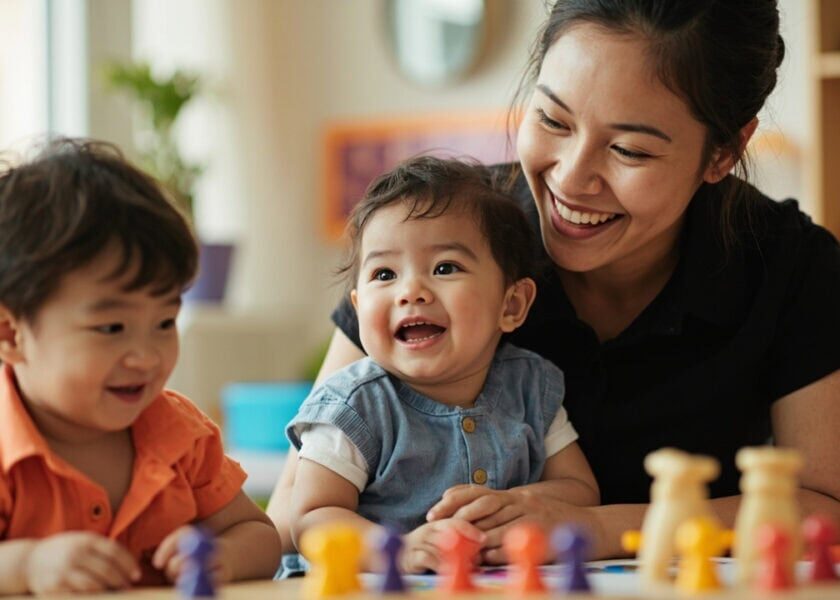
What Quality Childcare Builds Inside Your Singapore Child
The Invisible Architecture of Early Childhood
We spend a great deal of time talking about what parents need — peace of mind, trust, the right fit, confidence in the hours of care you have arranged. And all of that matters enormously. But today, let us look somewhere we rarely look with care: your child’s inner world.
Not what they signal to you at pickup. Not the body language you have become so skilled at reading. We want to talk about what is being built inside them during the hours you are not there — and why that building matters more than most of us are told to consider.
The first years of a child’s life are not simply a period of growth. They are a period of construction. And the construction site is not a physical one. It is internal, emotional — the slow and extraordinary assembly of a person who will carry certain qualities, certain tendencies, certain inner certainties or uncertainties into everything that follows.
The child who learns, in those early years, that their feelings are valid and that they will be responded to with care — that child is not simply having a good day. They are laying a foundation for emotional regulation that will serve them in primary school, in secondary school, in the complexity of human relationships they cannot yet imagine.
The child who discovers, in a morning of play and gentle interaction with an attuned caregiver, that their voice has weight — that what they say matters, that someone is listening not just with their ears but with their full attention — that child is not simply playing. They are constructing a belief about themselves as a person of worth and agency.
But here is what research does not always capture with enough urgency: you cannot see it happening. The architecture being built inside your child during those hours is largely invisible to you. You receive the finished wall — the flushed cheeks, the paint-stained sleeve, the story about a friend, the way your child moves through your door with a new kind of ease. But the laying of the bricks, the mixing of the mortar, the small daily decisions about to respond when a child is frustrated — none of that happens in your line of sight.
What Quality Care Actually Builds Inside Your Child
This is where the deepest tension of modern parenting lives. You are the primary architect of your child’s inner world, and yet there are hours — significant, formative hours — during which you must trust that the work is being done with the same intention you would bring to it yourself.
You cannot be there. You have to believe that what is happening is building something good inside them. And that belief, that trust — it cannot be built on good intentions alone. It needs to be grounded in something real.
The First Lesson in Emotional Regulation
Imagine a child who has just been dropped off. There is the initial settling — the moment where the caregiver does not rush, does not perform reassurance, but simply meets the child where they are. Perhaps the child is hesitant, clinging. Perhaps they are already scanning the room for the blocks, the books, the familiar corners they remember from yesterday.
The caregiver reads this not as a problem to be solved but as information to be honoured. They move alongside it. And in that quiet act of accompaniment — not fixing, not dismissing, not forcing the smile — something profound is modelled.
The child begins to learn that big feelings can be held by another person without being overwhelming to that person. That is the first lesson in emotional regulation. It is not taught in a lesson. It is felt, in the body, in the hours between drop-off and pickup.
The Friction of Early Friendship
Consider what happens when children play together. In the friction of early peer interaction — who had the red cup, who went first, who wanted the same book — children practice the full range of human negotiation. They practice losing. They practice winning. They practice the exquisite difficulty of wanting something another child has and finding a way through that does not destroy the relationship.
No adult can do this for them. It is work that must be done in the presence of attentive supervision, but with enough space for the child to feel the full weight of the social experience.
And when that supervision is attuned — when a caregiver notices the child on the edge of distress and offers just the right kind of scaffolding, not rescue but support — the child learns something that transfers far beyond the classroom: I can navigate difficulty. I am not alone when it is hard. Other people are not obstacles but companions.
The Emerging Sense of Self
And then there is the quieter, perhaps most important, layer: the child’s emerging sense of identity. Who am I? Not as an abstract question — children do not think in these terms — but as a felt experience, a texture, a quiet certainty or uncertainty that colours everything.
In quality care, a child is seen. Not just watched. Not just supervised. Their curiosity is met with genuine interest. Their questions are treated as worthy of real answers. Their attempts at mastery — stacking the cup, completing the puzzle, telling the story — are noticed and celebrated in ways that communicate something far deeper than “well done.”
What they communicate is: you are the kind of person who can figure things out. You are a learner. You are someone whose effort matters.
That narrative — formed in the earliest years, in the daily micro-moments of quality care — becomes part of the child’s internal compass. It shapes how they approach new challenges. It shapes how they fail. It shapes whether they believe their capabilities are fixed or whether they believe they can grow.
What Your Child Tells You at Pickup
The evidence is not only in research papers. It is in your own living room, in the way your child moves, speaks, relates, and explores in the hours after care.
The child who comes home regulated — not numb, not flat, but regulated, at ease in their own body, ready to play, ready to be with you in the way that matters — that child is showing you something. They are showing you that the hours of care were not just safe and structured. They were nourishing. That child was not merely minded. They were met.
And the child who comes home unregulated — prickly, collapsed, dysregulated, running hot with big feelings they cannot name or settle — that child is also showing you something. Not that they are bad, not that they had a bad day in the simple sense, but that the day’s emotional architecture did not hold. That there were too few attuned responses, too much dysregulation with no one to help them find their way back.
This is why what happens between eight in the morning and six in the evening matters so much. The actual product of quality care is not a certificate of attendance or a curriculum completed. It is the child’s inner state at the end of the day — and what that inner state tells you about the kind of person they are becoming.
The Singapore Reality for Working Parents
Let us bring this close to home — not just to Singapore in the abstract, but to the particular reality of parents here. The ones navigating two careers, the extended family networks that are sometimes near and sometimes across the island, the neighbourhoods that are dense and the commutes that are long. The particular pressure of wanting to give your children everything and knowing that time is the one resource you cannot manufacture.
You are doing something extraordinary. You are raising a person while building a life, and those two things do not always fit neatly together.
In Singapore, the search for infant care often begins in a particular state of anxiety. You want someone you can trust. You want ratios that make genuine attention possible. You want to know that the person caring for your child understands that a baby cannot yet use words to say “I am overwhelmed” or “I need you to slow down” or “I just want to feel held.”
These are not unreasonable expectations. They are the baseline of what your child deserves. And yet finding care that meets them — care where your child’s inner world is not just managed but genuinely nurtured — remains one of the most difficult decisions a Singapore parent faces.
What Good Childminding Actually Looks Like
If you are researching infant care options, here is what you deserve to understand: quality childminding is not primarily about activities, curricula, or even safety protocols. It is about whether the adults in the room are capable of doing the invisible work — the work of attunement, of holding space, of responding to your child not as a task to be managed but as a whole person to be known.
When evaluating infant care options, consider asking yourself these questions:
- Do the caregivers move alongside a child’s feelings rather than trying to fix or dismiss them?
- Is there enough adult attention available that each child can be truly seen, not just supervised?
- Do the children seem at ease, not just occupied? Do they look like they belong there?
- Is the environment structured enough to provide security, but flexible enough to follow the child’s lead?
- Are you receiving genuine information about your child’s day — not just logs and updates, but a real picture of who they are becoming?
The answers to these questions will tell you far more than a tour or a brochure ever could.
The EduNanny Approach: Holding the Child’s Inner World
EduNanny Singapore, a service under BUTLER, was built with a clear-eyed understanding of the reality Singapore parents face. It operates within the ECDA Childminding Pilot, offering home-based and community pathways alongside centre-based care, with infant ratios of up to one to three — ratios that make genuine attentiveness possible, that make the kind of individual observation and response we have been describing not just an ideal but an operational reality.
The care is structured across Monday to Friday blocks, designed to meet the rhythm of working family life. For families navigating the financial landscape of quality care, CDA and Baby Bonus provisions are applicable, making the investment not just a matter of values but a practical, Singapore-supported pathway.
Because trust cannot exist without transparency, EduNanny implements communication practices designed to keep parents genuinely connected to their child’s day — not just snapshots and updates, but a real picture of what is happening, how your child is feeling, what they are discovering. Where CCTV measures are deployed, they are deployed not as surveillance but as a layer of accountability, because you deserve to know that the space where your child’s inner world is being shaped is a space of integrity.
What is emerging through the Thomas AI Chatbot — an intelligent, responsive layer of support — is a way for parents to stay connected to the rhythm of their child’s care, to ask questions, to receive thoughtful, grounded guidance that meets them where they are. This is not automation for its own sake. It is a bridge between your world and your child’s world, built with the understanding that you are always, in some quiet part of your mind, wondering what is happening on the other side of that door.
Common Questions from Parents
What if my child cries at drop-off every day?
A hesitant drop-off is not evidence of poor care. It is evidence of a child who has a relationship with you and does not want to leave it. What matters is what happens next — whether the caregiver meets your child in that moment of difficulty with patience and presence, and whether your child begins, over time, to settle. The child who is never distressed at drop-off may simply have learned to suppress their reaction. The child who is distressed but held through it is learning something more valuable: that big feelings can be survived, and that the world contains people who can help.
How do I know what is really happening when I am not there?
You cannot be there. That is the fundamental reality you are navigating. But you can look for signs. You can look at how your child comes home. You can ask for genuine, narrative updates — not just “had a good day” but “noticed your child really engaging with the sand play today, and they seemed proud when the tower stayed up.” You can ask about the small moments, the invisible moments. Quality caregivers notice these things because they are paying attention.
Is home-based care or centre-based care better for my infant?
The honest answer is: it depends on the quality of the specific arrangement, not the model itself. What matters is the ratio, the attunement of the caregiver, the environment’s capacity to feel safe and responsive to your child. Both home-based and centre-based care can provide quality. Neither is automatically superior. What matters is what you observe in your child’s experience.
Your Child Is Becoming Someone
Here is what I want you to carry with you from this conversation.
The hours your child spends in quality care are not hours subtracted from your relationship with them. They are hours added to their development — hours in which their emotional regulation is being quietly strengthened, their social sense is being formed through the friction and joy of early friendship, their identity as a capable, curious, worthy person is being laid down in the most foundational layers of their selfhood.
And when that care is done with the kind of attentiveness we have been describing — when a caregiver meets your child not as a task to be managed but as a whole person to be known — then those hours are not a compromise. They are a gift you are giving your child, one that will compound in ways you will see over years: in their confidence walking into a new room, in the steadiness with which they navigate social complexity, in the quiet self-belief that says I can figure this out before they even know they are thinking it.
EduNanny Singapore is not simply a childminding service. It is a space where the child’s inner world is held — where it is observed with the same care a parent would bring, where it is nurtured with intention, and where it is communicated back to you as genuine partnership. We do not believe we replace you. We believe we extend you — taking the values you are already nurturing at home, the warmth, the attentiveness, the belief in your child’s potential, and holding those values in the hours when you cannot be there yourself.
You brought your child into the world. You love them in a way that is total and unreserved and, sometimes, almost too large to hold. That love is the reason this question — what is happening inside my child during those hours — matters so much to you.
It is not a question born of anxiety. It is a question born of devotion. And it deserves an answer that is worthy of that devotion.
At EduNanny, we understand that the child’s inner world is not a soft concept or a marketing angle. It is the most important reality in the room. It is the whole reason any of this matters.
Your child is becoming someone. Let us help them become someone extraordinary.
If you are looking for a childcare and childminding partner who takes the child’s inner world as seriously as you do, we would welcome the conversation. Connect with EduNanny Singapore to learn more about our approach.