What Your Child Is Quietly Becoming While You Are Apart
What Parents Cannot See Is Not Lost
You may have read articles about childcare ratios, curriculum frameworks, and facility standards. Those things matter. But this article is about something quieter and, I think, more important. It is about what your child is quietly learning—building—becoming—during the hours you are apart.
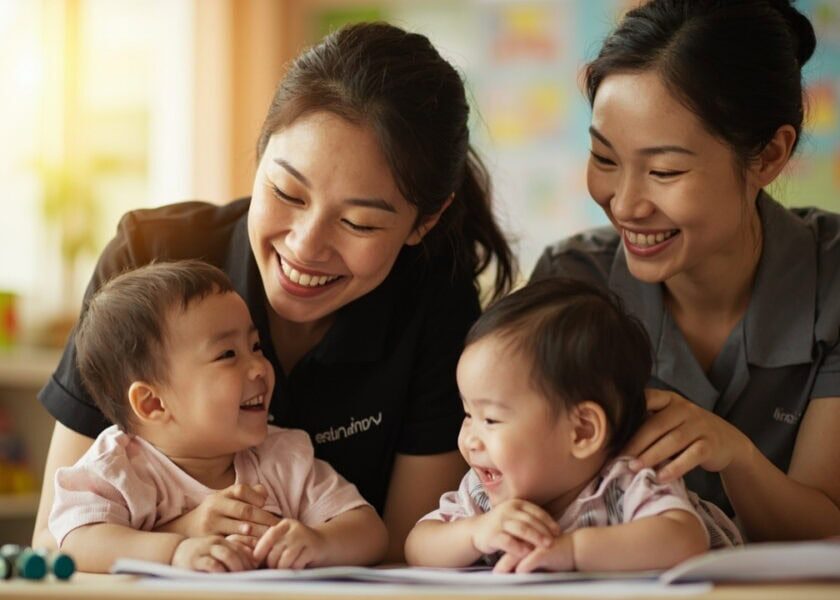
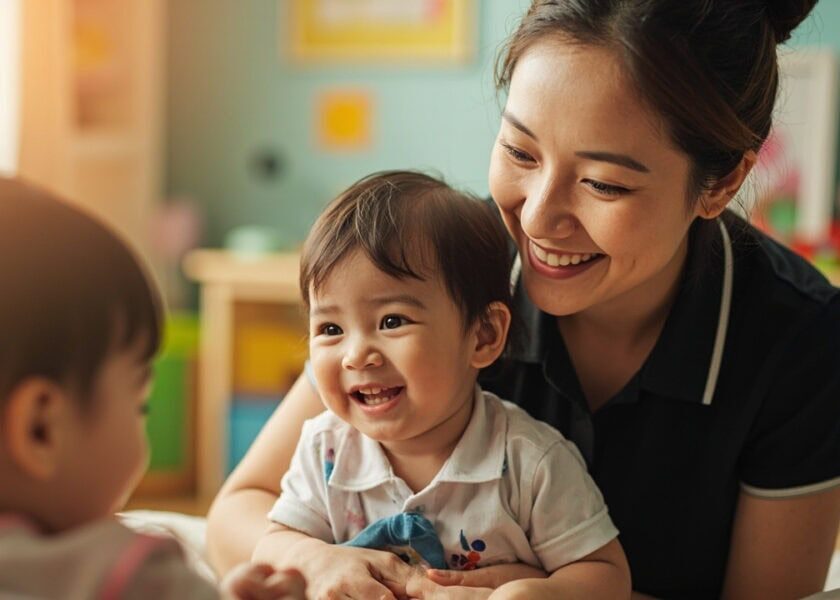
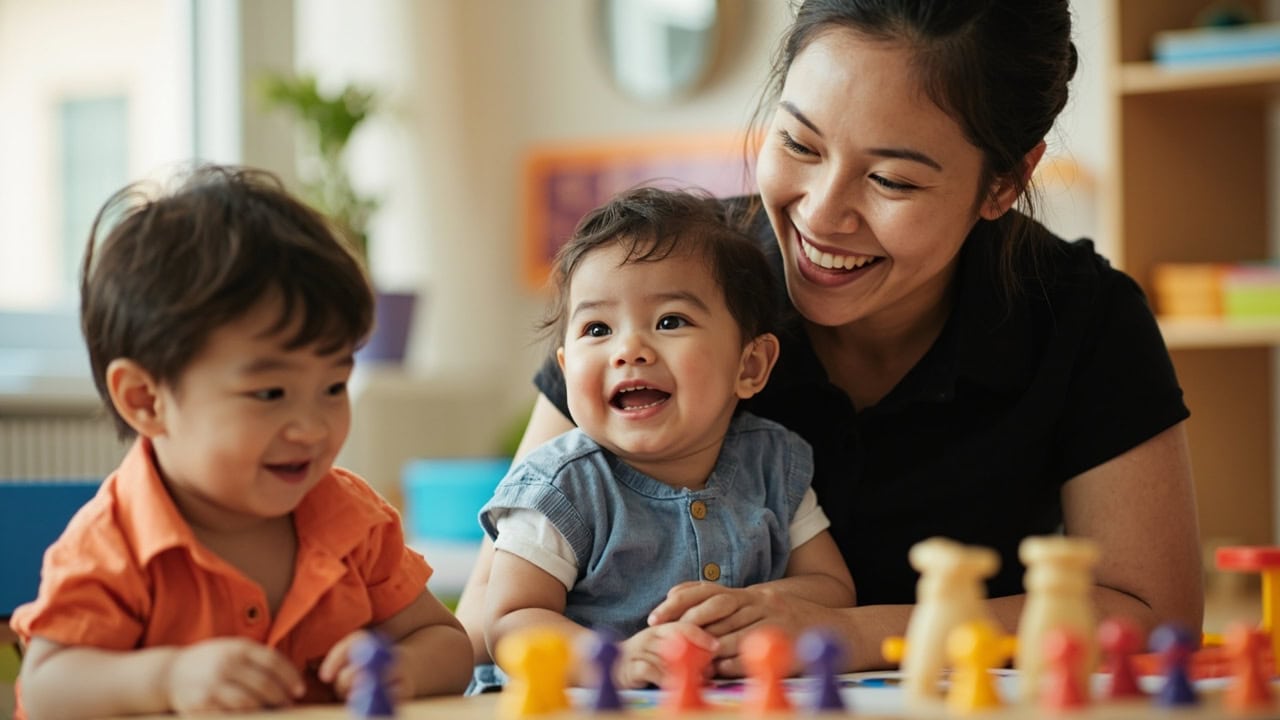
Let me take you into one of those hours. It is mid-morning in a quality infant care or childminding setting, and the children are gathered for a simple activity. Your child, who at home may be hesitant to try new things, who clings to familiar patterns, is watching another child attempt something new. The caregiver does not force attention. She does not announce a lesson. She simply notices.
She notices that your child is watching. And she waits.
There is power in that waiting. In the pause between your child’s observation and the caregiver’s response, something extraordinary is happening. Your child is deciding. Weighing. Building the internal architecture that will one day help them take risks, try new foods, speak up in a meeting, raise their hand in class.
The caregiver knows this. She has been trained to recognize it. And she trusts the silence enough not to fill it.
This is the unseen curriculum. It is not written on a wall. It does not come home in a report card. It is woven into the ordinary hours of an ordinary day, in moments so small they are easily missed. But they are not missed by the right caregivers. And they are not lost on your child.
What the Unseen Curriculum Really Means
- Emotional intelligence — Children learn to name and manage feelings through a caregiver’s patient narration of what she observes
- Social confidence — Sharing, cooperation, and belonging emerge naturally within a peer community, not through instruction
- Motor competence — Climbing, balancing, pouring, carrying—exploration supported by a safe, intentional environment
- Language emergence — Words surface most freely during play, when the pressure of performance is gone
- Identity formation — The quiet transformation of a shy child who, months later, introduces herself to new friends with ease
These are not small things. These are the foundations of the person your child is becoming.
The Worry You Already Feel Deserves Respect
Let us be honest with each other about something you may carry beneath the logistics and the routines. There is a quiet wondering: Are they okay? Are they happy? Are they growing in the ways that matter? And perhaps a deeper question, one you may not even want to fully ask: Am I missing something? Will I look back and realize I was not there for the important parts?
That question deserves respect. It is not irrational. It is not weakness. It is the mark of a parent who loves deeply and pays attention.
But I also want to offer a reframe: the hours you are apart are not hours of absence. They are hours of a different kind of presence—a presence shaped by trained hands, by intentional environments, by the daily rhythms that children need to feel safe enough to grow.
Your child is not waiting for you to return. Your child is living, learning, becoming—right now, in this moment—and the people who care for your child are part of that becoming in a way that is real, substantive, and worthy of your trust.
What Trained Caregivers Witness Every Day
Experienced, trained caregivers see things daily that most parents, no matter how devoted, rarely witness firsthand. Not because parents are not attentive—but because the right environment unlocks certain kinds of growth that simply cannot emerge in a parent’s presence alone.
They see children learn to name their emotions—not through worksheets or lectures, but through the patient repetition of a caregiver who narrates what she observes. “I see you are feeling frustrated that the block fell. That is a big feeling. Let’s take a breath together.” Over weeks and months, children begin to use these words themselves.
They see children practice sharing not because they are told to share, but because they live in a community of peers where sharing is how you play, how you connect, how you belong. The lesson takes hold because it is lived, not taught.
They see motor confidence develop—climbing, balancing, carrying, pouring—because the environment is designed for exploration and the caregiver is there not to restrict but to support. To step in when it matters and step back when the child can manage.
They see language emerge in the way children suddenly string words together during play, when the joy of communication takes over and the pressure of performance is gone.
They see identity form—the child who arrives shy and leaves, three months later, introducing herself to new children at the gate. These are the fruits of the unseen curriculum, witnessed quietly by people trained to notice.
Not every caregiver sees these moments. Not every environment nurtures them. The difference between a child being supervised and a child being tended often comes down to one thing: the quality of observation. Trained caregivers know how to read development—the small steps, the regressions, the patterns that reveal where a child is on their unique journey. They document gently and use what they observe to understand each child, not to grade or compare.
You cannot always be there to witness these moments. But someone should be watching—not just for safety, but for growth.
How to Read Your Child’s Day When You Were Not There
You may not have CCTV footage of every milestone. You may not receive a daily report card. But your child is already telling you about the hours you missed. You just need to know where to look.
“Aiden shared his crackers today.” “Miss Linda sang the rain song.” “I played with the big blocks.”
These are not random utterances. They are windows into what mattered to your child—what they are proud of, what they are processing, what is landing. The child who tells you about sharing crackers is telling you she is learning about generosity. The child who remembers Miss Linda’s songs is telling you she feels connected to her caregiver. These are the breadcrumbs of the unseen curriculum.
At pickup, the child who runs to you full of energy, satisfied and calm, has likely had a day of meaningful engagement. The child who melts down the moment they see you may be processing a big day—a day of learning that exhausted them, or a day that challenged them in ways they are still integrating. Both are signs that something real happened. Both are signs that your child was alive and growing in your absence.
You may almost miss the changes until one day you realize: my child is different now. Braver. More verbal. More socially confident. More curious. These are the fruits of the unseen curriculum, and they are the evidence that the hours apart were not empty. They were full.
What Quality Childminding Actually Looks Like
Philosophy matters. But so does reality. And you deserve to understand what you are actually choosing when you choose carefully.
Quality infant care and childminding in Singapore, particularly through structured pathways like the ECDA Childminding Pilot, operates on a set of conditions that make the unseen curriculum possible. These are not abstract ideals. They are practical realities that shape what your child’s day actually looks like.
| Condition | What It Means for Your Child |
|---|---|
| Small caregiver-to-child ratios | Up to 1:3 in infant care settings. Each child receives sustained, individualized attention—not just supervision |
| Trained caregivers | Caregivers trained in child development, emotional attunement, and the art of observation—not just safety protocols |
| Intentional environments | Spaces designed for exploration, risk-taking within safe limits, and the quiet independence that builds confidence |
| Transparent communication | Regular updates and systems that let you be present in your child’s day even when you are not physically there |
| Structured daily rhythms | Predictable routines that give children the safety they need to feel bold enough to grow |
For families navigating the realities of modern Singapore—where both parents often work, where extended family may not be close, where quality care can feel out of reach—the practical conditions matter as much as the philosophy. Quality childminding pathways under the ECDA framework are designed to be accessible. Subsidies, the Child Development Account, and Baby Bonus schemes can be applied where applicable, making informed care a realistic option for more families.
Reframing the Choice: Extension, Not Replacement
There is an older story about what parenting means—one that suggests children develop best in isolation, in the exclusive care of their parents, with minimal outside influence. Decades of research and the experience of early childhood educators across generations tell us this story was incomplete.
Children develop best in communities. They develop best when they are challenged, supported, and socialized by skilled adults beyond their parents. They develop best when their parents are present, engaged, and secure enough to share the work of raising them.
When you choose quality childcare—when you choose a pathway where trained caregivers, small ratios, and intentional environments are the standard—you are not choosing a substitute for your presence. You are choosing an extension of what your child needs. Your child is building a second set of roots. She is learning that the world contains trustworthy adults beyond her parents. She is learning that growth can happen in multiple places, with multiple people, and that she is capable of adapting, connecting, and thriving.
Children who have secure attachments at home and positive, enriching experiences in quality care do not suffer from divided attention. They flourish from it. They learn that love is not a limited resource. They learn that their parents trust the world enough to let them explore it. They learn, quietly and profoundly, that they are safe, loved, and capable.
What You Are Really Worried About
“Will my child feel abandoned?”
Children do not experience quality care as abandonment. They experience it as an expansion of their world—when the conditions are right. Secure attachment at home is the foundation. Quality care builds on that foundation. If your child runs to you at pickup, if your child mentions their caregiver with warmth, if your child settles into the routine of drop-off over time—these are signs that the experience is registering as safe, not as loss.
“Am I failing as a parent by not being there?”
No parent can be everything. No parent should try to be everything. What your child needs from you is not your constant physical proximity. What your child needs from you is your love, your consistency, your investment, and your trust—in yourself, in your child, and in the people you have chosen to care for them when you cannot be there. That is not a diminishment of your role. It is an expansion of your child’s world.
“How do I actually choose well?”
Here are some questions worth asking, beyond the brochure:
- What is the caregiver-to-child ratio, and does it allow for individualized attention?
- What training have the caregivers received—and does it go beyond safety protocols into child development?
- How does the setting communicate with parents about the child’s day?
- What does a typical day look like in terms of routine, free play, and structured activity?
- How does the environment support exploration—is it designed for children to move, climb, pour, and try things independently?
- What signs are there that caregivers observe and respond to emotional moments, not just physical needs?
The answers to these questions will tell you more than any marketing material.
EduNanny Singapore: Built on This Understanding
EduNanny Singapore operates under the ECDA Childminding Pilot, and it was built on exactly this recognition—that modern parents need more than a place to leave their children. They need a partner in their children’s development.
They need a pathway that understands the unseen hours are not a gap to be tolerated but a curriculum to be honored. And they need conditions—trained caregivers, small ratios, transparent communication, affordable access—where every child in their care can thrive in the hours parents cannot be there.
The care options available through the pilot include home-based arrangements and community or centre-based settings, allowing families to choose what fits their child’s temperament, their neighbourhood, and their family’s rhythm. For the youngest children, ratios are maintained at a level that allows caregivers to truly see each child—because infants need not just supervision but sustained, individualized attention.
Where communication systems are in place, parents can receive regular updates that let them feel connected to their child’s day. Where caregivers are trained not just in safety but in child development and emotional attunement, your child is not merely being watched. She is being tended.
Trust the Work
The next time you hand your child over at the gate, and the next time you turn away with that familiar ache, I want you to remember this: your child is not waiting for you to return. Your child is living, fully and presently, in the moment they are in. And in that moment, they are learning. They are growing. They are becoming.
Not despite your absence, but within a structure of care you have chosen, a community you have trusted, and a curriculum that runs quietly beneath every ordinary hour of every ordinary day.
That is what quality childcare gives your child. Not just a place to be. But a place to become.
What you are choosing matters. Not just for your family, but for the person your child will grow up to be—confident, curious, kind, capable. The hours you cannot see are not empty. They are full of your child’s future.
Trust the work. Trust the care. And trust your child—they are more capable of thriving in your absence than you may have ever imagined.
If you are ready to explore what thoughtful, development-oriented childminding looks like for your family, we would be glad to hear from you. Learn more about EduNanny and the ECDA Childminding Pilot, and discover how the unseen hours in your child’s life can become hours of quiet, powerful growth.