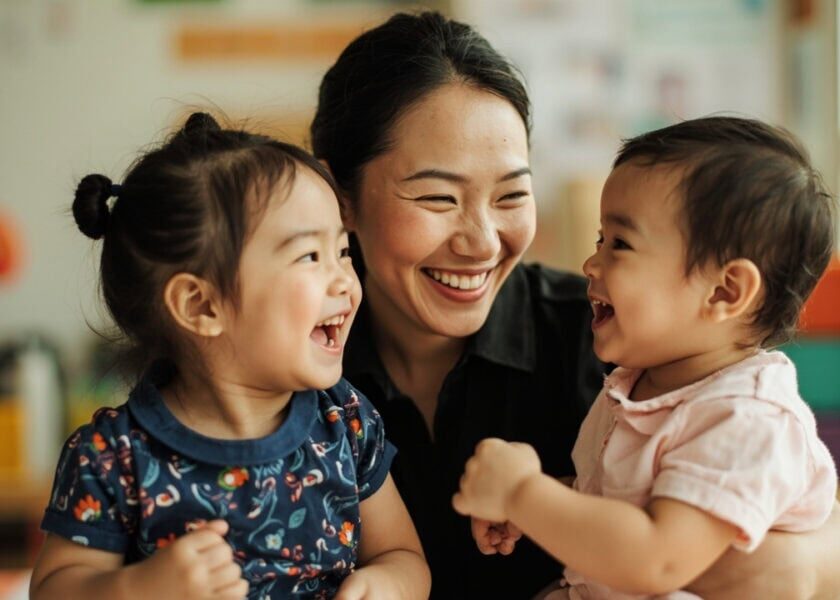
The Emotional Truth of the Childcare Chapter for Singapore Parents
The Wrong Question and the Right One
When you entrust your child to someone else’s care, something profound is happening. Your child is learning to be held by more than one pair of arms. They are forming a meaningful bond with another adult. They are building a life outside of you—not separate from you, not replacing you, but outside of you in a way that is necessary, healthy, and right.
And as a parent, you are learning something too. You are learning to hold love and letting go at the same time. You are learning to celebrate your child’s growth even as it creates distance. You are learning that the bond you share does not require your constant presence to remain real.
This is the tension that no one talks about directly. And it is the tension that makes the childcare chapter one of the most emotionally complex phases of parenting.
What Bonding With a Caregiver Actually Looks Like
It looks like your daughter coming home with a new song, one she learned from someone else. It looks like your son using a phrase at the dinner table that did not come from your household. It looks like your child talking about their day with a brightness that makes you realize: they have a whole world out there that does not include me.
And in that moment, something in you stirs. There is joy, yes. But there is also something older and more tender. There is the quiet recognition that your child is becoming whole in a way that does not require you to be the whole world.
And yet there is something to grieve in it. Something sacred about those early months, when your child knew only your arms, when every need was met by your hands and your voice, when you were the centre of their entire universe. That was precious. And it is ending—not in a single dramatic moment, but in a thousand small ones. A new word. A new friend. A new way of being in the world.
The grief you feel is not weakness. It is not guilt. It is love, doing what love does when it is real. Love expands. And expansion is always a little painful, because it means releasing who you were to become who you are becoming.
What This Chapter Is Doing to You
Here is the insight that most childcare conversations miss entirely: this phase is not just changing your child. It is changing you. And the parent you are becoming during this chapter is as significant as the child your son or daughter is becoming.
Before childcare, your parenting was defined by presence. By physical closeness, by the rhythm of feeds and naps and holding. After childcare begins, your parenting is defined by something more complex. It is defined by the quality of the moments you do have. By the attention you bring to pickup, to bath time, to bedtime, to the weekend hours. By your ability to be fully present in less time, because you have chosen to be present in a different way.
This is not a lesser form of parenting. It is a harder one. It requires you to let go of the idea that your worth as a parent is measured by hours spent. It asks you to find presence, not perfection. And it asks you to trust that the bond you have built—through every feed, every sleepless night, every moment of eye contact and skin-to-skin contact in those early weeks and months—is strong enough to hold the new shape of your family without breaking.
Your Emotional State Is Foundational to Your Child’s Development
Let me speak directly to something that every emotionally honest parent in Singapore has felt but rarely heard articulated: your emotional state during the childcare chapter is not separate from your child’s development. It is foundational to it.
When you drop your child off in the morning and feel your chest tighten, when you sit at your desk wondering if they are crying, when you drive home rehearsing the evening and feeling the weight of everything you need to be for them—your child feels that. Not the specific thoughts, but the emotional texture you carry. Young children are exquisite receivers of their parents’ inner states. They calibrate their sense of safety not only by what happens to them, but by what they sense in the adults who love them.
This means that the work of this chapter is not only about finding the right caregiver or choosing the right programme. It is about tending to yourself. It is about finding the emotional grounding that allows you to trust the process, to trust your child, and to trust the adults you have chosen to partner with in raising your family.
When you walk through the door at pickup and your child runs to you, your calm presence is a gift you are giving them. When you listen attentively at the end of the day, asking the right questions and receiving their answers without judgment, you are building something. When you regulate your own anxiety enough to speak positively about their caregiver and their day, you are teaching your child about trust and security and the goodness of the world.
Your emotional regulation is not a luxury or a distraction from the real work of childcare. It is the real work.
The Singapore Context: What Families Are Actually Navigating
You are not doing this in a vacuum. You are doing it in a city where the cost of living demands that most families have two working parents. You are doing it in a culture where the expectations on parents—particularly mothers—are extraordinarily high. You are doing it in a society where extended family may or may not be nearby, where the village that once surrounded new parents is often absent, and where the pressure to have everything figured out is relentless.
And you are doing it with a childcare system that is genuinely trying to evolve, to offer families more options, more flexibility, more quality. The ECDA Childminding Pilot is part of that evolution. It recognises that not every family needs centre-based care, and that home-based arrangements can offer something profound—smaller ratios, warmer environments, care that feels more like what a trusted relative might offer.
What Quality Childminding Actually Looks Like
Quality childminding is not primarily about curriculum or facilities. It is about relationships. It is about whether your child is known—whether the adult caring for them understands their rhythms, their preferences, the particular way they express hunger or fatigue or joy.
It is about ratios. A caregiver caring for fewer infants can offer genuine attention. They can notice the small shifts that signal a child’s needs before those needs become cries. They can respond with the consistency that builds trust.
It is about communication. You should be able to know what your child’s day looks like. You should not have to wonder. Transparency is not a luxury feature—it is a trust-building practice that supports the entire family system.
It is about partnership. The best childcare arrangements feel like an extension of your family, not a replacement for it. The caregiver speaks about you to your child. You speak about the caregiver to your child. Your child learns that the adults in their life communicate and collaborate. This is not just childcare logistics. This is a model for how relationships work.
How EduNanny Approaches This Chapter
EduNanny operates within this landscape. We believe that families in Singapore deserve more than logistics. They deserve a partner who understands what this chapter is really asking of them. Who understands that when you choose childcare, you are not outsourcing parenting. You are inviting another trusted adult into the ongoing story of your family. And that invitation deserves to be taken seriously.
Our approach begins with the understanding that the relationship between you and your child is the centre of everything. Not a product to be delivered. Not a service to be rendered. A relationship to be honoured, supported, and protected.
How We Put This Into Practice
- Caregiver matching is careful because it needs to be. We know that the person who will spend hours with your child is not interchangeable with any other person. They carry your child’s safety, your child’s routines, your child’s first words and discoveries. They become part of your family’s story. That is not a small thing.
- Our ratios—up to one to three infants in home-based care, depending on the arrangement—exist because we believe that your child deserves genuine attention, not diluted care. Because relationships require time and presence, and you cannot manufacture presence by spreading a single caregiver too thin.
- Our communication practices, including transparency measures and where deployed, CCTV in certain settings, exist because we know that trust is built through openness. You should be able to know what your child’s day looks like. You should not have to wonder.
- Our approach to fees, structured within the pilot programme’s framework, exists because we believe that the childcare you choose should not be determined by what you can afford alone. CDA and Baby Bonus funds can flow toward the care your child receives, making this chapter more manageable for families across Singapore, not just the ones with the most resources.
These are not just service features. They are expressions of a philosophy: that childcare is a relational act, and relational acts deserve relational thinking.
Addressing What Parents Actually Worry About
Some days are beautiful. Your child runs into your arms and you feel the weight of them, the warmth, the sheer aliveness of their small body pressed against yours. You think: this is everything. This is what I am doing this for.
Some days are hard. Your child clings at the door. You drive away with tears in your eyes. You spend the entire workday distracted by worry, wondering if you are failing them, wondering if this was the right choice.
And some days are stranger than beautiful or hard. Some days your child comes home and says something that stops you cold. A word you did not teach them. A story about something you were not part of. A moment of proof that their life is wider than you alone, and that this is exactly as it should be.
All of these days are part of the chapter. All of them are teaching you something. All of them are building the relationship you will have with your child for the rest of your lives.
When Your Child’s Bond With Their Caregiver Feels Difficult
It can be disorienting to hear your child talk about their caregiver with warmth and excitement. Part of you is glad—they are happy, they are safe, they are thriving. But part of you may feel a small, quiet sting. A recognition that you are no longer the only one who makes them laugh that way. The only one they run to.
Here is what helps: this is the milestone you were always hoping for. Your child is learning that love is not a finite resource. They are learning that they can attach to more than one trusted adult and that this multiplication of care makes them more secure, not less. The capacity your child is developing right now—the ability to love more than one adult well—will serve them in friendships, in partnerships, in the way they show up for their own children one day.
Your task is not to be the only one. Your task is to be one of the ones who matters most, and to trust that the foundation you built in those early months and years is deep enough to hold this new architecture.
When Separation Anxiety Is Overwhelming
If your child struggles at drop-off, your first instinct may be to interpret this as a sign that something is wrong. Sometimes it is. But sometimes a child who cries at goodbye is simply a child who has formed a strong attachment to you and finds temporary separation difficult—which is age-appropriate and emotionally healthy.
What matters is not whether your child cries. What matters is how the goodbye is handled: with calm consistency, with reassurance that you will return, with trust in the caregiver who receives your child. Over time, your child learns that goodbye is temporary and reunion is certain. This is foundational security work.
And what helps you, the parent, is knowing that your calm presence at goodbye is the greatest gift you can give. Your child reads you. When you can hand them over with quiet confidence, you are teaching them that this is safe, that this person is trustworthy, that the world is reliable.
What You Are Actually Building: The Long View
Your child will not remember the specifics of their first childcare arrangement. They will not recall the colour of the walls or the name of the song they learned at eighteen months. What they will carry forward—what will shape who they become—is what this chapter taught them about the world.
They will carry forward the sense that they are safe even when you are not in the room. That other adults can be trusted. That love is not a finite resource that runs out when it is shared. That the people who care for them communicate with each other and with them, and that this communication is a form of care.
They will carry forward the example you set, without knowing they are learning from it. They will learn from the way you handle goodbye in the morning, the way you handle reunion in the afternoon, the way you speak about their caregivers and their day. They are learning, in this chapter, what it looks like to be a secure person in a world that contains both closeness and distance.
And they will carry forward what you are becoming. The version of yourself that is learning to love more generously, to trust more deeply, to show up with presence rather than perfection. This version of you is not a lesser parent. This version of you is becoming someone your child will need for the next twenty years of their life.
The parent who can hold love and letting go. The parent who can trust the process even when it is hard. The parent who understands that raising a child is not about keeping them close but about preparing them to fly.
Walking Alongside You: The Relationship You Are Building
You are not losing your child to childcare. You are growing with them. The relationship you have is not diminishing. It is deepening. It is taking on new dimensions, new textures, new possibilities.
Your child is becoming someone who can love more than one adult well, and that capacity will serve them for the rest of their life—in friendships, in partnerships, in the way they show up for their own children one day.
The relationship between parent and child is the great work of a lifetime. It does not end when your child goes to childcare. It evolves. And evolution, even the most beautiful and necessary evolution, always asks something of you.
What it asks is this:
- Be present. Not perfect. Not constant. Present.
- Show up at pickup with your whole heart.
- Listen to the stories of their day with genuine attention.
- Speak about their caregivers with respect and trust, because what you model becomes what they believe.
- Tend to your own anxiety so that you can be the calm, grounded presence your child needs when they come home.
- Trust—deeply, in your bones—that what you are building together is strong enough to hold the new shape of your family without breaking.
EduNanny is here because we believe this chapter matters. We believe that the choices you make now—the caregivers you trust, the arrangements you build, the way you show up as a family navigating this transition—will echo through everything that comes after.
We are not here to take your place. We are here to walk alongside you. To offer care that honours your relationship with your child rather than replacing it. To provide transparency and communication so that trust can grow. To make this chapter more manageable, more supported, and more human than it might otherwise be.
We are here for the pickup that is joyful and strange. For the evening questions that require careful answers. For the mornings when goodbye feels impossible and the afternoons when reunion feels like everything.
The relationship you are building while your child is at childcare is one of the most important relationships you will ever form. It is the foundation your child will stand on as they grow. It is the model they will carry into every future relationship. It is the place where they learn that love is not diminished by being shared, that trust can survive separation, and that the adults who love them will work together on their behalf.
You are building something extraordinary. Even on the days when it does not feel like it. Even on the days when you are exhausted and uncertain and wondering if you are doing this right.
The answer is yes. You are doing this right. You are showing up. You are choosing. You are trusting. You are loving your child across the distance that this chapter requires, and you are becoming the parent they need you to be in the process.
That is not something to survive. That is something to be fully present for.
And that is exactly what you are doing.
EduNanny Singapore is proud to be part of your story. If you are ready to explore what a relationship-centred approach to infant care and childminding could look like for your family, we invite you to begin a conversation with us.
Learn more about EduNanny and our approach to thoughtful, development-oriented childminding for families in Singapore.