When Your Child’s Caregiver Becomes a Second Anchor to Their World
The Quiet Guilt Every Singapore Parent Carries
There is a particular kind of anxiety that grips Singapore parents when they notice their child developing a genuine attachment to their caregiver. It arrives quietly, often disguised as pride: Look how much she loves her nanny. But just beneath that pride is something more complicated—a flicker of worry, a whispered question:
But I am her mother. Shouldn’t she look at me that way?
What does it mean that she runs to the caregiver first when I drop her off?
This feeling is rarely named, yet it is extraordinarily common. The fear is not that your child loves someone else. The fear is that loving someone else might somehow replace what you bring. That your child might not need you as much.
This fear is a testament to how much you love your child. And in most cases, it is unfounded.
Why This Guilt Is Unfounded
The bond between a child and a caregiver who truly knows them does not subtract from the bond between parent and child. It adds to it. It extends it. It creates an additional layer of emotional safety from which your child can explore the world with greater confidence.
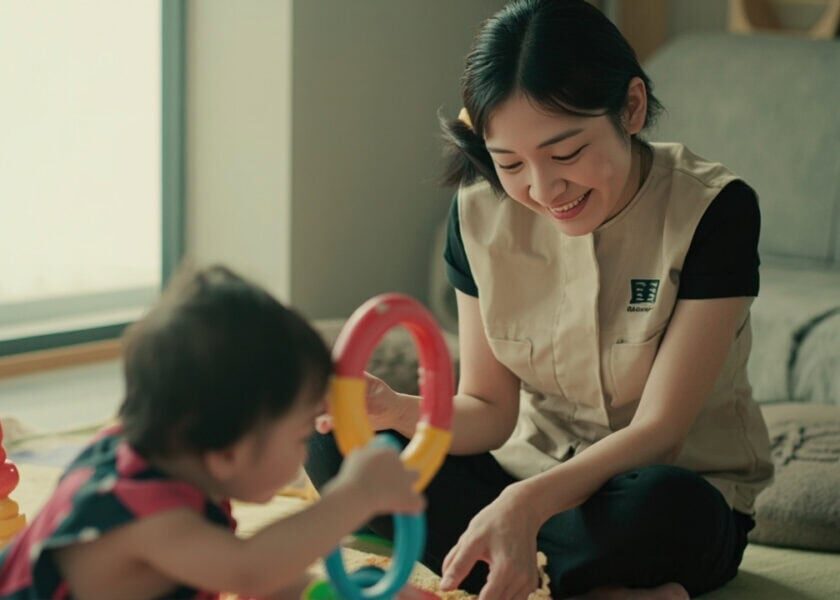
When a child has a caregiver who knows them deeply—who remembers that they are afraid of the hand dryer in the bathroom but love the sound of rain on the window, who knows they eat better with a purple spoon and a yellow bowl, who understands that their quietness after school is not sadness but the particular way they process a full day—then that child carries a different kind of security into every new experience.
They know that someone who is not their parent sees them, understands them, and remains constant. This is not a replacement for parental attachment. It is a second anchor. And for a child’s emotional development, having more than one reliable, emotionally attuned presence in their early years is not a risk. It is a gift.
Quick Summary for Busy Parents
- The fear is normal. Many Singapore parents feel guilty when their child develops a genuine attachment to their caregiver. This fear reflects love, not inadequacy.
- A caregiver who knows your child adds to your bond, not subtracts from it. Relational knowing creates a second anchor of emotional safety.
- There is a difference between knowing a child by name and truly knowing them. Genuine relational knowledge is built through consistent caregiver presence over time.
- EduNanny is designed around relational continuity. We maintain low infant ratios and build care around the same caregiver learning your child’s story over weeks and months.
- You can recognize quality care. Look for unprompted moments of recognition: when a caregiver recalls a preference from weeks ago, adapts activities to match your child’s current interests, or describes their mood with specificity and accuracy.
Knowing Your Child: What It Really Means
There is a difference—I want to be precise about this—between knowing a child and knowing a child by name.
Any caregiver can learn to use a child’s name. It appears on the intake form, on the cot label, on the daily report. But knowing a child is something altogether different. It is the accumulation of small observations over time:
- The way a child’s eyebrows furrow slightly before they are about to cry
- The rhythm of their nap schedule
- The story they ask to hear at least three times in a row
- The friend they tend to sit next to in a group
- The small triumph they still talk about days later
This relational knowledge is not accidental. It is cultivated through:
- Caregiver continuity—the consistent presence of the same caregiver over weeks, months, and in some cases, years
- Low infant-to-caregiver ratios—allowing a single caregiver to truly attend to each child’s individual rhythms and needs
- Supportive structures—that allow caregivers to do what they do best: be present, observe carefully, and build the kind of knowledge that cannot be rushed or delegated
How to Recognize When Caregiver Knowing Is Working
You know your caregiver knows your child when you notice small, unprompted moments of recognition:
- The caregiver recalls a preference your child mentioned weeks ago
- They adapt an activity to match your child’s current interest without being asked
- They describe your child’s mood or behavior in ways that feel specific and accurate, not generic
- Your child greets them with genuine pleasure—not the performed cheerfulness of routine, but the authentic delight of someone familiar
These are the signs of relational knowing, and they are far more meaningful than any credential checklist or facility tour can provide.
What Quality Childminding Looks Like in Singapore
Understanding the philosophy behind relational care is important. But parents also need practical clarity on what quality childminding actually looks like in everyday life.
The Structure That Makes Relational Care Possible
When evaluating childcare options in Singapore, look for these foundational elements:
- Consistent caregiver assignment. Your child should not be rotating between multiple caregivers. The same person should be the primary point of contact day after day.
- Manageable ratios. For infants, a ratio of no more than one caregiver to three infants allows for genuine attentiveness. Larger groups make personalized knowing nearly impossible.
- Time for observation. Quality caregivers are not just active—they are attentive. They watch, they notice, they remember. This requires unhurried time, not constant activity.
- Communication that reflects knowledge. Reports should go beyond what your child ate or when they napped. Look for observations that reflect genuine knowing: She was especially focused during the water play today or He asked about his grandmother again—this seems to be a theme he’s interested in.
How Relational Care Bridges Home and Childcare
When your caregiver knows your child deeply, something valuable happens: the gap between home and childcare begins to close.
A caregiver who truly knows your child can reinforce the values and rhythms you are building at home. They can notice when your child’s behavior shifts and communicate that shift to you with nuance and context. They can be a partner—not in the clinical sense, but in the deeply human sense of someone who is paying attention to the same small person you are, and who wants to help you understand what they are experiencing.
Imagine this: you arrive to pick up your child, and the caregiver mentions, She asked about her baby brother this morning—is he feeling better? In that moment, you realize the caregiver has been paying attention not just to the child in their care, but to the family the child goes home to. That is what relational bridging looks like.
The EduNanny Approach: Built Around Relational Continuity
At EduNanny by BUTLER, this philosophy sits at the heart of everything we do. We are part of the ECDA Childminding Pilot, a government-supported initiative that recognizes home-based and community-based care as a legitimate, high-quality alternative to centre-based services for Singapore families.
What this means practically is that we are committed to building our care around relational continuity rather than throughput. When you choose EduNanny, you are not choosing a facility where your child is one of many rotating faces. You are choosing a caregiver who will learn your child’s story, remember its chapters, and hold that knowledge with the professionalism and warmth it deserves.
Pathways Designed for Singapore Family Life
EduNanny offers pathways suited to different family needs:
- Home-based care offers the warmth and consistency of care in a familiar domestic setting, with a caregiver who becomes a trusted part of your household routine
- Community and centre-based pathways offer structured environments where relational continuity is still prioritized, but where children also benefit from peer interaction and group learning experiences
Across all pathways, we maintain low infant ratios—up to one to three infants in our care settings—because we know that genuine relational knowing requires time and attention that cannot be spread too thin.
Transparency, Trust, and Accessibility
We believe communication and transparency are not optional extras. Parents deserve to know what is happening in their child’s day—not just the milestones, but the texture of the experience. When CCTV measures are deployed, they are not there because we distrust caregivers. They are there because parents deserve the peace of mind that comes from knowing their child is in a space where care is visible, accountable, and grounded in trust.
We also believe that relational infant care should not be a privilege reserved for families who can afford private nannies or premium centres. Every Singapore child deserves to be known. Our fee structures are designed to be accessible within the ECDA Childminding Pilot framework, and we work with families to make care financially manageable. CDA and Baby Bonus funds can be utilized where applicable, and our team is transparent about fee structures so that families can plan with clarity.
Choosing Infant Care With Confidence
If you are a parent in Singapore navigating this decision, here is a practical framework for making this choice with clarity:
- Observe the unprompted moments. During visits, watch how caregivers interact with children—not just when parents are watching, but in passing moments. Do they notice a child’s mood before it becomes obvious? Do they adapt naturally to individual preferences?
- Ask about caregiver continuity. Who will be your child’s primary caregiver? How long do they typically stay in this role? What happens if that caregiver is unavailable?
- Listen for specificity. When caregivers describe children, do they use general terms or specific observations? “She’s friendly” is different from “She likes to start with the puzzles first thing in the morning—she’s very systematic.”
- Notice your child’s reaction. When you visit, does your child show genuine recognition of the caregiver? Not just tolerance, but authentic delight at seeing a familiar person?
- Trust your instincts. You know your child better than anyone. If something feels off, it probably is. If something feels warm, attentive, and genuine—that matters too.
Questions to Ask During Your Search
- What is your infant-to-caregiver ratio?
- How often does the primary caregiver change?
- How do you communicate daily observations to parents?
- Can you describe a recent moment where you noticed something specific about my child’s preferences or temperament?
- How do you handle a child who is having a difficult emotional day?
Answering Your Real Concerns
“Is it really okay to want someone else to know my child this well?”
Yes. Completely. The caregiver who knows your child is not a substitute for you. The caregiver who knows your child is someone who is teaching your child, alongside you, what it means to be loved well.
In the first thousand days of life, children are building the foundations of everything: their sense of security, their capacity for trust, their understanding of what relationships feel like. Every interaction a young child has with a consistent, emotionally attuned caregiver is quietly teaching them something about the world. It is teaching them that they are worth paying attention to. That their feelings matter. That when they are upset, someone will respond. That they can be known by another person and still be safe.
“How do I know if this is the right choice for my family?”
The right choice is the one where you can see your child’s relational wellbeing as the central priority. Where the caregiver is not just credentialed, but present. Where you feel, over time, that the person caring for your child is building something meaningful with them—not just going through the motions of a daily routine, but genuinely attending to who your child is.
“Isn’t this only for wealthy families?”
No. EduNanny is designed to be accessible within the ECDA Childminding Pilot framework. We believe relational infant care should not be a privilege. Our team is transparent about fee structures, and we work with families to make care financially manageable using available schemes like CDA and Baby Bonus.
You Are Not Giving Something Away. You Are Expanding It.
There is a moment—I have seen this happen with families in our care—where the relationship between parent and caregiver shifts from professional transaction to something closer to mutual trust. It does not happen overnight. It happens through small moments of recognition, through honest communication, through the caregiver remembering things and the parent noticing.
This is what relational childcare looks like when it is working well. It is not a hierarchy where the parent is always the authority and the caregiver is always the helper. It is a shared understanding of the same small person, held by two sets of attentive eyes, nurtured by two sources of care, protected by a common intention to do right by this child.
And when it works—when it truly works—the child benefits most. The child who has a caregiver who knows them does not have to constantly explain who they are in each new environment. They can simply arrive, and be recognized. They can trust that the world contains people who will pay attention to them, and they carry this trust into their futures: into their classrooms, their friendships, their eventual relationships.
The emotional intelligence built in those early years, with those steady, knowing caregivers, is not a small thing. It is the foundation on which so much else is built.
A Note on the Caregivers Themselves
The work of a childminder is often underestimated. It requires patience that runs deeper than most people realize, attentiveness that must be sustained across entire mornings and afternoons, and an emotional intelligence that is rarely celebrated in the way it should be.
A good caregiver is not simply someone who is kind to children. A good caregiver is someone who can read a child’s moods with precision, respond to distress with calm, celebrate small victories with genuine warmth, and hold the complexity of a family’s life with discretion and care.
At EduNanny, we are committed to supporting caregivers not just with training and frameworks, but with the recognition that this work is both demanding and profoundly meaningful. We believe in the dignity of the childminder’s role. We believe that when we treat caregivers as professionals worthy of respect and investment, they are better able to offer the kind of care that parents in Singapore are searching for—not just supervision, but presence. Not just safety, but knowing.
If you are a parent in Singapore who is navigating this decision, I want you to know something:
You are not alone in this. You are not inadequate for needing help. You are not failing for wanting someone else to share in the beautiful, exhausting, extraordinary work of raising a small human being.
And if you choose to place your child’s care with someone who will know them deeply—who will remember their drawings, notice their moods, celebrate their small victories, and hold them with warmth and professionalism—then you are not giving something away.
You are giving your child a second anchor. You are giving your family a partner in care. And you are giving yourself, perhaps for the first time since your child was born, the permission to trust that someone else sees what you see, and will protect it.
The caregiver who knows your child is not a replacement. It is an extension of the circle of love your family is building. And that circle, when it is wide enough and warm enough and wise enough, is exactly what Singapore’s children need to grow into the people they are meant to become.
Ready to Learn More About EduNanny?
EduNanny by BUTLER is here to walk alongside Singapore families in this journey—with the patience, the attention, and the relational intelligence that your child deserves.
We invite you to learn more about our approach to infant care and childminding, meet our caregivers, and discover what it looks like when a caregiver truly knows your child.
Because your child deserves to be known. And you deserve to feel confident that the person caring for them understands exactly who they are.
Learn more about our participation in the ECDA Childminding Pilot or get in touch with our team to begin a conversation about your family’s needs.