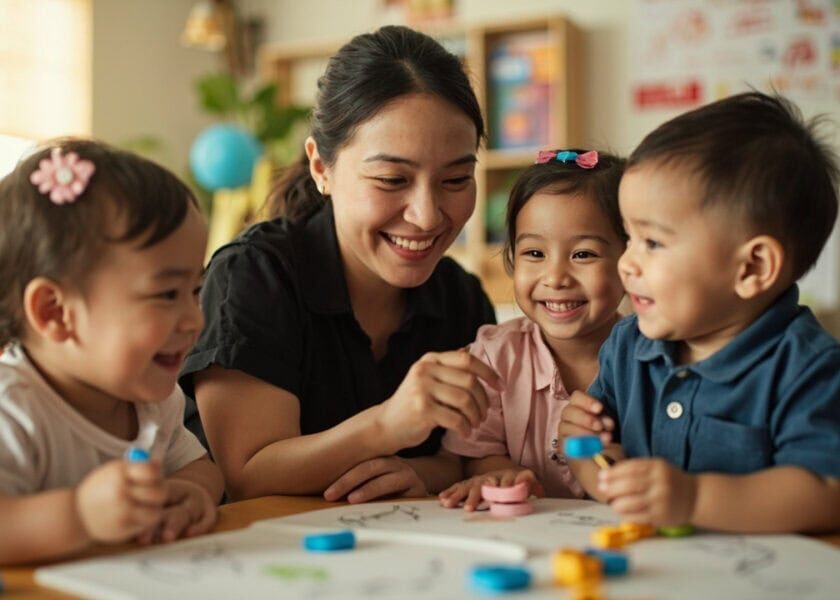
When Grandparent Care Meets Your Child’s Growing Needs
When Grandparent Care Is Beautiful, But Something Is Asking to Evolve
There is a moment, perhaps during a quiet evening after the children have finally slept, when a Singapore parent sits with a thought they almost feel guilty for having. It is not a dramatic realization. It is softer than that.
It is the quiet recognition that something which has worked beautifully for the past year or two — the familiar rhythm of grandparent care, the comfort of knowing your child is with family — may be approaching a gentle turning point.
In that moment, something else rises alongside it: gratitude, layered over with something harder to name. A sense of loyalty. A flicker of worry about what other people might think. And underneath it all, a question that deserves to be asked without shame: What does my child actually need right now, and am I brave enough to provide it?
This is where we begin. Not with a problem to solve, but with a truth to honor.
- Why grandparent care in Singapore is a genuine gift worth honoring
- The subtle signals that may indicate your child’s next chapter needs something different
- How to navigate the transition with grace — for your parents, your child, and yourself
- What quality professional care actually offers your growing child
- How to preserve and strengthen the grandparent-grandchild bond
- Why EduNanny Singapore is built to walk this journey alongside multigenerational families
The Blessing of Multigenerational Family Care
In Singapore, we are fortunate to live within one of the most multigenerational family structures in the world. Our grandparents are present, involved, and invested in ways that many other cultures can only admire from a distance.
They have held our children in their arms since the earliest days. They have sung the nursery rhymes. They have navigated the midnight feeds, the feverish nights, the fierce joy of watching a small person discover the world.
In many ways, the first chapter of our children’s lives has been written with grandparent hands — and those hands deserve our deepest gratitude, our continued respect, and our unwavering recognition of everything they have given.
But here is what we also know, if we are honest enough to admit it: families are not static. Children are not static. And the care that served us beautifully in the earliest stages of parenthood may, over time, begin to reveal its edges — not because it was ever wrong, but because growth demands evolution.
This is not a story about replacement. It never has been. It is a story about something far more nuanced and, frankly, far more loving: the understanding that honoring what came before sometimes means having the courage to build what comes next.
The Weight Parents Carry: Gratitude and Awareness Together
Let us speak honestly about what many Singapore parents feel but rarely say aloud. There is a particular kind of weight that comes with considering a shift from grandparent care to professional care. It is not the same as choosing between two childcare centers. It carries the texture of family history.
It touches on loyalty — the deep sense that your parents have sacrificed for your family. It carries gratitude — the genuine recognition of everything they have given. It holds the fear of seeming ungrateful — the worry that you are somehow diminishing their contribution. And it navigates extended family dynamics — generational expectations about who should care for the children.
And yet, beneath all of that weight, there is often another feeling — one that parents are sometimes reluctant to acknowledge. That feeling is awareness.
An awareness that your child is changing rapidly, that their developmental needs are becoming more specific, that the kind of stimulation and structured engagement they benefit from now looks different from what they needed as an infant.
An awareness that your own parents are aging too, that their energy has limits, that the physical demands of full-time childcare — chasing an active toddler, managing their endless curiosity, keeping up with their boundless pace — are not the same as they were five years ago.
None of this erases the gift that grandparent care has been. But it asks a question that caring parents must be willing to hear: Is the care we have now the care that will serve my child best in this next season?
The Gentle Signals: Recognizing When a Transition May Be Approaching
There is no single right answer, and no universal timeline for this decision. But there are signals — gentle, sometimes ambiguous signals — that families often recognize in hindsight as the quiet indicators that a transition was beginning to take shape.
Signal 1: Developmental Aspiration Meeting Practical Limitation
You may notice that your child is hungry for new kinds of experiences — social interaction with peers, structured learning activities, sensory-rich environments that a home setting may not easily provide. You may find yourself researching enrichment programs, wondering how to fit them into a schedule that depends entirely on grandparent availability. You may feel a tension between what you know your child could benefit from and what the current arrangement actually allows.
Signal 2: The Arrangement Is Beginning to Cost Something
Not financially — grandparent care in Singapore often represents an extraordinary financial gift. But it may be costing your parents their energy, their time, their ability to enjoy their own retirement. It may be costing your relationship with them, because the daily frictions of childcare — different philosophies, different expectations, different rhythms under one roof — can slowly erode the warmth that was always meant to be there.
And it may be costing your child the chance to see their grandparents in the fuller, more joyful light of grandparenting rather than the demanding light of primary caregiving.
Signal 3: Your Own Role Has Become Too Diffuse
There is a particular kind of parenting that emerges when you are the primary caregiver — a confidence, an intimacy, a fluency in your child’s cues and needs — that is deeply valuable. If the current arrangement has gradually shifted so that you see your child mainly in the evenings and on weekends, if the rhythm of their days belongs largely to someone else, you may find yourself quietly yearning for a different kind of presence in their lives.
Not less presence, but a presence that is yours — integrated into the texture of their everyday world.
Navigating the Transition with Grace
If any of this resonates, the next question is not whether to make a change. The next question is how to make it with grace.
Because this is where many parents feel the most stuck. They sense the signals. They sense the need. But the thought of having the actual conversation — with their parents, their in-laws, with the extended family — feels overwhelming.
How do you express gratitude and transition at the same time? How do you introduce a new caregiver without implying that what existed before was inadequate? How do you navigate the potential hurt, the sense of rejection, the generational expectations that may not align with your own vision for your child’s care?
These are not small questions. They deserve honest, thoughtful answers.
How You Frame This Transition Matters More Than the Transition Itself
If you approach this conversation from a place of guilt — if you apologize for what you are asking — you create a dynamic where your parents feel they must either accept your apology or reject your decision. Neither outcome serves the family well.
But if you approach this conversation from a place of clarity and love — if you are able to say, clearly and without defensiveness, that you are making this choice because you want what is best for your child, for your parents, and for your family as a whole — you create space for understanding rather than hurt.
A Framework That Works
One approach that many families have found helpful is to frame the transition not as a change in who cares for your child, but as a change in what your child needs from their care ecosystem.
“Mum and Dad, the way Joshua has been growing — he needs more than what we expected at this stage. He is learning so fast, he needs consistent structured activities, he needs to be around other children. And we also don’t want you to be so tired. We have been thinking about what comes next, and we want to find something that gives him everything he needs now while making sure you still get to enjoy being grandparents — the fun visits, the weekend trips, all the things that make that relationship so special.”
Notice what this framing does:
- It acknowledges the child’s growth — positioning the need as developmental, not as failure
- It acknowledges the parents’ contribution — honoring their sacrifice explicitly
- It positions professional care as an addition to the ecosystem rather than a subtraction
- It preserves the grandparent-grandchild bond by explicitly creating space for it to exist in a different, more sustainable form
Preserving and Strengthening the Grandparent-Grandchild Bond
Something important deserves its own moment of attention: the grandparent-grandchild bond does not have to live inside the childcare arrangement to remain strong.
In fact, for many families who have made this transition thoughtfully, something beautiful has happened. Once the daily pressure of primary caregiving is lifted, grandparents find themselves able to show up for their grandchildren in ways that feel more playful, more present, more purely joyful.
This is not a consolation prize. This is often the relationship that both grandparents and grandchildren were always meant to have.
The transition, when handled with care, can actually strengthen family bonds. It can give your parents permission to be grandparents in the fullest sense:
- To spoil a little without guilt
- To read stories at their own pace
- To take grandchildren to the park without the pressure of managing naps and schedules
- To show up joyful rather than exhausted
And it can give your child the experience of grandparent love that is not mixed with the inevitable frictions of authority.
What Quality Professional Care Actually Offers
Now, let us speak about what professional care actually offers — not in the abstract, but in the specific terms that matter for your child’s growth.
Consistency
When you choose a professional childminder or a quality home-based or center-based care arrangement, you are choosing a structure that is designed around your child’s developmental needs. You are choosing caregivers whose training, experience, and attention are oriented entirely toward the children in their care — not divided between childcare and other demands, not navigating the complexity of intergenerational family dynamics, but present, focused, and purposeful.
In quality professional care, your child receives something invaluable: consistency. The same rhythms, the same expectations, the same warm presence day after day. For a young child, this kind of consistency is not a luxury. It is the foundation of security. It is what allows them to explore, to take risks, to learn, because they know with quiet confidence that the environment around them is stable and safe.
Peer Interaction
Professional care also offers something that even the most loving grandparent may not be able to provide alone: peer interaction. Children learn from each other in ways that are qualitatively different from what adults can offer. They learn negotiation, sharing, empathy, the complex social dance of childhood — skills that emerge most naturally when children are together, under the guidance of trained caregivers who understand how to facilitate these moments rather than interrupt them.
Individualized Attention for Infants
For infants specifically, professional care offers something that cannot be overstated: the ratio of attention. When care is structured around small group sizes — with ratios that honor the reality that infants need individualized attention, not just supervision — your child receives the kind of focused responsiveness that supports their social, emotional, and cognitive development in profound ways.
Every coo acknowledged. Every reaching hand responded to. Every moment of curiosity gently extended. This is the environment in which the earliest foundations of trust, security, and learning take root.
Love and Developmental Fit: An Honest Distinction
I want to be clear about something, because it matters: this is not about suggesting that grandparent care was ever less than loving. It was not. It was, by definition, family love in its most generous and sacrificial form.
But love alone, however profound, is not always the same as developmental fit. And part of growing as a parent — part of the quiet wisdom that separates good parenting from great parenting — is the ability to recognize when what you need most is not more love, but a different kind of love, calibrated to where your child actually is in their journey.
This is not a criticism of grandparents. It is an acknowledgment of reality. Grandparents gave their best in the earliest chapter. Now, the story is asking for something new. And responding to that call — with honesty, with preparation, with respect for everyone involved — is not rejection. It is evolution.
Finding the Right Partner for This Next Chapter
Which brings us to the question of who you trust to walk this next chapter alongside you.
Not all professional care is the same. And if you are going to make this transition — if you are going to have the hard conversations with your parents, reshape the rhythms of your family’s daily life, and place your child’s weekdays in someone else’s hands — you deserve to work with people who understand the weight of what you are entrusting to them.
Addressing Common Concerns
“Will my parents feel rejected?”
When approached with clarity and love, many grandparents feel relieved rather than hurt. They may have been carrying their own unspoken concerns about whether they could keep up with their grandchild’s energy. Framing the transition as something you are doing for everyone — including them — can transform a potentially painful conversation into one that deepens mutual respect.
“Will my child adjust to new care?”
Children are remarkably resilient, especially when the transition is gradual and the new environment is warm and consistent. Quality professional care with small ratios and trained caregivers is designed specifically to support secure attachment during periods of adjustment.
“Is professional care really necessary? Isn’t family care enough?”
Family care has been enough for many children, and will continue to be part of your child’s ecosystem. But “enough” and “optimal for this developmental stage” are different questions. As your child grows, their needs grow too — for peer interaction, for structured learning environments, for the kind of consistent stimulation that supports their rapidly developing brain.
“What if we can’t afford it?”
The ECDA Childminding Pilot structure includes pathways designed to be affordable, with mechanisms for CDA and Baby Bonus utilization. This is about making quality care accessible, not reserving it for families with unlimited resources.
There is also no universal timeline for this decision. Some families transition when their child approaches toddlerhood. Others make the shift before their child turns one. Still others find that a gradual transition — starting with part-time professional care while grandparents remain involved — works best for their situation.
The right time is when you feel the genuine pull toward something that seems like it might be better for your child, for your parents, and for your family as a whole — and when you have gathered enough clarity and confidence to act on that pull with grace.
Why EduNanny Singapore
EduNanny Singapore holds a distinctive place in Singapore’s early childhood care landscape. Their approach was built with an understanding of exactly this complexity — the understanding that Singapore families are multigenerational, that the transition from family care to professional care carries emotional texture, that parents need more than a checklist of services.
EduNanny operates as part of the ECDA Childminding Pilot, which means they are embedded within a framework designed to make quality professional childcare accessible to families across Singapore. This is not a fringe arrangement. It is a recognized, structured pathway that aligns with how Singapore is thoughtfully expanding its early childhood care ecosystem.
What EduNanny Offers
- Home-based care with intentional ratios — designed to ensure each child receives the individual attention they deserve, reflecting the reality that infants need responsive care, not just supervision
- Monday through Friday care blocks — structured around weekday rhythms: school runs, work schedules, the practical architecture of modern Singapore family life
- Affordable pathways — mechanisms that allow CDA and Baby Bonus funds to be utilized where applicable, so quality care is a real option for every family who recognizes their child deserves it
- Transparent communication — regular updates and clear channels designed to give parents visibility into their child’s day, building trust rather than surveillance
More Than a Service: A Bridge Between Wisdom and Intentionality
The landscape of childcare in Singapore is changing. It is changing not because family care has failed — it has not — but because the expectations we hold for our children’s early years are evolving, because the demands on parents are evolving, and because the science of early childhood development continues to reveal just how consequential those earliest years truly are.
EduNanny exists within this changing landscape as something more than a service provider. They exist as a bridge between the wisdom of family care and the intentionality of professional care — honoring the village that Singapore families have always built, while recognizing that sometimes the village needs to expand, to evolve, to include new voices and new structures without erasing what was always there.
This is not a replacement. It is an expansion. It is the recognition that the best care for your child in this next chapter may still feel like family — warm, consistent, loving, and deeply attentive — while also being professional, structured, and developmentally grounded.
The two things do not have to be in opposition. And the families who have made this transition with thoughtfulness and care will often tell you: the best thing they did was trust that their child could have both.
The Highest Form of Honoring What Came Before
If you are sitting with the quiet awareness that something in your family’s care arrangement is gently asking to evolve — if you have felt the pull toward something that feels like it might be better for your child, for your parents, for your family as a whole, but have not yet found the words or the courage to act on it — I want you to know something.
You are not being disloyal. You are not being ungrateful. You are not failing your family by wanting more.
You are doing exactly what good parents do: you are paying attention. You are listening to the signals. You are asking what your child needs in this particular season, and you are gathering the courage to provide it — even when it is hard, even when it requires hard conversations, even when it means reshaping something that has felt comfortable and familiar for a long time.
The grandparent care your child has received was a gift. It will always be a gift. And the transition you are considering — handled with the grace and honesty it deserves — does not diminish that gift. It builds on it.
It says, in the most loving way possible: What you gave us was so good that we want to give our child the chance to keep growing. We want to make sure that the next chapter is as rich, as safe, as developmentally alive as the one you made possible.
That is not betrayal. That is the highest form of honoring what came before.
Ready to Explore What Comes Next?
If you want to find a care partner who understands the emotional weight of this decision, who will treat your family with the respect and thoughtfulness this moment deserves, EduNanny Singapore is here.
Not as a replacement for your village, but as its next chapter. Built on care. Designed with intention. Ready to walk alongside you.
Because your child’s story is still being written. And the next page deserves to be as beautiful as the one that came before it.
Take the First Step
Visit EduNanny Singapore to learn more about their home-based childminding services, their approach to infant care, and how they support families through this transition with warmth, professionalism, and genuine understanding of Singapore’s multigenerational family landscape.
Your family has already built something beautiful. The question is not whether to build on it. The question is who you want to build with.