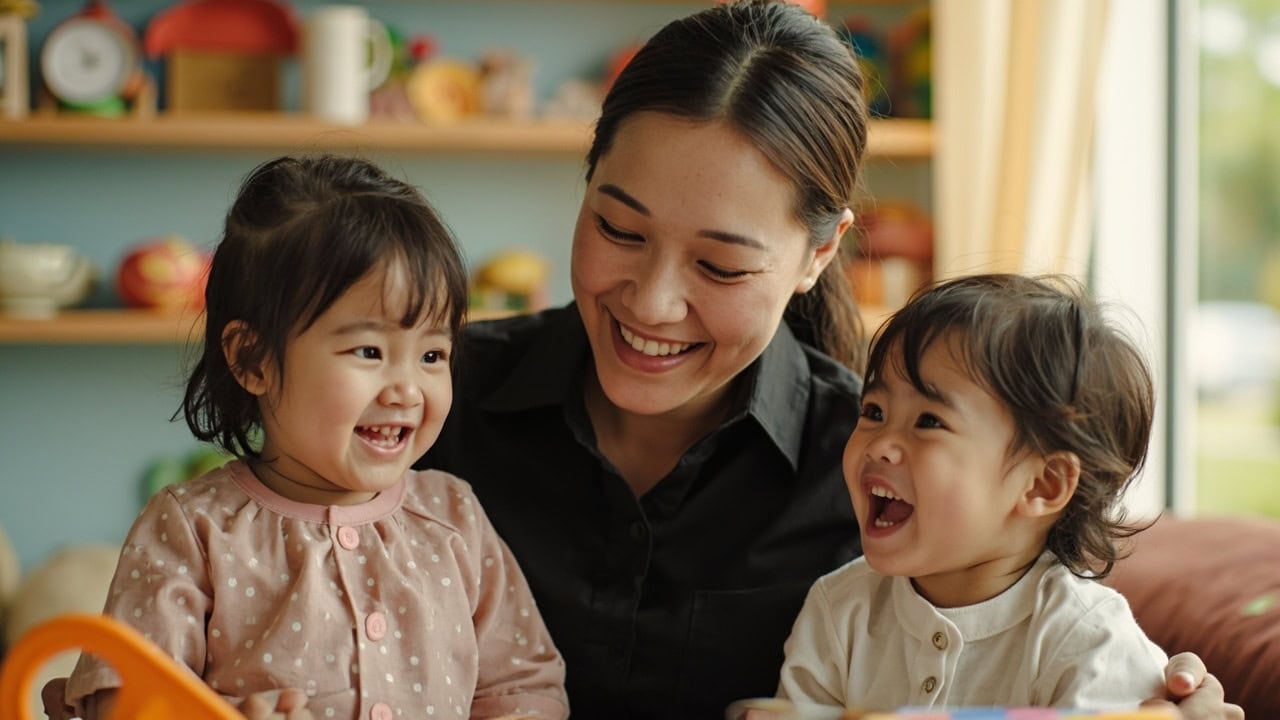
The Practice of Presence for Singapore Working Parents
The Silent Contradiction Singapore Working Parents Carry
Singapore has built something remarkable. In just a few generations, we have become a society where dual-income families are not just common but expected, where early childhood education is taken seriously as a national investment, and where parents—mothers and fathers alike—have ambitions that extend beyond the walls of their homes.
This is a source of strength. It is also a source of pressure that is rarely acknowledged with the honesty it deserves.
When a mother returns from maternity leave at twelve weeks—or six, or eight, depending on her employer—she is not just returning to a job. She is returning to an identity she inhabited before her child existed, and she is trying to carry it forward alongside this new, overwhelming, luminous identity of being someone’s mother.
When a father picks up overtime shifts or travels for work when his infant is only months old, he is not choosing his career over his family. He is often trying to hold together the very architecture of security and opportunity he wants to offer that family.
But the language we use, the expectations we inherit, and the guilt we internalize tell a different story—one where ambition and love are opposing forces, and to succeed in one domain is to fail in the other.
This is the silent contradiction. It is not a failure of individual parents. It is a structural tension that our culture has not yet resolved, and so it falls to each of us to navigate it alone, in the quiet hours of the night, when the house is still and the question resurfaces.
Why This Tension Feels So Heavy
In speaking with working parents across Singapore—in homes, childcare settings, and early childhood centres—I have observed something consistent: most parents do not just struggle with time. They struggle with integration.
In the early months and years of parenthood, many parents cope by building walls. Not walls of neglect or indifference. Walls of compartmentalization. They go to work and try to be fully at work. They come home and try to be fully at home. And in between, in the transitions, in the moments of overlap, there is a kind of emotional whiplash that nobody talks about.
- The parent who checks emails during naptime and feels a pang of something
- The parent who spends the 9 AM meeting thinking about whether their baby settled into nursery okay
- The parent who, at 6 PM, realizes they have not thought about work in hours and feels a flash of panic about what they missed
This is not poor time management. This is the mind trying to protect itself from carrying two enormous weight-bearing identities simultaneously.
Compartmentalization is a survival strategy. But it is also exhausting, and it carries a hidden cost: it asks parents to be fragmented rather than whole. It asks them to choose which version of themselves is real at any given moment, rather than allowing them to be fully themselves in all moments.
The question is not how to eliminate this tension—there is no elimination, not while children are young and careers demand attention and parents are human. The question is how to move from compartmentalization to integration.
What Presence Actually Means (And How to Practise It Daily)
Let us talk about what presence actually means, because I think we have been measuring it wrong.
Presence is not synonymous with hours. This is the first and most important reframe I want to offer you.
When your child runs to you at the end of the day, what do they need from you? They need your eyes to find them. They need your voice to say their name with joy. They need your body to kneel down to their level, to hold them, to be still with them for a moment in a way that says: You are the most important thing in this room right now.
This takes five minutes. It might take ten. It does not take three hours of uninterrupted play. It takes intention.
The parent who arrives home at 6:30 PM and gives their child twenty minutes of genuinely present attention—eye contact, laughter, full engagement in whatever the child is doing or feeling—is doing something profoundly different from the parent who is physically present from 8 AM but mentally elsewhere, scrolling a phone, thinking about tomorrow’s meeting, half-listening to every interaction.
One is present. One is not. And the child knows the difference.
This is not a licence to spend less time with your children. It is an invitation to stop measuring your worth as a parent by a clock that was never designed to capture what matters. It is an invitation to focus your energy on the quality of the moments you create rather than the quantity of hours you accumulate.
The Practice of Being Fully Present
There is a practice here, and like any practice, it gets easier with time. The practice is this: when you are with your child, be with your child. Not partially, not distractedly, but fully.
Put down the phone. Close the laptop. Let the emails wait ten more minutes. And for those ten minutes, let your child have all of you.
This is what presence means. It is not a sacrifice of your career. It is a reallocation of your attention, and it is available to you every single day, regardless of how many hours you work.
Rituals That Bridge Worlds
The transition from work to home is not just a change of location. It is a change of emotional register, and it requires intention to navigate well.
There are small rituals that help. Some parents change clothes—a physical shedding of the work self. Some parents take a few deep breaths in the car before going inside. Some parents have a short walk around the block, a moment of stillness, a phone call with no purpose that serves as a bridge between one world and the next.
These are not luxuries. They are the psychological infrastructure of re-entry.
The First Few Minutes Matter Disproportionately
Your child has been waiting for you. Not in an anxious, pathological way, but in the way that someone you love and trust and miss is someone you are glad to see. Their nervous system is activated by your arrival, and how you greet them signals something about the kind of home they are returning to.
- If you come through the door distracted, stressed, already asking about dinner or what happened today before your child has even taken off their shoes, the message is: home is still stressful, home is still a continuation of something hard.
- If you come through the door and you kneel down, you make eye contact, you say hello, my love, I am so happy to see you, you give them a moment of your full and joyful attention before you ask anything of them, the message is: you are welcome here, you are celebrated, you are the most important thing in this room right now.
Slowing Down at Bedtime
The other ritual that matters—and this is one that Singapore parents often overlook because our culture does not always value it—is the ritual of presence at bedtime. The transition from wakefulness to sleep is a time of maximum vulnerability, and for young children, it is often when big feelings surface.
The child who seemed fine all evening can suddenly become clingy, tearful, resistant, right at the moment when parents are most tired and most likely to rush through it.
I want to invite you to slow down at bedtime. Not indefinitely—parenting does not pause—but intentionally. To give your child those final moments of the day in a way that says: you matter, your feelings matter, I am here.
To tell them something about tomorrow that gives them something to look forward to. To say goodnight in a way that they will carry with them through the dark hours.
These are the moments that build a relationship. Not the big vacations, not the elaborate birthday parties. The daily rituals of reconnection. The bedtime that is never rushed. The morning that begins with eye contact before the rush begins.
Quality Childcare as the Architecture of Your Presence
Now, here is where the conversation turns toward something more practical, because presence without support is unsustainable, and Singapore parents are carrying more than any one person should carry alone.
I want to talk about what quality childcare makes possible. Not as a substitute for parental presence—I want to be clear about that from the start—but as the infrastructure that allows presence to happen.
Think about what it means to be fully present with your child at the end of the day. To kneel down, to look them in the eyes, to be truly there. This is only possible if, during the day, your child is safe. If they are in an environment that supports their development, that responds to their needs, that sees them as an individual.
If you trust the people caring for them—and I mean trust in your bones, the kind of trust that allows you to actually focus at work rather than spending half your meetings wondering if your baby is crying or if they ate enough or if they are being held enough.
Quality childcare does not replace you. It holds the space that allows you to return to your child as the parent you want to be: rested, present, emotionally available.
The Reframe That Changes Everything
You are not leaving your child in childcare so you can go to work. You are placing your child in quality care so that the time you spend together—however many hours it is—can be the best possible time. So that you are not depleted, not distracted, not running on empty when you finally walk through the door.
The parents who seem most present with their children are often not the parents who work the fewest hours. They are the parents who have found the right support, the right childcare architecture, and who have stopped apologizing for needing it.
Speaking to the Fear That Lives Beneath
There is something else that shapes much of the anxiety and second-guessing: the fear that your child is somehow missing you. That they know, in some deep and formative way, that you are not there. That this absence is registering in their developing brain and heart as something like abandonment.
Let me speak to this directly, because it deserves honesty rather than reassurance.
Children in the first thousand days are not developing a linear sense of time in the way adults do. They are not calculating how many hours you have been gone and feeling proportionally abandoned. What they are developing is a sense of the world as a reliable, safe, responsive place. They are building what psychologists call internal working models—the templates for trust, security, and relationship that will shape their emotional lives for decades to come.
What this means, practically, is that a child who is in consistent, quality, responsive care—who has caregivers who respond promptly to their cries, who hold them when they need holding, who notice them and engage with them—is not experiencing your absence as deprivation. They are experiencing it as a manageable fact of daily life, cushioned by the knowledge that the world takes care of them.
The child who runs to you at the end of the day and clings to you with intensity is not a child who has been neglected. They are a child who knows exactly who you are and what you mean to them.
That intensity is not damage. It is attachment. It is the sound of a child who has built a secure base and is returning to it with joy.
What harms children is not working parents. What harms children is unresponsive, inconsistent, neglectful care. And what helps children, alongside responsive parental presence, is exactly that: responsive, consistent, quality care.
You are not failing your child by working. You are providing one thread in a web of care that, when woven well, gives your child exactly what they need.
The Singapore Context: Why This Feels Harder Here
Singapore is a society that invests heavily in early childhood. We have national frameworks, professional development pathways for early childhood educators, and a government that has made early childhood a policy priority. Dual-income families are not just common here—they are the statistical norm, which means the systems around us—employers, housing, social expectations—are built, however imperfectly, around the reality that most families will have two working parents.
And yet the cultural narrative has not fully caught up. There is still, beneath the surface, a whisper of judgment directed at working parents, and at mothers in particular.
- The question that is not quite asked but is sometimes felt: should you not be home?
- The comparison that is not quite made but is sometimes inferred: if you were a better parent, you would prioritize this differently.
I want to be very clear: this whisper is not the truth. It is the echo of older ideas about gender and family that do not reflect the world we actually live in, or the children we are actually raising, or the parents we actually are.
You are not a lesser parent for working. You are not failing your child for having ambitions beyond parenthood. You are doing exactly what millions of parents in this country are doing, and what children in this country need: raising them in a household where adults have purpose, contribution, and identity beyond the family unit.
The children of working parents in Singapore are not disadvantaged. They are growing up understanding that the people who love them are also people who matter in the world—people with skills, ambitions, colleagues, and contributions that extend beyond the home.
This is not a loss. It is a gift.
What matters is not whether you work. What matters is the quality of care your child receives when you are working, and the quality of presence you bring when you are not. Everything else is noise.
How to Choose Infant Care That Supports Your Family
Choosing infant care is one of the most consequential decisions a working parent makes. It is not just about logistics—it is about creating the conditions for your own presence. Here is how to think about it.
What to Look For
When evaluating childcare options, look beyond the surface-level questions to the deeper ones:
- Responsiveness: Do caregivers respond promptly and warmly to children’s needs? Are children held when they need holding?
- Consistency: Is there a stable team of caregivers, or high turnover that means your child is constantly adjusting to new faces?
- Individual attention: What is the ratio of caregivers to children? Can each child be truly seen and known?
- Communication: Will you know what happened in your child’s day? Can you engage meaningfully when you return?
- Trust: Do you feel comfortable leaving your child here? Not just intellectually, but in your body?
Questions to Ask When Visiting
- How do you handle a crying baby?
- What does a typical day look like for infants?
- How do you communicate with parents?
- What is your caregiver turnover rate?
- Can I see where my child will be during the day?
- What training do your caregivers have?
The right childcare arrangement will not eliminate your working parent guilt entirely—because that guilt comes from love, and love does not come with an off switch. But the right arrangement will make it easier to return home and be the parent you want to be. That is what matters.
EduNanny: Holding the Architecture So You Can Hold the Relationship
Everything we have discussed in this article points toward a simple truth: parents need support to be fully present. And children deserve care that is responsive, professional, and developmentally rich.
This is why EduNanny exists—at the intersection of these two truths.
We are not in the business of replacing parents. We are in the business of holding the architecture that allows parents to be parents. Not anxious, depleted, guilt-ridden parents, but present, joyful, emotionally available parents who can give their children what matters most.
Built for Singapore Families
EduNanny operates within the ECDA Childminding Pilot, which means our model is grounded in national standards and built for the realities of Singapore families.
We maintain up to one-to-three infant ratios in our home-based settings, because we know that responsive care requires attention, and attention requires numbers that make responsiveness possible.
We offer Monday to Friday care blocks that align with the rhythms of working family life. And we have structured our fees to be accessible within the pilot framework, with CDA and Baby Bonus usability available so that financial considerations do not become another source of stress for families navigating this season.
Transparency as a Foundation
Where deployed, our CCTV measures give parents visibility into the care environment. Not because we have anything to hide, but because trust is built through transparency. Parents who trust their childcare arrangements are parents who can actually be present when they are with their children.
We communicate regularly with families about their child’s day. Not because it is a checkbox, but because parents who know what happened in the hours they were apart can engage more meaningfully when they return.
This is what we mean when we say EduNanny holds the architecture. We are not just a service you use. We are a partner in the integration you are building. We are the infrastructure that allows you to work with focus and return with presence.
Our childminders are trained, supported, and treated as the professionals they are. Because the dignity of the childminder and the quality of the childminder’s work are inseparable. When we value the people who care for your children, we elevate the care itself.
You Are Exactly the Parent Your Child Needs
Let me close by coming back to where we began, because the question that opened this article—the question in the silence at pick-up time, the question that lives in the quiet hours—deserves a real answer, not a platitude.
Was today enough?
Here is my answer to you.
Today was enough if you arrived home and your child knew you were glad to see them. Today was enough if your child felt, in their body and in their heart, that they were welcomed, celebrated, and held by someone who loves them. Today was enough if you gave someone your full attention—even for ten minutes—and that someone was your child.
You are not measured by the hours. You are measured by the love that passes between you, and love is not impeded by your work. Love is impeded by guilt, by distraction, by the internal voice that tells you you are not enough.
Love is freed by trust. Trust in your child’s resilience. Trust in the quality of their care. And trust in your own capacity to show up in the ways that matter.
You are not abandoning your career to be a good parent. You are integrating two identities that belong to you equally, and you are building a life in which both can flourish. This integration is not a destination. It is a daily practice. Some days you will do it brilliantly. Some days you will fall short. And on both kinds of days, you are enough.
Your child does not need a parent who is always there. Your child needs a parent who is present when they are there—fully, attentively, with love. And they need to grow up seeing that the adults who love them are also adults with purpose, contribution, and a life that extends beyond the family.
This is what you are giving them. This is what matters.
You do not have to choose between your career and your child. What you need is support, and trust, and a framework that validates your complexity rather than simplifying your choices.
If you are ready to explore what quality, home-based infant care can do for your family, we invite you to reach out and begin a conversation.
Your child is lucky to have a parent who asks this question. And you are exactly the parent your child needs you to be.
#WorkingParentsSingapore #InfantCareSG #ChildmindingSingapore #ParentalPresence #EduNannySG