
Fluent Grammar for Early Childhood Care Singapore, Attunement as Everyday Practice for Safe Joyful Learning

EduNanny Singapore: Fluent Grammar for Early Childhood Care
Good evening, friends, families, and fellow caregivers of Singapore. Before a nation learns to write its story, a child learns to be held. The great early childhood thinkers—Montessori’s respect, Piaget’s discovery, Vygotsky’s guided dialogue, Froebel’s play, Malaguzzi’s hundred languages, Bowlby’s secure base, Pikler’s unhurried movement, Spock’s common sense, and Erikson’s stages of trust—agree on one essential truth: the quality of early care becomes the grammar of a life. EduNanny exists to make that grammar fluent for every infant, every parent, and every neighborhood in our city. This article translates that vision into practical, field-tested guidance for parents and caregivers in Singapore’s dynamic care landscape.

Pedagogy: The Attunement Cycle
What is the Attunement Cycle?
The Attunement Cycle is a daily discipline that makes learning relational, not transactional. It is the humane intersection of respect for independence and guided support, where caregivers see and respond with intention.
- Primary caregiving at 1:3: Each infant has a consistent caregiver who understands cues, reducing stress and building trust.
- Rhythm-based days: Care, play, and rest follow predictable patterns, helping brains and bodies anticipate and regulate states.
- Schema play and heuristic exploration: Real-world objects in safe baskets invite mouthing, shaking, comparing, and storytelling.
- Serve-and-return language: When a baby coos, we answer; when they point, we name; when they pause, we wait with curiosity.
- Daily micro-reflections: Three minutes for the caregiver to note a moment of fascination and plan extension for tomorrow.
Practical Implementation for Families
How can families adopt the Attunement Cycle at home?
- Start with a predictable routine: Set three core daily blocks—care, play, and rest—so infants feel secure and curious.
- Observe before you respond: Spend 60 seconds simply watching a cue before offering an activity or a word.
- Extend learning with naming: When a child stacks blocks, name shapes, colors, and counts; pause to let them respond.
- Keep a simple log: A five-minute end-of-day note helps you plan tomorrow’s extension activities.
- Involve families in attunement: Share a brief “today’s insight” note with caregivers and invite family observation from home.

Safety: Four Rings of Protection
Ring One — Environment
Environment is the first line of defense and discovery. Modern layouts with clear sightlines, stable furniture, anchored shelving, gated zones, and dedicated sleep spaces create a safe stage for exploration.
- Safe-sleep practice: Lay infants on their backs in a clear cot, with breathable bedding and appropriate room conditions.
- Childproofed zones: Use safety gates, outlet covers, and low-height storage to minimize risk during active play.
- Adaptive spaces: Design calm corners for quiet listening, book-sharing, and caregiver-led activities, allowing gentle transitions between activities.
Ring Two — Hygiene and Health
Hygiene and health are daily rituals that protect both child and caregiver. Consistency here builds confidence and reduces illness-related disruptions.
- Hand hygiene as ritual: Hands washed at key moments—before meals, after outdoor play, after diapering.
- Toy and surface sanitation: Regular cleaning schedules with age-appropriate products; avoid shared gear that isn’t easily sanitized.
- Bottle and feeding protocols: Safe handling, appropriate temperatures, and allergy-aware practices.
- Monitoring routines: Daily checks on temperature, breathing, and general well-being; clear escalation paths for parents.
Ring Three — Practice
Careful handling and thoughtful routines support healthy development and posture, while minimizing risk during transitions and routines.
- Gentle handling: Supportive holds during movement, careful positioning for sleep, and avoidance of propping or unsafe devices.
- Outdoor transitions: Shade, hydration, and supervision during outdoor activities; adjust plans in heat or rain to maintain safety.
- Secure pick-up verification: Consistent, documented processes to confirm a child is released only to authorized adults.
Ring Four — Transparency and Governance
Transparency builds trust. CCTV, incident reporting, and ongoing training ensure care is accountable and continuously improving.
- Secure CCTV with clear guidelines: Oversight while protecting privacy; families have input on how footage is used and who can access it.
- Plain-language reporting: Incidents explained in accessible terms with steps taken to prevent recurrence.
- Training refreshers: Regular, bite-sized refreshers on safety, first aid, and child protection policies.

Development: The Play–Work Continuum
Play as Serious Work
Infants learn through play that engages their whole being. EduNanny designs activities around the five domains of development while honoring Singapore’s multilingual tapestry and cultural richness.
- Motor development: Emphasize floor time, safe exploratory movements, and outdoor experiences that respect weather and safety.
- Sensory development: Use varied textures, lighting, and sound to build sensory discrimination without overstimulation.
- Language development: Incorporate songs in home languages, routine naming during diapering and feeding, and gestural communication that matures into words.
- Social–emotional development: Practice shared attention, turn-taking, and gentle guidance that supports self-regulation.
- Early thinking: Introduce object permanence, cause-and-effect play, and simple problem-solving through guided exploration.
The Five-Second Windows
Young brains wire best with brief, timely cues. A caregiver’s nod, a word, or a smile within a five-second window can anchor confidence and curiosity.
Practical Home Activities
- Cause-and-effect play: Stacking cups, motion toys, and simple puzzles with guided support.
- Schema-rich exploration: A basket with safe household objects (soft fabrics, wooden spoons, bowls) for tactile discovery.
- Daily micro-reflections: End-of-day notes on what fascinated the child and how to extend it tomorrow.
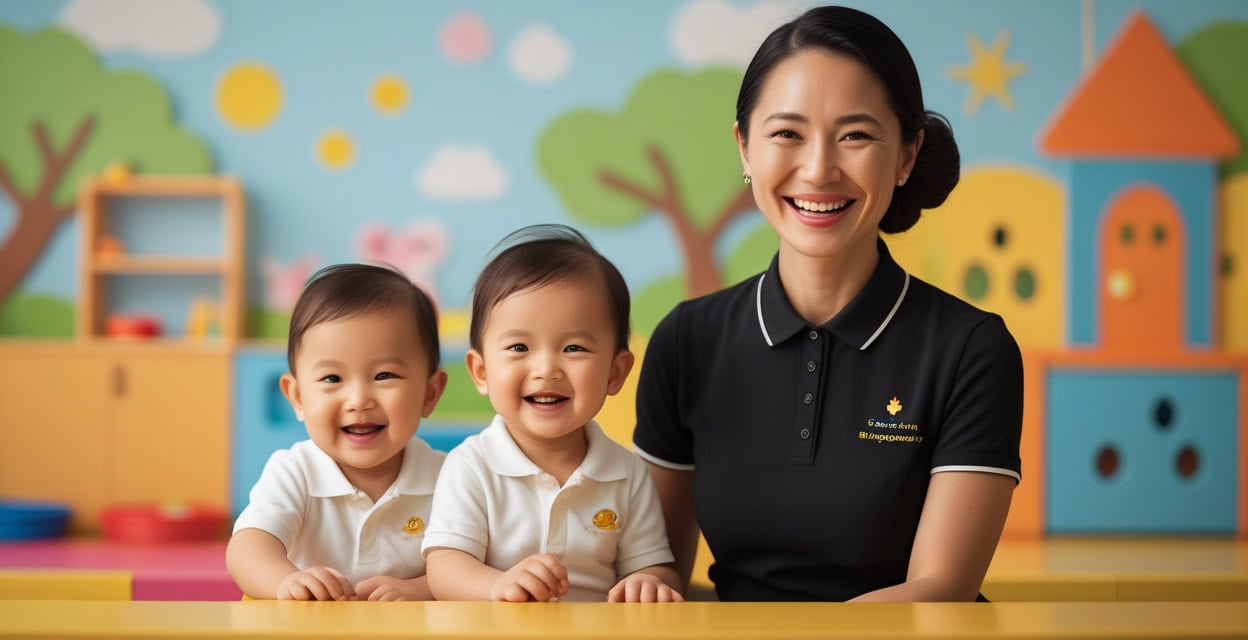
Happiness and Belonging: Joy as Baseline
Joyful Care as a Core Principle
Joy is not the reward after care; it is the foundation of secure attachment and healthy development. Safety paves joy, and joy reinforces trust in every interaction.
- Predictable greetings and departures: Rituals for reunification that reduce separation anxiety and foster a sense of belonging.
- Care as curriculum: Everyday routines—feeding, bathing, diapering—are moments for reciprocity and learning, not interruptions.
- Music, movement, and sunlight: Regular access to singing, dance, and natural light supports mood and circadian rhythm.
- Family partnership: Daily notes, consented photo sharing, and culturally respectful practices that honor family values and hopes.
- Gentle guidance: A calm, consistent tone that avoids shaming and supports steady autonomy development.

The Professional Childminder: A Civic Craft
Valuing Caregivers as Professionals
Great childminding is a profession with training, mentorship, and clear progression. EduNanny contributes to Singapore’s national initiative by elevating caregiving as dignified work, fostering career ladders, and recognizing excellence through certifications and ongoing development.
- Training and mentorship: Comprehensive modules on observation, safe handling, play-based pedagogy, and family collaboration.
- Certification pathways: Structured progression that encourages skill-building and professional recognition.
- Ethical standards: Privacy, transparency, and respectful engagement with families and communities.
- Impact on society: A stable, skilled workforce supports families, employers, and national well-being.

What It Looks Like for Families, Practically
Access and Convenience
Islandwide options at community centers and home-based settings, with center-based sites designed for modern learning. EduNanny operates Monday–Friday, 7am–7pm, to align with work and family life.
- Multiple pathways: Center-based, home-based, and distance-supported guidance to fit diverse family needs.
- Proximity and quality: Care that is near home or work yet meets the highest professional standards.
Affordability with Dignity
Quality care should be accessible. EduNanny offers fees from $33/day, with options to pay through CDA/Baby Bonus schemes to ease financial planning for families.
- Transparent pricing: Clear breakdowns of services, with predictable monthly costs.
- Flexible plans: Packages that align with work schedules and family income.
Ultra-Low Ratio
A 1:3 infant-to-caregiver ratio ensures each child is known, understood, and supported in real time.
- Consistency matters: Regular caregivers reduce stress and support consistent development trajectories.
- Individual pacing: Care plans tailored to each child’s pace of learning and comfort with new experiences.
Transparency with Care
Secure CCTV and clear communication provide visibility while respecting privacy, so families feel informed and included.
- Ethical CCTV: Oversight that protects children without compromising trust or family privacy.
- Accessible reports: Plain-language updates on daily progress and safety measures.
Multiple Pathways and Distance Support
For families who value in-home intimacy or need guidance at a distance, EduNanny offers flexible solutions that stay aligned with national standards.
- Center-based care: Social learning in a thoughtfully designed environment with trained caregivers.
- Home-based care: Small-group learning that mirrors family dynamics and block-based routines.
- Distance-supported guidance: Virtual coaching, development plans, and remote consultations to keep families engaged.
A Unified Promise
Behind every door—center, registered home setting, or distance channel—the EduNanny standard remains the same: safety by design, pedagogy by research, and relationships by heart.

Five Straightforward Questions
Who makes childminding matter?
Infants whose brains are rapidly forming; parents who pursue work and well-being with daily intimacy; professional childminders who convert routine moments into breakthroughs; employers and communities who benefit when families are supported and hopeful.
What is childminding, at its best?
Responsive, professional caregiving that integrates safety, development, and joy. It is not babysitting; it is the daily architecture of attachment and early learning.
When does it matter most?
In the first years when trust forms, language blooms, and movement organizes the mind; during life transitions such as returning to work, a new sibling, or relocation. Care is needed at 7am, 7pm, and in the quiet moments between.
Where should it happen?
Close enough to be part of family life, yet built to national standards—registered home environments, well-designed centers, and supportive distance channels that bring guidance into the living room.
How do we make it real, every day?
Through a 1:3 ratio, modern layouts that permit safe exploration, trained observation and gentle handling, secure CCTV with ethical privacy, and affordable options supported by programs like CDA/Baby Bonus. A workforce strategy that honors childminders as skilled professionals closes the loop between policy and practice.

Conclusion
In EduNanny’s view, the measure of a society is how it greets its youngest citizens. By holding the child with skill and warmth, holding the parent with respect and clarity, and holding the community with purpose, we turn small moments into mighty outcomes. If EduNanny’s approach resonates, explore EduNanny.com or Childminding.EduNanny.com for options near you, whether center-based, home-based, or distance-supported. Learn about availability, the ECDA Childminding Pilot, and how CDA/Baby Bonus can simplify fees. Let Singapore’s earliest care be a shared commitment—excellent care that families feel, safety they can trust, and joy children remember, in the hands of professionals who know that the smallest embrace can open the largest future.
Thank you.
[#keyword1, #keyword2, #keyword3, #keyword4, #keyword5]