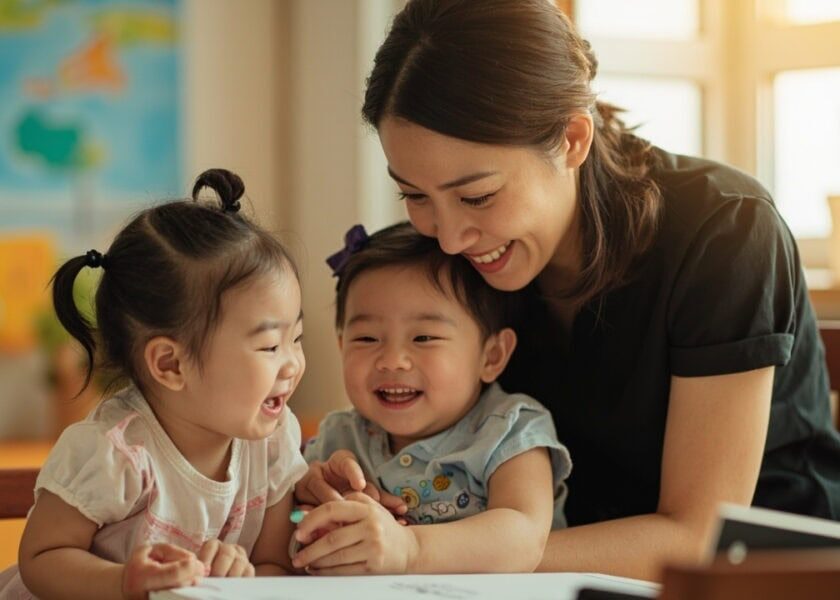
Why Caregiver Continuity Matters for Your Young Child
Why Caregiver Continuity Matters in Singapore
There is a particular kind of silence that falls over a family when a caregiver leaves. It is not the silence of relief or transition. It is the silence of a small child who does not yet have the words to describe what has been taken from them.
You know this silence. Perhaps you have heard it. Perhaps you have lived it.
The morning you arrive to collect your child and sense that something has shifted. The caregiver your child called for by name — the one who knew exactly how to soothe the particular cry that meant exhaustion versus hunger, the one who had learned the ritual your child needed before sleep — that person is gone. You are left holding the pieces of a disruption you did not choose, did not expect, and may not have been given a real explanation for.
This is not rare. It is a documented reality of Singapore’s childcare landscape, one that operates largely without acknowledgment because we have not yet developed the language to name what it actually costs.
We talk about curriculum frameworks and teacher qualifications. We compare ratios and inspection scores. We read reviews about food quality and facility cleanliness. But underneath all of that, there is a quieter grief — the loss of the specific person who knew your child.
Quick Summary: What Every Parent Should Know
- Secure attachment in the early years is foundational. Stable, responsive caregiving supports emotional regulation, social skills, and resilience throughout life.
- Disruption has a measurable cost. Young children experience genuine grief when caregivers leave, showing up in changes to sleep, appetite, and behavior — not as behavioral problems, but as grief responses.
- Qualified is not the same as known. A qualified caregiver has training. A known caregiver has spent enough time with your child to read subtle signals, anticipate needs, and provide genuine emotional security.
- You can choose for it. Ask about caregiver retention rates, tenure, and transition protocols before enrolling. The answers — and how they are given — reveal whether an institution understands what it is actually offering.
The Science of Being Known
In the first thousand days of life, the human brain undergoes a construction project of extraordinary complexity. Neurons are forming connections at a rate that will never be repeated. Language pathways are being established. The stress-response system is calibrating itself based on one primary input: the quality of relational experience.
The central relationship in that experience — the one that shapes everything else — is between the infant and the person who cares for them most consistently.
When a young child has a stable, responsive, familiar caregiver, something profound takes root. The child develops what psychologists call secure attachment — a quiet confidence that the world is predictable, that their needs will be recognized, that someone who truly knows them is paying attention.
This is not sentiment. This is neurobiology.
What Happens When That Foundation Is Disrupted
When a caregiver leaves — whether due to better opportunities, burnout, or the high turnover rates that plague the sector — the child experiences a loss that their developing brain processes as a genuine threat. The familiar face is gone. The predictable routines shift. The specific rhythm of comfort that had become synonymous with safety is suddenly absent.
We sometimes underestimate how much a young child has internalized their caregiver’s presence. It is not simply that they enjoy the company of a friendly adult. The caregiver has become part of the child’s internal working model of what relationships feel like, what trust means, what it is to be understood.
When that model is disrupted, the child does not have adult language to express what is wrong. They show us instead — through changes in sleep, in appetite, in the way they cling or cry or withdraw. These are not behavioral problems. They are grief responses. They are the visible manifestation of an attachment system under strain.
Research indicates that these disruptions carry developmental costs. Children who experience multiple caregiver changes in the early years may show elevated cortisol patterns, more difficulty with emotional regulation, and in some studies, measurable differences in the development of the prefrontal cortex — the region responsible for impulse control, planning, and executive function.
The effects are not catastrophic in every case. But they are real, and they are cumulative.
The Difference Between Qualified and Known
Singapore has become very good at measuring the visible markers of quality. We have been far less willing to examine the invisible ones — the ones that live in the space between a child and the specific human being who holds them when they are sad.
Here is the most important distinction in early childhood care, and one that too few parents are equipped to ask about when they are making enrollment decisions: the difference between a qualified caregiver and a known caregiver.
A qualified caregiver has training. They have certifications. They know developmental milestones and safety protocols. They can manage a room of children with competence. This matters. You want your child in the care of someone who knows what they are doing.
A known caregiver is something different. A known caregiver is someone who has been with your child long enough to read the subtle signals that no intake form can capture. They know that this particular child needs a longer wind-down period before transitions. They know that this child’s crying has a specific quality when it means fear versus when it means frustration. They have been present for enough of the ordinary, unremarkable moments of the child’s day to know what is normal for this specific little person — and therefore to notice immediately when something is not.
This knowledge is not credentialed anywhere. It cannot be transferred in a handover note. It is built over time, through repeated, consistent, attentive presence. It is the product of thousands of hours of relationship.
It is this depth of relationship that transforms caregiving from supervision into genuine care. A qualified caregiver can keep your child safe. A known caregiver can help your child feel known.
What Continuity Requires
In most childcare settings, the conditions are not structured to produce known caregivers. They produce qualified ones who, through no fault of their own, become ghosts in a child’s life — present for a season, then gone. The child loved them. The child needed them. And the system moved them along.
Protecting caregiver continuity requires intentional institutional design — systems built around the understanding that the relationship between caregiver and child is not an incidental feature of care, but its very core.
Continuity-supportive care includes:
- Intentional caregiver-to-child ratios. When a caregiver is responsible for fewer children, each child receives more of what cannot be automated: attention, recognition, responsiveness, presence. The caregiver learns the children in their care as individuals, not as a group to be managed.
- Institutional systems that value stability. Thoughtful recruitment, thoughtful matching, and a culture that treats caregiver retention not as an outcome to be hoped for but as a standard to be pursued. Investing in the conditions that allow caregivers to stay — competitive recognition, professional respect, manageable workloads — because caregivers who feel valued are the ones who stay.
- Transparent communication with parents. Regular updates, open channels for questions, and visibility into the care environment. These are expressions of a deeper institutional commitment: that parents should never feel they are handing their child into a black box.
- Respect for family life realities. Care arrangements designed with Singapore family life in mind — structured availability, accessible fee structures, and pathways to utilize government support schemes where available.
EduNanny’s Approach
EduNanny operates within the ECDA Childminding Pilot, a framework established to explore home-based and community-based pathways for infant and toddler care — models that are inherently more conducive to continuity than large centre-based settings.
Within this framework, EduNanny has built its approach around a commitment that is as much philosophical as it is operational: that the relationship between a caregiver and a child is not an incidental feature of care, but its very core.
What This Looks Like in Practice
In infant care, EduNanny maintains ratios of up to one to three — meaning one caregiver for no more than three infants at a time. This is an architectural choice that allows for genuine attention to each child’s individual rhythms, signals, and needs.
The model is structured to support caregivers in building lasting relationships with families. This means thoughtful caregiver-family matching from the beginning, a culture that treats caregiver stability as a metric of quality, and investment in the professional recognition and support that help caregivers build lasting careers.
Communication practices keep families informed and involved. In settings where deployed, additional measures like CCTV provide visibility without intrusion — expressions of transparency, not surveillance.
Care is available in structured Monday to Friday blocks, with fee structures designed to be accessible within the pilot framework. Families can utilize the Child Development Account and Baby Bonus schemes, removing unnecessary financial friction from a decision that is difficult enough without it.
What EduNanny Does Not Promise
No system can guarantee that a caregiver will never leave. Life intervenes. Circumstances change. That is the reality of human institutions, and it would be dishonest to pretend otherwise.
What a good institution can do is build the structures and culture that make stability the norm rather than the exception — and that take seriously its responsibility to protect the relationships that children and families depend on.
How to Evaluate Any Provider
Before you sign anything, ask this: what is this institution’s approach to caregiver retention?
Here are the questions that will reveal whether a childcare provider understands what it is actually offering when it offers to care for your child:
- What is the typical tenure of caregivers at this centre or service?
- How are new caregivers matched with families?
- What happens if a caregiver leaves unexpectedly — is there a transition protocol?
- Will I be involved in that transition process?
- What support does this place offer to help my child navigate that change?
- How do you invest in keeping your caregivers — not just recruiting them?
The answers you receive, and the way those answers are given, will tell you a great deal. The institutions that take continuity seriously will not be defensive about these questions. They will welcome them. They will have answers rooted in actual practice, not talking points.
What to Look For: A Quick Evaluation Guide
| Continuity Factor | What to Ask |
|---|---|
| Caregiver ratios | How many children per caregiver, especially for infants? |
| Retention culture | What is average caregiver tenure? How do you invest in keeping staff? |
| Matching process | How are caregivers and families paired initially? |
| Transition protocols | What happens if a caregiver leaves? Will I be involved? |
| Communication practices | How will I know what is happening in my child’s day? |
| Parent partnership | How do you involve parents in the care relationship? |
Your Role in Supporting Continuity
There is also a role for parents within these systems — not as overseers or inspectors, but as partners.
Communicate regularly with your child’s caregiver. You are doing more than sharing logistics. You are affirming that this person matters. You are building the bridge between your child’s life with you and your child’s life in care.
Speak about the caregiver at home with warmth and respect. You are teaching your child that this relationship is valued, that the person caring for them is a trusted member of a larger constellation of care around them.
Recognize the caregiver as an extension of your commitment. The most resilient caregiver relationships are not those that exist in isolation from the family. They are those that the family actively recognizes and honors.
When that is understood and respected from both sides, something remarkable becomes possible: a genuine triangle of trust, with your child at its center, held by people who know them, communicate about them, and care about them in concert.
The Gift of Being Known
There is a moment — perhaps you have lived it, perhaps you dread it — when your child runs toward a familiar face at the door of a childcare setting. Not toward any face. Toward a specific face. The face they have come to associate with comfort, with routine, with being understood.
In that moment, you see something that no inspection report can capture, no ratio can guarantee, and no marketing language can replicate. You see the evidence of a bond that has been allowed to form, to deepen, and to become a source of security rather than uncertainty.
That bond is not a luxury. It is not an add-on to quality care. It is quality care, in its most essential form.
Every child deserves to be known by the people who care for them. Every family deserves to trust that the arrangements they make are designed to protect, not merely to provide. And every parent deserves to make enrollment decisions from a place of genuine understanding — not just of what the service offers on paper, but of what it actually delivers in the daily lived reality of a young child’s world.
Choosing a childcare system that values the person caring for your child is one of the most consequential decisions you will make. Not because the wrong choice dooms a child — children are resilient, and love finds a way — but because the right choice gives your child something precious: the gift of being known, consistently, attentively, and with genuine care, in the years when being known matters most.
You are not being excessive when you ask about caregiver continuity. You are being wise. You are recognizing that the quiet, invisible work of relationship — the knowing, the being known, the steady presence over time — is not soft or sentimental. It is one of the most powerful protective factors in early childhood development that we have.
EduNanny stands for this commitment: that in the earliest, most formative years of life, the relationship a child builds with their caregiver is not a detail. It is the foundation. It is what everything else is built upon.
And it is worth protecting with everything an institution has.
If you are exploring infant care or childminding options in Singapore and want to understand how EduNanny approaches continuity of care, we welcome your questions.