What Your Child Cannot Tell You About Their Childcare Experience
The Emotional Cartography of Care
Long before your child could tell you that a caregiver’s voice sounds different from yours, before they had language for what safety means, they were already feeling. Every interaction in those early years leaves an impression—not just on their developing brain, but on their sense of what the world is like.
Whether people are trustworthy. Whether new places are interesting or frightening. Whether their feelings matter to the adults around them. Whether they can be soothed when they are upset.
Developmental researchers call these internal working models—the templates children build for relationship based on their earliest experiences of being cared for. But this concept is often discussed in ways that make it sound distant, something that happens in research papers rather than in the living room when your toddler comes home from care and immediately climbs into your lap, or refuses to let go of your hand, or tells you in their own language that they do not want to go back tomorrow.
These are not random behaviors. They are communications. They are the child trying to show you the map they are drawing.
Think of your child’s inner world as unmapped territory. There are regions of safety—the caregiver who consistently responds, the corner of the room where they know how everything works, the friend who shares their toys. There are regions of uncertainty—the large group time when things feel chaotic, the nap room that smells strange, the transition between activities that catches them off guard. There are regions of distress—the moments when they were overwhelmed and no one noticed, the times when they reached for comfort and it was not there.
What Thriving Looks Like
A child who is thriving will have more mapped territory than unmapped. They will carry that map home with them, and you will see it in their behavior, in their development, in the quiet confidence they are building without anyone teaching it to them.
It looks like a child who runs to greet their caregiver in the morning—not because they do not love you, but because they have built a second home. It looks like a child who comes home and plays out what happened during the day, processing their experiences through play. It looks like a child who is beginning to have the words for how they feel—not because anyone taught them in a lesson, but because they have been in an environment where feelings were noticed, reflected, and responded to.
It looks like a child who is building friendships, learning to negotiate, beginning to understand that other people have feelings too. It looks like a child who may resist leaving, who asks when they can go back, who brings you a drawing that means nothing to you but everything to them.
What Tolerating Looks Like
A child who is tolerating care may seem too compliant, too easy. They may adapt in ways that look like success but actually reflect a child who has learned to manage, to go along, to not make waves because waves have not been welcomed.
They may be exhausted after care in ways that seem disproportionate. They may have physical symptoms—tummy aches, disrupted sleep, changes in appetite—that do not have a medical explanation. They may resist the morning drop-off in ways that feel different from ordinary separation anxiety—more panicked, more convinced, as if they have learned something about that place that they cannot articulate.
The child who tolerates care may not cry at pickup because they have learned that crying does not help. They may seem more bonded to a toy or a transitional object than to the adults in the room, which can be a sign that they have learned to rely on what they can control rather than on the people who are supposed to care for them.
Both children may stop crying. But they are not the same.
The Caregiver Who Sits With Your Child in the Not-Knowing
Let me paint a picture of what this looks like from the inside.
Imagine you are two years old. You do not yet have words for most of what you feel. You know that the morning involves a car ride and a building and a separation that is confusing. You do not understand where your parent has gone. You only know they left.
And then something happens that you cannot explain but that you will remember.
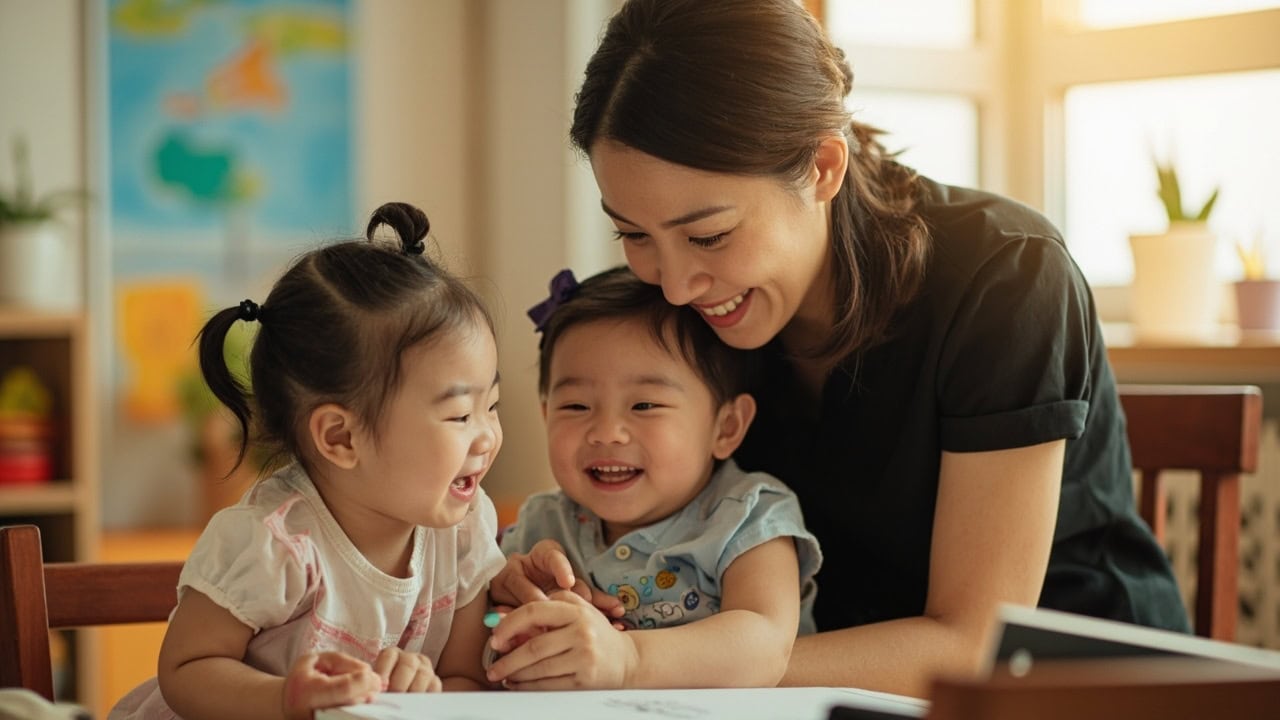
A particular caregiver crouches down to your level. She does not pick you up immediately. She does not rush. She sits with you in the not-knowing. She says your name in a voice that sounds like she has been waiting for you. She notices that you are holding your small stuffed animal tightly and she does not ask you to put it down. She lets you have your thing. She lets you have your time.
This is not complicated. It does not require a curriculum. But it requires something that cannot be trained into someone in a weekend workshop. It requires a quality of attention. A willingness to follow the child’s pace. An understanding that the child’s emotional state is the most important information in the room.
Now imagine a different scenario. You are two years old. You are upset. You are crying. And an adult rushes over with a toy to distract you, or tells you firmly to stop crying, or hands you to someone else because they need to attend to something else.
The crying stops. You have been soothed, in a technical sense. But something has been missed. The message your nervous system receives is this: your feelings are inconvenient. Your distress is something to be managed, not something to be understood.
The child in the first scenario is building a map that says: my feelings matter, I can be soothed, adults are reliable, this is a place I can trust. The child in the second scenario is building a map that says: my feelings are too much, I need to manage on my own, this place is tolerable but not quite safe.
Reading Your Child’s Emotional Report Card
Here is what Singapore parents often tell me when I ask them what they worry about most. They say: I do not know what my child feels when I am not there. They say: she cannot tell me, she just cries at pickup and I do not know if she is sad or tired or overwhelmed or actually fine. They say: I choose the best place I can find, but I am always wondering, am I missing something?
This doubt is not weakness. It is actually a sign of attunement. The parents who feel this uncertainty are the parents who are paying attention to their child, who are not satisfied with surface-level reassurance, who want to understand what is really happening in that world they cannot see.
Your child is communicating. They are just not communicating in the way adults typically expect.
Signs Your Child Is Flourishing
- They show signs that seem counterintuitive—they may be energized after pickup, not depleted
- They talk about their day in fragments and images rather than full sentences—the caregiver read a book about bears, we played with the water table
- They bring home drawings or papers that mean nothing to you but everything to them
- They may not want to leave—they may ask when they can go back
- They mention the caregiver or friends by name with positive emotion
- They play out elements of their day when they are at home
- They are building friendships and learning to negotiate
Signs Your Child May Be Struggling
- They seem too compliant, too easy, too willing to adapt without protest
- They are exhausted after care in ways that seem disproportionate to the day
- They have physical symptoms with no medical explanation—tummy aches, disrupted sleep, changes in appetite
- They resist the morning drop-off with panic or conviction that goes beyond typical separation anxiety
- They seem bonded to a transitional object rather than to the adults in the room
- They go quiet after care, shutting down, packing away that part of the day like a suitcase they do not want to open
Why Pickup Moments Matter Most
The quality of your child’s emotional life in care will show up most clearly not in the activities or the curriculum but in the transition moments. Watch your child at pickup. Not just whether they run to you—though that matters—but how they make the transition.
Do they release easily from the caregiver, or is there a clinging, a look back, a second of confusion about where they are and who is who? Do they settle in the car, or do they seem overstimulated, wired, unable to regulate? Do they ask about the caregiver later, mention a friend, reference something that happened?
A child who has a secure base in care will often show what looks like separation anxiety at pickup—but listen more closely and you will hear something different. It is not fear of the caregiver. It is confusion about the transition, an expression of the complex feeling of being caught between worlds, a moment of dysregulation that resolves quickly because the caregiver and the parent both understand what is happening. These are healthy, age-appropriate responses. They are the sounds of attachment doing its work.
Watch the whole pattern over time. Not one morning, not one pickup, but the arc of weeks and months. What is your child building? What is the map they are drawing?
Why Emotional Security Shapes Everything
The quality of your child’s emotional experience in care is not a luxury add-on. It is foundational.
Research on early childhood development consistently shows that the quality of caregiving relationships in the first years of life shapes neural architecture, stress response systems, social-emotional competencies, and the capacity for relationship throughout life.
A child who feels secure in care has more cognitive bandwidth available for learning. A child who is chronically stressed by their care environment is using that same bandwidth to manage their nervous system, leaving less available for the things we typically measure—language, cognition, school readiness.
We have been measuring the wrong things for too long. We have been asking whether children can name colors and count to ten. We should be asking whether children feel safe enough to explore, whether they trust enough to take risks, whether they are building the internal architecture that will support everything that comes after.
Every day your child spends in care is a day they are adding new territory to their understanding of what relationships feel like. The caregiver who greets them by name. The moment when they stumble and someone is already there. The way the room smells, the way the light falls, the rhythm of nap time and snack time and story time. All of this becomes part of their internal architecture.
The youngest children do not analyze their experiences. They inhabit them completely. And what they inhabit shapes everything that comes after.
What Singapore Parents Need to Know
There is something that sits at the heart of why this work is so difficult for parents in Singapore. You are making this choice under pressure. You are making it with limited information, with competing demands, with a society that tells you both that you should work and that you should stay home, that you should trust experts and that you should trust your instincts, that you should be grateful for options and that none of the options are quite right.
You are doing this while navigating costs that feel impossible, while managing extended family expectations, while watching your child for signs of distress that may or may not be meaningful. You are doing this with a tender heart and a tired body and the knowledge that you cannot go back and undo this choice if it turns out to be wrong.
The fact that you feel this weight is not a sign that you are failing. It is a sign that you understand what is at stake. The parents who agonize over this decision are often the parents who will be most attuned to their child’s emotional truth once care begins. Because they are already paying attention. They have already made the internal commitment to read their child carefully, to trust their instincts, to advocate if something is wrong.
What you need now is not just a childcare option. You need a partner in your child’s emotional development. You need a care environment that understands that what they are doing is not just supervising children while parents work. They are building the first maps. They are laying the foundation for everything that comes after.
EduNanny Singapore: Built on a Different Understanding
EduNanny by BUTLER operates within the ECDA Childminding Pilot, and that pilot structure reflects something important: a recognition that home-based and community-based care pathways offer something that large center environments cannot always replicate.
Smaller ratios. More individualized attention. The opportunity for your child to build a genuine relationship with their caregiver, not just be one face in a group of many. Up to one to three infants in care at any time, when we are talking about the youngest children. That is not an administrative detail. That is a fundamental difference in the emotional landscape your child will inhabit.
The caregiver in an EduNanny setting is not just a supervisor. She is a relationship architect. She is the adult who knows your child’s sleep rhythms, who notices when a slight change in appetite means a cold is coming, who has seen your child through their first separation and their first reunion and has learned to read their signals the way you do. She is someone who has chosen this work because she understands that what happens in these early years matters in ways that will echo through your child’s entire life.
Monday to Friday care blocks. Accessible fee structures through the pilot. CDA and Baby Bonus usability. These are the practical details that make it possible for families across Singapore to access this kind of care. They matter. But they are not the heart of it.
The heart of it is what your child feels when they are in that space. The safety. The belonging. The growing confidence that this is a place where they are known.
The caregiver who communicates with you not just about what your child ate and when they slept, but about how your child seemed today, what they noticed, what they wondered about. The transparency that comes from knowing that communication is a two-way street, that you will hear about your child’s day, that CCTV measures are in place not because anyone expects problems but because parents deserve to know what they cannot see.
Questions Every Parent Should Ask
- How does my child respond to the caregiver? Not just in the moment of introduction, but over time. Is there a genuine relationship forming, or is your child treating them like any other adult?
- What happens when my child is upset? Is there a patient, attunement-based response, or is the first instinct to distract, redirect, or manage the distress away?
- What do I hear about my child’s day? Is the communication focused on logistics—what they ate, when they slept—or on emotional observation—how they seemed, what gave them joy?
- How does my child talk about their care experience? Even before they can form sentences, what fragments, images, and behaviors do they bring home?
- How does my child behave at pickup and in the hours after? Watch the whole arc, not just the immediate moment.
- Does the caregiver seem to know my child as an individual? Not just their schedule and preferences, but their temperament, their fears, their joys?
Your child is communicating. They have always been communicating. The cry at pickup, the change in sleep patterns, the way they cling or the way they go quiet, the drawings they bring home and the fragments of story they offer—all of it is language. Your child is telling you about the map they are building.
Your job, your privilege, your responsibility as a parent in these formative years, is to learn that language. To read your child with the same attention you would give to anything else that matters enormously to you. To trust your instincts when something feels off and to trust your instincts when something feels right.
When you find a care environment that understands what I have been describing—when you find caregivers who know that they are not just keeping children safe but building emotional architecture, who notice the small moments of distress and the small moments of joy with equal attention, who communicate with you not as a formality but as partners in your child’s development—then you will know it.
Not because of a curriculum checklist or a tour impression, but because your child will show you. Your child will come home with something in their eyes that says I am building something here. I am safe. I am learning who I am.
That is what quality care looks like when we stop measuring the wrong things and start reading the ones that matter most.
Ready to Explore What Emotional Security Looks Like in Practice?
If you are researching infant care or childminding options in Singapore and want to understand what a relationship-based approach to early childhood care feels like, we invite you to learn more about EduNanny by BUTLER. We believe every child deserves to build their first emotional map in a place where they are truly known.
To understand how EduNanny supports both children and families across Singapore, explore our approach to thoughtful, development-oriented childminding. Or if you have questions about whether EduNanny might be the right fit for your family, we would be glad to hear from you.