Understanding Your Baby’s Brain: The First Thousand Days in Singapore
The First Thousand Days: Why Early Attachment Matters More Than You Think
To understand why the caregiver-child relationship matters so profoundly, we need to understand something about the first years of your child’s life — not the milestones and measurements we are used to tracking, but something deeper, something that no checklist can capture.
The science of attachment tells us that the first thousand days of a child’s life are not simply a period of growth and development in the way we usually mean those words. They are a period of profound relational construction.
Your child’s brain is not just developing in response to stimulation and nutrition, though both matter. It is developing in response to the quality of the relationships that surround it. Every moment of attunement — every time a caregiver notices your child’s frustration before it becomes a cry, every time a touch is gentle and timely, every time a response is consistent and warm — that brain is building something. It is building a template for what relationships feel like. It is building the architecture of trust.
This is not a metaphor. The pathways that form in a child’s brain during these early years are literally shaped by the quality of care they receive. Not the quantity — the quality. The presence, the responsiveness, the consistency.
Attachment researchers have spent decades documenting what happens when children experience secure care versus inconsistent or unattuned care. The findings are both sobering and hopeful:
- Stronger emotional regulation — the capacity to manage big feelings without becoming overwhelmed
- Better social skills — the ability to read others, to connect, to cooperate
- Greater curiosity — the willingness to explore because the world feels safe
- More resilience — the ability to recover from setbacks and adapt to change
These are not small things. They are the foundations of a human life. And they are built, day by day, through the quality of your child’s relationships.
Attachment Expands, It Does Not Divide
Here is what I find most remarkable, and most relevant to your conversation today: this secure attachment does not only form with parents.
It can form with any consistent, responsive caregiver who is attuned to your child’s signals and who responds in a reliable, warm way over time. A child can and does develop genuine, secure attachment to the person who feeds them, who comforts them, who celebrates their discoveries, who sits with them in the moments of overwhelm.
And here is the part that matters enormously for parents who are navigating childcare decisions: this attachment does not compete with the parent-child bond. It complements it.
If the parent-child attachment is a secure foundation — and research consistently shows that it is the primary attachment that matters most — then additional secure attachments are not a threat. They are a resource.
Think about what this means practically. The child with multiple secure relationships does not love their parents less. They feel more secure, not less. They have more people in their world who respond to them, who know them, who catch them when they fall.
This is not a zero-sum dynamic. This is how human development actually works. When your child experiences consistent, warm responsiveness from a caregiver who is trained, intentional, and present, they are not being divided. They are being expanded.
The child who has a secure attachment to their caregiver has a broader base of safety from which to explore, to learn, and to love you more rather than less.
Reading for Relational Depth: What Quality Care Looks Like in Practice
So how do you know if genuine connection is happening? How do you read for relational depth when you are not a specialist, when you are simply a parent making a decision about where to leave your most precious trust?
There are observable signals of secure caregiver-child attachment, and they are more accessible than you might think. You do not need a psychology degree. You need your eyes, your instincts, and a few signposts.
Signal 1: Responsiveness
Not the caregiver who is always doing something, always arranging activities, always producing output. Watch for the caregiver who is always noticing.
Who notices when a child’s face changes before a meltdown. Who notices when a child reaches for something just out of frame. Who notices the small shifts in mood, in energy, in need — and responds to them.
Responsiveness is the signature of attunement. It is the caregiver reading and reflecting the child’s internal state in real time. In a quality infant care setting in Singapore, this might look like a caregiver who pauses mid-sentence when a baby’s expression shifts, who adjusts their approach before the cry comes, who reads the quiet distress that louder signals would only reveal later.
Signal 2: Synchrony
This is the word researchers use for moments of genuine emotional connection between caregiver and child — moments where the caregiver’s face, voice, and body language match what the child is experiencing.
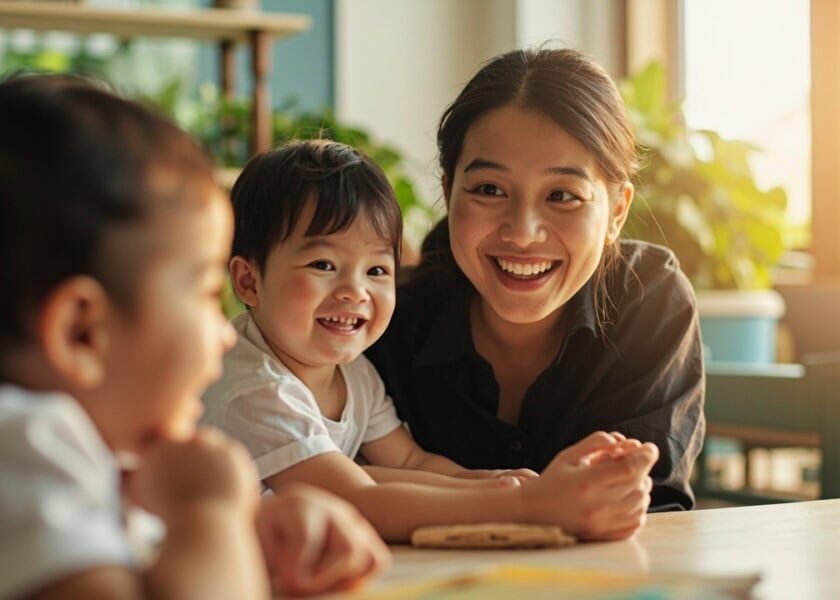
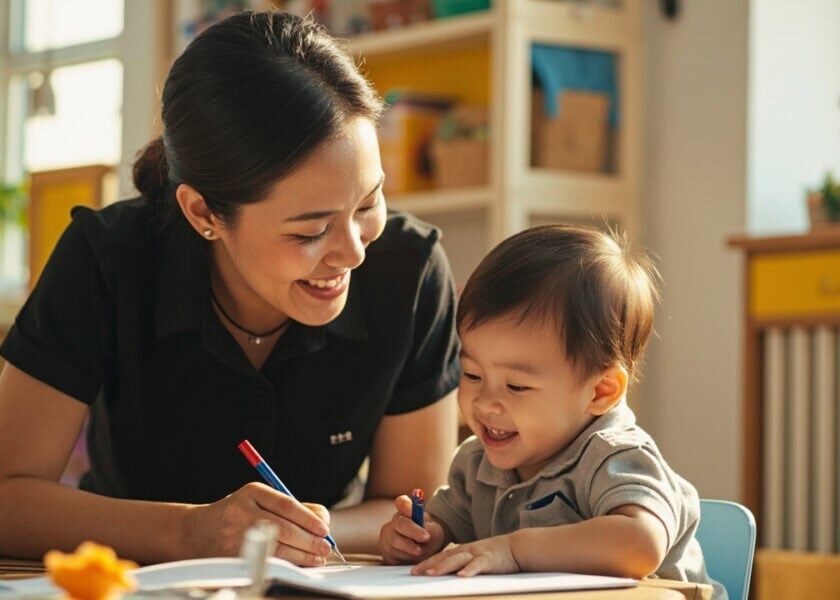
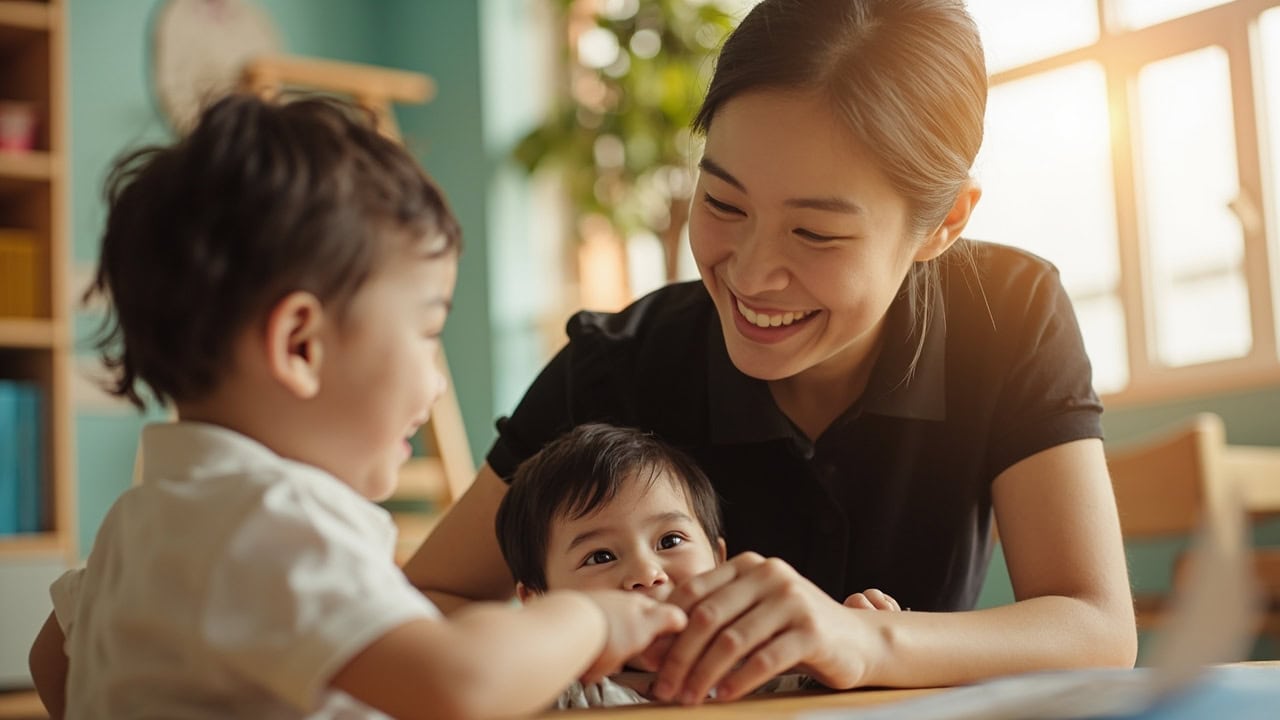
Where the caregiver laughs when the child laughs. Where the caregiver’s brow softens when the child shows distress. Where there is a rhythm to the interaction, a back-and-forth that looks and feels like conversation even before words exist.
Synchrony is not about technique. It is about presence. It is about the caregiver being genuinely with the child, not just managing them. When you visit a potential infant care arrangement in Singapore, watch for these moments of genuine emotional matching. They are harder to fake than a clean environment or a polished schedule.
Signal 3: How the Caregiver Relates to Your Child as a Full Human Being
Does the caregiver speak to your child with the same respect they would offer an adult? Does the caregiver narrate what is happening, ask questions, acknowledge the child’s experience as valid?
Or does the caregiver speak about the child in third person, in fragments, as if the child is a task rather than a person? “She needs a nappy change.” “He’s tired.”
The language a caregiver uses — about your child and to your child — is a profound indicator of how they understand their role.
Signal 4: What Your Child’s Behavior Tells You
Watch for how your child responds to their caregiver at pickup. Not every child shows obvious excitement, and that is fine. But is there recognition? Is there a softening? Do they look toward their caregiver when they enter the room?
More importantly: watch your child at home. Does your child come back from a day with their caregiver energized or depleted? Children who are securely attached to their caregiver do not come home as empty shells. They come home still curious, still engaged, still capable of connection. They may be tired — connection is work, even for children — but they are not withdrawn.
Signal 5: Emotional Regulation Over Time
One of the developmental outcomes of secure attachment is the capacity to manage big feelings. A child who is securely attached to a consistent caregiver has had thousands of experiences of being soothed, of having their distress met with calm, of learning that overwhelming feelings do pass.
Over time, this builds the capacity for self-regulation. If your child’s caregiver is genuinely attuned, you should begin to notice — over weeks and months — a growing ability in your child to recover from frustration, to modulate strong emotions, to return to equilibrium after upset.
The child who is upset when the caregiver leaves, but who settles. The child who protests separation but who is consolable. This is the pattern of a child who has internalized a sense of security — who has taken into themselves the experience of being reliably cared for, so that even when the caregiver is gone, the knowledge of that care remains.
That is not separation anxiety in the concerning sense. That is the beautiful, appropriate protest of a child who knows what good care feels like.
Your Role: Becoming an Active Partner in the Attachment Relationship
Reading these signals is not about surveillance. It is not about finding evidence that something is wrong. It is about developing a new kind of literacy — a literacy in relational quality that most of us were never taught.
And there is something else you can do that is even more powerful: become an active partner in the attachment relationship.
The quality of your child’s caregiver-child attachment is not something that happens to you and your child. It is something you can actively support, strengthen, and make real.
Share What You Know
Tell your child’s caregiver about the rhythms of your child’s day at home. Share the cues you have learned — what your child’s tired cry sounds like versus their hungry cry, the song that always settles them, the way they like to be held when they are overwhelmed.
This is not background information. This is the texture of your child’s inner life, and it is invaluable to a caregiver who is trying to attune. When you share these details, you are not micromanaging. You are giving your child’s caregiver the tools to know your child the way you do.
Ask What You Do Not Know
How is my child during the day? What are they drawn to? What makes them laugh? What have you noticed about them that I might not see?
These are not intrusive questions. They are the questions of a parent who cares deeply and who wants to understand their child’s full life. Any caregiver who is genuinely invested in the relationship will welcome these questions. If they do not, that is itself information.
Notice What You See
When you observe moments of genuine connection between your child and their caregiver, name them. Not to the caregiver necessarily, though that too is valuable, but to yourself. Take them in. Let them reassure you.
The image of your child reaching for their caregiver is not an image of replacement. It is an image of your child building security. It is your child saying: there are people in this world who know me, who respond to me, who hold me when I fall.
This is what a healthy, developing relational world looks like.
How EduNanny Singapore Approaches Caregiver-Child Attachment
EduNanny was founded on a simple, evidence-based conviction: the relationship between caregiver and child is not a feature of quality childcare. It is the foundation of it. Everything else — the curriculum, the environment, the safety protocols — matters, but none of it means anything if the relational heart is not beating.
EduNanny is part of the ECDA Childminding Pilot, and that is not incidental. The pilot exists because Singapore recognizes that families need more than one model of care. They need flexibility, accessibility, and genuine quality. EduNanny operates across home-based, community, and centre pathways, and every element of the model is designed with relational depth in mind.
Small Groups, Real Attention
EduNanny maintains ratios of up to one to three infants in infant care settings, because attachment requires time, attention, and space. It is very difficult to attune to a child when you are managing five or six. It is possible to respond to a cry when you are managing three. It is possible to notice the flicker before the storm. It is possible to sit with a child, to be genuinely present, when the numbers allow for presence.
This is not a small thing. This is the architecture of relationship. And it is why the structure of care matters as much as the philosophy behind it.
Consistent Caregiver Assignments
Relationships require continuity. A rotating cast of caregivers prevents attachment from forming. At EduNanny, your child has a primary caregiver who is consistent, present, and known — someone who builds the ongoing relationship that makes attachment possible.
Accessible by Design
Quality care must be accessible. For many families in Singapore, the cost of care is not an abstraction. It is a real, often anxious calculation — how do we make this work, how do we give our child what they need without straining our family beyond its limits.
EduNanny operates within pilot fee structures designed to make quality relational care achievable. Your CDA and Baby Bonus funds are usable here. The care your child deserves should not be reserved for families with unlimited resources. It should be available to all families who want it, and every family who needs it.
Communication as Infrastructure, Not Surveillance
EduNanny knows that communication is not the enemy of trust — it is the infrastructure of trust. When you know what is happening in your child’s day, you are freed to be present at home. When you receive real updates, genuine observations, daily reflections, you are not being surveilled as a parent. You are being included. You are being trusted with the full picture of your child’s life.
Addressing What Singapore Parents Really Worry About
“Will my child forget me?”
No. Your child will not forget you. Your child is building a relationship with their caregiver while maintaining the primary attachment bond with you. Multiple secure attachments are additive, not competitive. The child who knows their caregiver well feels more secure, not less — and that security allows them to explore, learn, and grow.
“How can I trust someone I barely know?”
Trust is built through observation, communication, and time. Watch how your child’s caregiver responds to them. Ask questions. Notice how your child behaves after time with their caregiver. Trust is not given blindly; it is developed through evidence. And if a caregiver welcomes your questions, your observations, your involvement — that openness is itself a sign of quality.
“I feel guilty for not being the one there.”
That guilt is the sign of love, not the sign of failure. The love you feel for your child is precisely why you are so careful, so thoughtful, so committed to finding the right care. That care — given by someone who is genuinely present, genuinely attuned, genuinely connected — does not erase your role. It extends your child’s world of security. Your child is not choosing someone over you. Your child is adding to their foundation.
“How do I know if what I’m seeing is real warmth or just good performance?”
This is one of the most important questions a parent can ask. Surface warmth is easy to fake in a short visit. Genuine attunement is observable over time. Look for consistency: does the caregiver respond the same way when you are watching as when you are not? Watch for the small, unguarded moments — how the caregiver responds when no one is paying attention, how they speak to your child during routine tasks, not just during a performance.
Most importantly: watch your child. A child who is truly attached to their caregiver will show it in subtle ways — a softening when they enter the room, a reaching hand, a settling into the caregiver’s presence. These are not things a caregiver can manufacture. They are the natural product of a relationship that has been built over time.
A Practical Framework for Choosing Infant Care in Singapore
When you visit potential infant care arrangements in Singapore, use this framework:
- Visit more than once — First impressions can be polished. Return at different times of day to see how caregivers interact with children during routine moments, not just during a demonstration visit.
- Observe, then ask — Watch the caregiver-child interactions before you ask questions. Notice responsiveness, synchrony, how the caregiver speaks to children. Then ask specific questions: “How does my child respond when they’re upset? What do you do when you notice frustration building? How do you handle the transition when parents arrive for pickup?”
- Notice the environment’s warmth, not just its order — A clean, organized space is important, but warmth is different. Is the space filled with genuine interaction? Do you hear laughter? Do you see caregivers kneeling to a child’s level, not just standing over them?
- Ask about caregiver consistency — Who will be the primary caregiver for my child? How often does that change? Consistency matters enormously for attachment. If caregivers rotate frequently, relationship-building becomes nearly impossible.
- Ask about communication — What will I know about my child’s day? How will you share observations with me? What would prompt you to contact me during the day?
- Trust your child’s response — After visits, notice how your child responds to the caregiver. Not every child shows obvious affection, but there should be recognition, a softening, a willingness to be in that person’s presence.
- Ask about ratios and group size — In infant care, smaller groups allow for deeper attention. Ask specifically: how many children per caregiver? What is the maximum group size?
The Decision Framework
| What to Look For | Why It Matters |
|---|---|
| Caregiver who notices before reacting | Attunement, not just management |
| Child who settles when upset | Evidence of secure attachment over time |
| Caregiver speaks to child as a person | Respect and relational understanding |
| Consistent primary caregiver | Continuity builds attachment |
| Small group sizes (1:3 maximum for infants) | Space for genuine connection |
| Transparent communication | Trust infrastructure, not surveillance |
| Caregiver welcomes your questions | Partnership, not hierarchy |
| Child returns home curious, not depleted | Sign of secure, energizing attachment |
The Morning Moment, Revisited
Now let us return to where we began: that moment every morning in homes across Singapore. The moment you hand your child over. The quiet question that lives in your chest, the one you have probably never said aloud but that lives there every time you leave.
Will they know my child?
The answer is not in the brochures or the inspection reports or the credentials on the wall. The answer is in the quality of the gaze. In the attunement behind the routine. In the responsiveness behind the schedule. In the relationship behind the role.
Your child deserves more than a person who will keep them safe. They deserve a person who will know them. And you deserve to trust that this is happening — not because someone told you it was, but because you have learned to read for it, to value it, and to seek it out in every choice you make.
That is what EduNanny Singapore is built for. That is what we believe in. That is why we do what we do.
When your child reaches for their caregiver at the end of a long day, that is not a betrayal of your bond. It is a testament to it. It is your child saying: I have people. I have more than one person. I am held by more than one pair of hands, known by more than one heart.
And that is not a threat to what you have built with your child.
That is an expansion of it.
The question you carry — the quiet, tender, loving question — is the right question to ask. And now you have the framework to find the answer.
EduNanny Singapore welcomes you to explore how our attachment-informed approach to infant care and childminding can become part of your child’s story. We are here — ready, present, and deeply committed — to doing the work that matters most.
Because the thing that matters most cannot be photographed or streamed. It cannot be captured in a daily report or measured in a ratio. It is the thing that happens when a caregiver sits on the floor with your child and is genuinely, fully there. When a hand reaches for a face and a face responds. When a cry is met not with management but with presence.
When a child looks up and sees someone who is looking back — not at a task, not at a schedule, but at them.
That is what we are here for.