How Singapore Parents Can Develop the Trained Eye for Quality Childcare
Quick Summary: Developing the Trained Parent Eye
- Quality childcare reveals itself in small moments — not in impressive facilities but in the texture of daily interactions
- You can learn to read a room’s atmosphere — the temperature of interactions, the quality of sounds, the genuine attentiveness of caregivers
- Micro-interactions are the real curriculum — watch what happens between planned activities, not during them
- Your child’s behavior after pickup is data — their mood, energy, and responses communicate volumes about their day
- Routine architecture reveals philosophy — intentional design shows in smooth transitions, not just in posted schedules
- Learn to see past the performance — look at margins, unguarded moments, and what happens when no one is watching
The Starting Point: Why Uncertainty Is Not a Deficiency
Consider for a moment what brought you here. Perhaps you are preparing to return to work after maternity leave, and the calendar has begun its quiet pressure. Perhaps you are searching for the first time, or the second, carrying the weight of a previous experience that did not feel right even when you could not explain why.
Perhaps you are simply a parent who knows that the early years matter enormously — that the brain develops faster between zero and three than at any other point in life — and that the quality of care your child receives during these foundational days will shape capacities you cannot yet name.
You know this. You feel it in your bones. And yet the question remains: How do I evaluate something so important when I do not yet have the language for it, the framework, the trained eye?
Here is what we want you to understand: this is not a deficiency. It is a starting point. And it is precisely where we begin.
Learning to See: Atmosphere, Interactions, and Behavioral Clues
The first thing a trained eye learns is not to look at what is obvious. It learns to look at what is ambient — the atmosphere of a space, the texture of an environment.
Before your child has spoken a single word about their day, before you have read any note or received any update, you can feel something when you walk through certain doors. Some spaces feel tense in ways that are hard to name. Others feel loose, chaotic — the kind of freedom that is really just absence. And some spaces feel right. Not sterile. Not performative. Warm. Alive. Responsive.
When you visit a childcare setting, pause before the tour begins. Stand in the doorway for a moment. Breathe. Notice what you feel. This is not mysticism. It is observation. And it is the first skill in developing the trained parent eye.
Signs of a Warm, Responsive Atmosphere
- Adults kneel or sit at children’s eye level when speaking
- Conversations between caregivers and children feel unhurried
- The space feels lived-in, not staged — there are signs of real use
- Children appear calm and engaged, not merely supervised
- The soundscape includes child-initiated voices, not just adult direction
Reading Micro-Interactions: The Curriculum That Is Never Written Down
Now let us go deeper. Beyond the room itself, into the moments that matter most.
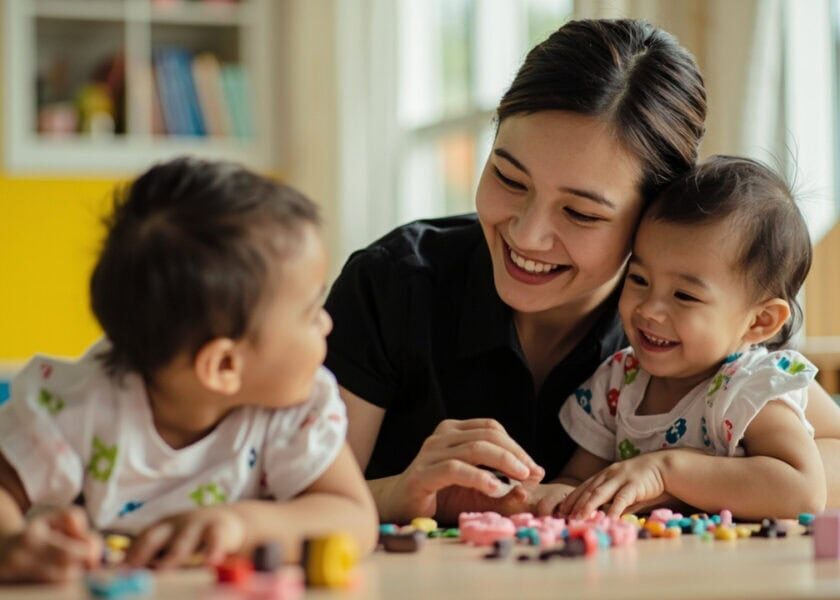
Watch a caregiver with a child. Not the planned activity, not the circle time, not the carefully staged interaction. Watch what happens in between — in the pause between one activity and another, in the moment a child stumbles and the adult is there, not hovering but present, in the exchange that happens when a small person brings an unremarkable object to show someone and that someone stops, looks, responds.
These are the micro-interactions. The moments that reveal, more than any curriculum document or inspection report, what care actually means in this place.
A trained eye notices whether a caregiver’s body is oriented toward the child when they speak, or turned partially away. It notices whether the adult responds to a child’s communication with words, with touch, with eye contact, or simply with absence. It notices whether a child’s cry is met with swift, calm attention or delayed, distracted acknowledgment.
Why does this matter? Because the quality of these micro-interactions is not incidental. It is the substance of your child’s day. Research consistently tells us that the developing brain is shaped not by dramatic moments but by the accumulation of ordinary exchanges that build a sense of security, of being known, of learning that the world is a responsive place.
What to Look For in Caregiver-Child Interactions
- Does the caregiver respond to a child’s communication — even small gestures — with acknowledgment?
- Is physical comfort offered naturally when a child shows distress?
- Do caregivers speak with children, not just at them?
- Are children given time to respond, or are conversations rushed?
- Does the caregiver follow the child’s lead during play, or is play adult-directed?
After Pickup: Your Child’s Behavior Is Data
And then there is what happens after. The walk home. The pickup. The car seat conversation, if there is one.
Here is something many parents in Singapore have not been told: your child’s behavior after childcare is not random. It is data. It is your child’s subconscious report card, delivered not in words but in tone, in energy, in the particular quality of their neediness or their quietness.
| After-Care Behavior | What It Might Communicate |
|---|---|
| Extremely ravenous hunger | Meals may have been paced around a schedule rather than children’s hunger cues |
| Profound flatness or depletion | The environment may have demanded more energy than it returned |
| Disproportionate tearfulness or falling apart over small things | Accumulated stress that had no space to release during the day |
| Clinginess or neediness beyond the usual | A need to reconnect and restore a sense of security |
| Grounded ease, natural energy | The day contained what it needed — engagement without overstimulation |
| Wanting to share small things from the day | A sense of safety and desire to connect about their experience |
| Smooth transition to sleep | A day that honored their natural rhythms and provided adequate downtime |
You do not need a camera in every room. You need to learn what your child is already showing you. Over time, these patterns become a window into the actual quality of your child’s day — more honest than any tour or report could be.
Routine Architecture: How Structure Reveals Philosophy
Structure. Schedule. The architecture of a day. Every childcare setting has one. But not all architectures are created equal, and this is where a trained eye becomes invaluable.
A routine that is truly designed around children’s developmental needs will feel, paradoxically, both structured and flexible. There will be predictable rhythms: consistent meal times, rest periods that honor the science of children’s alertness cycles, transitions that are prepared for rather than announced abruptly.
But within that structure, there will be responsiveness. A child who is deeply engaged in play will not be yanked away for the next scheduled activity. A child who is not tired will not be forced into rest. A child who needs more time to eat will not be rushed.
The Difference Between Intentional Routine and Mere Supervision
The gap between these two reveals itself most clearly in transitions — those moments when one activity ends and another begins.
In a setting where quality is prioritized, transitions are prepared. Children are given warning. They are helped to close one experience before opening another. The shift from active play to calm activity, from indoor to outdoor, from group time to individual choice: these transitions are where the philosophy of a setting reveals itself.
- Rushed, chaotic, authority-driven transitions indicate that the schedule serves the adults
- Smooth, prepared, child-aware transitions indicate that the schedule serves the children
Seeing Past the Performance
Here is a truth that no childcare centre will volunteer during a tour: the performance is always better than the average day.
This is not a criticism of dishonesty. It is a description of human nature. When you know you are being observed, you present your best self. But a trained eye knows how to see past the performance to the underlying reality.
- Look at the margins. The way the caregiver speaks to a child when they think no parent is watching
- Notice what is not polished. The way a messy corner of the room is or is not attended to
- Watch the periphery. The way children who are not the focus of any activity are nonetheless present in the room’s awareness
- Listen in hallways. The way staff speak about children when they think parents are not in earshot
- Ask about difficult moments. What happens when a child is struggling? How are conflicts between children handled?
Ask questions that cannot be fully prepared for. Ask what a typical afternoon looks like, not just a typical morning. Ask what the staff turnover rate is and watch whether the answer comes easily or with hesitation. Ask what training the caregivers receive and whether they receive it continuously or only once.
Beyond Facilities: What Quality Actually Looks Like
It is easy to be impressed by what can be purchased: the gleaming equipment, the colorful learning materials, the spacious play areas. And none of these things are wrong. But they are not the point.
A trained eye learns to distinguish between impressive facilities and meaningful engagement. Between a room full of toys and a caregiver who knows how to follow a child’s interest. Between a curriculum displayed on a wall and a caregiver who can read a child’s cues and respond in the moment.
The most important question is not what do you have here? but how do the people in this space relate to the children in it?
Quality does not live in square footage or equipment lists. It lives in the quality of attention that children receive — in the ten thousand small moments that accumulate into a sense of security, of being known, of learning that the world is a responsive place.
Addressing Your Concerns: Questions Every Parent Asks
“Am I qualified to judge quality?”
There is a question that sits beneath all of this, and we want to name it directly, because until it is named, it cannot be resolved.
You are more qualified than you think, and less qualified than you need to be. Both of these things are true at once, and the space between them is exactly where growth happens.
You know your child better than anyone. You know their cues, their thresholds, their particular temperament. You know what they need to feel safe and what makes them dysregulated. That knowledge is not nothing. It is the foundation. But it is not sufficient on its own, because quality childcare operates within a framework of developmental understanding that is not intuitive, that must be learned.
“What if I still feel uncertain after visiting?”
Uncertainty will not disappear entirely. Parenting always carries some uncertainty. But it can become a different kind of uncertainty — the productive uncertainty of a person who is still learning, still growing, still developing skill.
You stop hoping you made the right choice. You start knowing.
Practical Steps for Your Observation
- Visit more than once. Different times of day reveal different truths about a space.
- Observe before you ask. Spend time watching interactions before seeking explanations.
- Notice your gut. Your initial reaction to a space and its people is data — but learn to articulate why.
- Ask about the ordinary. What does a typical afternoon look like? What happens during meals? These details reveal philosophy.
- Talk to your child. Over time, their behavior after pickup will become your most honest feedback.
- Trust the process. Observation is a skill. It develops. You will get better at this.
What Quality Childminding Looks Like at EduNanny
EduNanny was built with this parent in mind. The one who wants to make a good decision. The one who knows the stakes are real. The one who has felt the uncertainty and refused to let it paralyze them, and instead has turned it into a question: how do I learn to see?
Our approach begins with a fundamental belief: that parents deserve to be partners in their child’s care, not passive consumers of it. That transparency is not a feature but a prerequisite.
This is why EduNanny operates within the ECDA Childminding Pilot, under standards that hold us accountable to more than profit. It is why we maintain ratios that allow for genuine attention: up to one caregiver for every three infants in our care. It is why we build communication into the daily rhythm of our service, offering parents windows into their child’s day that go beyond the formal report.
Where deployed, CCTV measures provide an additional layer of transparency — not as surveillance but as invitation: come, see what we are doing, trust what you witness.
We offer both home-based and community-based pathways because families are not uniform, and the best setting is the one that fits your life. Monday to Friday care blocks provide the consistency that children’s developing brains need to feel secure. And we have worked to ensure that this quality is accessible: pilot fee structures are designed to be affordable, and payment options include CDA and Baby Bonus, because we believe that excellent care should not require extraordinary means.
How EduNanny Supports Your Observation
- Small ratios that make micro-interactions possible — not administrative convenience but the condition for quality care
- Communication transparency that acknowledges you as the most important person in your child’s life
- Thoughtful routine architecture that honors children’s rhythms and developmental needs
- Accessibility features including CDA and Baby Bonus payment options
We also know that modern parenting moves fast and questions arise at odd hours. That is why we built Thomas, our AI chatbot, to be available when you need answers — not just during business hours. Thomas is not a replacement for human guidance; it is an extension of our commitment to being present for the questions that matter.
From Hoping to Knowing
There was a time before you learned to read. The symbols on the page meant nothing, and then one day they meant everything. You did not acquire literacy by waiting for someone to test you. You acquired it by being taught, by practicing, by gradually realizing that the patterns you had been seeing all along were, in fact, a language.
The trained parent eye works the same way.
You are already observing more than you realize. You notice when your child’s teacher remembers a small detail from a previous conversation. You notice when the caregiver kneels to a child’s level rather than looming above them. You notice when your child seems genuinely glad to arrive or genuinely relieved to leave. These observations are data. They are meaningful. And they are the raw material of evaluation literacy.
What you need is not more information about childcare. You need to learn to trust what you are already perceiving and to deepen your capacity to perceive more. You need a framework that says: this is what that behavior means. This is what that atmosphere signals. This is the difference between impressive facilities and meaningful engagement.
When you develop this capacity, something shifts.
The thousand days of early childhood are passing right now. The hours in which your child’s brain is forming its architecture, in which the foundations of emotional regulation and social capacity and language and learning are being laid, are not waiting for you to feel ready. They are here. They are now.
And you are not helpless in the face of that urgency. You are not condemned to hope without knowing. You can learn to see. You can develop the trained eye.
And when you do, the decision that once felt impossible will become clear — not because the options stopped mattering but because you finally have the capacity to weigh them well.
Whether you are preparing for your return to work, searching for the first time, or seeking something that feels more right than what you have found before — we invite you to begin. Visit us. Ask your questions. Watch what happens when you walk through the door.
Trust what you feel. Trust what you see.
Your child deserves to be seen. And so do you.
Ready to learn what quality looks like up close? Book a visit with EduNanny and let us show you what we mean.
If you found this guide helpful, explore more about what sets EduNanny apart or return to our homepage to learn how we support families across Singapore.