What Singapore Parents Should Know About Caregiver Continuity
The Moment You Realize Someone Else Knows Your Child
There is a moment that arrives somewhere between the settling-in phase and the ordinary rhythm of weeks and months. If you are a parent in Singapore, you may have felt it without knowing how to name it.
It is the moment you realize your child has someone else in their life who knows them. Not just their name. Not just their schedule. But them. The particular way they take time to warm up to new situations. The songs they ask for when they are tired. The specific comfort they need when the world feels too loud. The small triumph they felt when they finally stacked three blocks and wanted someone to witness it.
You feel something that is not quite jealousy and not quite relief, but something more complex and more tender. You feel grateful. Perhaps, for the first time, you feel a quiet confidence that your child is not just being cared for but is being genuinely known.
That moment is not a milestone you will read about in parenting books. It does not come with a certificate or a developmental checkpoint on a clinic chart. But it is one of the most significant relational turning points in your child’s early life, and it happens quietly, over months, in the presence of someone who has become far more than a service provider.
This is the relationship I want to talk about today. Not the relationship between parent and caregiver, which is important and deserves its own attention. But the relationship your child is building with their caregiver—the one that, when it is allowed to deepen and stabilize over time, becomes something so foundational that it reshapes how your child understands the world, other people, and their own place in it.
What Developmental Science Tells Us About the Bond That Builds
We talk about ratios and curricula. We talk about enrichment schedules and facility safety. We talk about whether an infant can thrive in a group setting or whether home-based care is the better choice. All of these are legitimate questions, and they matter. But beneath all of these practical considerations is something deeper—something that parents in Singapore carry as a quiet longing even when they cannot fully articulate it.
The hope that their child will not just be cared for, but will be genuinely connected. To someone consistent. To someone warm. To someone who stays.
The Architecture of Early Security
In the first years of life, children are not simply growing bodies and developing vocabularies. They are building the architecture of their capacity to trust, to attach, and to explore the world from a base of security rather than from a base of anxiety.
This is the work of attachment, and it is not a soft or sentimental concept. It is neurological. It shapes stress response systems, emotional regulation pathways, and relational templates that children carry into school, into friendships, and into their own future families.
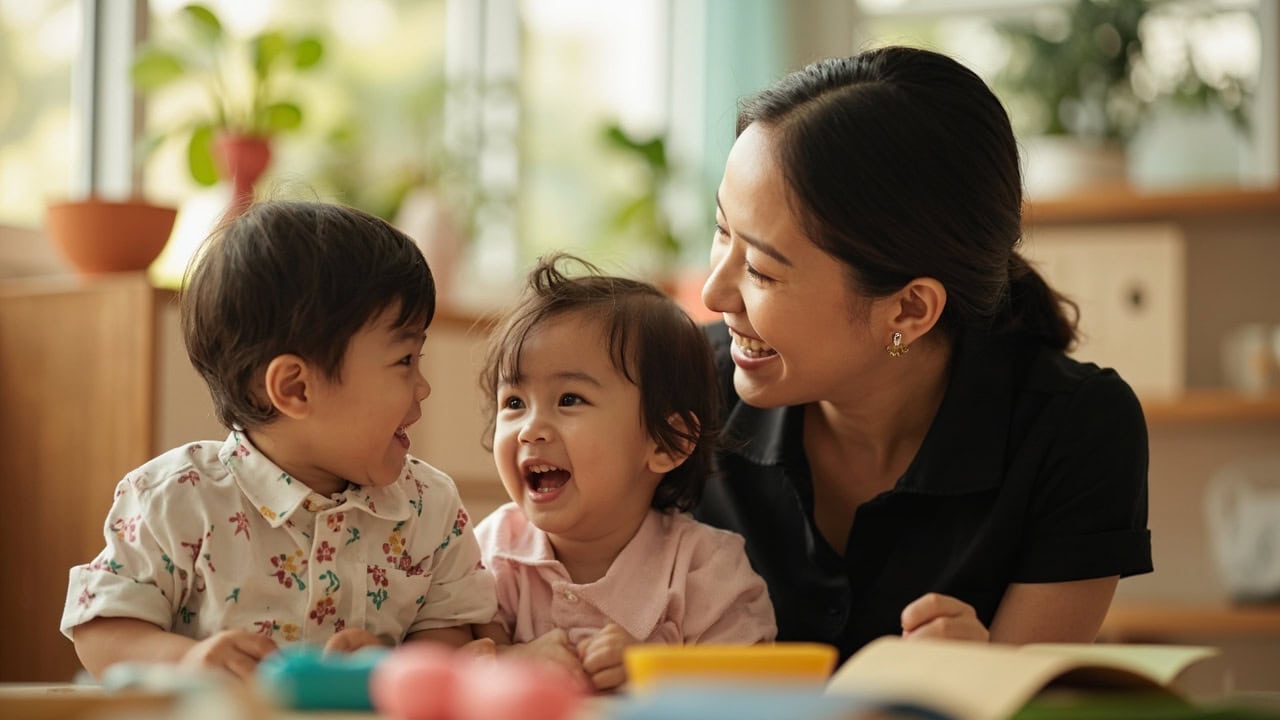
Most of us understand that parents are the primary attachment figures in this process. What is less well understood, but equally important, is that children can form additional secure attachment relationships. They can build what developmental psychologists call a second secure base—another person who functions as a reliable, warm, and emotionally attuned presence in their lives.
This is not competition for parental love. It is not a dilution of the family bond. It is complementary developmental architecture. It is another pillar of security from which your child can reach out into the world, experiment with independence, and know that there will be someone to catch them if they fall.
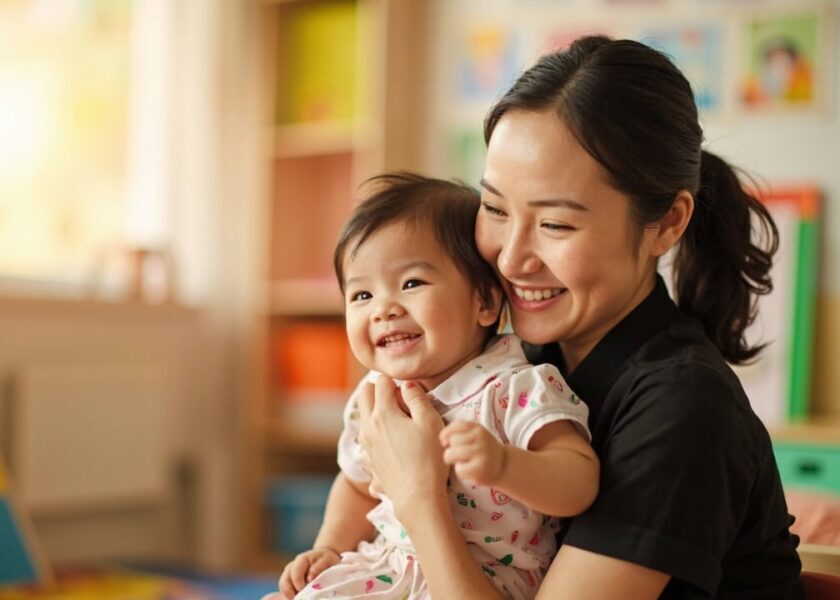
The caregiver who spends five days a week with your infant, who learns the texture of their cry when they are hungry versus tired, who celebrates the first time they clap or wave or say a new word, who notices when they are frustrated before anyone else does and knows exactly how to help—that caregiver is not filling a logistical gap. They are building a relational bond that has genuine developmental weight.
Why Consistency Is Not Negotiable
Here is what so few childcare conversations address directly: this bond does not form in weeks. It forms over months and seasons. It deepens through accumulated moments of attunement, consistency, and care.
When you change caregivers frequently, you do not just lose a familiar face. You interrupt a developmental process. You ask a child to grieve, to adapt, to lower their expectations of relational permanence, and then to start the slow, vulnerable work of trusting again.
The child may appear fine on the surface. Singapore children are remarkably resilient, as are Singapore parents. But the undercurrent of that disruption—the subtle recalibration of how much they can expect the world to be consistent—is real, even when it is invisible.
A caregiver who has been with your child for eighteen months knows them in a way that no orientation checklist or transition protocol can replicate. That knowledge translates into how quickly they can soothe a distress that a new caregiver would need weeks to understand. It translates into creative, responsive play that emerges when someone knows exactly what captures a child’s curiosity and how far to stretch it. It translates into the kind of warmth that does not have to be earned again and again because the foundation of trust is already laid.
Your child walks through the door on Monday morning. They are not starting over. They are continuing a relationship that has been growing since the first time someone held them, spoke to them with patience, and responded to their needs in a way that felt reliable. That continuity is not incidental. It is the work itself.
How to Recognize When the Bond Is Really Forming
You may be wondering: how do I know if this bond is actually forming? How can I tell whether my child has a meaningful connection with their caregiver, beyond just being comfortable and familiar? These are the right questions, and they deserve honest answers.
- Full-body recognition. Your child gets visibly excited when they see their caregiver—not the performative excitement of a child who has learned to greet politely, but the genuine recognition of someone who is a source of safety and joy.
- Name-based comfort. Your child asks for their caregiver by name when they are upset. This is a profound signal: your child has learned that this person is a source of comfort they can actively seek.
- Stories that matter. Your child talks about things that happened with their caregiver in a way that suggests these experiences are meaningful to them, not just a recounting of activities.
- Knowledge that goes beyond reports. The caregiver knows details about your child’s day, their eating habits, their sleeping patterns, their mood shifts—details that no amount of daily report cards could fully capture, because they were there. They witnessed it.
- Your child returns to you more secure, not less. More curious. More willing to explore because they have experienced the world from a second secure base and found it navigable. A healthy attachment to a caregiver does not compete with your attachment as a parent. It supplements it. It gives your child additional evidence that the world is populated with warm, reliable people who can be trusted to care for them.
What Happens If the Caregiver Leaves?
Let me address something that many Singapore parents feel but rarely say out loud: the fear of what happens if the caregiver leaves. It is a real fear, and it deserves a real answer.
The truth is that in any childcare arrangement, caregiver transitions are possible. Life circumstances change. People move on. This is the reality of human systems. What distinguishes quality childcare from commoditized care is not the claim that transitions will never happen, but how transitions are handled when they do.
A quality provider understands that a caregiver transition is not a logistics event. It is a developmental event. It affects the child, and it deserves the same thoughtful attention you would give to any significant change in your child’s environment.
That means careful transitions that preserve the emotional continuity of care. It means involving parents as partners in the process. It means introducing the new caregiver in a way that is gradual and respectful of the child’s need for security. It means acknowledging what the child is losing and giving them space to grieve while also giving them confidence that the new person is trustworthy.
Transitions handled well are not painless, but they are survivable—and they can even be growthful. What causes damage is not transition itself but the absence of thoughtful handling, the absence of acknowledgment, and the pattern of repeated disruption that teaches a child the world cannot be counted on.
What Quality Childminding Actually Looks Like
Quality childcare is not primarily about activities or facilities. It is about the quality of the relationship your child is forming with the person caring for them. It is about creating the conditions for that relationship to deepen over time rather than being disrupted by turnover, staffing changes, or the logistical pressures that characterize so much of the childcare sector.
For Singapore families navigating Monday to Friday schedules, the cost considerations that weigh on every household, and the CDA and Baby Bonus structures that can make quality care more accessible, the question of relational quality might feel secondary. You need care that is affordable. You need care that is available. You need care that meets regulatory standards and feels safe. These are not small things. They are significant.
The Small Ratios Difference
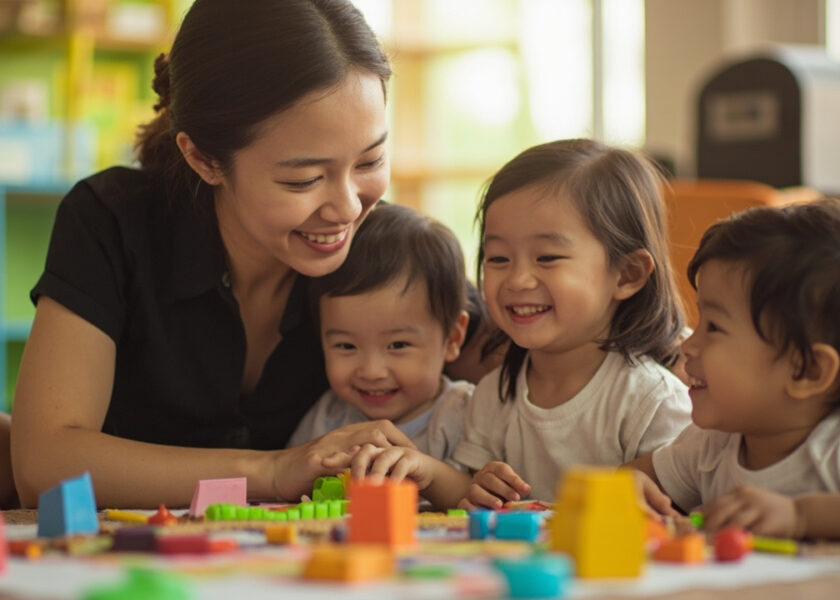
Small ratios change everything about what a caregiver can do. When a caregiver is responsible for up to three infants rather than ten, they can truly know each child. Not as a name on a roster. But as a full, unfolding human being with preferences, fears, strengths, and an emerging personality.
They notice things. They remember things. They respond to your child as a specific person, not as a category of need.
This is the principle behind home-based childminding models that keep groups small and caregiver relationships stable over the long term. The regularity of five-day care blocks allows bonds to compound. Each day builds on the last. The relational investment is protected rather than reset.
The Questions Worth Asking Before You Enroll
Before you sign any enrollment agreement, there are questions worth asking that go beyond the standard tour checklist. These are the questions that reveal whether an organization understands what it is actually providing.
Questions About Caregiver Stability
- How long does the average caregiver stay with this organization?
- What does the organization do to support and retain the caregivers it trains?
- What is the transition process if a caregiver needs to leave?
Questions About the Relationship Itself
- How is the caregiver-child relationship observed and nurtured on a daily basis, not just during settling-in?
- What does daily communication look like, and how does it reflect the actual quality of the relationship my child is having?
- How does the caregiver approach creative play and responsive interaction with my child?
Questions About Values and Philosophy
- What values guide the selection and training of caregivers?
- How does the training equip caregivers to understand and respond to individual children’s temperaments, rhythms, and needs?
- How does the organization define quality in care—and is relational quality part of that definition?
You can evaluate curricula and facilities on paper. But the bond your child forms will be shaped not just by the time spent together but by the quality of attunement, respect, and warmth that the caregiver brings to every interaction. Ask questions that reveal the philosophy behind the practice. Trust that an organization whose model is built around relational quality will have thoughtful, specific answers.
The EduNanny Approach: Built Around the Relationship
EduNanny Singapore operates within the ECDA Childminding Pilot and is designed with a clear understanding at its foundation: quality childcare is fundamentally about the quality of the relationship your child is forming with the person caring for them.
The EduNanny model is built around small ratios—up to one caregiver to three infants in infant care settings. This is not an accident of logistics. It is a deliberate structural choice that creates the conditions for genuine knowing. When a caregiver can focus their attention on a small number of children, each child receives the kind of attunement that builds attachment over time.
Monday to Friday care blocks provide the regularity that allows bonds to compound, as described earlier. But structure alone is not enough. What makes EduNanny distinctive is the investment in caregiver training, support, and retention. The operational philosophy is built around protecting the relational investment that families make when they entrust their children to care. Caregivers are not treated as interchangeable resources. They are developed as professionals who understand the developmental significance of what they are doing every day.
For families, this means communication and transparency are prioritized. The relationship between your child and their caregiver is, by its nature, largely invisible to you during the hours you are apart. The quality of what you are told matters—because it is your window into a bond you are trusting someone else to build.
Finding a Caregiver Who Will Know Your Child
If you are a parent in Singapore weighing your childcare options, I know that you want what is best for your child. I know that the guilt of returning to work, the anxiety of the first drop-off, the second-guessing about whether you are making the right choice—these are real and they are heavy.
I also know that there is a quiet, profound solution to much of that anxiety, and it is not found in finding the perfect centre or the most impressive activity schedule. It is found in finding a caregiver who will know your child. Not as a job. As a person.
When you invest in a childcare relationship that is stable, warm, and consistent, you are not just buying a service for the hours you are at work. You are contributing to your child’s internal architecture. You are giving them an experience that says: the world has reliable people in it, and I am safe enough to explore it.
This is a gift that compounds. It is not visible in the short term the way a new vocabulary word or a motor skill milestone is visible. But parents who look back, sometimes years later, recognize it.
They say: I did not realize at the time how much Ms. Rachel meant to my son. I did not know that the bond he had with his caregiver was doing that much work. But I see it now. I see it in how he relates to people. I see it in how he trusts.
Enrichment classes come and go. Activity schedules change as children grow and their needs evolve. But the sense of security, the capacity to trust, the experience of being truly known by another person outside of your immediate family—these are capacities that, once built, stay with your child. They shape how they walk into a classroom at four years old, how they make friends at six, how they navigate the inevitable disappointments and transitions of growing up.
When you find that, you will know it. You will see it in your child’s face. You will feel it in the confidence they carry. You will recognize it in the years to come when your child speaks of someone who mattered to them—someone who was there at the beginning, someone who helped them believe that the world was safe enough and interesting enough to explore.
That relationship is worth protecting. It is worth asking the right questions about. It is worth choosing a provider whose entire model is designed to nurture and sustain it.
At EduNanny Singapore, we believe that every child deserves to be known. Our model is built around small ratios, consistent caregiver relationships, and a deep commitment to the developmental care that shapes early security. We welcome the opportunity to speak with you about what that looks like for your family.