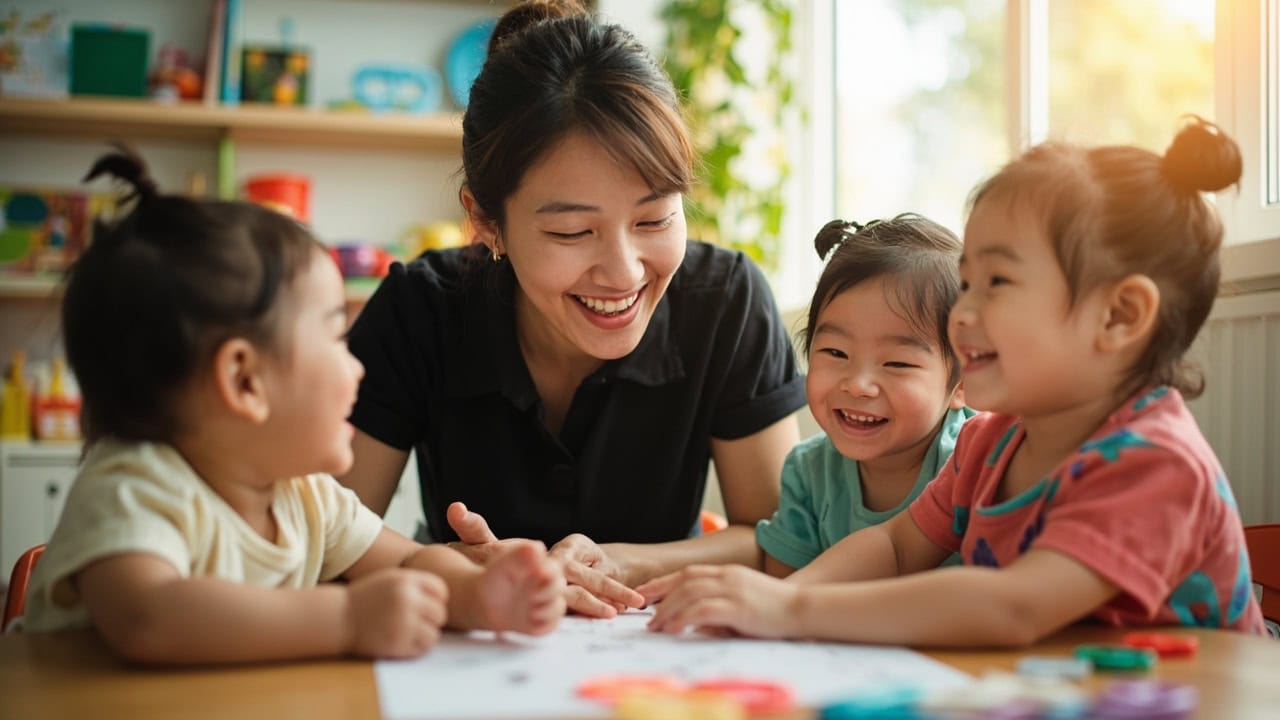
Why Being Seen Changes Everything About Childcare
The Question Beneath the Question
When you drop your child at childcare, what are you really looking for?
Most parents answer: someone kind. Someone patient. Someone who will keep my child safe and happy.
These are legitimate needs. But they are not the whole answer. After years of working alongside families across Singapore, we have come to understand something deeper about what parents actually need when they make this choice.
You need your child to be seen.
Not supervised. Not merely kept safe, fed, and occupied. Seen. Observed. Understood by someone who knows what to look for, who notices what matters, and who can tell you—with precision and care—who your child was while you were apart.
This is the difference between childcare that merely fills hours and childcare that actually shapes them.
What Professional Observation Looks Like in Practice
When a trained caregiver enters a room with an infant or a toddler, she is not simply present. She is observing. Here is what that looks like across a single day of care:
Morning: Reading the Arrival
A child who has been in care for three weeks enters, still adjusting to the routine. The caregiver notes that she is crying less at dropoff than last week, but still hangs back at the door, scanning for her mother.
Rather than simply comforting her, the caregiver has been tracking this pattern. She noticed that the child settles more quickly when offered a specific book—the one with the yellow cover her mother mentioned in conversation last Friday. She documents this in her daily record and shares it with the mother at pickup, not as small talk, but as meaningful information: here is what I observed, here is what it tells us, here is how we are responding.
Mid-Morning: The Territory of Social Development
During free play, a caregiver observes a toddler who typically engages in parallel play beginning to watch another child building with blocks. She sees the moment of interest—the leaning forward, the hand that reaches out tentatively before pulling back.
This is significant. The caregiver does not rush the interaction. She positions herself nearby, available but not intrusive. Later, when she documents the day’s observations, she records it as a potential milestone: increased interest in cooperative play emerging.
Lunchtime: Reading Physical Cues
An infant pushes away the spoon, turning her head away. The caregiver does not force the feeding. She notes the pattern. This child has been doing this for two days now.
Could be a phase. Could be a sign of illness beginning. Could be a preference change. The caregiver documents it and flags it for the parent’s awareness. This is how patterns emerge. This is how concerns get caught early, before they become problems.
Late Afternoon: Noticing What Is Different
A caregiver notices a toddler who is usually talkative becoming unusually quiet. He moves to a corner of the room. His breathing seems slightly labored.
She checks his temperature. It is slightly elevated. She documents her observation and contacts the parent directly, clearly, calmly, with specific information: he has been quieter than usual, he moved away from the group, I noticed his breathing, his temperature is currently at this reading, here is what I have observed.
The Training Behind Genuine Observation
These are not casual observations. They are trained observations.
EduNanny caregivers develop these skills through structured training, practice, and ongoing professional development. Our participation in the ECDA Childminder Pilot reflects our commitment to establishing real standards for what professional childminding looks like in Singapore.
The observation framework our caregivers follow is not a bureaucratic checklist. It is a professional discipline. They learn to observe across developmental domains:
- Cognitive development — how your child solves problems, explores cause and effect, engages with toys and activities
- Language development — new sounds, words, phrases; how your child communicates needs and responds to others
- Social-emotional development — how your child relates to peers and adults, how they manage emotions, attachment patterns
- Physical development — motor skills, coordination, progression toward physical milestones
Caregivers learn to document in ways that are useful, not just complete. They learn to communicate observations to parents in language that is clear, specific, and actionable. And they do this consistently, day after day, so that patterns emerge and development tells its own story.
What You Should Expect from Quality Care
Parents who experience this approach describe something specific: the pickup conversation changes. Instead of “how was her day”—a question that invites vague answers—parents arrive with the updates their caregiver shared throughout the day. They build on them. They follow up.
The conversation between parent and caregiver becomes a partnership: a shared understanding of who this child is and how she is growing. Parents tell us they feel, for the first time, that they truly know what happened during the hours they were not there.
That knowledge is not just reassuring. It is transformative. It allows parents to continue their child’s development at home in alignment with what is happening during care. It allows them to trust—genuinely trust—because trust is built on evidence, not faith.
When you choose care for your infant or toddler in Singapore, you should be able to expect:
- Caregiver-to-child ratios that allow for genuine attention—one caregiver to three infants at most
- Documented observations that track patterns over time, not just daily logs
- Specific communication about your child’s day: what they ate and how, how long they slept, what engaged them, what they struggled with, what they achieved
- Transparency about the environment where your child spends their day
- Training and standards that distinguish professional care from well-intentioned supervision
Warmth without training is instinct. Warmth with training is expertise. And expertise is what gives warmth its power to actually help a child grow.
There is a difference between a caregiver who notices your child is upset and a caregiver who notices that your child is upset in a specific way—a way that signals anxiety rather than ordinary frustration, a way that has been emerging over the past several days, a way that might be connected to a developmental leap or a change at home.
There is a difference between a caregiver who knows your child is making progress and one who can tell you exactly what that progress looks like, when it began, what preceded it, and what it suggests about the weeks ahead.
For families across Singapore, this quality of care is within reach. CDA and Baby Bonus funds are usable for EduNanny services, because professional observation should not be a privilege available only to families with significant means.
Evaluating Your Care Options
If you are researching infant care or childminding in Singapore, here are the questions worth asking:
- What does the observation process look like? Ask to see examples of documentation. Are records specific and pattern-based, or generic and checklist-driven?
- What training do caregivers receive? Professional development should be ongoing, not just initial onboarding.
- What is the caregiver-to-child ratio? For infants, one to three should be the maximum.
- How is information communicated to parents? You should receive meaningful updates—not just photographs, but observations about development, patterns, and needs.
- What standards does the service follow? Participation in recognized pilot programs or professional networks indicates a commitment to standards beyond the minimum.
EduNanny offers home-based and community-based pathways that recognize a simple truth: infants and toddlers thrive in environments that feel domestic, warm, connected. Not institutional. Our caregiver ratios allow for attention that larger childcare centres simply cannot provide. This is not a trade-off against professionalism—it is a different model of care, one designed around the developmental needs of infants and toddlers rather than administrative efficiency.
Observing That Goes Beyond Watching
Watching is easy. Anyone can watch. Supervision is simple. Safety is baseline.
But observation is a skill. It requires training. It requires systems. It requires commitment to the kind of attention that actually helps a child grow.
When you choose EduNanny, you are choosing a service that participates in the ECDA Childminder Pilot because we believe that childminding in Singapore deserves to be taken seriously as a profession. You are choosing caregivers who have been trained not just to be present but to be attentive. You are choosing systems and standards that exist because Singapore’s children deserve them.
We invite you to experience the difference between childcare that watches and childcare that observes. Come and see what that difference looks like in practice. Come and meet the caregivers who have devoted themselves to this work. Come and discover what it feels like to leave your child with confidence that comes not from blind trust, but from knowing—actually knowing—what happens during the hours you cannot see.
Your child is being seen. That is what we promise. And that is what we deliver, every single day, because we believe that every child in Singapore deserves to be known.
EduNanny provides professional infant care and childminding services for families across Singapore. Speak with our team to learn more about our approach to developmental, observation-based care.