Seven Quiet Signs Your Child Is Thriving in Their Care Environment
What Does a Thriving Child Really Look Like?
There is a question that lives quietly in the hearts of every parent who entrusts their child to someone else’s care. It does not appear on intake forms. It rarely surfaces in the conversations you have at the school gate or during pickup. But it is there, underneath the logistics and the schedules and the practical arrangements—a question so tender and so important that it shapes every decision you make about who will care for your child when you cannot.
The question is not whether your child is safe. That, of course, is the foundation—the non-negotiable. You have already done that work of vetting and trusting. The question runs deeper than that.
The question is: is my child flourishing?
Is there something happening inside my child—something invisible to most eyes but deeply real—that speaks to wellbeing, to curiosity, to the quiet confidence that comes from feeling held, known, and understood?
This is the question we want to speak to today. Not because we have all the answers, but because we believe it is the right question. And because we believe that when you know what to look for, thriving is not a mystery. It is observable. It is present. And it is what quality care makes possible.
The Seven Signs of a Thriving Child
There is a meaningful difference between a child who is surviving and a child who is thriving. A child who is surviving is okay—they are fed, changed, comforted. They make it through the day.
But a thriving child has a quality of presence that is unmistakable. There is a brightness in their eyes. There is a spontaneity to their engagement. There is an ease that goes beyond mere compliance—an inner settledness that says: I am comfortable here. I am confident in this space. I know what happens next, and I feel good about it.
This distinction matters enormously, because Singapore parents are not merely looking for a place that will keep their children alive and content for the day. You are looking for a place where something deeper is happening. Where your child’s inner world is not just being preserved but being nurtured.
The first thousand days of a child’s life are a window of extraordinary sensitivity and potential. The neural pathways that will govern emotional regulation, social connection, curiosity, and resilience are being formed now. What happens in these days leaves an imprint that echoes forward into childhood, adolescence, and adulthood.
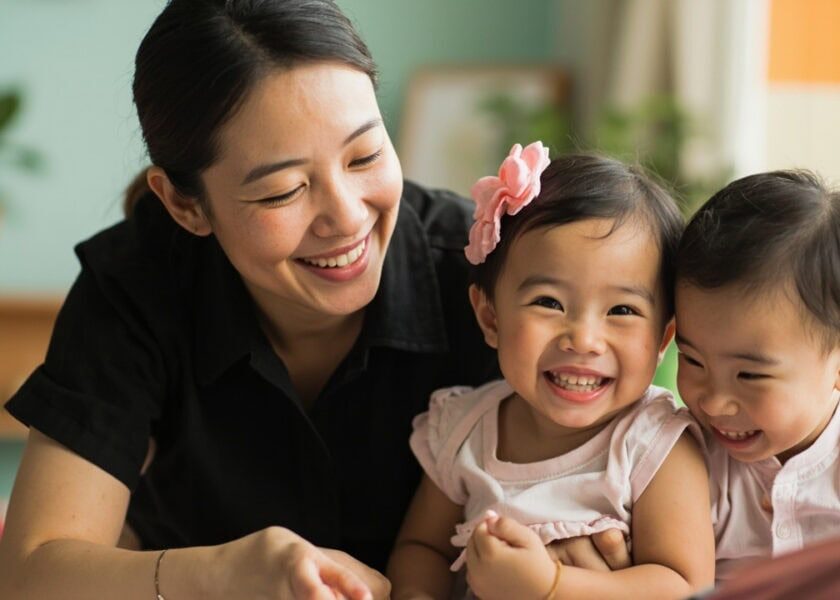
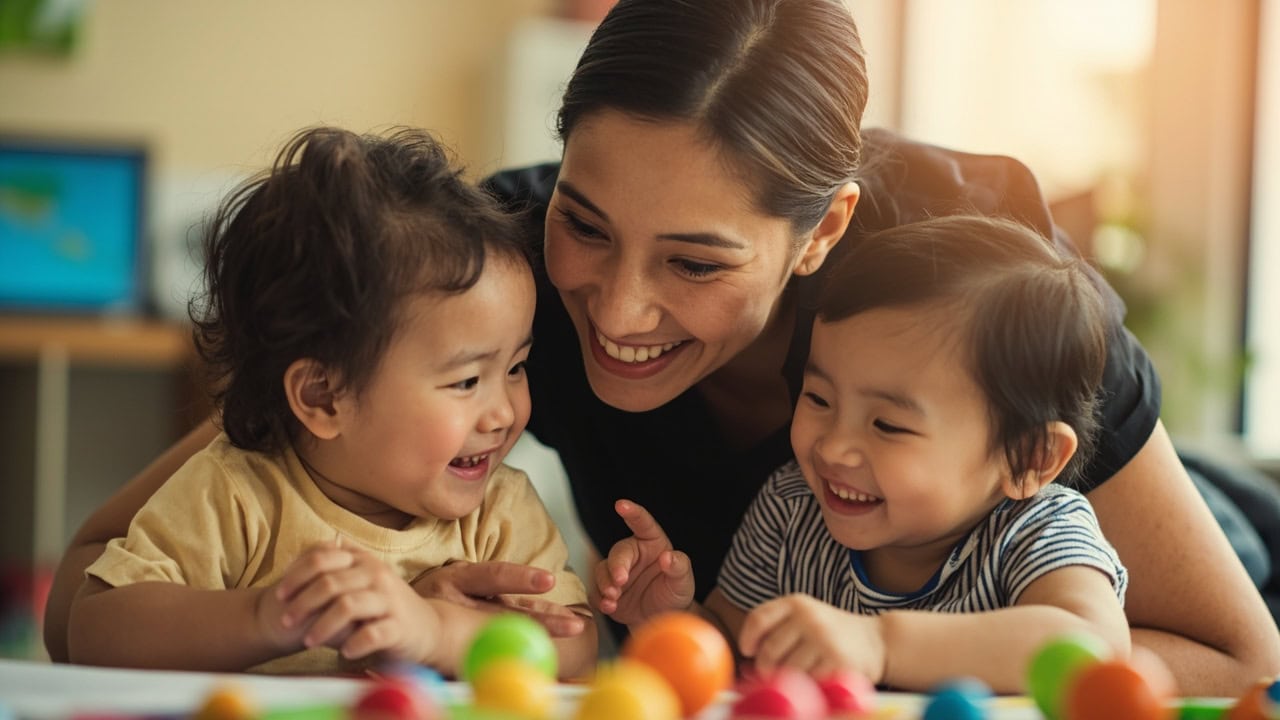
Watch a child who is truly thriving in their care environment. You will notice things that go far beyond whether they are smiling.
- Emotional Regulation: A thriving child has the capacity to feel a big feeling and return to calm. They do not fall apart when something does not go their way. They may protest, feel frustrated or disappointed. But they have learned, in the secure environment of quality care, that big feelings pass. That someone is there to help them through. That they are not alone with their distress.
- Spontaneous Curiosity: A thriving child reaches for the world. They point, they explore, they ask silent questions with their eyes and their fingers. They are drawn to new textures, new sounds, new faces. Quality care does not suppress this curiosity; it cultivates it.
- Social Ease: This is not the same as extroversion. A child can be quiet and still be socially at ease. A thriving child will look to the adults in their environment for security, but also for joy. They will seek connection. They will show interest in other children—sometimes tentatively, sometimes boldly—with a sense that they belong to this social world.
- Comfort in Routine: Young children are not confused by routine; they are nourished by it. When a child knows what comes next, they can relax. They can be present. They can engage. A child who is thriving has internalized the rhythm of their day, and this gives them the freedom to be curious and playful rather than perpetually vigilant.
- Confident Communication: Not just in words, but in gesture, in expression, in the way they use their whole body to make their needs known. A thriving child feels heard. They have learned, through consistent and responsive caregiving, that their communications matter. That when they reach, someone notices. When they babble and experiment with sound, someone is listening.
- Physical Confidence: The body of a thriving child moves with a kind of ease. They are comfortable in their own skin. They have had the space and encouragement to develop motor skills, to test their physical capabilities, to fall and get up and fall again.
- Inner Calm: A thriving child carries a quiet sense of peace. Not an absence of emotion—children feel everything vividly, as they should—but a rootedness. A sense that they are okay, that they are held, that the adults in their environment are steady and reliable. This inner calm is the bedrock upon which all other development rests.
Why Thriving Does Not Happen by Accident
Here is what is important to understand: this kind of thriving does not happen by accident. It is not simply a matter of time passing or a child growing. It is cultivated—or not cultivated—by the environment in which your child spends their early years.
The environment matters enormously. Not just in the abstract, but in the specific, concrete ways that a quality care setting is designed and staffed and run.
When we talk about quality care, we are not using the word loosely. We are pointing to something specific:
- Caregiver ratios that allow for genuine responsiveness—where the numbers of children per caregiver are low enough that each child can be truly seen and known
- Caregiver training that equips them to read and respond to the subtle cues of infant and toddler development
- Physical space that communicates safety and invitation—organized not just for supervision but for flourishing
- Routines structured to provide the predictability that children need while leaving room for spontaneity and discovery
This is why the search for childcare is not merely a logistics exercise. It is one of the most consequential decisions you will make in your child’s early years. The place where your child spends their days is not just a place where they are supervised. It is a place where their brain is being shaped, where their emotional patterns are being established, where their sense of self in relation to others is being formed.
How to Choose with Confidence
So what should you look for? How do you know whether the environment your child is in is one that genuinely supports their thriving?
You observe. Not just at pickup, when everything has been arranged for your eyes, but in the way you can. You watch how the children move through the space. You notice whether they seem tense or relaxed, guarded or open.
You look at the faces of the caregivers and ask yourself: do these adults seem genuinely present? Do they seem to enjoy being with children? Are they calm? Are they responsive?
You watch the interactions—not the grand gestures, but the small, everyday moments of connection. The way a caregiver kneels to speak at a child’s level. The way a cry is met with swift and gentle attention. The way a child’s small accomplishment is noticed and celebrated. These small moments are not small at all. They are the texture of your child’s daily experience, and they add up to something enormous.
You ask questions. Not just about safety protocols and meal plans and nap schedules—though those matter—but about philosophy:
- How does this environment understand child development?
- What do they believe children need?
- How do they support emotional regulation?
- How do they handle the difficult moments?
The answers to these questions will tell you whether this is a place that sees your child as a whole person—an inner world to be nurtured as well as a small body to be cared for.
You trust your own observation. You know your child better than anyone. You know what their thriving looks like, even if you have not yet had the language for it. When you see the signs—the curiosity, the confidence, the social ease, the inner calm—you will recognize them. You have been your child’s first and most attentive observer since the moment they were born. That instinct is not something to override. It is something to trust.
What EduNanny Was Built For
Singapore parents are navigating something genuinely complex: the challenge of returning to work, the challenge of finding care that meets the highest standards, the challenge of trusting someone else with the most precious person in your life.
We know that beneath all the practical arrangements, there is a profound hope—that your child will be okay, yes, but also that they will flourish. That something beautiful and important will be happening during the hours you are apart.
Affordability is a real concern for many families. Quality care should not be reserved only for those with significant resources. The pilot fee structures are designed to make quality care accessible, and CDA and Baby Bonus funds can be used to support enrollment.
Communication and transparency are central to how we work. When parents feel secure in their knowledge of what is happening, they can relax into the confidence that comes from genuine thriving rather than anxiety about the unknown.
EduNanny was founded with this understanding at its heart. We are part of the ECDA Childminding Pilot, which means we operate within a framework that values quality, oversight, and the professional development of caregivers.
Our caregivers are trained not just in the technical aspects of infant and child care, but in the deeper understanding of child development. They know how to read the cues that indicate a child is thriving or struggling. They know how to create environments that invite curiosity. They know how to respond to emotional distress with calm and steadiness. They know how to nurture the inner world of each child in their care.
We offer pathways designed to meet different family needs:
- Home-based care, where your child can thrive in the familiar comfort of their own home environment
- Community-based pathways, where children benefit from small group experiences and rich social interaction
Our caregiver ratios are designed to ensure responsiveness—up to one to three infants, depending on the pathway, so that every child receives the attention and attuned care that thriving requires.
Beyond structures and services, what we want to offer you is something simpler and more profound: the assurance that your child’s inner world matters. That the wellbeing you long for them is not a luxury or an afterthought. That it is the very centre of what we do.
We have also developed resources to support you along the way. Our Thomas AI Chatbot is available to help answer questions about child development, to offer guidance when you are uncertain, to be a resource you can rely on at any hour. Parenting is not a solitary journey, and we want to be a partner you can rely on—not just in the logistics of childcare, but in the larger project of raising a thriving child.
The Decision You Are Really Making
When you choose care for your child, you are not choosing a service. You are choosing an environment in which your child’s inner world will unfold. You are choosing the people who will witness your child’s first discoveries, who will comfort their first sorrows, who will celebrate their first triumphs.
These are not small responsibilities. They are sacred ones. We take that responsibility seriously. We believe that every child deserves to flourish—not just to be safe, not just to be occupied, but to truly thrive. We believe that this thriving is visible, recognizable, and worth attending to with all the care and attention we can muster.
The question you have been asking—Is my child truly thriving?—is the right question. You do not need to set it aside or wait for someone else to answer it for you. You can see it for yourself. You can observe the signs: emotional regulation, spontaneous curiosity, social ease, confident communication, physical confidence, inner calm. You can trust what you see.
And when you see those signs, you will know that your child is not just surviving but flourishing—that something beautiful and important is happening in their inner world, even when you are not there to witness it directly.
EduNanny exists to walk alongside you in this journey. To be the environment your child thrives in. To be the partner you can trust with the most important work of your life: raising a child who is confident, curious, emotionally grounded, socially at ease, and full of joy.
Your child’s inner world is waiting to flourish. Let us help you find the space where that can happen.
Explore how EduNanny supports your child’s holistic development. Visit our website or speak with our team to learn more about our home-based and community-based childminding pathways.
You can also learn more about EduNanny and our commitment to quality, development-focused childminding in Singapore.