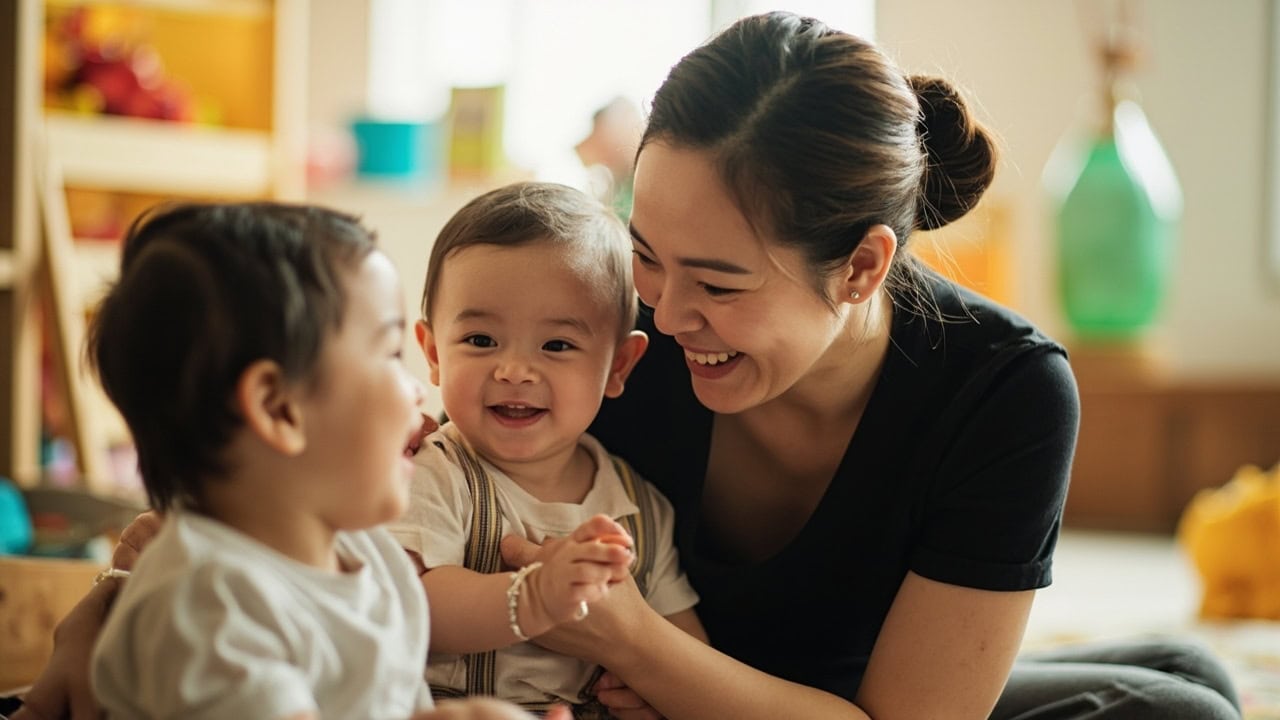
Why Your Child’s Peer World Is the Most Important Classroom
The Social Curriculum: What Your Child Is Really Learning
When you choose childcare for your child in Singapore, you learn quickly what questions to ask. You ask about the caregiver’s qualifications. You ask about the curriculum. You ask about safety measures, nutrition, and how they handle fevers and scraped knees. You ask about daily reports, cameras, and what a typical day looks like.
These are the right questions, and they matter enormously.
But there is a world your child enters each morning that you cannot observe directly, that does not appear on daily report cards, and that shapes them in ways that are difficult to articulate but impossible to ignore. It is the world of the other children. The peer world. The small society of toddlers and infants that becomes, for the hours you are apart, the primary context in which your child learns what it means to be a person among people.
This is the curriculum no one talks about. And it may be the most important one of all.
What Your Child Is Building in Quality Childcare
You will know when your child learns to walk. You will celebrate the first words, the sentences, the questions that never stop. You will notice when they can hold a crayon, when they start drawing faces instead of circles, when they begin to recognize letters and numbers.
These are real milestones, and they deserve your attention.
But the social milestones happen differently. They happen in glimpses. You might notice that your child has started holding hands with another child at the playground, or that they have developed a preferred companion, or that they have begun to say “no” with a conviction that suggests they are discovering the power of their own voice.
The truth is that your child is building something in quality childcare that will serve them for the rest of their lives. They are learning how to be a friend. They are learning how to negotiate, how to share, how to feel the weight of another person’s disappointment and respond to it. They are learning that they are not the only person in the room, and that this is not a tragedy but a gift.
How Peer Learning Unfolds: From Parallel Play to Friendship
In the infant room, in the earliest months of formal care, you will see something that looks, to the untrained eye, like isolation. Children playing side by side. Reaching for the same toy but not quite touching.
This is called parallel play, and it is the foundation of everything that comes after. What is happening here is not loneliness. It is the quiet work of learning that other people exist, that they have intentions, that the world contains desires besides your own. A child in parallel play is beginning to understand that they are one among many.
A trained caregiver in a quality infant environment does not rush this process. They do not force interaction. They create the conditions in which parallel play can deepen naturally into something more. They position children where they can see each other. They narrate what they observe: “I see Mei Ling looking at Jun Wei’s block. Jun Wei has a block too.” They model attention, showing children what it looks like to notice another person.
As children move into toddlerhood, parallel play begins to dissolve. The reaching becomes touching. The watching becomes following. A child who has been playing beside another for months suddenly turns, extends a toy, and waits. The other child takes it. Something shifts.
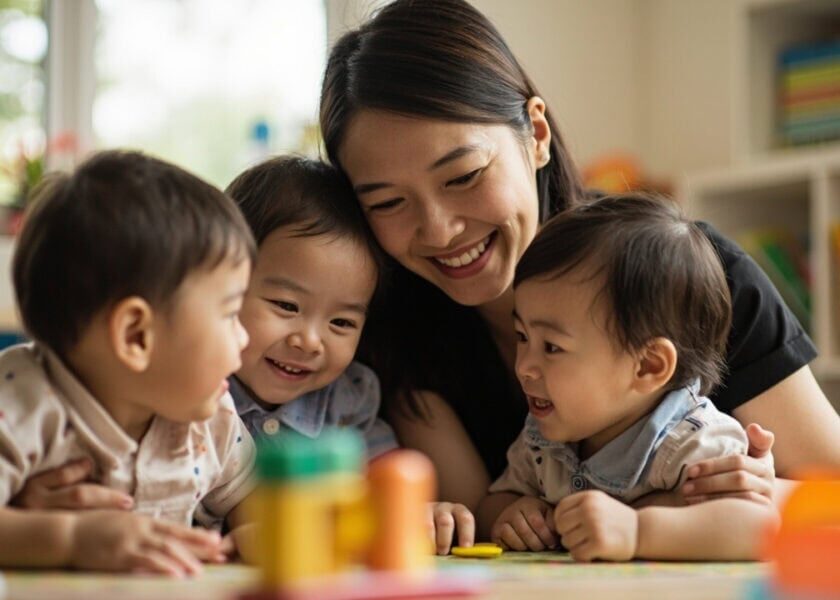
In a quality toddler environment, you will see children learning to cooperate before they have the words for it. You will see them negotiate over a toy using gestures, expressions, the entire vocabulary of pre-verbal communication. You will see conflict—because conflict is where the real learning happens—and you will see trained adults who do not rush in to solve the problem but who stay close, who model calm, who guide children toward resolution without removing the opportunity for growth.
Emotional regulation is one of the most important skills a human being can develop, and children learn it not from being told what to do but from living it, again and again, in the company of their peers. A child who learns to navigate their first social conflict with patient support learns something that no lesson can teach: I can handle this. I can figure this out. Other people’s needs and my own needs can both be met.
Why the Peer Environment Matters More Than You Think
There is a question that sits quietly in the back of every parent’s mind when they drop their child at childcare. It is not about curriculum or qualifications or even safety. It is simpler than that: is my child happy? Are they okay? Are they building something good while I am away?
Your child’s happiness is not only about being comfortable or safe. It is about belonging. It is about being known. It is about waking up each morning and knowing that there are people who expect you, who are glad you came, who will remember what you liked to play with yesterday and save it for you today.
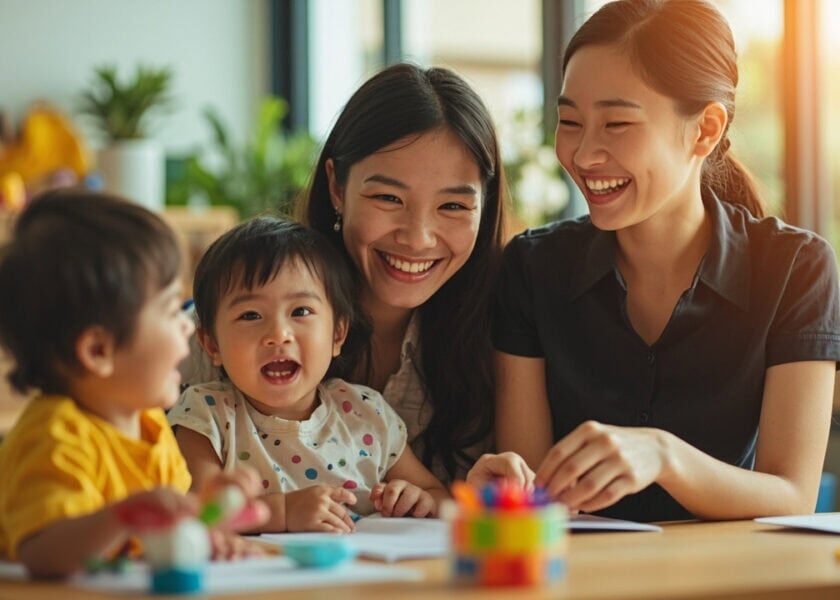
In quality childcare, this is what the peer world provides. It provides a micro-community in which your child is not just a name on a register but a person with a place. It provides the child who will notice when they are upset, the child who will learn, alongside yours, how to be a good friend.
Home, however loving, cannot fully replicate this. Home has adults who love you and siblings if you are lucky, but it does not have the particular crucible of childhood friendship, where status does not matter and kindness is learned by necessity.
Belonging, Not Just Supervision
There is a difference, and it is the difference that changes everything. It is the difference between children being supervised and children belonging.
A supervised child is safe, occupied, watched over. This is necessary and good. But a child who belongs is different. A child who belongs knows that they matter to the group, that their presence makes a difference, that there are people who will miss them if they are absent.
A child who belongs learns, in the deepest possible way, that they are worthy of connection.
This is not a luxury. This is the foundation of mental health, of relationship, of the ability to navigate the social world with confidence and compassion. In quality childcare, this belonging is cultivated deliberately. It is not left to chance. It is woven into the daily rhythms, the caregiver training, the way group activities are structured, the way conflicts are resolved, the way individual children are noticed and named and celebrated.
What EduNanny Singapore Offers
EduNanny Singapore operates as part of the ECDA Childminding Pilot. This means the programme is designed with intentionality, built with developmental principles at its core rather than convenience. Whether your child is in a home-based setting or a community or centre-based pathway, they are in an environment structured to support exactly this kind of growth.
The ratios matter here. With up to one caregiver for every three infants in our infant programme, your child receives the individual attention that builds security, while still being part of a peer group that builds everything else. They are not lost in a crowd. They are known, and they are also together. Both of these things are necessary for the social education we are describing.
The practical matters matter too. Monday to Friday care blocks, CDA and Baby Bonus usability, transparent communication and CCTV measures where deployed—these are not just administrative features. They are the conditions that allow parents to relax, to trust, to let go of the background anxiety that makes it hard to believe their child is truly happy.
When you know that the logistics are handled, you can be present. When you trust the environment, you can let your child belong to it fully.
What to Look For When You Visit
- Observe how caregivers interact with children: Do they narrate what they see? Do they model attention toward other children? Do they position children to notice each other?
- Notice the physical environment: Are children arranged where they can see and reach each other? Is there space for parallel play to become interactive play?
- Watch how conflicts are handled: Do caregivers step in immediately, or do they stay close and guide resolution? The goal is not to prevent conflict but to support children through it.
- Ask about group dynamics: How does the setting ensure stability in peer relationships? Do the same children spend time together regularly, building familiarity and trust?
- Look for signs of belonging: Do caregivers know each child by name? Do they notice when a child is absent? Do children seem comfortable with each other?
You Are Building Something Good
You are doing something that is not easy. You are navigating the complex, often guilt-laden landscape of early parenthood in Singapore, where the pressure to make the right choices is constant and the information is overwhelming.
You are making decisions about childcare with incomplete information, trusting that the place you choose is good for your child even when you cannot be there to see it. This takes courage. It takes trust. It takes the willingness to believe that your child is building something valuable even when you are not there to witness it.
I want you to know that they are.
In quality childcare, your child is not just being cared for. They are being shaped. They are learning to be a friend, a playmate, a collaborator, a negotiator, a comforter. They are learning that other people matter, that they matter, that the social world is complex and sometimes difficult but also rich and rewarding. They are building the foundation for every relationship they will ever have.
And when they come home at the end of the day, tired and full of the small dramas of their peer world, they are bringing something back to you. They are bringing the beginning of a person who knows how to belong.
This is what we build, at EduNanny Singapore. We build the community that raises your child. We build the peer world that teaches what no lesson plan can teach. We build the place where your child belongs.
You chose well. Trust that. Trust your child, who is more capable than you know. And trust the place you have chosen, because the peer world your child is building in quality childcare is one of the most important worlds they will ever belong to.
It is the world that will carry them forward.
To learn more about how EduNanny Singapore creates quality peer environments for infants and toddlers, speak with our team. We are happy to answer your questions and help you find the right fit for your family.