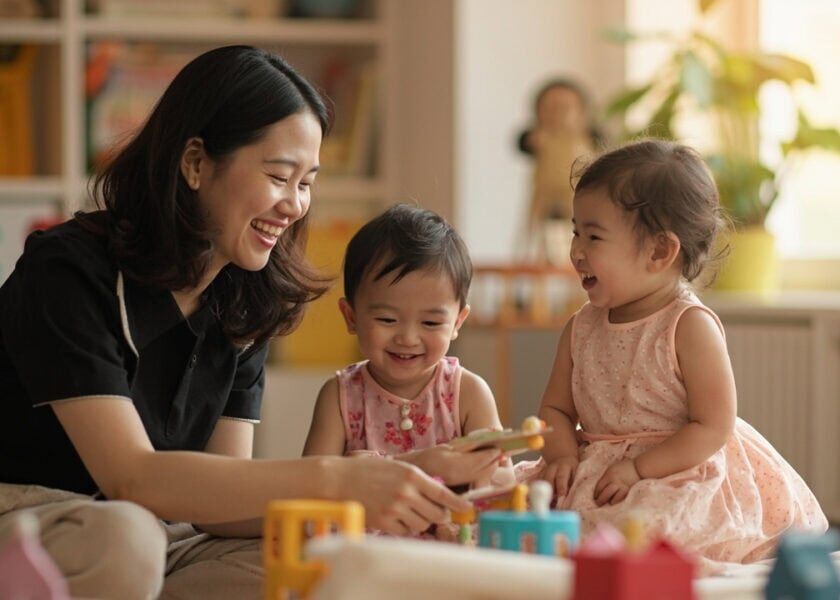
Your Family Village Awaits: Design It With Intention in Singapore
Quick Summary: Reframing Childcare as Family Design
- The tension is real: Singapore parents often feel caught between wanting quality professional care and honoring their parents’ desire to be involved
- The reframe: Professional childcare and grandparent involvement are not competitors. They are partners in your child’s village
- Children thrive with multiple caring adults: Different people bring different strengths, and that richness benefits development
- You can do both: Choosing professional care does not mean rejecting family. It means designing a family arrangement that works for everyone
- The conversation matters: Talking to grandparents about roles and expectations transforms rejection into invitation
The Unspoken Tension Every Singapore Parent Knows
Ask any parent in Singapore about childcare, and the conversation quickly moves beyond logistics. Beneath the practical questions—caregiver ratios, operating hours, curriculum frameworks—lies something deeper. A quiet anxiety. A sense of carrying an impossible weight.
On one side: the genuine desire to give their child the best start in life. You have read the research. You know the importance of those first thousand days. You understand that infants need responsive, intentional care that supports cognitive, emotional, and social development.
On the other side: your own parents. Generations of Singaporean families built their villages the same way—grandparents raised children, grandchildren came after, and love expressed itself through caregiving. To choose differently feels, in some quiet corner of the heart, like choosing away from family. Like rejection. Like telling the woman who raised you that she is not enough.
But here is what we need to say clearly: that feeling is not a truth. It is an assumption. And assumptions can be examined.
Love Is Not a Pie: A New Way to See It
The assumption that professional childcare and grandparent involvement are competitors is so deeply woven into how many Singapore families think about this topic that we rarely examine it. But when we do, we see something important.
The assumption only holds if we accept a false premise: that love is a finite resource. That a child can only have so many people who truly care for them. That bringing in skilled, trained, dedicated professional care somehow diminishes what grandparents offer.
But love is not a pie. It does not run out when it is shared.
In fact, what both research and the lived experience of families across Singapore and around the world tell us is something far more hopeful: children thrive when they have multiple caring adults in their lives. They thrive when those adults bring different strengths, different kinds of attention, different rhythms of play and comfort and learning.
A grandparent offers a child something irreplaceable: the presence of their history, their stories, their unconditional love rooted in the deepest family bond. A trained professional caregiver offers something equally irreplaceable: developmental expertise, consistent routines, intentional early learning, and a relationship built on the child’s individual needs.
These are not the same thing. And that is precisely why both matter.
What the Best Arrangements Actually Look Like
Think about what happens in the childcare arrangements that work best. The grandmother who picks up her grandchild from care and spends the afternoon at the park, present and joyful, because she is not exhausted from six hours of active caregiving. The grandfather who reads stories on the weekends because he has not spent all week on toddler duty. The parent who returns to work with confidence because they know their child is in skilled hands, and then comes home to a child who runs to greet them, who has had a rich day.
This is not a compromise. This is not settling. This is what a healthy family village actually looks like.
The Village Has Always Been More Than One Person
The phrase “it takes a village” has become so familiar that we have almost stopped hearing it. But the village has always been more than one person, more than one generation. It has always been a network of roles, each one distinct, each one contributing something different to the child’s world.
What we are doing now, in this generation, is not breaking that tradition. We are simply adding a professional role to it. A role that exists precisely because we now understand more than ever before about how children develop, about the importance of those first thousand days, about the kind of intentional care that supports cognitive, emotional, and social growth.
This is not about replacing wisdom with expertise. It is about recognizing that both have their place. The patience that comes with having seen it all before. The stories that connect a child to where they come from. And the expertise of dedicated professionals who have trained to understand infant development, who can recognize developmental milestones, who can create environments that support learning through play.
These things do not compete. They complete each other.
Professional Does Not Mean Cold
Here is something important to understand: professional does not mean cold. Trained does not mean impersonal. At its best, professional infant care is warm, responsive, and deeply relational.
It is built on the understanding that a baby’s brain is forming new connections every second, that the quality of care they receive shapes their sense of security, their ability to trust, their capacity to explore the world with confidence. That is not a clinical fact. That is a sacred responsibility. And the professionals who take it on deserve to be seen not as substitutes for family, but as allies in the work of raising the next generation.
What Quality Childminding Actually Looks Like
For parents researching their options, knowing what to look for matters. Quality childminding is not just about safety—though safety is foundational. It is about something more subtle: the quality of attention your child receives.
Consider these markers of genuine quality:
- Responsive caregiving: Caregivers who notice your child’s cues, who respond promptly to crying, who learn the difference between your baby’s “I’m hungry” cry and “I’m tired” cry
- Developmentally appropriate environments: Spaces designed for exploration, with age-appropriate materials that invite curiosity and learning through play
- Communication and transparency: Regular updates about your child’s day, their mood, their milestones, their challenges—because you cannot ask an infant what happened while you were away
- Appropriate ratios: Small enough groups that every child receives individual attention, large enough that children benefit from peer interaction
- Trained caregivers: Not just anyone who loves children, but people who understand infant development, who can support emerging skills, who know what to expect at each stage
These are not luxuries. They are the basic conditions that allow children to flourish in the first years of life—when the architecture of the brain is being built faster than at any other time.
Having the Conversation That Matters Most
There will be a conversation you may need to have. A conversation with your own parents about roles and expectations, about what you need and what they want to give.
That conversation is not easy. It carries decades of relationship, cultural expectations, and love that does not always know how to express itself in new ways. Singapore families have deep traditions of intergenerational caregiving, and choosing differently can feel like a rejection of everything those traditions represent.
But it is a conversation worth having. And the frame for that conversation is not rejection. It is invitation.
What if you approached this conversation not as defending a choice, but as extending an invitation? What if you could say: “We need you, and we also need this. You are not being replaced. You are being invited into a new configuration of the family we are building together.”
Some families find it helpful to be specific about what they are asking for. Perhaps grandparents can be the special weekend people—the ones who take children to the park, who read stories at bedtime, who represent the continuity of family history and the particular joy of being a grandchild rather than a parent. Perhaps they can be the people who are present at birthdays and festivals and ordinary Tuesday dinners, without the exhaustion of being primary caregivers.
This is not a lesser role. It is a different role. And for many grandparents, it is a role they actually want—once they understand that it is available to them.
Give Yourself Permission First
Before you can have this conversation with your parents, you may need to have it with yourself. You need to give yourself permission to want more than one kind of love in your child’s life. Permission to want the warmth of your parents and the expertise of trained caregivers. Permission to want your child to know their grandparents intimately, to spend holidays and weekends and quality time together, and also to spend their weekdays in an environment designed for their development.
You are allowed to build a family arrangement that includes multiple people who love your child, each in their own way, each with their own strengths.
You do not have to choose between honoring your parents and choosing the best care for your child. You can do both. And when you do, you are not abandoning a tradition. You are extending it. You are saying: this is my village now, and I am designing it with intention.
You Are Allowed to Trust Your Own Judgment
Your child does not need you to be everything. No child has ever needed that, and no parent has ever been able to provide it.
Your child needs you to be present. To be loving. To make good decisions on their behalf. And to surround them with a network of care that reflects the complexity and richness of the world they are growing into.
That is not a failure of parenting. That is parenting.
The guilt that many parents carry about childcare choices often comes from an unspoken belief that they should be able to do it all—that wanting help is weakness, that relying on others is failure. But the research on child development tells a different story. Children whose parents feel supported and confident do better. Children who have warm, stable relationships with multiple caring adults do better. Children whose parents make intentional choices about care do better than children whose parents make guilt-driven choices that leave everyone exhausted and resentful.
Choosing what is right for your family is not selfish. It is good parenting.
EduNanny by BUTLER: Joining Your Village
We want to be honest about who we are and what we offer, because trust matters more than promises.
EduNanny by BUTLER is part of the ECDA Childminding Pilot. This means our approach is grounded in standards that take infant and early childhood development seriously—not as an afterthought, but as the foundation of everything we do.
We offer pathways that include both home-based and community or centre-based options, because families are not all the same. The right arrangement is the one that fits your life, your home, your relationships, and your child’s needs. Some families need care in their own space. Others benefit from the social environment of a quality centre. We work with you to find what works.
Our caregiver-to-infant ratios are designed to ensure that every child receives the attention and responsive care that their development requires. We know that infants cannot advocate for themselves. They cannot tell you if they had a good day, cannot explain what they learned or how they felt. That is why we build in communication, transparency, and trust at every level.
For working parents, our care operates on a Monday to Friday structure, with care blocks designed to fit the rhythm of working life. The pilot fee structures are built to be affordable and accessible. And where applicable, your Child Development Account and Baby Bonus can be used—because quality care should not be a privilege reserved only for families with unlimited resources.
A New Framework for an Old Question
The choice you are making is not between family and quality. It is not between tradition and progress. It is between an old framework that told us we had to choose and a new understanding that says:
We can have both. We should have both. And our children will be stronger for it.
You are building something. A family. A future. A village that can evolve and grow. Trust that building. Trust that the love you feel for your child and for your parents is not pulling you in opposite directions. It is pointing you toward the same destination: a child who is safe, who is loved, who is developing into everything they can be.
EduNanny by BUTLER is part of that network. We are not here to replace your village. We are here to join it, to complement it, to bring professional expertise and genuine care to a family system that already has love at its center.
We know that you are entrusting us with something precious. We do not take that lightly. Every routine we design, every communication we send, every caregiver we train is in service of one simple goal: to be worthy of the trust you have placed in us.
If you are ready to explore what a childcare arrangement designed with intention looks like for your family, we would be honored to walk alongside you. Not as the only answer, but as part of your answer. Not as a replacement for the people you love, but as support for the family you are building together.
The village you are creating is real. And you do not have to build it alone.