The Daily Words That Bridge Trust in Singapore Childcare
Two Pictures of the Same Morning
Let us paint two pictures.
The first: You drop your child off. The caregiver looks up, nods, takes your child’s hand. You say have a good day. They say they will. You leave. At pickup, you ask how it was. They say fine, good day, no issues. You nod. You leave.
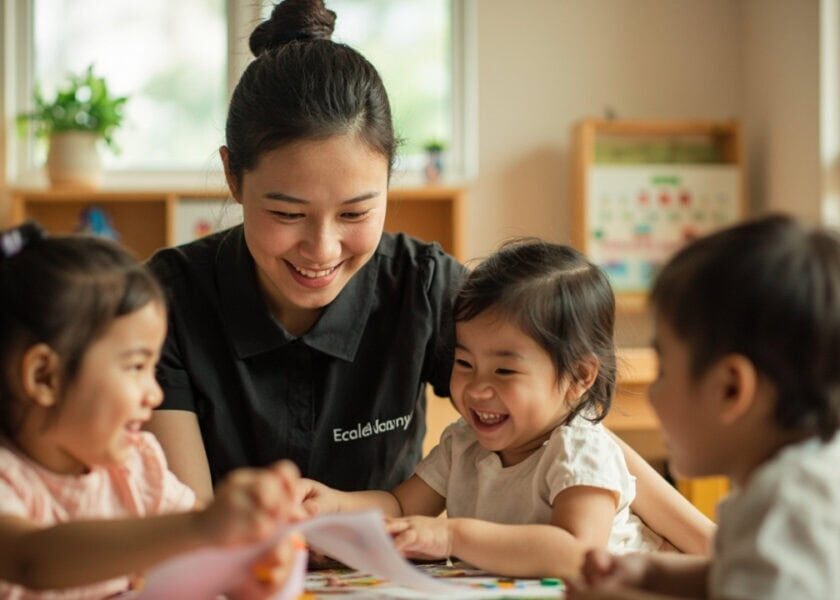
The second: You drop your child off. The caregiver meets your eyes, notices the new shoes your child is wearing, and asks if they are for walking practice. You mention they have been trying to climb everything lately. That evening, the caregiver tells you they spent extra time on the climbing structure today and discovered your child uses both hands equally — a small detail that would have been invisible unless someone was paying close attention. And the next morning, when you mention your child was up twice last night, the caregiver nods and says they noticed a slight rash on the arms — nothing serious, but they wanted you to know so you could watch it at home.
Same centre. Same caregiver. Completely different experience.
The difference is not the facility. The difference is communication.
The Daily Language of Quality Care
This is what we call the daily language of quality care. And it is the most overlooked indicator of whether your childcare is truly excellent or simply adequate.
Most parents do not know to look for this. You have been taught to ask about ratios, qualifications, curriculum, food menus. Those are the questions that appear in every guide, every forum, every tour checklist. And yes, they matter. But they only get you to the door. Once your child is inside, the quality of care is carried in language — in what the caregiver notices, what they share, what they ask, what they remember.
When a caregiver tells you your child said a new word today, that is not small talk. That is a signal that they are paying attention to who your child is becoming.
When they mention a struggle — a conflict over a toy, a moment of frustration — that is not a complaint. That is an invitation to work together.
When they remember details from previous conversations, follow up on things you mentioned in passing, reference your family’s routines or your child’s particular quirks — that is not incidental. That is the architecture of partnership.
What quality communication sounds like
In the morning: Notice whether the caregiver is present and attentive, or distracted and transactional. Notice whether they receive your child with their full attention or with one eye on their phone. Notice whether they ask you anything — not just for form’s sake, but because they genuinely want to know. A caregiver who asks about your child’s night, who notices a change in mood, who asks about something you mentioned days ago — that is language. That is care in motion.
In the evening: Notice whether the caregiver gives you anything specific. Not just a report card of meals and naps — those are logistics. Logistics are the minimum. What you want to hear is observation. What you want to hear is your child reflected back to you. Did they do anything surprising today? Was there a moment that moved them? Were they different than usual in any way?
These are not big revelations. They are small, daily proofs that someone is watching your child as a person, not just as a task.
Trust Without Communication Is Just Hope
Here is what makes this so difficult for Singapore parents: you want to trust. You genuinely do. You did the research, you made the choice, you want to believe you chose well.
But trust without communication is just hope. And hope, while beautiful, is not a strategy for knowing whether your child is thriving.
The real question is not whether you trust your childcare. The question is whether your childcare is communicating in a way that lets you verify that trust.
If you are not hearing this, the instinct is often to assume the worst — that the care is not good, that you chose wrong. But consider a different possibility: the caregiver may be competent but untrained in the art of communication. They may be doing excellent work but have never been taught that sharing it matters. Or the centre may be understaffed, stretched thin, running from pickup to dropoff without time to breathe.
Communication gaps are not always signs of bad care. Sometimes they are signs of a system that has not made communication a priority.
Even the best childcare will have days that feel thin. There will be mornings when the caregiver is rushing, when the handoff is rushed, when you leave with a vague sense of incompleteness. There will be evenings when you ask how the day was and the answer is not as rich as you hoped.
This does not mean the partnership is broken. It means you are in a relationship — and relationships have rhythms, and not every note is a chord.
What matters is the pattern over time:
- If thin days are rare and rich days are common — you are in a healthy place.
- If thin days are the norm and rich days are exceptional — you have information. And that information is valuable, not to judge, but to act on.
What You Can Do as a Parent
The parents who feel most connected to their child’s care are not passive receivers. They are active participants. Here is what that looks like in practice:
Ask better questions
Not just “how was your day,” but:
- What was the best part?
- Who did you play with?
- What did you build?
- What did you try that was new?
- Did they seem rested when they woke?
These are not interrogative. They signal to the caregiver that you are an active participant. And most caregivers, when they sense that parents care about these details, begin to share them.
Share from your side
Do not wait for the caregiver to ask about your child’s life outside the centre. Tell them:
- Mention that your child has been working on something at home — a puzzle, a book, a phrase.
- Mention a change in routine or a family event.
The more you give, the more you receive. Communication is a loop, and it requires both ends to be open.
Acknowledge what you are given
If your caregiver shares something specific about your child — a moment of frustration, a new skill, a particular friendship — do not let it disappear into the pickup rush. Acknowledge it. Ask a follow-up question. Let the caregiver know that these details matter to you.
This is not about being demanding. It is about being present. And presence is contagious. When caregivers see that parents are genuinely engaged, they tend to rise to meet that engagement.
Trust without check-listing
Trust that the caregiver is capable and caring. But then let that trust be reinforced by evidence, not just assumption. Ask for what you need. Observe what you are shown. Build the relationship as an active participant, not as someone waiting to be reassured.
A simple communication quality check
| Element | Adequate | Excellent |
|---|---|---|
| Morning handoff | Transactional, brief acknowledgment | Present, asks questions, notices details |
| Evening pickup | Logistics: meals, naps, diaper changes | Observations: mood, interactions, discoveries |
| Following up | Only addresses issues that arise | References earlier conversations, follows through |
| Sharing news | Only when something notable happens | Daily, specific, child-centred observations |
How EduNanny Bridges the Communication Gap
EduNanny was built with this gap in mind. Not just as a nice-to-have feature, but as a core operating principle.
When you work with EduNanny, you are not just accessing childcare. You are entering into a relationship designed for transparency, responsiveness, and daily partnership.
Operated under the ECDA Childminding Pilot, EduNanny by BUTLER has been structured from the ground up to offer something different:
- Ratios up to 1:3 for infants — meaning caregivers have the capacity to truly know each child in their care, not just manage them.
- Home-based and community pathways — care happens in environments designed for warmth and attention, not throughput.
- Accessible fee structures — CDA and Baby Bonus funds can be used, removing unnecessary financial friction for families across Singapore.
But what matters most is not the logistics. It is the culture.
EduNanny has built communication into how they operate. Caregivers are trained not just in safety and development, but in the practice of daily sharing. They understand that parents need to know what happened, not just that their child was fed. They have systems — structured handoffs, observation notes, responsive messaging — that make daily communication a standard, not a bonus.
This is what it means when EduNanny says they stay with you after the decision. Most providers are excellent at winning your trust during enrollment. EduNanny is designed to earn it again, every single day.
What this looks like from a parent’s side:
- You drop your child off on a Monday morning, mention in passing that they have been obsessed with trucks lately. By Wednesday, your caregiver has built a small truck-themed activity and sends you a photo of your child arranging them by colour.
- You mention at pickup that your child has been resistant to naps. The next day, your caregiver tries a different approach and lets you know what worked.
- You simply arrive to collect your child and find that the caregiver has been tracking a new physical skill — the way your child is climbing differently now, the new sounds they are attempting — and shares it as casually as passing you a cup of coffee.
This is not exceptional. This is supposed to happen. And in the right environment, it does.
Your Invitation
The best childcare does not just keep your child safe. It speaks to you every day about who your child is becoming — not in grand pronouncements, but in the small, daily language of attention.
In the note about how your child stacked the blocks today. In the comment about a new word. In the observation that they seemed proud of something. In the question about a bruise you had not noticed. In the conversation at pickup that makes you feel seen as a parent, not just as a handoff point.
EduNanny was built for parents who want this. Parents who understand that the decision to return to work, to entrust someone else with their child’s earliest years, is not a diminishment of their role as a parent — it is an expansion of it.
Parents who know that they are still the primary architects of their child’s world, and who need a partner who respects that architecture enough to stay in conversation.
If you are one of those parents, know this: you are not imagining the gap. You are not being too demanding. The silence you feel after drop-off, the uncertainty that lingers through the workday — these are real, and they point to something that matters.
They point to the need for communication. They point to the need for a childcare provider that does not just open its doors and hope for the best, but one that actively builds a bridge between your child’s day and your understanding of it.
When you drop your child off tomorrow morning, pay attention to what you feel. If it is only hope, that is a starting point. But ask yourself what it would feel like to also have evidence. To have language. To have a caregiver who communicates not just that your child is fine, but who they are today, what they did, who they are becoming.
That is not an unreasonable ask. That is the minimum of what partnership means.
And for parents in Singapore who have been carrying quiet uncertainty, who have been trusting without seeing — this is your invitation to ask for more. Not with suspicion, not with complaint, but with the quiet confidence of a parent who knows that communication is not a luxury. It is how we know that the people caring for our children are truly with us.
EduNanny is listening. And they are ready to speak.
Ready to explore a different approach to childcare in Singapore?
EduNanny by BUTLER offers home-based and community childminding under the ECDA Childminding Pilot — designed for parents who want daily partnership, not just daily supervision.
Connect with EduNanny to learn more about their approach to daily caregiver communication and how they support families across Singapore.