The Truth About What Your Child Carries Home from Care
The Question You Were Never Sure You Were Allowed to Ask
There is a moment — and you probably know the one. When you hand your child over at the door and watch them walk, or be carried, into someone else’s morning. You kiss the top of their head. You say the things you always say. And then you step back, and the door closes, and you are left with a question that has no satisfying answer.
What is actually happening in there, inside that building, inside my child’s chest, in the hours between now and the moment I see them again?
You are not a bad parent for wondering this. You are a parent who has been handed something extraordinary and asked to navigate it without a map.
You have read the handbooks. You have toured the centres. You have asked the right questions about ratios and credentials and curriculum frameworks — and you have received the right answers. They have helped you feel confident that your child is somewhere that meets the standard. But somewhere beneath that confidence, there is still a small, persistent wondering. Not about safety. Not about learning. But about feeling.
What is my child actually feeling right now? Is she scared? Does he think I left him? Is she okay — not okay as in safe and fed, but okay as in whole, as in held, as in growing into something good while she is away from me?
This is the question we want to sit with today. Because it is the truest one — and it is the one we rarely let ourselves ask directly.
Walking Into the Room: What Separation Actually Looks Like From Your Child’s Side
Let us try to describe what we have seen, because seeing it changes everything.
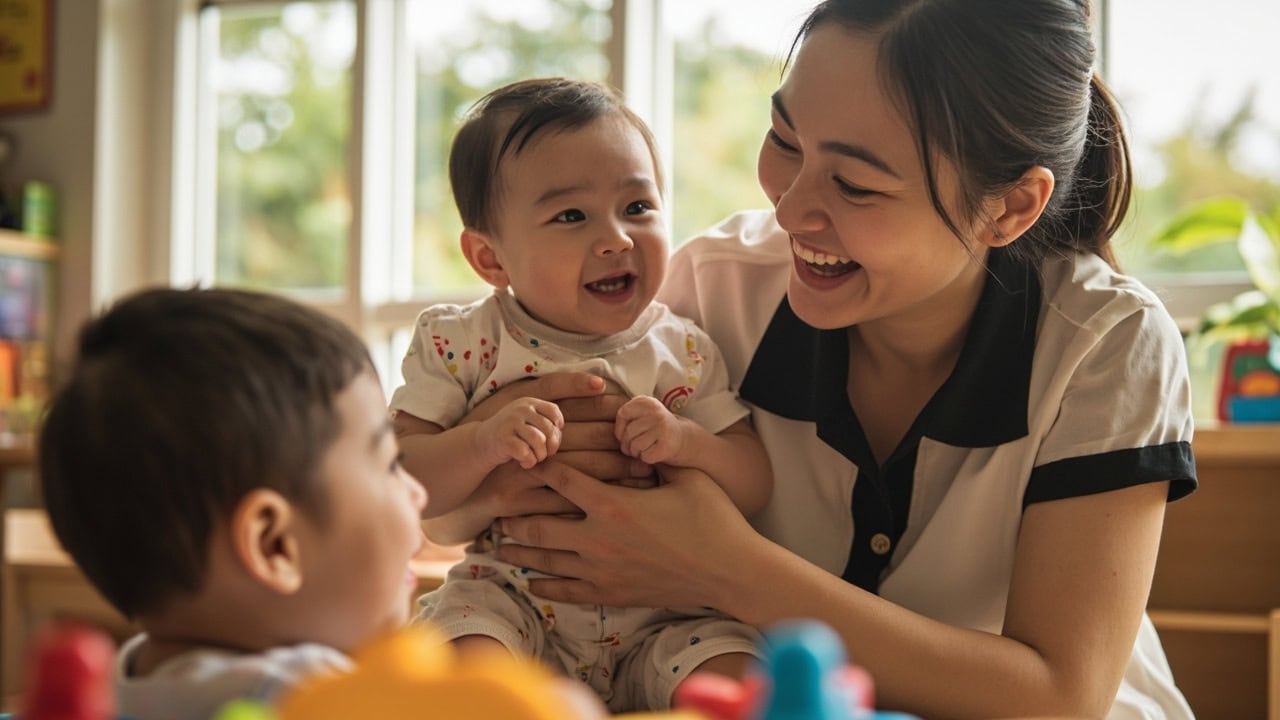
Walk with us, for a moment, into a room where a small group of children — three, five, eight, depending on the setting — are beginning their morning. The room is not large. The walls might be pale yellow or warm white. There are low shelves with open-ended materials. There is a reading corner with a small couch that has been sat on so many times it has begun to shape itself around children’s bodies. The caregiver is kneeling — not crouching, not leaning, but kneeling — so that her face is level with the children’s faces. She is not managing them. She is joining them.
And your child — your child who just ten minutes ago may have cried at the door, or gone stiff with reluctance, or simply stared at you with an expression so complex you still think about it on the bus to work — is standing in the middle of this room, taking it in. Taking in the sound of other children. Taking in a smell that is not home. Taking in the particular way this person, this caregiver, moves through the space.
What is happening in that child’s body and mind is not nothing. It is, in fact, one of the most extraordinary and underrated processes of early childhood: the slow, uneven, achingly brave act of expanding one’s sense of the world.
Separation Is a Series of Small Thresholds
It is not a single event. It is a series of small thresholds, and each one is met and re-met with slightly different results.
- Monday: Your child falls apart at the door.
- Tuesday: He falls apart but stops sooner.
- Wednesday: He walks in and looks for one particular toy before he remembers to be uncertain.
- Thursday: He does not cry at all — and you feel guilty about having worried, and then guilty about feeling guilty, and that is its own kind of exhaustion.
And then one morning — it will not be predictable, and it will not be on your schedule — he will walk into that room and something will settle in his body. A kind of recognition. Oh. This place again. These people again.
He will move toward the shelf where the wooden animals live, and another child will come and sit beside him, and neither of them will say anything. That silence is the beginning of something. That something is belonging — not the adult idea of belonging, but the child’s idea. The visceral, sensory, moment-to-moment experience of being in a place where I am known. Where that person remembers that I like the yellow cup. Where that other child and I have learned that we do not need to talk to be together.
The Science of What Your Child Is Learning in Group Care
This is not sentimentality. This is what developmental science describes as happening — and precision matters when we are talking about your child.
The group setting of quality infant care gives children something a home environment, however loving, cannot replicate in quite the same way: the experience of navigating emotional complexity among peers.
Consider what this means in practice. A child learns that someone else can feel what she feels. That another child also wants the red truck. That frustration exists and it does not destroy me or the other child or the room. That there is a word for what I am experiencing — I am frustrated, I am excited, I am surprised — and that saying the word helps.
In a home where an only child is surrounded by adults who love them and anticipate their every need, there is limited opportunity to encounter emotions in their full, uncontrolled, relationship-disrupting reality. In a group setting, she is bumped into. She is disappointed when the swing is taken. She is surprised when a peer shares. She is indignant when someone takes her block.
And there, in real time, a skilled caregiver does what only the best emotional teachers do — she names what is happening. Not to manage the child. Not to end the feeling. But to be with the child inside the feeling and hand her the language for it.
“I see that you are feeling really angry right now. That is a big feeling.”
And something shifts. The feeling has been seen, and being seen by someone who stays is different from being managed. A child who experiences this — consistently, patiently, across months — begins to internalise something remarkable. She begins to believe that her feelings are survivable. That they can be named. That they do not require her to fall apart or shut down. That there is a way to be a whole person with big feelings, because she has watched it modelled, over and over, by an adult who was never impatient with her complexity.
The Caregiver: At the Centre of Everything, and Often the Least Described
We want to say something about the caregiver, because she is at the centre of all of this and she deserves more than a footnote.
We have a word for what she does — childminder, caregiver, educator — and none of the words quite capture it. What she is doing, across a day that begins before your morning coffee and ends after your evening commute, is holding a psychological container for a small human being.
She is not just feeding and soothing and protecting. She is being the steady presence around which a child organises his understanding of safety, of otherness, of how the world works when the people who made him are not here.
That is an enormous thing to ask of a person. Quality care begins with the person doing the caring — their training, their emotional attunement, their capacity to kneel down and mean it. Within the ECDA-aligned Childminding Pilot framework, that recognition is not just philosophy. It is structure. It is oversight. It is the kind of intentional, principled approach that lets you, as a parent, rest knowing that the person holding your child’s inner world is not improvising.
She has been prepared for it. She has been supported in it. And she is being seen herself — which is the only way she can keep seeing your child.
What Your Child Brings Home: The Hidden Richness of the Day
Here is what we find most quietly beautiful about the hours your child spends in quality care — and it is what you will notice most when you pick them up.
It is not in their bag, though sometimes there is a painting or a torn piece of paper with something that might be a bird. It is not in their body, though they are usually tireder and often hungrier in that specific way that means they have used their body and mind fully. But it is in the way they play after you collect them. In the way they narrate — in fragments, in non-sequiturs, in the sudden declaration of a name you have never heard before — their day.
“I played with Kai.”
“The fish is sad.”
“We read the blue one.”
You lean in. You ask questions. And slowly, from these small offerings, you begin to reconstruct something you were not present for. You begin to realise that your child has been having an inner life — a rich, textured, entirely human inner life — without you.
And this should be a source of grief — and sometimes it is, because parenting is full of the bittersweet knowledge that your child is becoming a person who needs you less. But it can also be a source of something extraordinary. Not just pride, but curiosity. A new desire to know this version of your child. The version who exists in the hours you are not there. The version who is learning to belong to something beyond you, and who is somehow, miraculously, carrying what she learns back into the relationship with you.
Because that is what the best childcare does, when it is done beautifully. It does not replace the parent. It does not diminish the bond. It expands it.
Choosing Quality Care in Singapore: Framework, Settings, and What to Ask
When Singapore parents research infant care and childminding, the discussion often centres on matters that are genuinely important — ECDA licensing requirements, caregiver-to-child ratios, CDA portability, Baby Bonus usability. These things matter. They are the architecture of trust.
But beneath these practical considerations lies the real question: what is your child doing with those hours? Not whether they napped at the right time or learned their colours. But who they are becoming — and what that becoming means.
Home-Based or Centre-Based: Why the Setting Matters Less Than You Think
The ECDA Childminding Pilot offers both pathways, because the right setting is not a universal answer but a contextual one.
For some children, the intimacy and scaled-down sensory environment of a home-based setting is where they feel safest. The smaller group, the house-like space, the particular rhythms of a family home — these can be deeply reassuring for a child in the earliest months of separation.
For others, the richness and social complexity of a centre-based group is where they discover themselves. The variety of peers, the range of materials, the larger world of sounds and movements and social possibilities — these are where a different kind of child finds her footing.
What matters is not the setting label but the quality of the emotional environment within it. With infant-to-caregiver ratios of up to one-to-three in the earliest months, your child is not one of twelve. She is one of three. She can be known, specifically, by name, by a voice, by a person who knows her rhythms the way you do.
Questions to Ask Before You Choose
These questions will tell you the most — not just about logistics, but about the emotional quality of the care your child will receive.
About the caregiver:
- What training has the caregiver completed, and how does the programme support their ongoing professional development?
- How long has the primary caregiver been in this role? Consistency of attachment matters enormously in the first months of care.
- What does a typical day look like from the child’s perspective — not the schedule, but the emotional rhythm?
- How does the caregiver respond when a child is distressed? What words do they use?
About the environment and communication:
- What is the infant-to-caregiver ratio, and is this consistent across the day?
- How will you receive updates about your child’s day — and what kind of updates will they be?
- Is there a way to ask questions or raise concerns in real time?
- How does the programme handle the adaptation period — those first weeks when separation is hardest for everyone?
About the framework:
- Is the programme aligned with ECDA licensing standards or the Childminding Pilot framework?
- What oversight and quality assurance measures are in place?
What You Are Really Choosing: A Foundation, Not a Gap
Your child is not waiting for you to rescue her. She is not marking time until you return. In the hours she spends in quality care, she is not suspended, not paused, not merely safe. She is alive in the fullest sense. She is navigating. She is feeling. She is forming her first friendships, learning her first emotional words, discovering that she belongs to a world that is larger than your living room — and that the larger world is not a threat but a place where she can grow.
She is doing the deepest and most important work of early childhood. That work is not learning to count or to read. It is learning who she is in relation to others. And the caregiver who kneels beside her, who names her feelings, who holds the boundary and holds the warmth simultaneously — she is teaching your child something you could never teach her alone. She is teaching her that she is worthy of being seen.
And when you pick her up at the end of the day, and she reaches for you with that mix of exhaustion and contentment that is the unmistakable signature of a day well lived, we want you to know that what you are holding is not a child who merely missed you, though she may have. What you are holding is a child who spent the day becoming more herself.
Not a child who needed you less. But a child who needed you and also, bravely, needed the world — and who is finding her way into that world, one morning at a time, in a place that sees her. That holds her. That is worthy of the trust you have extended, not because trust is easy, but because trust, in the end, is what our children need most to learn.
What EduNanny Is Built to Do
EduNanny cannot promise you that every morning will be easy. It cannot promise that your child will never cry, or that you will never feel that tug of reluctance as you walk away from the door.
What it can promise — and what it does promise, in operational reality rather than marketing language — is that it has been built to take that question seriously. The question of what your child is feeling. The question of who is doing the caring and whether they are worthy of the trust. The question of whether the environment is a place where a child can flourish emotionally, socially, sensorially as well as cognitively.
These are not abstract questions to EduNanny. They are the architecture. They are the ECDA-aligned framework, which sets the standard for training, ratios, and caregiver preparation. They are the communication channels that give you not just updates but genuine insight into your child’s day — their mood, their discoveries, their small victories. They are the structured care pathways, designed for both home-based and centre-based settings, that give you not just information but understanding.
Begin the Conversation
EduNanny is not here to take your place. It is here to walk alongside you — and your child — into the years ahead, with care, with clarity, and with the conviction that what happens in the hours of separation is not a gap to be endured but a foundation to be built upon.
If you are exploring infant care or childminding options in Singapore, we invite you to take the next step. Speak with our team. Ask the questions that matter most to you. Visit a setting and watch — really watch — what happens when a caregiver kneels down to meet a child’s eyes.
That is the work. That is what matters. And that is what we are here to do.
Quality infant care is not just supervision — it is an active emotional environment where your child is learning about feelings, relationships, and belonging every single day. What your child carries home from quality care is not just tiredness. It is a wider emotional vocabulary, a deeper trust in the world, and a relationship with you that has been expanded, not replaced.
Learn more about EduNanny and our ECDA-aligned Childminding Pilot. Contact us to begin the conversation.