What Trained Parents Look for in Singapore Childcare
Why Quality Is Visible When You Know What to Look For
Singapore parents researching infant care are spoiled for choice and anxious for certainty. You read reviews, compare curricula, ask friends for recommendations, visit campuses with polished brochures. And still, something feels uncertain. You want to trust your choice, but you do not know how to evaluate beyond surface impressions.
This is completely understandable. The childcare decision is one of the most vulnerable choices a parent makes. You are asking someone else to stand in your place for hours each day. You want assurance that your child will be safe, loved, and developing. But here is the uncomfortable truth: most parents are never taught how to evaluate what they are seeing when they walk through a childcare door.
They look at the decorations, the wall displays, the cheerful photographs. They watch for a few minutes of smiling children and attentive teachers. They leave feeling either reassured or vaguely uneasy, without quite knowing why.
The difference between those two outcomes is not luck. It is observation training.
Quality childcare leaves visible traces. The physical environment, the caregiver’s posture and voice, the daily rhythm, the communication patterns, and most importantly, the observable wellbeing of your child—these are not secrets. They are available to any parent who knows how to look.
This article will teach you to see what professionals see. Not because you need to become an early childhood expert, but because you deserve to make this decision with confidence grounded in evidence, not hope.
What Trained Observation Reveals
When you develop these observation skills, you begin to notice things that once seemed invisible:
- The environment is arranged for small bodies, not adult convenience.
- Materials are within reach, at child height, chosen for open-ended play.
- The lighting is natural where possible, warm where artificial.
- The space has a lived-in cleanliness, not a sharp chemical smell.
- Caregivers speak to children with warmth, narrating what happens, naming emotions, giving children time to process.
- Transitions are prepared, not abrupt.
- Your child comes home with a quality of aliveness that tells you something.
These are not trivial observations. They are the signals of quality that separate genuine care from careful performance.
The Physical Environment: What a Quality Space Actually Looks Like
When you walk into a childcare environment, the first thing you notice might be the bright colors on the walls, the cartoon decals, the cheerful furniture. These are not meaningless, but they are also not the point. The first thing trained eyes notice is how the space breathes.
Intentional Arrangement, Not Aesthetic Display
A quality environment is never chaotic, but it is also never sterile. There is a crucial difference between a room that is merely clean and a room that is intentionally arranged. In the best early childhood settings, every surface, every material, every height of shelf tells you something about the philosophy behind the care.
Look at the furniture. Is it scaled for small bodies? Can a toddler actually sit in those chairs without dangling awkwardly or being overwhelmed? Can they reach the sinks? In quality care, the environment is built for the child, not for the adult who is supervising.
Look at the shelves. Do they hold a limited number of toys, not because there is no budget for more but because children concentrate better with fewer choices? Are the materials open-ended, meaning a child can use a wooden block as a building piece, a phone, a train, whatever the play demands? Or are the toys single-purpose gadgets that do the thinking for the child?
Are materials arranged at child height? This is one of the simplest tests of whether a space has been designed with children in mind. If everything is stored at adult eye level, behind closed cabinets, out of reach of small hands, that tells you something.
Light, Smell, and the Feel of Lived-In Care
Look at the light. Natural light matters. It is not a luxury. Children in well-lit, naturally bright spaces tend to be calmer, more regulated, more available for learning. If you see a childcare room where children are consistently in artificial light, where there are no windows at child level, where fluorescent tubes are the main source of illumination, that is a signal worth noting—not of malice, but of a place that has not thought carefully about what children actually need to thrive.
And smell it. A quality childcare environment has a specific smell. It is not the sharp chemical smell of industrial disinfectant. It is a clean, lived-in smell. A place where spills are cleaned promptly, where diapers are changed regularly, where food is prepared nearby, where children are active and breathing and being children. The absence of smell is not necessarily good. A neutral, healthy smell is good.
Floors, Movement, and Outdoor Access
Look down. The floors matter too. Are they cleanable? Are they safe? Is there a quiet area with soft flooring where a child can sit and read or simply be still?
Is there an outdoor or semi-outdoor space where children move their large bodies, where they can run and climb and feel the ground beneath their feet? Movement is not a break from learning. In early childhood, movement is learning. A space that separates the child from physical exploration is a space that does not fully understand how children grow.
In Singapore’s context, where outdoor space is precious and air quality can fluctuate, a quality setting will have thoughtfully designed semi-outdoor areas or robust indoor gross motor alternatives. Ask about how much outdoor or active movement time is built into the day.
Your first observation lesson is this: quality environment is not about aesthetics. It is about whether the space has been designed with deep knowledge of child development, whether every choice from the height of the sink to the texture of the mat reflects intentionality. When you walk into such a space, you feel it even before you analyze it. But now you can name why.
Daily Rhythm: The Difference Between Rhythm and Rigidity
Walk a little further into your visit. It is mid-morning, and the children are not all doing the same thing at the same time. This matters more than most parents realize.
Rhythm vs. Schedule
In a quality early childhood setting, the day has a rhythm, not a rigid schedule. There is an important difference. A schedule says snack at 10:00 regardless of whether the children are deeply engaged in play. A rhythm says there is a predictable flow from active play to quieter activities to shared eating, but the timing responds to what the children actually need in that moment.
You will see this most clearly in how transitions happen. In a place with genuine rhythm, transitions are not abrupt. There is a signal, a gentle warning, a few minutes of winding down before the next thing begins. A caregiver might dim the lights, sing a transition song, or simply crouch down and speak quietly to children who need to move.
This is not permissive or chaotic. It is because children who feel rushed, who are pulled from one activity to another without warning, become dysregulated. And a dysregulated child is not learning. They are surviving.
So when you observe a childcare setting, watch the transitions. Do children seem prepared for what comes next? Are there rituals, small repeated patterns that help children predict the shape of their day? A quality rhythm is deeply reassuring to children. It tells them: the world is predictable, and you are safe here. It is one of the most powerful gifts a childcare environment can offer.
Responsive Programming, Not Uniform Rotation
You will also notice that in quality settings, children are not all doing the same thing simultaneously in rigid rotations. Some children may be engaged in sensory play. Others may be looking at books. A few may be helping the caregiver set up for snack. This is not disorder. This is responsive programming.
The caregiver is watching, following the children’s lead, extending their interests, meeting them where they are. It looks less like a classroom and more like a carefully curated ecosystem.
When you understand rhythm architecture, you stop worrying about whether your child will have “enough activities.” You start noticing whether the activities you see are responsive to the children’s actual needs in that moment. That is the difference between programmed care and intentional care.
Reading the Caregiver: Engagement vs. Mere Supervision
Now let us talk about the caregiver, because this is where your observation skills matter most. You want to watch not just what the caregiver does but how they do it. There is a distinction between a caregiver who is supervising and a caregiver who is engaged. Both might be in the same room. Both might have their eyes on the children. But one is present, and one is merely present.
Body Position and Physical Availability
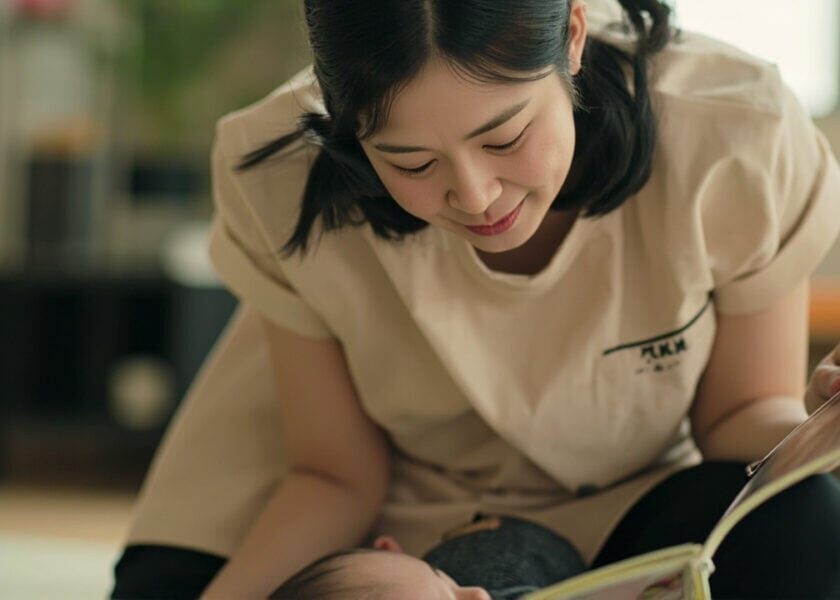
Watch where the caregiver’s body is. A quality caregiver does not spend the majority of their time sitting at a table or standing at a distance. They are on the floor. They are at child level. They are within reach.
Their posture is open, relaxed, available. When a child approaches, the caregiver turns toward them, makes brief eye contact, responds with words and touch. This is not constant hovering. It is a quiet, steady availability that says I am here, I see you, you are not alone.
Voice and the Face That Cannot Be Faked
Notice the caregiver’s voice. In quality settings, caregivers speak to children the way thoughtful parents speak to children. They narrate what is happening. They name emotions. They ask questions that extend thinking rather than quiz for right answers. They speak at a moderate pace, giving children time to process. And they do not speak down to children. A quality caregiver respects small people as individuals with thoughts worth hearing.
Now notice the caregiver’s face. There is a quality of warmth that is not performed. It is the face of someone who genuinely delights in children, who finds meaning in the work, who is not counting the hours until their shift ends. You cannot fake this, and you cannot miss it once you know to look.
Consistency and Ratio: The Structure That Makes Attention Possible
In the best childcare settings, your child does not see a rotating cast of strangers. They see the same faces, the same voices, the same arms that held them when they fell. Caregiver consistency is not a feature added because it sounds good. It is foundational, because a child who trusts their caregiver is a child who can explore, learn, and grow.
When you see the same caregiver morning after morning, week after week, you will notice something shift in your child. The clinging decreases. The waving goodbye becomes easier. The tears, if they come, are shorter. That is not because your child has forgotten you. It is because they have formed a secondary attachment, a bond of trust with someone outside the family who is reliable, who shows up, who knows their name and their needs and their preferences.
A quality childcare setting in Singapore, whether home-based or centre-based, maintains ratios that make this kind of relationship possible. In infant care, the ratio is no more than one to three. One caregiver to three infants. That is not an arbitrary number. It is the ratio that allows a caregiver to truly know each child, to notice when something is off, to respond to distress before it escalates, to engage intentionally rather than just supervise.
When you see a caregiver who knows each child’s name, who notices when one child is tired before they start rubbing their eyes, who remembers that one child prefers the blue cup, who can tell you something specific about your child’s day beyond the generic they had fun—that is a sign. That is a caregiver who has the time, the capacity, and the genuine interest to pay this kind of attention. That is quality you can see.
Communication: Where Invisible Hours Become Visible
For the hours your child is in care, you are not there. You do not know what happened at snack time, whether there was a conflict over a toy, whether your child smiled when they saw the caregiver arrive, whether they ate well or barely touched their food. You have to trust that the account you receive at pickup is an honest one, and that is a vulnerable place to be.
Quality childcare settings know this. They do not leave parents to guess or worry or fill in the gaps with anxiety. They build communication structures that make the invisible visible.
What Genuine Communication Looks Like
This might be a daily verbal update at pickup, not a scripted report but a genuine exchange. The caregiver tells you something specific: Your daughter spent a long time at the water table today. She was really focused. She did not want to leave it. Or Your son was a little tired this afternoon. He napped longer than usual.
These small details are not trivial. They are windows into your child’s day. They tell you that someone was watching, that someone noticed, that your child was not just one of many but was seen as an individual.
Caregivers trained in structured observation share genuine information because they know that informed parents are confident parents. This is the kind of transparency that builds trust over time—not through promises, but through consistent, specific communication.
What You Are Really Looking For: Responsiveness
Does the caregiver or administrator answer your questions fully? Do they seem irritated or relieved when you ask about something specific? Do they offer information proactively, or do you have to pull every detail from them?
A quality setting wants you to know what is happening. They know that trust is built through transparency, not through promises.
When you find a setting where the communication feels like a genuine partnership, where you leave pickup knowing more than you did when you dropped off, where the caregiver seems as interested in your child’s wellbeing as you are—that is not a bonus feature. That is a core indicator of quality.
Pickup: What Your Child Tells You When They Come Home
This is the moment you know well: pickup. This is when your child comes back to you, and there is a brief window where you can read everything if you know what to look for.
Reading Your Child’s State
The first thing to notice is your child’s state. A child who has had a quality day will come to you in a particular way. Not necessarily perfectly calm. Children are complex, and some children need to cry when they see their parents, to release the tension of the day in the arms of the person they trust most. That is not a sign of failure. That is normal.
But watch the quality of that cry, the arc of it. Does your child collapse into you and then settle quickly? Does their body relax? Does the crying feel like relief rather than despair?
A child who is coming from quality care will often show a mixture. There might be some residual protest at leaving, a reluctance to leave the caregiver, and then a settling into the reunion. The caregiver will often be part of this transition. They will say goodbye warmly, specifically, in a way that acknowledges the child’s feelings. They might say I will see you tomorrow, and we will continue building that tower. This is not hollow cheerfulness. It is genuine, bounded connection that helps the child close one chapter and open another.
Patterns Over Single Moments
Notice your child. How do they look? Not just physically, though you will register if they seem tired, fed, changed. But how do they carry themselves?
A child who has been in a quality environment often has a particular quality of aliveness, a curiosity that is not exhausted but renewed. They might want to tell you about something. They might show you something they made. They might be humming a song they learned. Or they might simply be quiet, settled, at ease in their body.
This is what reading your child at pickup teaches you: your child is an accurate reporter of their own experience. They cannot give you the verbal account an adult would, but their body, their affect, their behavior tells you something.
A child who comes home regularly distressed, who resists going to childcare in the morning with increasing intensity, who shows signs of withdrawal or aggression that are new—that is data. That is not just the normal adjustment period. That is information you act on.
Conversely, a child who gradually settles into a routine, who begins to show some positive reference toward the caregiver, who is generally available for play and connection at home, who sleeps well and eats well—that is data too. That is the data of a child who is likely having a good experience.
The trained observation described here is not about reading one day perfectly. It is about noticing patterns over time. What is the general trajectory? Is your child developing in the direction you would expect? Are they meeting milestones, engaging with you, growing more confident rather than more anxious? One difficult day means nothing. A pattern of data means everything.
Beyond Performance: Seeing What Is Genuine
There is a particular observation skill that separates experienced parents from novices: learning to read the gap between what is performed and what is genuine.
In any service industry, there is a temptation to perform quality. To have the right posters on the wall, the right language in the orientation, the right scripts at pickup. This is not unique to childcare. Every sector has its surface presentations. The question is not whether a setting has these presentations—every professional setting will. The question is what lies beneath them.
How to See Past the Performance
When you visit a childcare setting, you will be shown the best room, the most organized shelf, the happiest children at the most photogenic moment. This is normal. But your job is to look past the performance to the underlying reality.
Ask questions that require specific answers, not general ones. Instead of does my child play outside? ask what does my child do when they are outdoors, and how long do they usually spend there? Instead of how do you handle tantrums? ask what happened when my child had a meltdown yesterday? A setting that is genuinely responsive will have answers. A setting that is performing will give you generalities.
Observe caregivers when they do not know you are watching. If you can, linger at pickup, or arrive early for a visit and watch through a window. How do caregivers interact with children when no parent is present? Is the warmth the same? Is the engagement the same? A caregiver who is genuinely warm will be warm whether or not a parent is watching. A caregiver who is performing warmth will shift their behavior when an audience appears.
Notice whether your child seems to distinguish between your presence and the caregiver’s presence. A child who has a genuine bond with their caregiver will show some positive reference toward them, will be comforted by them, will seek them out in distress. A child who is merely tolerating the caregiver will not show this. They will treat the caregiver as a stranger who happens to be present. This is not about replacing you. It is about whether the caregiver has earned some level of trust from your child.
And finally, notice how you feel in the setting. Not just whether you like the aesthetics or the marketing. But what is your gut telling you? Do you feel welcomed or tolerated? Do you feel that the caregiver is interested in your child as a person or as a client? Do you feel that the administrator is proud of what they do or defensive about scrutiny?
Trust your instincts. You have spent your whole life reading people. Apply those skills here. A parent who is learning to observe is not a nervous parent grasping for reassurance. They are a parent who is developing a sophisticated reading of quality. That is what this article wants for you.
The Framework Behind Quality Care
The observation skills described in this article are not abstract ideals. They are grounded in frameworks that bring structure, accountability, and developmental intentionality to childcare settings across Singapore.
The ECDA Childminding Pilot, for example, establishes standards for caregiver training, ratio compliance, and developmental programming that parents can verify. Within this framework, settings are expected to maintain ratios that make genuine engagement possible—one caregiver to no more than three infants in infant care. This is not a marketing number. It is the structure that allows a caregiver to truly know each child.
Quality care pathways also recognize that Singapore families are not all the same. Some children thrive in the intimacy of a home setting, with one or two caregivers and a small group of peers. Others benefit from the broader community of a centre. What matters is not which setting is theoretically superior but which setting is genuinely responsive to your child’s temperament and your family’s needs.
The financial dimension of this decision matters too. Quality childcare should not only be for families who can afford premium pricing. Government-supported frameworks offer affordable fee structures, with mechanisms such as the Child Development Account and Baby Bonus to help ease the cost for eligible families.
When you understand these frameworks, you stop evaluating childcare on surface impressions alone. You start asking the right questions, expecting specific answers, and recognizing quality when you see it.
Making This Decision with Confidence
Every parent who drops their child at a childcare setting is making a profound act of trust. They are saying: I believe this place will care for my child the way I would. That is not a small thing. That is one of the most vulnerable decisions a parent makes.
But trust without observation is fragile. It wobbles. It requires constant reassurance. It is easily shaken by a single bad day or a single ambiguous moment.
What transforms trust into something durable, something that can hold the weight of real life, is seeing. Learning to see what quality looks like. Developing the skills to read a room, a caregiver, a child, a day. Knowing what questions to ask and how to evaluate the answers.
When you develop these skills, something shifts. The anxiety does not disappear entirely. It never does, and it should not. But it becomes manageable. It becomes grounded. You stop needing to believe in quality and start being able to recognize it. And when you can recognize it, you can trust it, truly trust it, with your whole self.
So the next time you drop your child in the morning, you will still feel the weight of it. That is love. That is good. But you will also feel something else. The beginning of trained trust. The confidence of a parent who has learned to see what professionals see.
And you will know, as you drive away in that quiet car, that you are leaving your child in a place you have evaluated, a place you have observed, a place you have chosen not on faith but on evidence.
That is the freedom this article wants for you. That is what quality childcare, genuinely practiced, makes possible.
Ready to see what quality looks like for yourself?
Schedule a visit and bring this article with you. Ask the questions that require specific answers. Watch the transitions. Notice the caregiver’s posture. Read your child’s face at pickup. You now have the tools. Use them.
Finding the right childcare is one of the most important decisions your family will make. If you are looking for a setting grounded in developmental intentionality, caregiver consistency, and transparent communication, EduNanny welcomes the opportunity to walk you through what quality looks like in practice. Learn more about our approach or get in touch to schedule a visit.