Beyond Tears: Your Baby’s First Forty Days in Singapore Childcare
The Silence Before You Leave: Your Child’s First Forty Days in Childcare
There is a particular silence in the moment before you leave your child for the first time. It is not the silence of peace. It is the silence of a held breath, of a small hand releasing yours, of the walk to the door that feels longer than any corridor you have ever walked.
You turn back once. You tell yourself you will not turn back again. You turn back again.
And then you are outside, in Singapore’s morning light, and something inside you has been permanently rearranged.
No one tells you how much this moment will cost you. Not in money, not in logistics, but in the quiet currency of your own resolve. You have handed your child to someone else, and you did it because you had to, and you did it because it was right, and you did it because the life you are building requires it.
But knowing something is right does not make it easy. And feeling afraid does not mean you are doing it wrong.
This is what most childcare guides get wrong. They tell you it will be hard. They tell you it is normal. They tell you to trust the process. And all of that is true, but it is not enough. Because what you need, in those first days and weeks, is not reassurance that feels like comfort. You need something harder and more generous than that. You need to understand what is actually happening inside your child, and inside yourself, so that the fear you feel is no longer running your decisions, but informing them.
What Is Actually Happening Inside Your Child
When you hand your child to a caregiver for the first time, she does not understand what is happening. She understands only that you are leaving, that this is not her choice, and that she has no framework yet for understanding that you will return.
This is not a failure of your bond. This is developmental reality.
The capacity to hold an abstract concept like “mommy comes back at five o’clock” in mind while standing in an unfamiliar room with an unfamiliar person is a cognitive achievement that develops over time. It cannot be rushed by desire or by reason.
What your child has instead is response. She has her body, her voice, her tears, her protest. These are not symptoms to be managed or suppressed. They are communication. They are her way of saying that this matters, that you matter, that the bond between you is significant enough to mourn when it is disrupted.
Separation Protest Is Not Distress
Parents often interpret loud crying as a sign that their child is suffering, that something is deeply wrong, that they should intervene or remove their child from the situation. But protest is not distress. Protest is a healthy, adaptive response. It means your child has a strong enough attachment to feel the loss acutely. She is fighting for connection, not retreating from it.
The children we worry about, the children who are actually telling us something is wrong, are often the ones who go very quiet. Who accept the transition without apparent resistance. Who seem, on the surface, to be managing.
This is not to alarm you. Many children do adjust through quiet observation before they engage. But reading your child accurately requires looking beneath the surface, and the loudness of crying is not a reliable indicator of the depth of harm.
The Forty-Day Arc: What to Expect Week by Week
We talk about the forty-day arc as a framework rather than a deadline. Forty days is not a magic number, but it is a useful horizon. It gives you permission to expect that this will take time, and that time is not wasted.
Week One: The Most Brutal Days
Your child may cry at every handover. She may seem inconsolable at points. She may come home exhausted and fragile. You may second-guess every choice you have made. You may wonder if you have made a terrible mistake.
You have not made a terrible mistake. You have made a necessary transition, and necessary transitions are hard by definition.
Week Two: The Shift Begins
Something often shifts. The crying at handover may decrease, not because your child has forgotten you, but because she is beginning to build a secondary memory. She is beginning to associate this place, this person, with a kind of safety that is not the same as you but is not the opposite of you.
This is enormously important. It means her brain is doing exactly what it is designed to do: building attachment pathways that can hold more than one significant person.
Weeks Three and Four: Unexpected Growth
You may start to notice something unexpected. Your child may come home and show you something new. A song she learned. A way of stacking blocks. A word she has never said before.
And you will feel, in that moment, a small explosion of something that might surprise you with its intensity: pride. Not the pride of having taught her this yourself, but the pride of having given her a world in which she could learn it.
The child who comes back to you after settling into care is not the same child who left. She has grown in ways that would not have been possible in your living room alone, not because you were doing anything wrong, but because growth requires difference. It requires other minds, other hands, other rhythms.
This is not a failure of parenting. This is parenting working exactly as it should.
The Evening Meltdown and Your Anxiety
One of the most disorienting experiences for parents in the first weeks is what happens in the evenings.
Your child comes home, and instead of being relieved or happy, she is clingy. She cries at small frustrations. She wakes in the night when she had been sleeping through. She wants to be held in a way that feels more intense than before.
This is not regression. This is communication.
Think about what your child has done all day. She has been in a novel environment, managing uncertainty, regulating her nervous system without the benefit of the person who has regulated it since birth. She has held herself together, often magnificently, often with a courage that would astound you if you could witness it.
And now she is home, with you, and her body knows that she is safe enough to let go.
The evening meltdown is not evidence that the day went badly. It is often evidence that the day went well enough for her to finally release what she was holding. When you understand this, you respond differently. You do not try to fix it or rush it. You hold her. You let her cry. You say, in whatever words feel true to you, that you are here, that she is home, that she does not have to hold anything alone tonight.
Your Anxiety Is Also Data
The transition period is not only hard for children. It is hard for parents.
One of the things that is rarely acknowledged is that your anxiety is also data. It is not evidence that you are failing. It is evidence that you are paying attention, that your bond with your child is significant enough to generate fear when that bond is challenged.
But anxiety can also mislead you. When you drop your child at childcare and feel a wave of panic, it is tempting to interpret that panic as a signal that something is wrong. But panic is not a signal about your child. It is a signal about you. It is the echo of a separation that has not yet resolved in your own body.
And while it is important to take your anxiety seriously, to examine it and learn from it, it is equally important not to let it make decisions for you.
This is one of the most counterintuitive lessons of the transition period: the thing that feels most dangerous is often the thing that is most necessary. Leaving your child, even when she cries, even when it costs you, is not abandonment. It is the act of trust that allows her to grow. And growing, even when it is hard, even when it is resisted, is what children are designed to do.
What Quality Care Looks Like During Transition
We want to be honest with you about what quality looks like during this period, because not all care arrangements are the same, and the difference matters more during transition than at almost any other time.
Quality is not a clean facility or a published curriculum. Quality is responsiveness.
It is the caregiver who bends down to your child’s level when she cries instead of distractedly shushing her. It is the caregiver who notices when your child’s play shifts from engaged to anxious and intervenes before the anxiety escalates. It is the caregiver who reports to you not just what happened, but what it meant, what she observed, how she interpreted your child’s signals.
The Importance of Ratio
Quality is also ratio. When a centre maintains one caregiver to three infants, there is time to respond to distress with presence rather than strategy. There is time to comfort rather than manage. There is time to build the specific, attuned relationship that your child needs before she can feel safe enough to explore.
This is not a small thing. It is the whole thing.
Ask any teacher who has been in a classroom for years to describe the difference between a child who has settled into care and one who has not. They will tell you about the body.
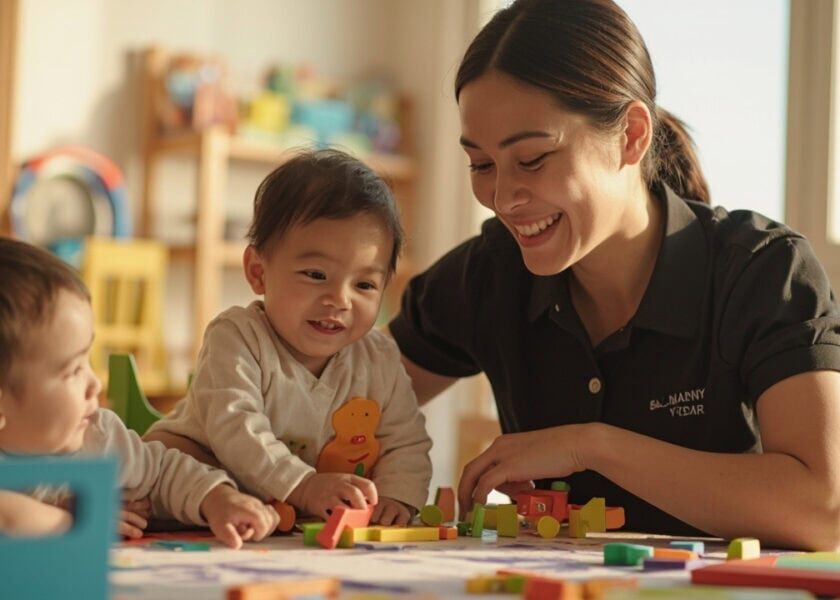
The settled child moves through the room with a kind of ease, picks up toys, engages with other children, glances toward the caregiver not with anxiety but with the casual confidence of someone who knows they are seen.
The unsettled child stays close to the door. Holds a toy too tightly. Watches the gate. Her body is doing exactly what her mind cannot yet articulate: it is searching for you.
Reading the Signs: Adjustment vs. Distress
Here is a practical framework for understanding what you might observe:
| Behavior | Likely Meaning | When to Be Concerned |
|---|---|---|
| Crying at handover | Normal separation protest | Only if it continues without decrease over weeks |
| Quiet withdrawal | Processing; may be adaptive | If prolonged without engagement emerging |
| Evening clinginess | Safe release of held tension | If accompanied by weight loss or visible fear of caregiver |
| Sleep disruption | Nervous system processing | If severe or persistent beyond a few weeks |
| New skills emerging | Growth and engagement | N/A — this is a positive sign |
Questions to Ask When Choosing Infant Care
If you are in the process of evaluating childcare options, here are the questions that matter most during transition:
- What is the caregiver-to-infant ratio, especially in the first weeks?
- How does the caregiver respond to crying and separation protest?
- What does daily communication look like? Will I know how my child was, not just what she ate?
- What is the settling process? Is there flexibility in the early days?
- How do you handle evening transitions and reunions?
- What training do caregivers have in infant attachment and development?
- What are the signs that my child is settling well versus struggling?
The answers to these questions will tell you far more than a facility tour or a curriculum document.
The EduNanny Approach: Built for This Transition
We believe that infancy is not a waiting period before real education begins. It is education. The connections formed in the first months and years of life are not warm-ups for later attachment. They are the architecture of attachment itself.
This is why our infant care model maintains ratios of up to one to three, meaning that during those critical early weeks, your child has the gift of focused attention. Not divided, not scattered, but present with her.
When a child protests and a caregiver responds with warmth, with presence, with the quiet confidence that communicates “I see you, I am here, I will hold this space for you,” the protest can resolve. It can move through the child’s system and out. But when a child protests and the environment is chaotic, understaffed, or emotionally flat, the protest has nowhere to go. It becomes lodged, stuck, a wound that does not close.
Communication as Partnership
We have built our model around transparency and partnership. Our arrangements include communication protocols that keep you informed not just of what your child ate and when, but of how she was, how she slept, how she played, how she cried or did not cry.
These are not administrative details. They are the data you need to read your child’s experience accurately.
Some parents feel anxious receiving too much information. They worry it will make them more anxious, that they will fixate on details that are not meaningful. We understand this. But we have also seen, over and over, that parents who receive honest, detailed communication about their child’s day are better able to trust the process than parents who receive generic reassurances.
Trust is built on information. It is eroded by mystery.
Support for Singapore Families
Singapore parents face pressures that are specific to this context. The cost of living, the expectations of the workplace, the reality of extended family that is often not nearby, the particular cultural balance between achievement and wellbeing that Singapore families navigate every day.
We participate in the ECDA Childminding Pilot, which offers pathways for home-based and community-based care that are accessible in ways that centre-based arrangements sometimes are not. We have structured our fees to be affordable within pilot frameworks, and we have made it possible for parents to use the Child Development Account and Baby Bonus funds for which they are eligible.
These are not peripheral features. They are acknowledgments of the real conditions under which Singapore families are making these decisions.
Trust the Process, With Eyes Open
There is a moment, and you may not know it when it happens, when your child turns to wave at her caregiver before running to you at pickup. When she mentions her caregiver’s name with warmth rather than wariness. When she walks into the centre without looking back.
This moment is not the end of the transition. It is the beginning of something new.
Your child has learned something that most adults never fully master. She has learned that she can love and be loved by more than one person. That separation does not end love. That she can be held by the world and still come home to you, more herself than before.
We are not asking you to trust blindly. We are offering you permission to trust the process, with eyes open, with questions asked, with your attention tuned to what your child is actually telling you.
Trust that is earned by understanding, by observation, by the slow accumulation of evidence that your child is not just surviving this transition but growing through it. Trust that is supported by caregivers who are as invested in your child’s wellbeing as you are, who see themselves not as replacements for you but as extensions of the village it takes to raise a child.
Singapore is not always easy on parents. The pace is fast, the expectations are high, and the support systems are not always what we need them to be. But in the midst of all that, there are choices you can make that honor both your child’s needs and your own.
Choosing care that sees your child as a whole person, not just a schedule to be filled. Choosing arrangements that give you honest information instead of false reassurance. Choosing to stay when it is hard, because staying is how the arc completes itself.
You are not abandoning your child when you leave her at childcare. You are teaching her that the world is large enough to contain both the grief and the wonder of growing up. You are teaching her that you trust her, even when you are afraid.
And you are teaching yourself that you are capable of a love that lets go, and that letting go is not the opposite of love.
It is the bravest thing you will ever do.
If you would like to learn more about how EduNanny supports families through this transition, we invite you to reach out. We are here, beside you, for every step of the way.