What Singapore Parents Get Wrong About Primary One Readiness
What Real School Readiness Actually Means
The word itself is seductive. Ready. It implies a threshold, a checklist, a moment when the conditions are met and the child can proceed. Somewhere along the way, the conversation about Primary One readiness in Singapore became exactly that: a checklist.
Can they hold a pencil correctly? Can they write their name? Can they count to twenty? Can they sit still for thirty minutes? Can they follow instructions from a stranger in a room full of other children?
These are not terrible questions. They are, in fact, the kinds of questions that teachers ask themselves when planning a classroom. But they are proxies—signs of readiness, not its substance. When we mistake the sign for the thing itself, we begin to build the wrong structure in the name of preparation.
Here is what developmental science has been quietly telling us for decades: the children who arrive at Primary One and thrive are not, in the main, the children who know the most. They are the children who are most ready to learn.
These are not the same thing, and confusing them is one of the most expensive mistakes we make—not in dollars, but in the quiet erosion of something that took years to build.
Real readiness is a constellation of capacities that develop in the early years when the conditions are right. It includes the ability to regulate your own emotions when something goes wrong. It includes the ability to wait, to resist an impulse, to try again after failure without collapsing. It includes the ability to be curious about something you do not yet understand, rather than afraid of it.
These are not soft skills. They are not extras. They are the infrastructure of learning.
The Executive Function Foundation
The research on executive function is quite clear on this point. Children who enter Primary One with stronger self-regulation, stronger working memory, and stronger cognitive flexibility—the ability to shift from one task to another without falling apart—do better academically, not just in the first term, but across their entire primary school experience.
Consider what this means in practice. A child can memorize their alphabet and still struggle in Primary One. They can count to a hundred and still become anxious when the lesson format changes. They can complete a worksheet beautifully and still feel, somewhere in the pit of their stomach, that school is not really for them.
These capacities are not taught. They are not drilled. They are built—slowly and consistently—in an environment that provides emotional security, responsive relationships, and the freedom to practice being a person who can manage themselves.
What This Environment Looks Like
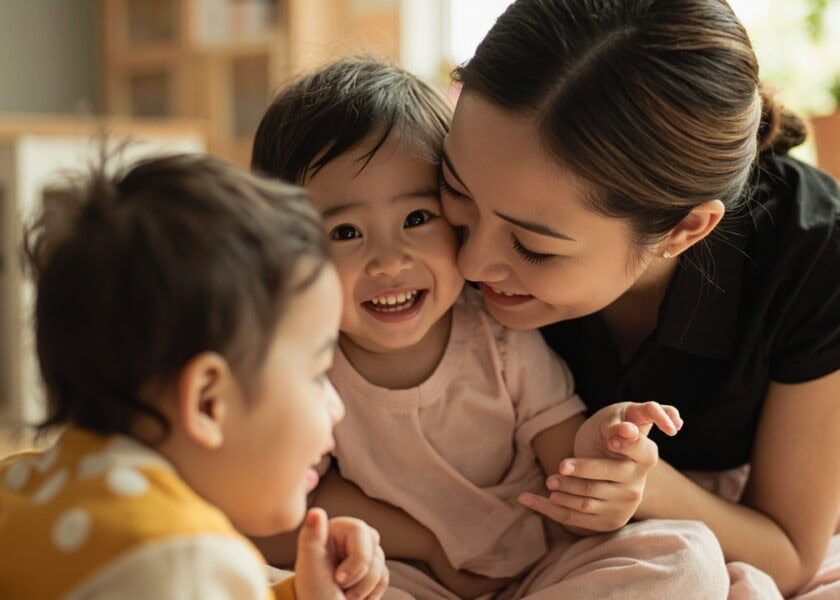
It looks, in many ways, like what young children have always needed: attentive adults who are not rushing them toward a destination. Rich opportunities for play that require imagination and negotiation and the slow, patient work of figuring out how things fit together.
Time to get frustrated and time to recover. Time to fail at something and discover that failure is survivable. Time to build a relationship with a caregiver who knows them deeply, who can read their cues, who provides a secure base from which exploration becomes possible.
This is not a romantic ideal. This is the precise recipe for developing the capacities that will carry your child through Primary One and beyond.
Why Singapore’s Enrichment Culture Misses the Point
And that environment is, I want to be honest with you, increasingly rare.
In Singapore, we have built an enrichment culture that is extraordinary in its ambition and its reach. There are classes for toddlers that would have been considered advanced enrichment for older children a generation ago. There are programmes that promise school readiness in twelve sessions. There are workbooks designed for three-year-olds that presuppose a very particular kind of learning—one that looks like school before school has even begun.
None of this is malicious. The parents who sign up for these programmes are doing what they believe is best. They are responding to a real anxiety, and the anxiety is real because the stakes of Primary One do feel high, and because the comparison culture around us is relentless.
I do not say that to dismiss the concern. I say it because we do a disservice to parents when we pretend that their anxiety is irrational or their love is misplaced. Their anxiety is a sign of how much they care. The question is whether that care is pointing them in the right direction.
The Cracks That Show Later
A child who has been drilled on Primary One content but has not had the space to develop genuine self-regulation will often perform well in the first few months, when the content is familiar. But when the curriculum moves forward, when the demands shift, when the classroom becomes less about what you know and more about how you learn, the cracks begin to show.
And by then, the narrative has often already been set. The child is now the child who struggles. The parent is now the parent who is anxious. And the intervention becomes much harder than the preparation would have been.
What Quality Childminding Actually Looks Like
When a quality infant care or childminding environment invests in your child, it is not building the same thing that a phonics class or a mathematics enrichment programme builds. It is building something that those programmes cannot build, because they do not have the time, the relationship depth, or the developmental science embedded in their approach.
A quality childcare environment is, when it is done well, a place where executive function is developed through the daily texture of lived experience. Where emotional regulation is learned because there is a trusted adult who models it, reflects it, and holds the child steady when it feels overwhelming.
Where social confidence grows because there are other children to navigate, to negotiate with, to learn from. Where the love of learning is preserved because learning is happening in context, through play, through discovery, through the quiet satisfaction of mastering something that mattered to you.
The Daily Elements That Build Real Readiness
- Responsive caregiving: A caregiver who notices your child’s cues, matches their energy, and responds consistently builds the secure attachment that becomes the foundation for all future learning.
- Play-based exploration: When children play, they are not just having fun—they are building working memory, practicing self-control, and developing the cognitive flexibility that Primary One will demand of them.
- Managed frustration: A skilled caregiver allows children to experience manageable levels of frustration and guides them through recovery, building resilience that worksheets cannot teach.
- Social navigation: In a quality setting, children learn to read social cues, negotiate shared resources, and navigate friendship—all essential Primary One skills that do not appear on any readiness checklist.
- Emotional vocabulary: Children who can name their feelings can manage their feelings. This is not taught through drills but through relationship.
EduNanny Singapore: Where Readiness Is Quietly Built
And this is where EduNanny Singapore comes in. Not as a replacement for your love or your instincts, but as a place where those instincts can be trusted and extended. Where the science of early childhood development is not a buzzword but a daily practice. Where your child is known, not just cared for.
EduNanny operates within the ECDA Childminding Pilot, and that matters for your family. The Childminding Pilot represents a recognition at the policy level that the early years are not an afterthought. That what happens before Primary One shapes what happens after it. That children thrive when they are in environments that are safe, responsive, and grounded in understanding of how development actually works.
When you choose EduNanny, you are choosing a model that has been examined, that has been supported, and that is built on principles that ECDA has identified as central to quality in infant and toddler care.
Practical Details That Reflect Quality
For families, this is not simply a philosophical point. It is practical.
EduNanny offers pathways that include home-based childminding, where your child is cared for in a familiar environment with a dedicated caregiver, as well as community and centre-based options where appropriate. The ratio of caregivers to infants is kept to a maximum of one to three, which means your child is not one of twelve in a room. They are one of one or two or three. They are known. Their cues are noticed. Their individual rhythm is respected.
The cost structures within the pilot are designed to make quality care accessible. CDA and Baby Bonus funds can be utilized, which means the financial architecture that the government has put in place to support families in these years is available to you here, integrated naturally into the way care is structured.
Trust Built on Transparency
And then there is the question that sits underneath all of it, the question that parents do not always voice but that they carry everywhere: can I trust this place with my child? Can I leave them in the morning and believe that they are safe, that they are being seen, that the person caring for them is genuinely invested in who they are becoming?
EduNanny’s approach to trust is not built on promises alone. It is built on transparency. Where CCTV measures are deployed, families know. Where communication protocols exist, they are shared openly. Where caregiver selection and training is rigorous, that rigor is visible in the daily experience of care.
Parents deserve to know what is happening in the hours they are apart from their children. Not because they should be suspicious, but because trust is built through clarity, and clarity is a form of respect.
Technology in Service of the Relationship
EduNanny is also a place where technology serves the relationship rather than replacing it. EduNanny offers access to Thomas, an AI chatbot designed to support parents in navigating the questions and concerns that arise in the early years.
Parenting is not a solved problem. Every child is different. Every stage brings its own uncertainties. Thomas is not intended to replace the wisdom of experienced caregivers or the instinct of parents. It is intended to be a resource, available when you need it, for the questions that come up at odd hours, in difficult moments, or in the quiet spaces between one milestone and the next.
It reflects a larger belief: that supporting families means being present in more ways than one.
A Framework for Choosing What Your Child Actually Needs
When you strip away the comparison culture and the marketing language and the quiet anxiety that Singapore parents carry so bravely, what remains is something very simple: children need to feel safe. Children need to feel seen. Children need to develop the internal capacities that will allow them to walk into any room, any classroom, any challenge, and believe that they can figure it out.
That belief is not given to them by enrichment classes. It is built through the experience of being cared for by people who understand what they are doing and why. Through the experience of being in an environment where they are not rushed toward a result but are allowed to develop at the pace that their own nature requires.
Choosing depth over acceleration is not a compromise. It is the most intelligent, most loving, most forward-looking choice you can make.
Questions Worth Asking When You Evaluate Your Options
- Do the caregivers seem genuinely interested in my child as a person, not just as a task to be managed?
- Is there time in the day for child-initiated play, or is every moment structured and directed?
- Can I observe how the caregivers respond when a child is frustrated or upset?
- What is the ratio of caregivers to children, especially for infants and toddlers?
- How does the environment handle the development of self-regulation and social skills?
- Is the programme built around what developmental science tells us about early childhood, or is it primarily focused on academic content?
- Do I feel respected and informed as a parent, or is communication one-directional?
These questions will not be answered the same way by every family or every programme. But they point toward the things that matter most—the things that worksheets and assessments cannot capture but that will determine how your child feels when they walk into Primary One.
The Gift You Are Already Giving
If you have been wondering whether quality matters more than acceleration, I want to tell you that the answer, in my experience, is yes. Not sometimes. Not in certain circumstances. Yes, as a general principle.
The children who arrive at Primary One curious, confident, emotionally secure, and ready to learn in the deepest sense are the children who have been given the gift of time. Time to develop. Time to play. Time to build the foundation that everything else stands on.
Your child’s readiness for Primary One is not a checklist to be completed. It is a person to be trusted. And the best thing you can do for that person is to give them the early years that the science tells us they need—rich, responsive, secure, and full of the kind of learning that happens when children are allowed to be exactly who they are.
EduNanny is a place that gives that gift. By design, by training, by the daily choices of caregivers who understand what they are building and why. By a model of care that has been recognized at the national level as worth investing in. By a commitment to families that goes beyond the transactional and into the relational.
If you have been carrying the quiet question—am I doing the right thing?—I hope you will feel, when you are ready, that you have a place you can turn to. A place where your instincts can be trusted. A place where your child is known. A place where readiness is built the way it was always meant to be built: slowly, lovingly, and with deep respect for who your child is becoming.
That is what EduNanny offers. That is why we exist. And that is the gift I hope you will feel that you can give.
If you would like to learn more about how EduNanny supports families in Singapore, visit our homepage or read about our approach. We welcome the opportunity to answer your questions—get in touch with us when you are ready.