What Happens in Infant Care: Building Your Baby’s Brain in Singapore
The Hours You Cannot See: What Your Baby’s Brain Is Actually Learning in Infant Care
There is a world your baby enters every morning that you cannot follow into. You hand over a small, warm body at the door, and then begin the hours you cannot see—the hours your imagination fills with fragments. Is she content? Is he being held with patience? What is the shape of her day?
You chose this. You agonized over the choice, visited the spaces, asked the questions, weighed the options, and made the decision that felt right for your family. And now you trust. But trust is not the same as certainty, and certainty is not the same as knowing.
So the wondering persists, quiet beneath your days, shaped by a question you may never have fully articulated: what is actually happening in there, in those hours I cannot witness, in that mind I cannot yet reach?
Let me tell you what is happening.
The Architecture of Your Baby’s Brain: What the First Thousand Days Actually Mean
You cannot see this happening. But in the first thousand days of life—from conception to approximately age three—your child’s brain is building itself at a speed it will never match again.
By age three, a human brain has reached approximately eighty percent of its adult size. One million new neural connections form every second during the peak years of infancy. This is not metaphor. This is architecture—literal, physical, electrochemical architecture being constructed in response to every touch, every sound, every movement, every moment of spatial experience.
Your baby is not simply being cared for during these hours. Your baby is being wired.
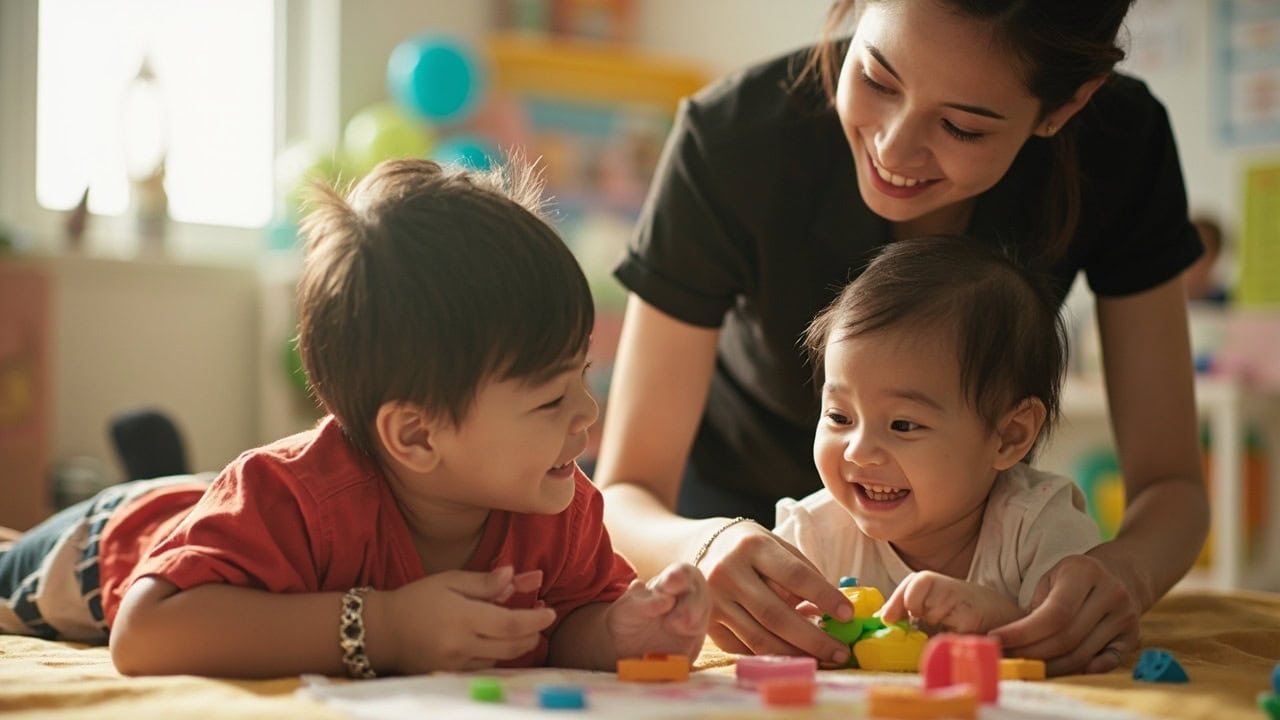
And this is the truth that most parents carry as an abstract worry and never get to see made real: the sensory environment of infant care is not incidental to development. It is development. Every holding of a body, every response to a cry, every spoken word, every change of position, every moment of freedom to move or reach or roll or watch—the texture of a play mat against skin, the echo of voices in a room, the tilt of being lifted, the light coming through a window onto a surface that a baby tracks with widening eyes—all of it is feeding the construction of a brain that will belong to your child for the rest of their life.
What Science Tells Us
- Neural development peaks in the first thousand days. From conception to age three, one million new neural connections form every second. By age three, the brain reaches approximately 80% of its adult size.
- Every sensation is building the brain. Touch, sound, movement, and spatial experience are not incidental to infant care—they are infant care. Each interaction is literally wiring your child’s nervous system.
- Not all care settings provide the same sensory diet. Caregiver ratios, physical environment design, and staff training directly shape what neural pathways are being formed during the hours you are away.
How Your Baby’s Senses Are Building Neural Architecture
Let me take you into this sensory world. It is worth following.
The Language of Touch
When a caregiver lifts an infant with slow, responsive hands—hands that wait for a startle to settle before moving, hands that cradle the head with knowledge of its weight—a very specific kind of learning is happening.
The baby’s proprioceptive system, the sense that tells the body where it is in space, is receiving information: I am held, I am secure, my body has boundaries. The tactile system is learning the difference between firm and gentle, between cold and warm, between the texture of skin and the texture of fabric.
These are not simple sensations. They are the early vocabulary of the body—sensory information that travels from skin and joints up through the nervous system and becomes the foundation for how your child will eventually understand physical selfhood, physical confidence, physical regulation.
You cannot see this happening. But it is happening. Every time a caregiver handles your baby with the particular kind of attention that slow, intentional movement requires.
And it is absent in environments where handling is rushed, where the ratio of caregivers to infants means that holding becomes logistics rather than presence. The difference is not visible to a parent on a visit. It is visible in the child’s nervous system, three years later, five years later, twenty years later.
The Sounds That Build Minds
Your baby is not hearing language the way you hear it—sequentially, grammatically, with attention to meaning. Your baby is hearing acoustic patterns. The rise and fall of pitch in a voice that is speaking to them. The rhythm of syllables. The difference between the sound of a human voice and the sound of a door closing, a fan humming, a television murmuring in another room.
Every hour of exposure to the melodic, responsive speech of a caregiver who narrates the day, who speaks to the baby not at them but with them, is building neural pathways for language that will open decades later in the form of vocabulary, comprehension, the ability to argue, to persuade, to write, to feel.
Research on early language exposure is not ambiguous. The number of words a child hears in the first three years correlates with language outcomes in school. But it is not just quantity. It is quality—the contingent, back-and-forth responsiveness of a speaker who pauses for a baby’s coo, who waits for a response, who treats the pre-verbal infant as a participant in conversation rather than an audience for announcement.
In a childcare environment where one caregiver holds the attention of three infants simultaneously, this contingent responsiveness is not impossible, but it is mathematically harder. In an environment where ratios are lower, where a caregiver can truly attend, language exposure becomes something closer to a dialogue even before your child has words.
Movement as Curriculum
Movement is perhaps the most underappreciated sensory dimension in infant development.
The vestibular system, housed in the inner ear, responds to motion and position—the sense of being rocked, of tilting, of being carried upright versus lying flat, of experiencing the world from different angles. This system is deeply connected to emotional regulation, to balance, to the coordination that will eventually allow a child to sit still, to focus, to manage their own body in a classroom chair.
Proprioception, the sense of where one’s limbs are without looking at them, develops through weight-bearing, through the experience of pushing against surfaces, of reaching and grasping and pulling to stand.
In a quality infant care environment, movement is not incidental. It is planned.
- Tummy time is not just about strengthening neck muscles—it is about giving a baby the sensory experience of gravity, of effort, of the body working against resistance.
- Floor time is not just about convenience—it is about the vestibular and proprioceptive experience of free movement, of choosing which way to turn, of experiencing the consequences of one’s own motion.
- The physical environment—the surfaces, the open areas, the equipment that allows for safe but varied physical experience—matters not because it looks good in photographs but because it determines what a baby’s nervous system learns about its own physicality.
Learning to See
The visual system at birth is immature, and it develops rapidly in response to appropriate stimulation.
A baby needs to see faces clearly, at the distance of feeding and conversation. A baby needs to track moving objects. A baby needs spatial contrast—light and shadow, near and far, the visual complexity of a prepared environment versus the visual monotony of a bare cot.
The spatial awareness that develops in infancy, through visual experience, becomes the foundation for later spatial reasoning—the kind of thinking required for mathematics, for navigation, for understanding how objects relate to one another in three-dimensional space.
This is not speculation. This is developmental neuroscience. And it is happening in every waking hour of your baby’s life, including the hours you are not there.
What Quality Infant Care Actually Looks Like
So here is the question worth sitting with: when you chose your childcare arrangement, were you choosing only supervision? Were you choosing only safety, only convenience, only the logistics of returning to work? Or were you, perhaps without fully knowing it, choosing an environment that would build your child’s brain?
The best infant care is not a babysitting arrangement with educational aspirations. The best infant care is a deliberate sensory environment, staffed by people who understand that every interaction is building something, that every moment of handling is information, that the architecture of a room is the architecture of experience, and that the infant brain is not merely present in this environment—it is being shaped by it.
This is what separates quality infant care from basic supervision.
Here is what developmental care actually looks like in practice:
- Intentional handling: Caregivers move slowly and responsively, understanding that the way a baby is lifted teaches the body about security and boundaries.
- Rich language environment: Caregivers speak to infants as participants—narrating actions, pausing for responses, using the melodic, back-and-forth rhythm that builds language pathways.
- Planned movement opportunities: Tummy time, floor time, and varied physical experiences are designed into the day, not left to chance.
- Visual environment design: The space offers contrast, complexity, and faces to track—appropriate visual stimulation for developing eyes.
- Low ratios: Fewer infants per caregiver means more contingent responsiveness—the quality interaction that research shows matters most for development.
What to Look For in Singapore
When researching infant care options, consider these factors not as a checklist but as questions to hold in mind:
- Caregiver ratios: How many infants per caregiver? Lower ratios enable more responsive, intentional interaction.
- Handling quality: Do caregivers move slowly and attentively? Does handling feel responsive or rushed?
- Language environment: Do caregivers speak to infants as participants, not objects? Is there back-and-forth responsiveness?
- Physical environment: Is there space for floor time? Is the visual environment varied and engaging? Is movement planned, not incidental?
- Communication practices: How does the setting keep parents informed? What transparency measures exist?
- Staff understanding: Do caregivers understand that every interaction is building neural architecture? Do they see themselves as developers, not just supervisors?
- Regulatory alignment: Is the setting licensed or aligned with ECDA frameworks? Does it participate in quality improvement pathways?
Addressing What Singapore Parents Actually Worry About
“Will my baby feel abandoned when I leave?”
Responsive, consistent care builds security. When caregivers respond promptly and sensitively to infant cues, babies learn that the world is trustworthy. The goal is not to replace parental attachment but to support it during the hours apart.
“How do I know if the care is actually developmental?”
Ask about ratios. Ask whether caregivers narrate and interact verbally beyond necessities. Ask about the physical environment—tummy time, floor time, visual complexity. Observe how caregivers move and handle infants. These are the visible markers of an invisible architecture.
“Is home-based care as developmental as centre-based care?”
Both can be excellent. Home-based care offers a domestic environment with consistent caregivers and lower ratios. Centre-based care may offer more structured programming. What matters most is the quality of interaction, the intentionality of the sensory environment, and the training of caregivers—not the setting itself.
“What if I can’t afford premium care?”
Singapore’s ECDA Childminding Pilot is designed to make quality care accessible. Fee subsidies, Baby Bonus, and CDA fund usage can significantly reduce costs. The first thousand days are neurologically irreplaceable—investing in quality care during this window is one of the highest-return decisions a family can make.
What EduNanny Does Differently
EduNanny operates within the ECDA Childminding Pilot, which reflects a growing recognition in Singapore that infant care is not simply about oversight—it is about development. The pilot offers pathways that include home-based care, where a childminder provides care within a domestic setting, and community or centre-based options where families can access care within a supported environment.
In the EduNanny model, the ratios matter. With up to one-to-three infant care, caregivers have the capacity to respond not just to need but to presence—to notice when a baby is alert and ready for interaction, to narrate the moment, to handle with the intentional slowness that the proprioceptive system requires. This is a deliberate structural choice that makes developmental care possible.
Affordability is not an afterthought. Within the pilot fee structures, quality infant care becomes accessible to families who might otherwise be priced out of the environment their child’s developing brain needs. The Baby Bonus scheme and the use of CDA funds where applicable further reduce the financial weight of these early years—a period that is, neurodevelopmentally, the most consequential period of the entire lifespan.
Communication bridges the gap that parents feel most acutely. When you cannot see what is happening, uncertainty grows. EduNanny addresses this through transparency measures, including communication practices and in some settings, camera access, that allow parents a window into the world their child inhabits. This is not about surveillance. It is about trust—about giving parents the evidence they need to quiet the wondering, to know that the sensory world their child is experiencing is the world they hoped to find.
Across Singapore, EduNanny childminders are holding infants with hands that understand the weight of a skull. They are speaking in the melodic, responsive tones that build language pathways. They are creating movement opportunities that challenge and strengthen the vestibular system. They are preparing visual environments that support spatial development. They are, in every hour of care, building the neural architecture that will shape how your child thinks, feels, moves, and relates to the world.
The Hours You Cannot See Are Not Empty Hours
You chose this. And now, perhaps, you know more fully what you chose.
The hours you cannot see are not empty hours. They are not mere care. They are a curriculum without textbooks, taught through touch and sound and movement and spatial experience, shaping a brain that will one day read, and reason, and feel, and wonder about the world in ways you cannot yet imagine.
You are not leaving your child behind when you walk out that door in the morning. You are placing your child inside a learning environment that will speak to their developing brain in a language they cannot yet translate but will carry with them always.
The wondering you feel is not a sign that you are doing something wrong. It is a sign that you understand, at some level beneath thought, that these years matter. And they do matter. They are wiring a human being.
When you are ready to learn more about how infant care can be developmental care, connect with EduNanny to explore what this looks like for your family.