The Quiet Revolution Inside Your Child During Childcare Adaptation
The Quiet Revolution Inside Your Child
It is one of the most quietly devastating moments of early parenthood. You stand at the doorway of a childcare centre or childminder’s home, your child crying in someone else’s arms, and you are expected to leave. Not because you want to. Not because you don’t love them. But because life in Singapore requires two incomes, or because your child’s development calls for social experiences beyond what your household can offer, or simply because you believe—perhaps even know—that quality care will benefit them in ways you cannot provide alone.
And still, every cell in your body resists.
That feeling you are carrying—that persistent, aching question of what is actually happening inside your child when you cannot see them—is not weakness. It is the purest form of love. It is the evidence that you understand your child is not simply being minded. Your child is being formed.
This article is about that formation. It is about what your child is actually experiencing in those first weeks, what adaptation truly looks like, and how quality care becomes the foundation upon which an inner emotional world is built. Not to tell you it will be fine. But to help you understand what is happening so you can trust the process—and trust yourself.
What Separation Actually Means to Your Child
Consider what your child experiences in those first days. They wake in a familiar room. They are fed by familiar hands. They smell familiar fabric and hear familiar voices. And then something profoundly disorienting occurs.
They are placed into a car, or walked down a street, or carried into a building, and everything changes. The faces are different. The sounds are different. The smell is different. And then, most jarring of all, the one face that has always been constant—their parent’s face—turns away and disappears.
From an adult perspective, we know this is temporary. We know you are coming back. We know, intellectually, that the childcare arrangement is a few hours long, not a permanent abandonment.
But your child does not know this.
Developmentally, young children have not yet built the internal architecture to understand that a parent still exists when they cannot see them. This is not a failure of your parenting. It is simply where they are. They are processing one of the most profound transitions of their young life without the vocabulary to articulate what they feel, without the cognitive framework to reason through it, and without the emotional regulation to calm themselves when fear rises.
The crying at drop-off is not manipulation. It is not a sign that your child is unhappy in some simple, solvable way. It is communication—your child telling you, in the only way they know how, that something significant is happening and they need you to understand.
What Research Tells Us About Early Adaptation
- Protesting is healthy. A child who cries has a functioning attachment system—they know what they have lost, and that knowing is evidence of your bond.
- Separation is genuinely disorienting. Without the cognitive architecture to hold the concept of a parent who still exists out of sight, young children experience real distress. This is developmental reality, not a reflection of your care.
- Adaptation follows recognizable stages. Most children move from protest, to tentative engagement, to genuine security—but on their own timeline, which varies widely.
- Not all calmness means the same thing. A quiet child may be flourishing or may be in protective withdrawal. The difference lies in what is happening beneath the surface.
- Quality care builds internal models of trust. Brick by brick, your child is constructing an understanding that the world contains reliable people. The caregiver’s responsiveness is the foundation of this.
The Three Stages of Childcare Adaptation
The question, of course, is what happens next. How does your child move from that raw, initial protest to something that looks, to your wondering eyes, like adjustment? The answer lies in understanding the stages of adaptation—stages that unfold differently for every child, on their own timeline, but that follow a recognizable pattern.
Stage One: Protest
In the earliest days, protest is the dominant mode. Your child cries. Your child reaches for you. Your child looks for you in faces and calls your name.
This is not a sign that childcare is wrong for them. This is a sign that your child has a healthy, functioning attachment system—that they have learned, in your care, that you are the secure base from which they explore and to which they return. A child who protests is a child who knows what they have lost, and that knowing is evidence of love, of bonding, of the very attachment you have worked so hard to build.
The crying is the sound of that bond being tested.
Stage Two: Building New Connections
What comes next, in the weeks that follow, is something more complex. The protest may diminish—not because your child has forgotten you, but because they are beginning, tentatively, to build something new. They are beginning to build a relationship with their caregivers, with the other children, with the rhythms and routines of this new environment.
They are beginning, without anyone explaining it to them, to develop what developmental psychologists call an internal working model of care—an internal sense that the world contains reliable people who respond when you signal distress, who feed you when you are hungry, who comfort you when you cry.
This is the invisible skill your child is building in those first weeks. It is not visible on any assessment. It does not show up in photographs. But it is the foundation upon which all future adaptation rests.
Stage Three: Expanded Security
A child who learns, in those first weeks, that this new environment contains trustworthy adults becomes a child who can venture further, explore more, take small risks. A child who does not learn this—who experiences inconsistent care, or who learns that crying brings no response—becomes a child who shuts down, who stops signaling, who appears compliant but is actually in a state of protective withdrawal.
This is the distinction that parents in Singapore desperately need to understand, because it is the difference between two outcomes that can look identical from the outside.
Parents often ask how long this process takes, and the honest answer is that it varies enormously—and that variation is not a sign of pathology but of the beautiful diversity of childhood temperament. Some children adapt within a few weeks. Others take months. Some have good days and difficult days, seem settled and then regress after a holiday or illness, and then settle again. All of these patterns are normal. Your child’s timeline is not a reflection of your parenting. It is a reflection of who they are.
Reading the Signs: Genuine Adaptation vs. Anxious Compliance
When you pick up your child at the end of the day, and they are quiet, and calm, and seem content—how do you know whether you are seeing genuine flourishing or anxious compliance?
What Genuine Adaptation Looks Like
Genuine flourishing often hides behind behaviors that parents initially read as problems. A child who is genuinely adapting will show:
- Increasing interest in their environment between drop-off and pick-up
- Engagement with toys, activities, with other children—not constantly, not with the abandon of a child who has never known anxiety, but with growing willingness
- Seeking out their caregivers not in desperation but in the ordinary way that a child seeks out a friendly face
- What researchers call proximity-seeking behavior—moving toward parents when they arrive, with recognition and relief
- The ability, gradually, to be willing to release that parent at the door
The child who runs into your arms and then, five minutes later, looks back at their caregiver and waves is a child who is building multiple relationships, multiple sources of security. That is a child who is adapting well.
What Anxious Compliance Looks Like
Anxious compliance often presents itself as:
- Unusual quietness—a child who seems almost too easy, too undemanding, too content in ways that feel hollow
- A child who has stopped protesting because they have learned that protest does not work
- No trust built—only a protective shell constructed
- May not cry at drop-off because they have learned that you leave regardless, and crying only exhausts them
- Clinging intensely when you arrive, unable to be soothed, because they have not developed the confidence that you are reliably returning
- Physical stress signals: changes in appetite, disrupted sleep, regression in toilet training or speech
The difference between these two outcomes is not the presence or absence of tears. It is what is happening beneath them.
What Quality Childcare Actually Looks Like
This is why the question of caregiver quality is not a logistical concern—it is an emotional one. It is the question of whether your child is building an internal model of reliable care or learning to survive without one.
Quality childcare is not just about ratios or curricula or facility cleanliness, though these matter. It is about something more fundamental: the capacity of an adult to receive your child’s distress signals and respond to them with consistency, warmth, and attunement.
It is an environment where your child learns, through repetition, that:
- When they reach out, someone reaches back
- When they cry, they are not alone
- The world is, in fact, reliable
Signs of Quality Responsive Care
Quality care means your child is:
- Seen as a person, not a task. Fewer children per caregiver means their signals are visible, their rhythms are learned, their emerging trust is noticed and reinforced.
- Calibrated to their distress level. A quality caregiver notices when distress is escalating and intervenes before it becomes overwhelming.
- Celebrated in their discoveries. When your child is on the edge of a small triumph, there is an attentive adult close enough to share it.
- Anchored in predictable routines. Consistent rhythms across the day help your child learn that the world has reliable patterns—and those patterns are safe.
These are the skills that will stay with them: the ability to regulate their own emotions, the capacity to trust others, the resilience to navigate inevitable small rejections and conflicts of human life, and the security that transfers to future transitions—primary school, new activities, new relationships.
Quality childcare, when it is truly responsive and warm, does not merely watch your child. It participates in the building of their inner world.
How EduNanny Singapore Supports This Journey
EduNanny Singapore was built with a structure that allows for exactly this kind of responsive care. Operating under the ECDA Childminding Pilot, EduNanny offers both home-based and community-based pathways, recognizing that different children, in different families, will thrive under different arrangements.
What remains constant across both pathways is a commitment to ratios that allow caregivers to truly know your child—to notice when distress is escalating and intervene before it becomes overwhelming, to notice when a child is on the edge of a discovery and stay close enough to celebrate it with them.
The Numbers That Matter
The infant ratios maintained within the pilot—up to one caregiver for every three infants in certain configurations—are not simply numbers on a compliance checklist. They represent the difference between a child who is merely watched and a child who is genuinely known.
Communication and Transparency
The communication practices within the pilot are designed to bridge the gap between your wondering and your child’s actual experience. When transparency measures are in place, including where applicable structured observation updates and appropriate visibility measures, you are not receiving surveillance data. You are receiving windows into your child’s day—proof that they are engaged, that they are cared for, that the promises made at enrollment are being kept.
This information is not merely reassuring to you. It is evidence that supports your own capacity to trust, and your trust is one of the greatest gifts you can give your child in this adaptation process.
Accessibility as Emotional Support
Singapore parents should not have to choose between quality care and financial sustainability. The pilot fee structures within the ECDA framework are designed to make this care accessible, and the usability of CDA and Baby Bonus subsidies means that families across the income spectrum can access these arrangements without choosing between their child’s early development and their family’s financial wellbeing.
The stress of financial strain adds another layer of anxiety onto parents who are already carrying the weight of wanting to do right by their child. EduNanny’s approach removes that burden where possible, allowing parents to focus on what matters: the journey their child is on.
Your Role in the Adaptation Journey
What you can do, as a parent navigating this journey alongside your child, is resist the urge to let your own anxiety become the story. Children are extraordinarily attuned to the emotional states of their caregivers.
When you arrive at drop-off with a tight jaw and a forced smile, your child notices. When you linger, unable to leave, because your own distress at their distress is overwhelming, your child reads it. Not consciously, not with the vocabulary to name what they are sensing, but at the level of the nervous system.
They learn from you how to feel about this transition.
Practical Drop-Off Guidance
This does not mean you must perform false cheerfulness. Your child does not need you to pretend that this is easy. They need you to be honest, calm, and consistent.
“I love you. I am going to work. Ms. Sarah will take care of you until I come back. I will pick you up after snack time.”
And then, crucially, you leave. Not because you don’t care. Because you care enough to trust the process.
Signs You May Be Amplifying Anxiety
Watch for these patterns in yourself:
- Prolonging goodbyes beyond what feels comfortable
- Returning to check “just one more time”
- Asking anxious questions that signal your own worry
- Speaking about the caregiver or childcare setting with hesitation or doubt
If you recognize these patterns, pause. Take a breath. Remind yourself that your calm is one of the greatest gifts you can give your child right now.
What You Will See If You Watch Carefully
If you watch carefully—not with anxiety, but with curiosity—you will see things that will take your breath away.
You will see your child, who has never been without you for more than a few hours, discover that they can be without you and still be okay. You will see them form a second bond, a second source of comfort, without the first bond weakening. You will see them learn, through the rhythms of a quality childcare day, that the world has predictable patterns and that those patterns are safe.
You will see them develop what looks like, from the outside, simple social skills—but what is actually the complex, invisible work of learning to be a person among other people.
Honoring the Caregiver’s Role
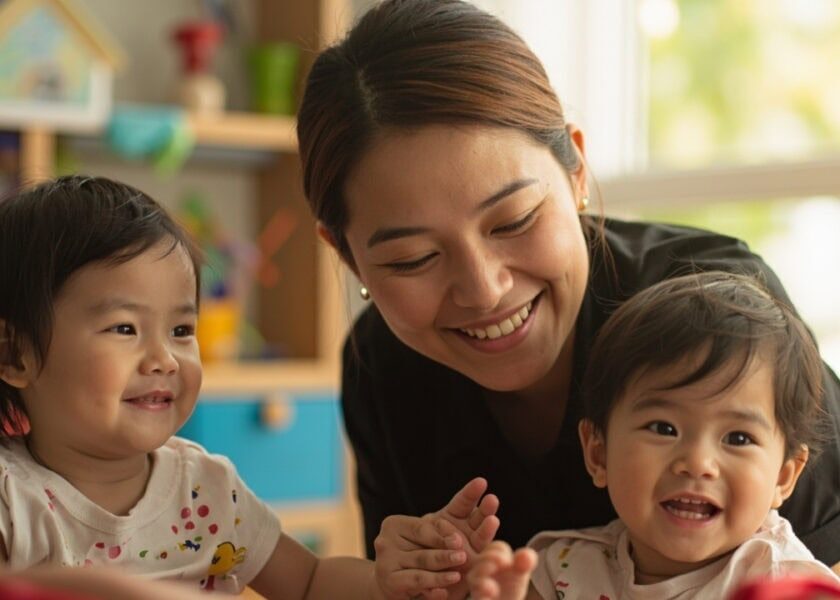
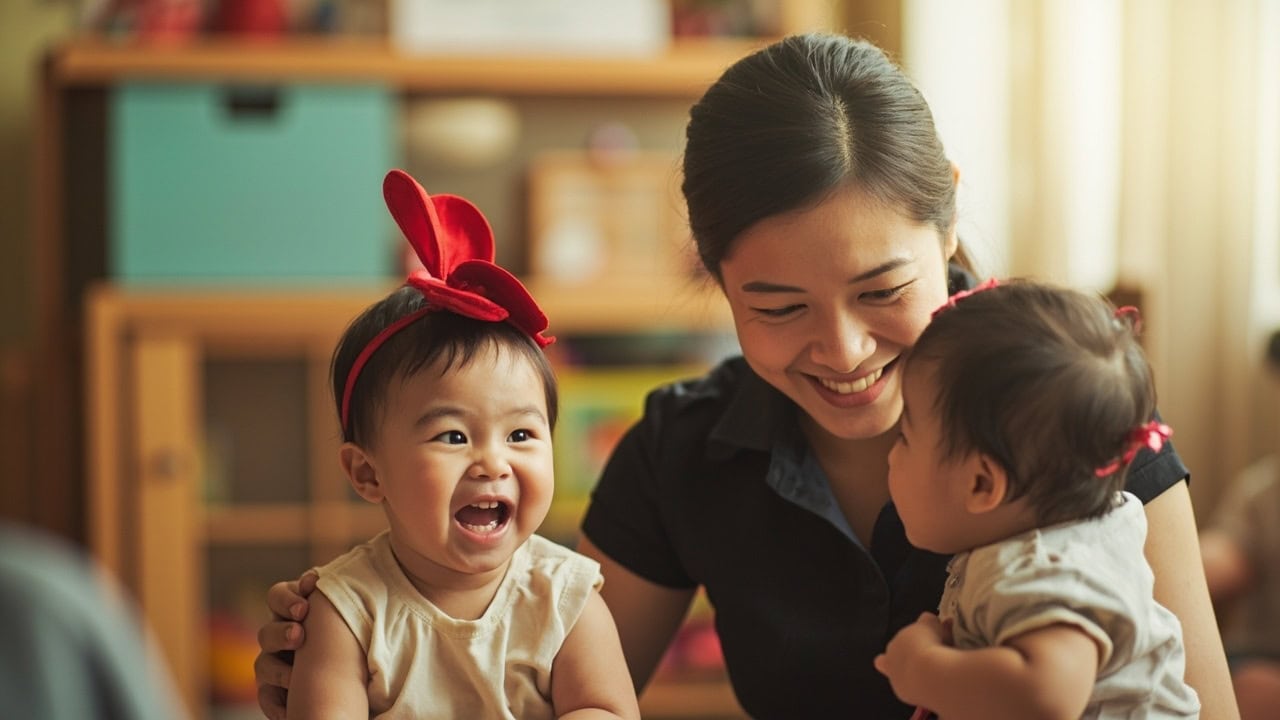
When a childminder in the EduNanny pilot receives your child into her home, she is not simply providing a service. She is doing developmental work of profound importance. She is holding space for your child’s distress and responding to it with consistency. She is teaching your child, through hundreds of small interactions across the day, that the world is trustworthy.
She is, in the deepest sense, a collaborator in your child’s emotional development—and the quality of her attunement, her warmth, her professional commitment to responsive care, is what determines whether your child builds the internal working model of security that will serve them for life.
The ECDA Childminding Pilot, with its training pathways and quality standards, is beginning to formalize what should always have been clear: that childminding is not a fallback profession for those who cannot do more important work. It is, in the earliest years of a human life, one of the most important roles anyone can play.
Trusting the Process
Here is what we have learned, from watching thousands of children move through this adaptation: they are more capable than we give them credit for. They are more resilient. They are more adaptive. They do not merely survive the first weeks of childcare—they are transformed by it, in small but meaningful ways, into children who are broader, braver, and more secure than they were before.
Your child is not broken by this transition. Your child is being built by it. And in a quality childcare environment, with responsive caregivers, with consistent routines, with warmth and attention, that building is happening in the right direction.
So when you stand at that door, and your child cries, and every instinct tells you to stay—pause. Take a breath. Remind yourself of what is actually occurring.
Your child is learning something enormous. They are learning that they can exist without you in their direct line of sight and still be safe. They are learning that other adults can be trustworthy. They are learning that the world has reliable patterns. And yes, they are crying, because that is the only way they know how to communicate the enormity of what they are feeling.
But then you leave. And the caregiver receives them. And the day begins. And somewhere inside your child, a small seed of something new is taking root—the quiet, invisible knowledge that they are capable, that they are held, that they belong.
That is what EduNanny is here to protect. Not just your child’s physical safety, though that matters. Not just their educational readiness, though that matters too. But the integrity of their inner emotional world as they take their first steps into a larger world.
That is the work. That is why this matters. And that is why, if you are a Singapore parent standing at the beginning of this journey, uncertain and afraid and filled with love—you are exactly where you need to be.
Your child is in exactly the right place. And this adaptation, difficult as it sometimes feels, is one of the first and most important acts of trust your child will ever make.
Trust it. Trust them. And let us help you trust the process.
Ready to explore how EduNanny Singapore supports your child’s adaptation journey? Learn more about our home-based and community-based childminding options under the ECDA Childminding Pilot, or get in touch to begin a conversation about your family’s needs.
EduNanny Singapore — thoughtful, development-oriented childminding built on warmth, standards, and trust.