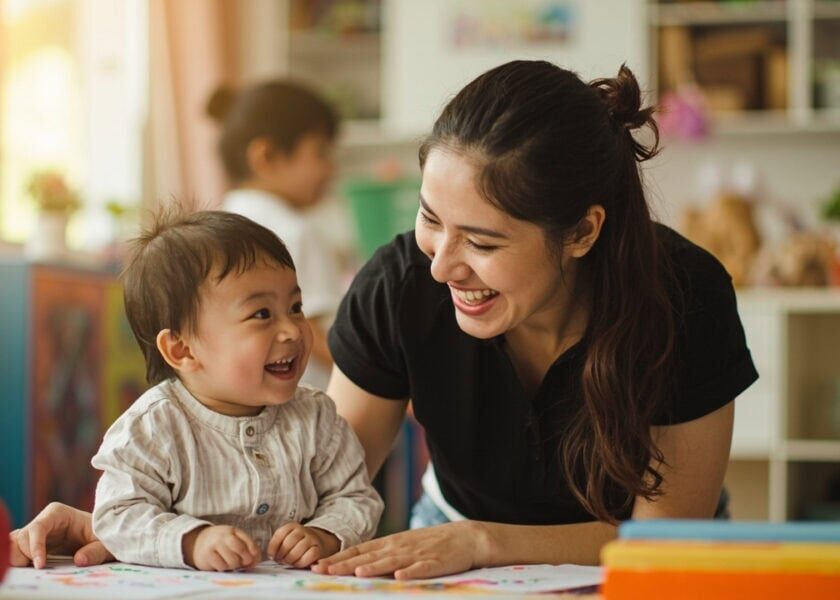
The Hidden Curriculum That Shapes Your Child While You’re Apart
What Your Child Is Actually Learning While You Are Apart
There is a question that lives quietly in the chest of every working parent in Singapore. It surfaces at odd moments—during a morning commute on the MRT, in the middle of a quarterly review, at the preschool gate as you hand over your child.
It is not the question you bring up at playdates or raise with your pediatrician. It is the one you carry alone, in the private space between what you know you must do and what you wonder is truly best for your child.
That question is simple, and it sounds like this: What is my child actually learning while I am not there?
You chose childcare because you had to. Or because you wanted to. Or because life in Singapore moves at a pace that requires both parents in the workforce, and grandparents who once helped have their own lives, and extended family across the causeway or across town. You made the decision with your head. But your heart has been making a different kind of calculation, one that no amount of rational reasoning has quite settled.
Here is what I want you to know: that question you have been carrying is not a sign that you are doing something wrong. It is a sign that you are paying attention. And the answer to that question—spoken plainly, without euphemism or deflection—is more hopeful than you have been allowing yourself to believe.
The Architecture of Early Learning
In the first thousand days of life—those extraordinary months from conception through your child’s second birthday—the human brain builds its foundational circuitry at a pace it will never again match. By the time a child turns two, more than one million new neural connections have formed every single second.
What this means practically is simple but profound: the environment surrounding your infant and toddler is not simply a backdrop to development. It is building the architecture of thought itself.
Consider a caregiver who narrates what she is doing: “Now I am going to wash your hands before we eat.” She is doing far more than maintaining hygiene. She is modeling language, building temporal understanding, and wiring in the cognitive pattern of sequence and cause.
When she notices a toddler’s mounting frustration before a toy is snatched away and gently intervenes, she is not just preventing a meltdown. She is teaching the child that big feelings can be seen, named, and managed. She is building emotional circuitry that will serve that child in primary school, in friendships, in relationships decades later.
What Researchers Call Scaffolding
In child development, this is called scaffolding—the careful construction of support around a child’s emerging abilities, always calibrated to be just slightly ahead of what the child can do alone, never so far ahead that the child is overwhelmed.
It is a word borrowed from architecture, and it is not used carelessly. The structures built in early childhood bear weight for a lifetime.
The hours your child spends in quality care are not empty hours. They are some of the most architecturally important hours of early childhood. In developmentally-informed care, every interaction is an opportunity for this building: narrating activities, naming emotions, asking curious questions, scaffolding emerging abilities.
Supervision vs. Development: The Difference That Matters
Now, let me be honest with you about something. Not all care is created equal. You know this. I know this. And I raise it not to induce guilt, but because clarity serves you better than reassurance ever could.
There is a meaningful difference between supervision and development.
Supervision asks: Is my child safe? Is she fed? Is she not crying? These are legitimate questions, and they matter. But they answer the minimum requirements of early childhood, not the maximum potential.
Development asks something different: What is my child’s brain doing right now? What social skill is she practicing in the give-and-take of parallel play? What executive function is he developing when he decides to wait for a turn instead of grabbing? What language is being absorbed, processed, and stored when a caregiver responds to a babbled sentence with a full, grammatically correct reply?
In adequate care, your child is kept. In excellent care, your child is being built.
What the Difference Looks Like Over Time
The difference is not visible in a photograph. Both settings might show happy children, clean environments, attentive adults. The difference reveals itself over time.
It shows in a three-year-old who can name her emotions because someone taught her the words. It appears in a four-year-old who knows how to negotiate, who understands that other people have perspectives different from his own. It emerges in a five-year-old who runs toward learning instead of away from it, because curiosity was protected, not just praised.
You cannot see the scaffolding. But you will see what it holds up.
The Hidden Curriculum of Quality Childcare
Two toddlers at a water table are not merely splashing. They are conducting experiments in physics—what happens when I pour from this cup versus that one? They are practicing reciprocity—my turn, your turn, my turn. They are learning cause and effect, sharing space, noticing another person who wants what they want. All of this is happening simultaneously, in the unselfconscious language of early childhood.
A caregiver who understands this does not simply watch. She notices. She names what she sees. She asks a question just slightly beyond the toddlers’ current language abilities: “What do you think will happen if we mix the blue and the yellow?” And in doing so, she builds something precious: the architecture of curiosity itself.
This is the hidden curriculum of quality childcare. It operates beneath the surface of every craft activity and song circle, every nap time and story reading. It is intentional even when the child does not recognize it as learning, because the most powerful development happens when the child is simply living, exploring, being.
Here is what is actually being built during those hours:
- Cognitive architecture: Neural pathways that will later support reading comprehension, mathematical reasoning, and complex problem-solving.
- Executive function: The ability to wait, to focus, to adapt when plans change—skills that predict academic success more reliably than early literacy scores.
- Social intelligence: Understanding that others have minds, desires, and perspectives different from their own.
- Emotional vocabulary: The words to name what they feel, which is the first step in learning to manage it.
- Curiosity and resilience: The willingness to try, to fail, to try again—built through experiences where effort was noticed and persistence was rewarded.
The Signs You Can Look For
While you cannot observe neural development directly, there are observable markers of quality care:
- Language-rich interactions: Caregivers talk with children, not just at them. They expand on what children say, modeling complete sentences and new vocabulary.
- Emotional naming: Caregivers label feelings as they observe them. “I see you’re feeling frustrated because it’s not working.”
- Intentional scaffolding: Activities are slightly challenging, not too easy. Caregivers offer help calibrated to need.
- Responsive interaction: Caregivers respond promptly to children’s cues, showing that they are truly present and attuned.
- Protected curiosity: When a child asks “why,” the answer comes with another question. Curiosity is met with curiosity.
Addressing the Quiet Anxiety
There is a quiet anxiety in handing over your child—not just their safety, but their shaping—to someone else. You worry that someone else is becoming their teacher, their influence, their formative experience. That in your absence, something is being built that you have no say in.
This fear is understandable. And here is the truth: it is not wrong to want to be present in your child’s development. It is right to care deeply about what kind of care they receive. This is what good parents feel.
But here is what I also want you to understand: quality care does not replace what you do at home. It works alongside it. The child who receives emotional scaffolding at the care setting and the child who receives it at home do not get double the development. They get exponentially more—not because the hours add up simply, but because the brain builds on what it already knows.
Every secure attachment, every language-rich interaction, every moment of being seen and responded to builds the foundation for the next one. Your child’s brain is not a zero-sum system where someone else’s influence diminishes yours. It is a building system, where every positive experience adds to the structure.
Quality care is not a competitor to your role as parent. It is an extension of it.
What to Look For When Choosing Childcare in Singapore
If you are now thinking about how to evaluate the options available to you—fair enough, there are many—here is what matters most:
Ask About Interactions, Not Just Activities
A schedule of activities means less than you think. What matters is how caregivers interact with children during those activities. Ask: How do caregivers respond when a child struggles? When a child asks a question? When two children want the same toy?
Notice the Ratio
Attention cannot be fractioned beyond a certain point without losing something essential. The number of children per caregiver matters. Lower ratios mean more individual interaction, more language, more attunement. This is not a luxury—it is a developmental necessity.
Look for Intentionality
Ask about the philosophy behind the care. Not just “what do you do” but “why do you do it this way.” A quality setting will have reasons for its practices, grounded in child development understanding.
Consider Communication
You cannot be in the room, but you should know what happens there. How does the caregiver share your child’s day with you? What transparency is built into the model? Trust requires visibility.
Trust Your Instincts
Visit. Watch. Notice how the children move, how the caregivers speak, how the environment feels. Your instincts as a parent are not irrational—they are data. If something feels off, it is worth investigating.
Where Development Meets Trust
There is a growing movement in Singapore toward childcare that takes development as seriously as parents do. A small but meaningful community of childminders, trained and supported through programs like the ECDA Childminding Pilot, are building something different—care environments where the hidden curriculum is not hidden at all to the adults inside them.
In these settings, every interaction is intentional. Your child’s cognitive development and emotional well-being are held with equal weight. Caregivers narrate activities, name emotions, ask curious questions, and scaffold emerging abilities—not because it looks good on a report, but because they understand that every moment in these early years is a brick in a structure that will stand for a lifetime.
What distinguishes these environments is not the activities on the schedule or the toys on the shelves. It is the quality of presence that caregivers bring—the noticing, the responding, the building that happens in the ordinary moments between.
When you can find a care setting where this is the norm rather than the exception, something shifts. You begin to trust differently. Not just trust that your child is safe, but trust that something meaningful is happening in the hours you are apart. Trust that the building continues.
The Choice You Are Actually Making
Let me return to where we began, because the most important thing I want to leave you with is not about any single provider. It is about you.
You are not a lesser parent for placing your child in care. You are not failing to be present by being present in your career. The hours you spend away from your child do not subtract from your relationship with them. They add to the village that raises them.
The care setting you choose—deliberately, thoughtfully, with the same rigor you bring to their school or their health—is one of the most consequential developmental environments you will ever select.
This is not a choice between supervision and education. It is a choice about which learning environment your child enters while you are apart. It is a choice about who builds with your child when you are not in the room. It is a choice about what kind of scaffolding surrounds your child’s emerging self during those crucial early years.
The hidden curriculum is real. It is happening right now, in every quality care setting across Singapore. Your child is being built—carefully, intentionally—by people who understand that every moment in these early years is a brick in a structure that will stand for a lifetime.
So the next time that quiet question surfaces—during your commute, in the middle of a workday, at the preschool gate—I hope you will answer it differently than before.
I hope you will say: My child is being built. Carefully. Intentionally. By people who understand that every moment in these early years is a brick in a structure that will stand for a lifetime.
And I hope you will choose that building with the same care you bring to everything else that matters.
Because it is, in every sense, what matters most.
If what you have read resonates with the questions you have been carrying, we invite you to schedule a conversation with our team, explore our pilot programs, or simply ask the questions that matter most to you. Every family deserves to leave for work in the morning knowing that something meaningful is happening in the hours in between.
To learn more about who we are and what guides our work, visit our About Us page or explore our full range of resources.