The Invisible Architecture of Trust: How Quality Childcare Shapes Your Child
What Quality Childcare Builds Inside Your Child
Before we explore deeper, here is what Singapore parents need to understand about quality infant care:
- Trust is built interaction by interaction — When caregivers respond to your child’s needs with genuine attunement, they are constructing your child’s fundamental sense that the world is a safe, trustworthy place. This is not sentimental thinking. This is the foundation upon which all subsequent development depends.
- Security enables exploration — The child who ventures farthest is often the one who feels most secure. When your child feels safe, their nervous system can shift from vigilance to curiosity, allowing genuine learning to occur.
- Identity begins early — By age two, children have already developed a sense of who they are, constructed from how others have responded to them. Quality care shapes this by making your child feel they belong, that they matter, that their presence is welcomed.
- Peer relationships are developmental laboratories — Early social experiences teach children to navigate difference, to experience complex emotions, to practice negotiation and resilience in ways that will serve them throughout their lives.
- Development is mostly invisible — Much of what quality care builds occurs in quiet moments you are not present for. The cumulative effect of months of consistent, responsive care creates changes that show up gradually, often surprising parents at pick-up with a shift they can sense but cannot name.
Understanding what is actually being built inside your child transforms the uncertainty you might carry about your childcare choice into something more grounded. You are not simply outsourcing supervision. You are choosing an environment that actively participates in your child’s development.
The Architecture of Trust: Where Security and Learning Connect
Let us begin with what is perhaps the most fundamental thing quality childcare builds, and yet the thing most invisible to the watching eye: the architecture of trust.
A child who feels secure does not simply appear content. There is something deeper operating beneath that contentment, something that expresses itself in every subsequent area of development. When an infant’s needs are responded to consistently, promptly, and with genuine attunement, something extraordinary happens in that child’s nervous system. The child begins to form what developmental psychologists call internal working models of relationships—in simple terms, the child learns, at the most cellular level, that the world is a place where needs are met, where comfort is available, where presence means safety.
This is not sentimental language. This is measurable, observable development with profound lifelong consequences. Children who develop this foundational trust are not merely easier to care for in the short term. They are children who have the emotional infrastructure to explore, to take age-appropriate risks, to recover from disappointment, to form healthy attachments later in life.
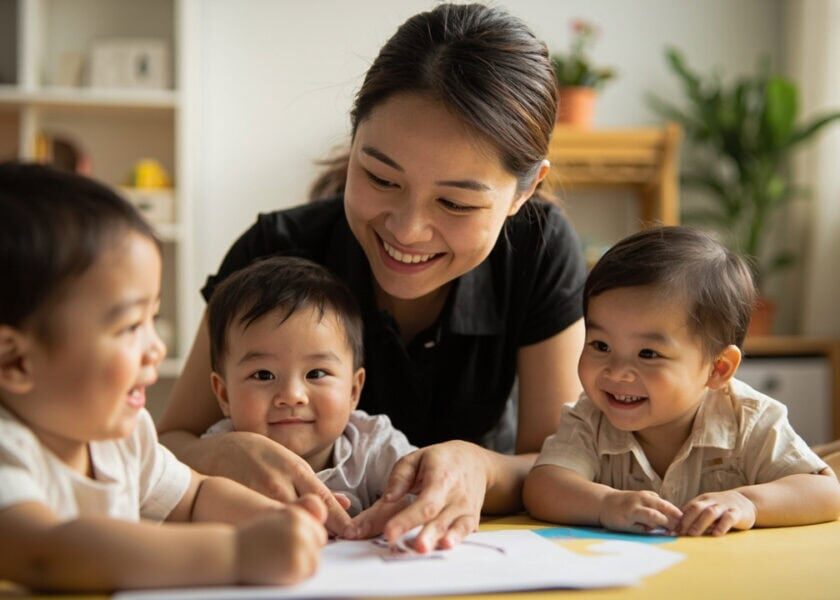
In quality infant care settings, this trust is built through hundreds of small interactions that most parents never see. The caregiver who responds to a child’s cry not with mere efficiency but with calibrated attention, who notices the difference between a hungry cry and a tired cry, who creates a rhythm of care that the child begins to anticipate and trust. This is what we mean by emotional scaffolding. The caregiver is not simply providing food and diaper changes. She is constructing, interaction by interaction, the child’s fundamental sense of whether the world is a trustworthy place.
This is why caregiver-to-child ratios matter so profoundly. When an infant is in a setting with a high ratio of caregivers to children—ideally one to three for infants—each child receives the kind of focused, responsive attention that builds this trust. When ratios are stretched, when one caregiver must attend to too many children simultaneously, the quality of responsiveness degrades. The child does not receive the signal that their needs are met with precision. The architecture of trust develops cracks.
Here is where we arrive at something many parents sense but have never had named for them: the connection between felt safety and a child’s willingness to learn.
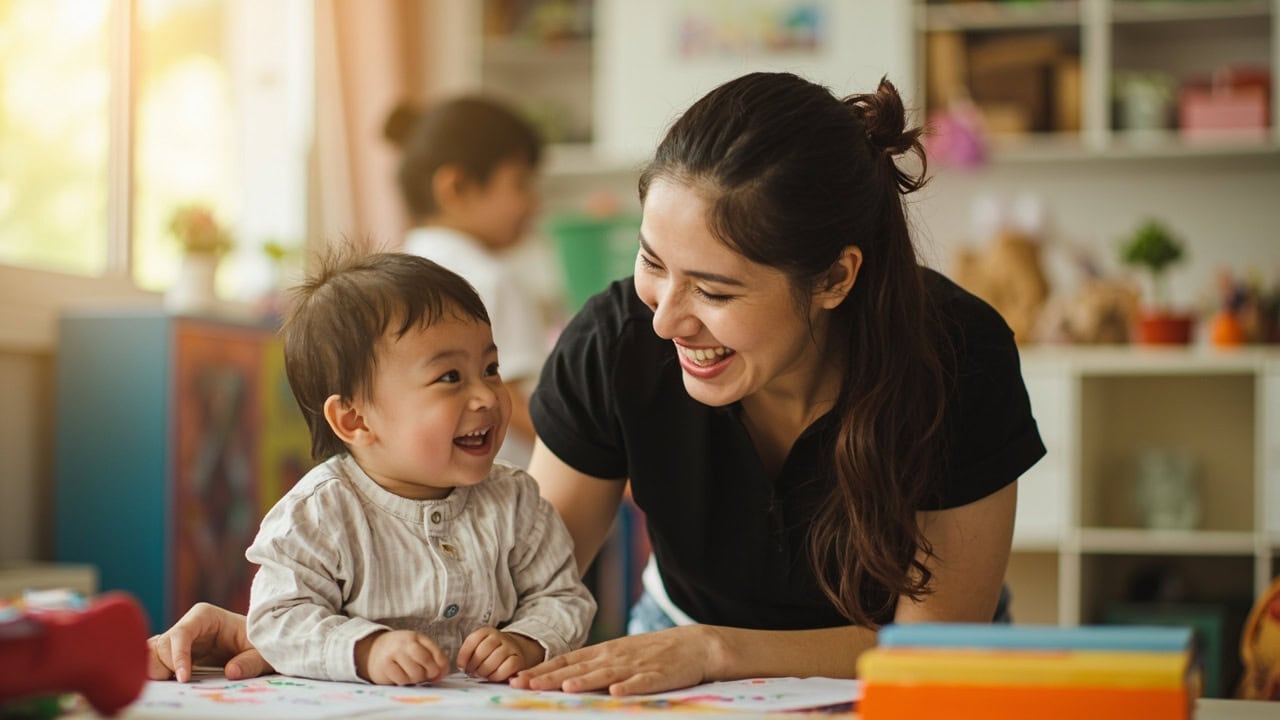
Watch a child who feels secure in their care environment. Watch them as they move away from their caregiver to explore a shelf of toys, to investigate a texture, to peer into a mirror. There is a quality to this exploration that is different from mere activity. It is purposeful, engaged, curious. The child is not simply moving; they are discovering. And they are discovering with the knowledge that they can return at any moment to the secure base that their caregiver represents.
This is the paradox that makes early development so remarkable and so frequently misunderstood. The child who appears most independent, most curious, most willing to venture forth, is often the child who feels most secure. Security does not create dependency. Security creates the conditions for exploration.
In contrast, a child who does not feel secure will not explore freely. They will remain close, vigilant, hesitant. Not because they lack ability, but because their nervous system is prioritizing safety over discovery. The learning that could happen—the cognitive growth that comes from exploring, experimenting, making mistakes, trying again—cannot fully occur when a child is operating in a state of underlying anxiety.
This is why quality infant care is not merely a holding service. It is an active creator of the conditions for learning. Every toy that is offered at the right moment of readiness, every gentle encouragement to try something new, every patient presence when a child encounters frustration—these are not extras. They are the substance of early cognitive development. They are what builds the neural architecture for thinking, for problem-solving, for creativity, for the capacity to persist in the face of difficulty.
Identity, Belonging, and the Social World
As children grow from infancy into toddlerhood, quality care begins to do something more: it begins to build a sense of self.
Identity formation begins earlier than most of us realize. By the time a child is two years old, they already have a developing sense of who they are—a sense constructed from how others have responded to them, from the messages embedded in the tone of voices, the quality of attention, the respect shown for their emerging preferences and capabilities.
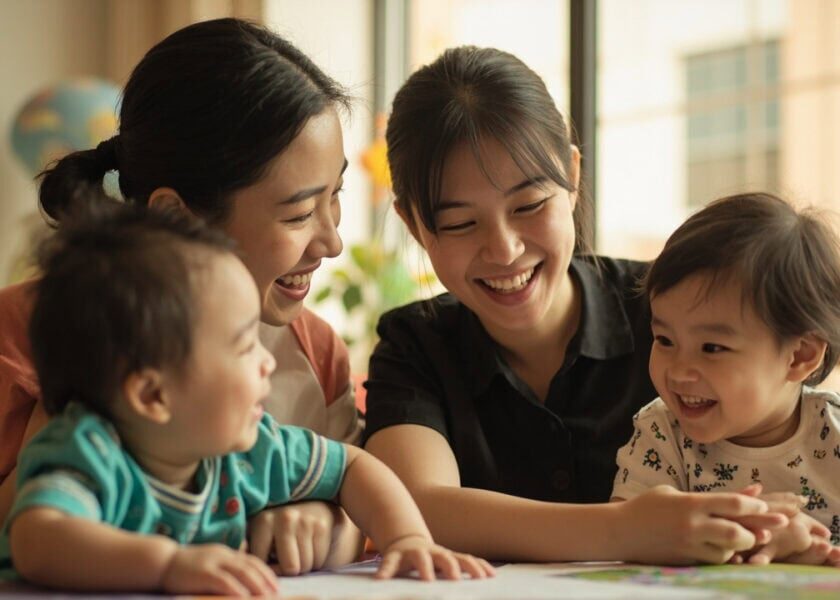
In a quality care community, this identity formation is shaped by belonging. The child learns, through daily repetition, that they are welcomed. That their presence matters. That when they enter the room, the caregiver’s face registers their arrival with genuine recognition. This may seem like a small thing. But for a child constructing their earliest understanding of their place in the social world, it is foundational.
The child begins to see themselves as someone who belongs to a community of care. This shapes their emerging social confidence—their willingness to engage with peers, to negotiate, to share, to experience the complex emotions that arise in early social interaction. Children who have this foundational sense of belonging do not become socially skilled because they are taught social skills. They become socially confident because they have internalized, over months of belonging, that they are capable of being in relationship with others.
Watch these children at play, if you have the opportunity. Notice the quality of their engagement with peers. There is a robustness to it, a resilience when conflict arises, a willingness to try again. These are not behaviors that have been drilled into them. They are expressions of an inner security that has been built over time in a consistent, responsive care environment.
Early Peer Relationships: Where Social Capacity Is Forged
Peer relationships in early childhood serve purposes beyond simple socialization. They are the first contexts in which children learn to navigate difference, to experience the social emotions—jealousy, disappointment, joy in another’s success—that will color their social lives for decades to come.
In quality care settings with thoughtful caregiver guidance, these early peer experiences become laboratories for social learning. The caregiver does not hover, but she is present. She creates the conditions for peer interaction and is available to help children navigate the inevitable social friction that arises when young humans try to share the same toy.
This is where the caregiver’s skill becomes visible. A thoughtful caregiver will not intervene at the first sign of conflict, denying children the opportunity to practice negotiation. But she will be attuned enough to step in when a child becomes overwhelmed, to offer language for feelings that a toddler cannot yet articulate, to model the calm de-escalation that children internalize as their own capacity for managing social difficulty.
For Singapore parents, this matters deeply. Many families here are nuclear units without the extended family networks that once surrounded children with daily peer exposure. Quality childcare becomes the place where your child learns to be part of a social world, where they practice the fundamental skills of human relationship that no amount of adult attention can fully substitute.
Why the Caregiver Is Not Interchangeable
When we speak about quality infant care, we are ultimately speaking about the quality of a human relationship. The caregiver is not interchangeable. She is not a function. She is a person who brings her attention, her warmth, her consistency, her understanding of child development to bear on your child’s life every day. She is, in the truest sense of the word, a significant person in your child’s world.
This deserves to be honored. The work of a childminder who responds to an infant’s cry with genuine attunement, who notices the subtle shifts in a toddler’s mood, who creates a space of warmth and safety that enables exploration, who guides peer interaction with wisdom and patience—this work is profound. It is the work of building human beings.
EduNanny understands that supporting and respecting the childminder is inseparable from supporting and protecting the child’s development. The quality of care your child receives is only as good as the quality of care the caregiver herself experiences. This is not a soft consideration. It is a structural one. A childminder who feels valued, who is fairly compensated, who receives ongoing training and support, who is not burned out by impossible ratios—this childminder can offer your child the attentive, warm, consistent presence that development requires.
What You Can Actually Look For
Understanding what quality care builds gives you a framework for recognizing it. Here are signs that your child is developing well in ways that go beyond surface-level contentment:
- Your child separates from you with growing ease. This does not mean they never show hesitation. It means they can be comforted, that they trust the environment enough to allow you to leave.
- Your child explores their environment with purpose. They are not just moving randomly. They are investigating, experimenting, returning to preferred activities with deepening engagement.
- Your child shows increasing comfort with peers. This might start as parallel play and gradually become more interactive. The key is that your child is interested in other children, not merely tolerating their presence.
- Your child recovers from small disappointments. A toy taken away, a caregiver momentarily occupied with another child—these minor frustrations are met with protest but not with prolonged despair. The child has an internal reserve of emotional security to draw upon.
- Your child shows you something from their day. Not because they have been taught to do this, but because they have an emerging sense of themselves as someone with experiences to share, a person whose inner life matters to you.
- Your child demonstrates increasing language and understanding. Words are emerging. Concepts are connecting. Your child is making sense of their world and bringing that sense into relationship with you.
Practical Quality Indicators
What does it mean, practically, to choose quality childcare in Singapore? Here is what to look for:
- Caregiver-to-Child Ratios — For infants, ratios of 1:3 or better are ideal. For toddlers, ratios of 1:5 to 1:6 represent good quality. These ratios are not arbitrary. They reflect the minimum conditions needed for responsive, attuned care.
- Emotional Attunement as Priority — Ask how caregivers are trained to respond to infant distress. The answer should reflect genuine attunement—differentiation between different cries, consistent and warm responses, an understanding that responsiveness is not spoiling but building.
- Consistency of Caregivers — Children develop trust through predictability. Ask about caregiver turnover and how the program handles transitions. A quality setting will minimize unnecessary caregiver changes and manage transitions thoughtfully.
- Communication Systems — How will you know what your child is experiencing during the day? Quality providers offer regular, meaningful updates—not just photographs, but insights into your child’s emotional state, discoveries, and development.
- Space and Environment — Quality care environments are thoughtfully arranged to support exploration, to offer appropriate challenges, to create spaces where children can be together and spaces where they can withdraw.
- Respect for Family Culture — In Singapore’s multicultural context, quality care respects and incorporates family languages, traditions, and values.
- Financial Accessibility — Quality care should not be a privilege available only to those with substantial means. Ask about fee structures, available subsidies, and how families can use CDA and Baby Bonus funds.
What Singapore Parents Really Carry
Let us speak directly to the concerns you may be carrying as you read this.
“Am I abandoning my child by working?”
You are not abandoning your child. You are making a choice that many parents in Singapore must make, and that choice can serve your child’s development well when made thoughtfully. Quality childcare, chosen with attention to what we have discussed here, is not a compromise. It is an environment that can actively build your child’s capacity for trust, exploration, and social confidence.
“How do I know what is really happening when I am not there?”
You cannot witness everything, and that is okay. What you can do is choose a provider who prioritizes transparency, who communicates meaningfully about your child’s day, who invites your questions and takes them seriously. What you can do is learn to read the signs we have discussed—the signs that trust is building, that exploration is flourishing, that your child is growing in ways that will matter.
“What if I cannot afford the highest quality option?”
Quality matters, but it is not only found in expensive programs. What matters most is the fundamental relationship your child has with their caregiver, the consistency of care, the responsiveness to your child’s needs. These are not expensive luxuries. They are the minimum conditions for healthy development. Look for providers who maintain these standards while making them accessible to ordinary families.
“My child seems happy. Is that enough?”
Happiness is a good sign, but it is not the whole story. A child can appear happy while still developing anxiety underneath, still struggling with trust, still not exploring to their full capacity. Look beyond happiness to engagement, to resilience, to the quality of your child’s peer relationships, to their willingness to venture away from you and return. These are the signs of deep development.
EduNanny represents something more than a service option. It represents a philosophy of care that takes seriously what is actually happening inside your child during those hours apart. EduNanny understands that infant care is not a waiting room before real education begins. It is the beginning itself. Every interaction, every responsive moment, every safe exploration enabled by consistent care—this is education in its most fundamental form.
Their home-based and community-based pathways offer families in Singapore something important: options that can fit the realities of modern family life while maintaining the quality standards that early development requires. Pilot fee structures have been designed with accessibility in mind, recognizing that quality care should not be a privilege available only to those with substantial means. CDA and Baby Bonus funds can be utilized, removing unnecessary friction from a family’s financial planning. Monday to Friday care blocks align with the rhythms of working parents’ lives.
Because they understand that trust flows in both directions, EduNanny has built transparency into their model. Communication is not an afterthought. Parents receive regular, meaningful updates about their child’s day—not just photographs, but insights into what their child is experiencing, discovering, and building. Where CCTV measures are deployed, they serve not as surveillance but as reassurance, creating a bridge of visibility between the parent’s world and the child’s world.
Most importantly, EduNanny maintains the carefully considered caregiver ratios that allow for the kind of responsive, attuned care that builds trust. This is not a luxury feature. It is the condition upon which all other development depends.
Your Next Step
Let us return, one final time, to that moment at the door.
Your child looks up at you. You look at your child. And this time, perhaps, you see something different. Not an unknown world you are leaving behind, but a world you are beginning to understand. A world of active construction, of profound development, of the building of everything your child will one day become.
The hours you spend apart are not lost hours. They are hours of meaning. Your child is not simply being minded. Your child is being built—brick by brick, interaction by interaction, moment by moment—in the image of what they will become.
And you, in choosing quality care with understanding and intention, are not abdicating your role as your child’s primary developer. You are partnering with people who understand what is at stake and who take that understanding seriously.
If you are researching infant care or childminding options in Singapore, take the time to visit potential providers with these questions in mind. Ask about ratios. Ask about caregiver training. Ask about communication. Ask how they build trust with the children in their care. Observe the environment. Watch how caregivers interact with children. Trust your instincts.
You now have a framework for understanding what quality care looks like. Use it. Your child deserves to be built well, and you deserve to stand at that door with understanding rather than uncertainty.
The question you have been carrying—Is my child growing?—has a more textured answer than you may have expected. Your child is building an inner world. A world of trust, of security, of curiosity, of social confidence, of emerging identity. These are not abstractions. They are the substance of who your child will become.
Choose wisely. Choose with understanding. And know that when you do, you are giving your child something profound: the best possible foundation for everything that will follow.
To learn more about EduNanny’s approach to quality childminding in Singapore, visit our website or explore our ECDA childminding pilot programme. If you have questions about whether EduNanny might be the right fit for your family, we would welcome the conversation.