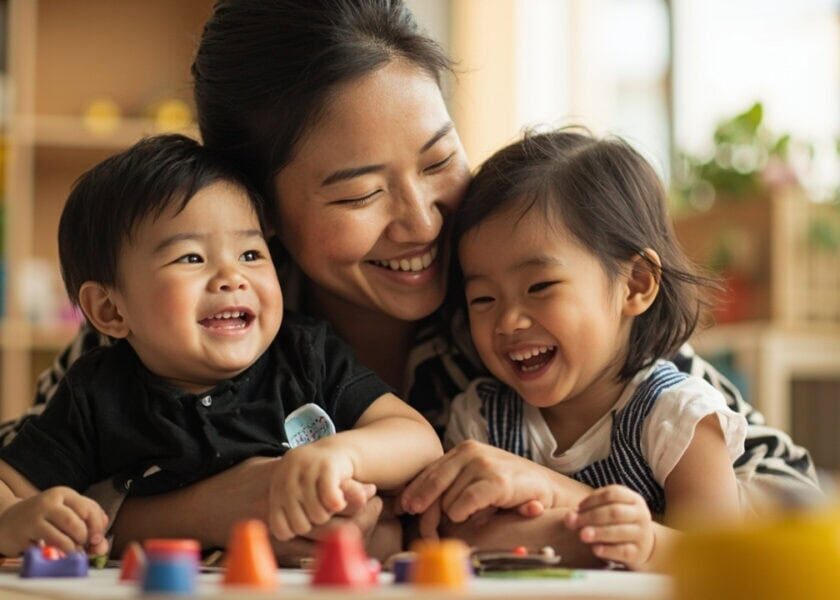
How Quality Childcare Transforms Your Family in the First Year
There Is a Moment
There is a moment—and you will recognize it when it comes—when a parent realizes that the decision they are about to make is not really about childcare at all. It is about what their family is becoming.
They stand at the threshold of something that looks, on the surface, like a practical arrangement. Who will watch the baby while they work. How many hours. What will it cost. Is the space safe. Are the people kind. And all of those questions matter. They matter enormously.
But beneath them runs a deeper current, one that most parents sense but rarely have the language to name: this decision will change us. Not someday, not eventually—but in the first year. In the very first year of quality care, your family will become something it has never been before.
If you are reading this, you are probably standing somewhere near that threshold too. You may be comparing infant care centres, reading reviews, visiting home-based care options, or simply lying awake wondering whether the choice you are about to make will reshape your marriage, your relationship with your child, your sense of who you are as a parent.
You are not being irrational. You are being wise. And this article is written for you.
The Weight of the Decision
Let us begin where every Singapore family begins: with the weight of the decision itself.
We live in a city where both parents work, where grandparents often continue working well past what previous generations considered retirement age, where the cost of living demands two incomes and yet the heart demands something more—a connection to your child that feels real, that feels present.
You are not choosing a service when you choose quality childcare. You are choosing the architecture of your family’s next chapter. And architecture, as anyone who has ever built anything knows, changes everything. The walls you place determine where the light falls. The foundation you pour determines what can be built upon it.
What strikes me most about the families I have walked alongside through this decision is how clearly they sense the magnitude of it, even when they cannot articulate it. They come to tours, they ask about ratios and curricula, they examine the communication policies, they probe for transparency—and they should.
But underneath all of those questions lives a quieter inquiry. One that surfaces not in the tour, but in the car on the way home:
- What will this do to us?
- How will my marriage hold up when our child spends their days with someone else?
- Will I still feel like a parent?
- Will my relationship with my baby change in ways I cannot control?
- Will my older child feel displaced—or will they flourish?
- Will my parents feel replaced, or will they finally be free to just be grandparents?
These are not anxieties to be managed or dismissed. They are wisdom trying to surface. Because the truth is, choosing quality childcare for your infant does reorganize your family. It does shift the architecture. And the families who enter this passage with open eyes—not naive eyes, but open, honest, curious eyes—are the families who emerge from it not merely intact, but transformed in the best possible way.
How Your Family Transforms
The first thing that quality childcare does is it gives your family rhythm. And rhythm, I have come to believe, is the unsung hero of family life.
Before quality care enters the picture, many Singapore families are held together by sheer will and caffeine. Mornings are emergencies. Bedtimes are battles. Weekends are recovery periods from the week, not genuine family time. The rhythm, such as it is, is frantic and fragile.
When you enroll your infant in quality care, something shifts. There is now a structure that holds. Monday through Friday, there is a place your child belongs. There is a beginning and an end to each day. There is a predictability that creates safety—not just for your child, but for you.
Paradoxically, this external structure that some parents fear will make their family feel less their own is exactly what gives you the freedom to be more present during the hours you do have together.
Parental Identity: Redefinition Is Not Diminishment
There is a particular grief that modern parents carry, and I do not think we name it honestly enough. You have carried this child inside you, or beside you through adoption, and you have imagined yourself as their primary everything. Their food. Their comfort. Their world. And then reality intervenes, and you return to work, and someone else becomes a daily presence in your baby’s life.
The question that surfaces, the one that can keep you up at night, is this: will I still matter?
Let me speak to you with the clarity that comes from seeing this unfold across hundreds of families. You will not be replaced. But you will be redefined. And redefinition is not diminishment.
Here is what quality care actually does to parental identity. It gives you back yourself.
The mother who was drowning in the constant demands of full-time infant care finds, when she enrolls her child, that she becomes more rather than less. She returns to work and remembers that she is a person with competencies, with colleagues, with adult conversations. She returns to her baby in the evening carrying something she had lost: herself. And her baby feels this. Children are exquisitely tuned to the emotional states of their parents.
A mother who is depleted and frantic is not a gift to her child, no matter how present she is. A mother who is whole—who has been able to work and think and be competent in the world, who returns to her child carrying the fullness of her own life—this mother gives her child something extraordinary. She gives them a model of a person who is many things. She gives them permission to become many things too.
Quality childcare is not a delegation of parenthood. It is an expansion of it.
The Marriage: From Co-Survivors to Partners
Before quality care enters the picture, many couples are not really couples at all in the way they imagine themselves. They are co-survivors. They are roommates who happen to be parents to the same children. The exhaustion is so profound, the logistics so consuming, that there is no space left for the relationship that created the family in the first place.
When you choose quality care, you create something you likely have not had since before parenthood: time. Not just fragmented, stolen time, but real, predictable, reliable blocks of time that belong to you and your partner. The Monday to Friday structure that holds for your child becomes a structure that holds for your marriage.
A father told me something I have never forgotten. He said, “I have my wife back. Not the wife I had before children—I don’t think anyone has that again—but a new version. A more intentional version. We actually talk now. We parent together instead of just tag-teaming exhaustion.”
That is what quality care can do for a marriage. It can restore it to itself.
Siblings: From Rivalry to Alliance
Parents fear displacement. They worry that the child in care will prefer the caregiver, or that the child at home will feel abandoned. What actually tends to happen, in the rhythms of quality care, is something more beautiful.
Siblings in a family touched by quality care begin to form a different kind of bond. The child at home becomes, in many cases, the first teacher. When a younger sibling comes home from care full of new discoveries, the older sibling has a role. They become the guide, the supporter.
This transforms sibling rivalry into sibling alliance. The competition for parental attention is replaced by a shared project: growing up together.
Grandparents: From Obligation to Genuine Presence
In Singapore, the multigenerational family is a cultural reality. Grandparents are involved. They are expected to be involved. And many grandparents want to be involved—but there is a difference between being present and being obligated.
When quality care enters the picture, something remarkable happens to the grandparent role. It is liberated.
Grandparents who have been carrying the weight of childcare responsibility are suddenly free to just be grandparents again. They can visit on Wednesday afternoons and be fully present, not because they are the ones who must manage the afternoon, but because they have chosen to.
A grandmother who had been caring for her granddaughter three days a week, exhausted and wondering where her retirement had gone, told me six months after enrollment that she felt like she had her daughter back too. Not her daughter the mother—her daughter the daughter. They could go for dim sum together on Sundays now. They could just talk.
This is what quality care does across the generations. It does not replace the village. It restores the village to its proper function.
What to Expect: The Phases of Family Transformation
This transformation—the one that begins in the first year of quality care and unfolds across the months that follow—is predictable. It has phases. Knowing the phases does not take away the difficulty, but it takes away the surprise, and that is a gift.
In the First Weeks
There is often a period of adjustment that feels more acute than you expected. Your baby may cry at handover, or sleep poorly, or seem different in ways that worry you. This is normal. This is the system recalibrating.
What helps: go to your caregiver honestly. Share what your child needs. Trust that the crying is not a failure—it is communication.
In the First Months
There is often a period of renegotiation. Your marriage has new space and must decide what to do with it. Your older child is recalibrating. Your relationship with your own parents may be shifting as their role shifts. This is not a crisis. This is the system finding its new equilibrium.
What helps: talk to your partner about what you both want from this new chapter. Make space for the conversation, even when it feels like there is no time.
By the End of the First Year
Something tends to happen that I have seen again and again. Families who entered this passage with anxiety and uncertainty emerge from it with a kind of settled confidence. They know who they are now. They know how their family works. They have found a rhythm that holds not because it is rigid, but because it is honest.
What Quality Childminding Actually Looks Like
At this point, you may be nodding along but wondering: yes, but what does quality actually mean? How do I know if I am choosing something that will produce this kind of transformation, rather than something that will create new problems?
In Singapore, families navigating infant care have a few pathways. The childminding model—particularly the home-based pathway offered through the ECDA Childminding Pilot—represents a fundamental belief that infants and young children develop best in environments that feel like home.
The ratios in this model matter. When a caregiver knows three infants deeply, she can respond to each one’s unique rhythms, needs, and emerging personality. When a caregiver is managing ten or twelve, she is responding to logistics. The difference matters—to your child’s brain development, to their sense of security, to the quality of the care they receive.
There are practical dimensions designed with real Singapore families in mind. The Monday to Friday care blocks create the rhythm we have been describing. The pilot fee structures are designed to be accessible. Your Child Development Account and Baby Bonus can be used, making the financial architecture of this choice more manageable.
Transparency measures—the communication practices, the visibility structures where deployed—are not there because we assume something will go wrong. They are there because trust is built on openness.
Addressing the Concerns You May Still Carry
Even with all of this context, you may still have questions that feel too raw to ask out loud.
“Will my baby forget me?”
No. Your baby is not a blank slate being filled by whoever holds them. They are building their capacity for attachment, and you are their primary anchor. What quality care does is give your baby additional secure bases to explore from.
“What if the caregiver is better than me?”
You are not in competition with your caregiver. You are complementary. The caregiver knows what happens in a group setting. You know your child in the context of your family. The best outcomes happen when these two knowledge sets are shared, not when they are kept apart.
“Will my child have attachment issues?”
Attachment research is clear: it is the quality and consistency of care, not the location or identity of the caregiver, that matters most. A child with one primary attachment figure who is sometimes stressed and depleted can develop less secure attachment than a child whose parent is supported by quality care and therefore more emotionally available during the hours they share.
“What if my child gets sick constantly?”
It is true that children in group care are exposed to more germs, particularly in the first year. This is a real consideration. But it is also how the immune system is built—and children who build their immune systems early often have fewer absences from school in the long run.
What You Can Do Now
If you are reading this and feeling the weight of the decision, here is some practical guidance for the path ahead:
- Visit before you decide. Pay attention not just to the facilities, but to how the caregivers interact with the children who are there. Do the children seem at ease? Is there laughter? Is there genuine engagement?
- Ask about communication. How will you know what your child’s day looked like? What are the handover practices? Can you expect daily updates? These details matter more than most parents realise until they are missing.
- Trust your instincts about ratios. Small is not just a luxury—it is a different quality of care. If you have a choice, choose the arrangement where your child’s caregiver can genuinely know them.
- Talk to your partner about what you want your marriage to look like in a year. Let that vision guide your childcare decision as much as logistics do.
- Have a conversation with your own parents about what role they want to play. This may be the most important conversation you have before enrolling. Listen to what they want, not just what they have assumed.
- Expect the adjustment period. Give yourself permission to feel the difficulty of the first weeks without interpreting it as a sign that you made the wrong choice.
The Invitation
You came to this decision carrying the weight of something you sensed but could not name. You knew, in some quiet place, that choosing quality childcare was not really about logistics. It was about transformation. It was about the family you were building, not just the child you were raising.
And you were afraid—not irrationally, not without wisdom—that this transformation might cost you something you could not afford to lose.
I want you to know that your fear was honest. Your questions were valid. And your instinct that this decision reaches far beyond the practical was correct.
But here is what I also want you to know. The family you will become in the first year of quality care is not a diminished family. It is not a family that has lost something essential. It is a family that has been reorganised, restructured, rebuilt in ways that create more space for everything that matters.
More space for your marriage. More space for your children to be siblings in the truest sense. More space for your parents to be grandparents, present and joyful. More space for you to be the parent you always wanted to be—the one who is genuinely there, fully present, carrying the fullness of your own life into your children’s lives.
The answer to the question you asked at 2 a.m.—will I still recognize myself?—is yes. You will. But you will also be different. And that difference, that evolution, is not a loss to mourn. It is a transformation to embrace.
The first year changes everything. And that is not a warning. It is an invitation. Step into the first year with open eyes and a full heart. The family you are becoming has been waiting for you.
Choosing quality childminding for your family is one of the most significant decisions you will make—and you do not have to make it alone. At EduNanny, we walk this path with families every day, offering the warmth, standards, and developmental care that help Singapore families not just survive this transition, but truly flourish through it. If you are ready to learn more about what quality childminding looks like for your family, we would love to hear from you.