Culturally Intelligent Childcare for Singapore’s Heritage Languages
The Question Singapore Parents Carry
You are not alone in this. Walk into any playground in Jurong or Tampines or the East Coast, and the same quiet tension lives in conversations that never quite name it.
Parents will tell you they want their child to thrive in English. They will tell you they value the advantages of multilingualism. And then, almost in the same breath, they will ask — in the way Singaporeans ask things, carefully, almost apologetically — whether their child will still speak to their grandparents without translation. Whether the Malay their mother sings in the kitchen will feel native to their child. Whether the Teochew phrases their father drops into conversation will land anywhere in their daughter’s ear.
These are not anxieties born of doubt in your choices. They are anxieties born of love. And they deserve to be met with honesty, not dismissed with reassurances.
We also understand that in Singapore, this conversation is shaped by a reality that is uniquely ours. We are a multiracial, multilingual society. That is not a challenge to manage. It is a richness to inhabit.
A child who grows up here has access to languages and cultures that many children in the world will never encounter. Quality childcare in Singapore should not flatten that richness into a single dominant tongue. It should amplify it.
Understanding the Real Concern
Here is what we know, and what we believe parents deserve to hear honestly. When childcare is only focused on outcomes and benchmarks, it can inadvertently create a monoculture of the dominant language.
Not because anyone intends harm — but because language is not neutral. It carries attention. It carries time. It carries assumption.
If a childcare environment is not intentional about heritage language, it will fill the space with something, and that something tends to be the language of instruction, the language of fluency, the language of progress.
This is not a failure of the system. It is a gap in design. And it is a gap that thoughtful, culturally intelligent childcare can close.
The fear we began with — the quiet question that surfaces in a car ride home or at the end of a long day — is a legitimate fear. But it is built on a false premise: that professional care and cultural transmission are competing forces. That choosing one means losing the other.
We are here to tell you this premise does not have to be true. When care is designed with cultural intelligence at its centre, something different happens. Professional childcare does not have to replace the family’s role in heritage transmission. It can become a partner in it.
What Culturally Intelligent Childcare Looks Like
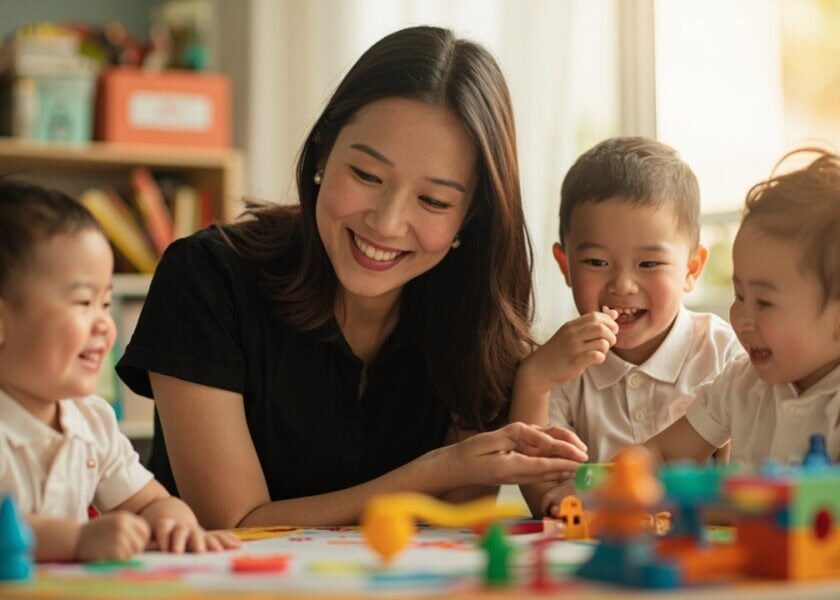
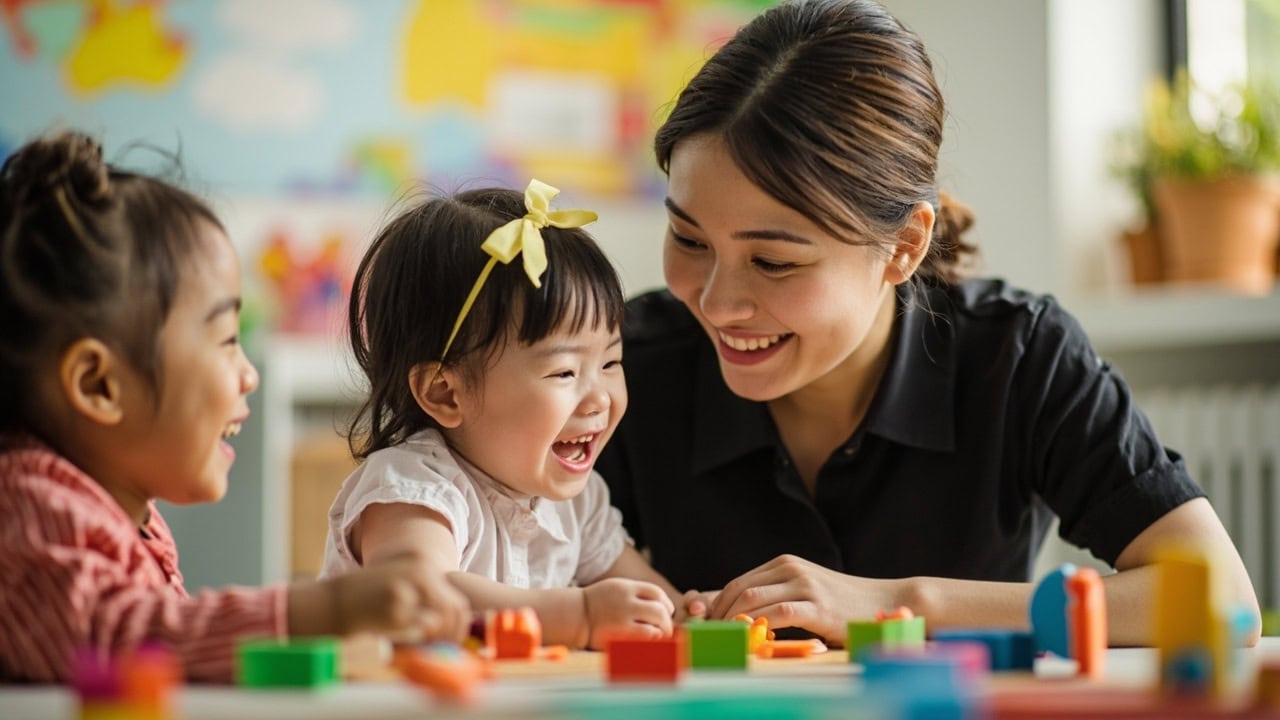
Think about what caregivers actually do. They sing. They tell stories. They mark festivals. They respond to a child’s first attempts at language with warmth and repetition. They create the daily texture of a child’s early world.
Now imagine that same caregiver singing not just in English, but in your child’s home language. Not perfectly — there is no need for perfection — but consistently, intentionally, and with respect for what that language carries.
Imagine your child hearing Mandarin nursery rhymes in the morning alongside English ones, and beginning to understand that both belong to their world.
Imagine a childcare environment where Malay pantun are part of the rhythm of the week, where Tamil counting songs are celebrated alongside Western ones — not as novelty, but as normalcy.
This is not a radical idea. It is what cultural intelligence in childcare looks like in practice. And it is what makes the difference between a child who learns about heritage and a child who lives it.
What makes this possible is not accident. It is training, intention, and design.
A caregiver’s role is not simply to supervise and stimulate. It is to be a steward of a child’s developing sense of self — their language, their cultural awareness, and the invisible roots that tell them who they are and where they belong.
When caregivers are trained to understand the significance of mother tongue in early identity formation, they make different choices every day. They choose the right song. They pause to learn the phrase a child brings from home. They create space for the language that does not live in the curriculum.
A child who grows up with this kind of care feels the Tamil their father speaks and the English their mother uses at work as two strands of the same strong rope — not in competition, but complementary. Not diluted, but enriched.
Questions to Ask Before You Choose
For parents navigating this decision — and we know the decision is not small — there are practical things worth considering. When you evaluate a childcare arrangement, ask:
- What languages does the daily programming include beyond English?
- How are festivals and cultural rhythms observed throughout the year?
- Are caregivers encouraged to learn basic phrases in home languages?
- What songs is my child learning, and in which languages?
- How is my child’s home language use acknowledged and supported?
- Can I observe or receive regular updates about my child’s language environment?
These are not unreasonable demands. They are the questions of a parent who knows that language is not just communication. It is belonging. And belonging is not something you leave at the door when you walk into professional care. It is something you carry with you, and it deserves to be honoured in every environment your child enters.
What Makes This Kind of Care Accessible
Thoughtful, culturally intelligent childcare is not only possible — in Singapore, it is increasingly supported by frameworks designed with real family needs in mind. The ECDA Childminding Pilot, for instance, offers both home-based and centre-based pathways that allow caregivers to give focused attention to each child’s individual language environment.
- Small caregiver ratios — sometimes 1:3 or fewer — mean each child’s home language can be genuinely seen and supported, not just managed in a group.
- Affordable fee structures mean quality cultural care is within reach for a wider range of Singapore families, not only premium budgets.
- CDA and Baby Bonus support provide accessible payment options for eligible households.
- Monday to Friday consistency builds the regular routines that steady language learning and cultural reinforcement.
- Regular parent communication keeps you connected to what your child experiences throughout the day.
These are not peripheral details. They are the conditions that make quality cultural care genuinely possible.
Why This Matters Beyond the Brain
What we are describing is not a compromise. It is not care that supports heritage language because it cannot match the English fluency of a fully English immersion programme.
What we are describing is a model that understands multilingualism not as a cognitive checkbox but as an identity anchor.
Research does support cognitive benefits — there is genuine science there — but the reason this matters goes beyond the brain. It matters because:
- A child who speaks their mother tongue fluently can have a different kind of conversation with their grandmother.
- A child who is culturally rooted has a different kind of confidence in a room full of people who are not like them.
- A child who does not have to choose between who they are at home and who they are in the world has something that no cognitive score can measure.
They have a self that feels whole.
A Note to Singapore Parents Feeling This Weight
If you are reading this and feeling that quiet question pressing at your chest — the one about whether your child will still know where they come from — we want you to hear this clearly:
That question is not a sign that you made the wrong choice.
It is a sign that you are paying attention. That you understand what matters. That you are the kind of parent who is thinking deeply about the whole child, not just the legible outcomes.
The answer to that question is not found in choosing between professional care and cultural transmission. It is found in choosing professional care that understands what cultural transmission means, and that is willing to do the quiet, daily, intentional work of making it real.
At EduNanny, we believe the early childhood period — those foundational years when language is acquired with a plasticity that will never return — is too important to be left to accident or default. We believe that Singapore parents deserve childcare that sees them fully, that understands the full weight of what they are entrusting when they hand their child to someone else’s care.
Heritage and fluency, culture and capability, roots and reach — these are not opposites. They are what a whole child is made of.
Your child’s languages do not have to compete with each other. The people who care for your child — when they are the right people, in the right environment, with the right values — are not replacing what your family gives them. They are reinforcing it. They are expanding it. They are holding it alongside you.
That is what quality childcare in Singapore can be. That is what we believe it should be. And that is what EduNanny is here to build — not just for the children in our care today, but for the people they will become.
Grounded. Multilingual. Certain of where they come from, and confident in all the places they are going.
EduNanny is a Singapore childcare and childminding service built on developmental care, cultural intelligence, and the belief that every child’s roots deserve to be held with intention. If you are ready to explore childcare that understands the full weight of what you are entrusting, we invite you to start a conversation with us.