The Multilingual Advantage of Singapore’s Best Childcare
Quick Summary: Language Development in Singapore Childcare
- Early childhood is the peak window for language acquisition — the brain is wired for language in the first six years more powerfully than at any other point in life.
- Language requires interaction, not just exposure — back-and-forth conversation builds language far more effectively than passive media.
- Quality childcare can be an active language environment — intentional caregiver interaction during daily routines scaffolds language development.
- Singapore’s multilingual context creates specific opportunities — English, Mandarin, and heritage languages can all be supported through quality care.
- You can observe language milestones and use them to evaluate whether your child’s environment is truly supporting their growth.
Understanding Singapore’s Multilingual Reality
Singapore is unlike almost anywhere else in the world. In a single day, a Singaporean child might hear English, Mandarin, Malay, Tamil, Teochew, Hokkien, Cantonese, Hindi, Malayalam, Bengali, Indonesian, Tagalog — sometimes all within the same household, the same neighbourhood, the same family gathering.
We are multilingual not by aspiration alone but by inheritance. By history. By the choices our parents and grandparents made about which languages to speak, which to pass on, and which to let fade. And now, as parents raising children in this environment, we carry a particular weight.
We want our children fluent in English — the language of their classrooms, their workplaces, their futures. We want them to have Mandarin, because it connects them to heritage, to extended family, to a culture and economy that spans continents. Some of us want them to hold onto dialects — the languages our grandparents speak with a warmth that somehow feels irreplaceable. Some of us are raising children between languages that do not share the same script, the same sounds, the same grammar, and we wonder how they will manage it all.
The research offers reassurance: young brains are extraordinarily well-equipped for learning multiple languages simultaneously. The neural pathways for language are carved deepest in the early years, when the brain’s plasticity is at its peak and language acquisition happens almost naturally — without conscious effort, without formal instruction, without the struggle adult language learners know too well.
But here is what many parents discover too late: this remarkable capacity needs something from the environment. It needs language to be present. Spoken to the child, around the child, with the child. It needs interaction — responsive, back-and-forth conversation, not passive exposure to screens or recordings. It needs caregivers who repeat words, who expand on what the child says, who name the world as they move through it together.
The Tension Every Working Parent Carries
And this is where the tension lives. Because we know — every working parent knows — that the years when language learning is most effortless are also the years when we are most likely to be away from our children for the bulk of their waking hours.
We have perhaps two to three waking hours on weekdays to pour language into our children. We drop them at childcare in the morning and pick them up when they are tired, when dinner needs to be made, when bedtime is approaching. And we wonder: is it enough? Have I already fallen behind?
Here is the reframe that changes everything: when your child is in quality childcare during the workday, those hours are not time spent away from language learning. In the right environment, with the right caregivers, those hours become some of the most language-rich hours of your child’s day.
What Language-Rich Childcare Actually Looks Like
This is not a platitude. It is a description of what actually happens when caregivers understand language development as part of their work — when they view every feeding time, every nappy change, every walk to the park, every moment of play as an opportunity to build language.
Consider what happens during a routine that may seem ordinary. Your child’s caregiver picks up your baby after a nap. She says, “Good morning, did you sleep well? Look, the sun is coming through the window. It’s a beautiful day today.” She names the sensation of being lifted, the texture of the blanket, the sound of birds outside. She is not performing. She is not reciting a script. She is doing what language-rich caregiving looks like in practice — turning routine into conversation, filling the spaces between care with the raw material of language.
Multiply this across a full day, a week, the months of your child’s first and second and third years. The child hears thousands of words — not in isolation but in context. He hears the same words repeated in predictable situations: “morning,” “hungry,” “milk,” “done,” “play,” “book,” “song.” He hears new words introduced with care and repetition. He hears stories with beginnings, middles, and ends, with characters who want things and face obstacles and find resolutions. He hears songs with rhythm and rhyme — cognitively important because rhyme helps children hear patterns within sounds, which is foundational for reading later on.
A Language-Rich Day: Concrete Examples
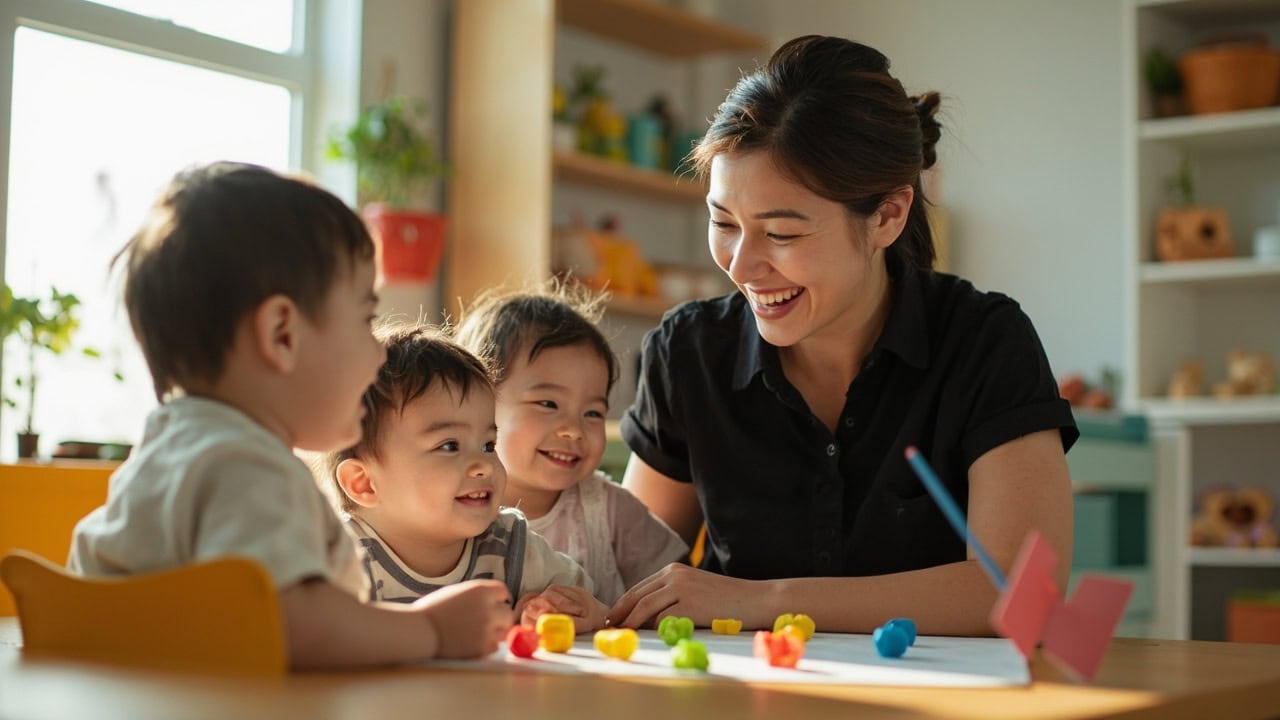
In a language-rich childcare environment, you might see a caregiver sitting with a small group of toddlers for story time. She is not simply reading the words on the page. She is pausing to ask questions: “What do you think will happen next?” “Where is the little rabbit going?” “Have you ever seen a rabbit?” She is pointing to pictures and naming what she sees. She is repeating key words: “The rabbit hopped. He hopped all the way home. Can you hop like the rabbit?” The children are not just listening. They are participating. They are hearing language in motion, language that responds to them, language that feels alive.
In another part of the room, you might see a caregiver feeding an infant. She is narrating the moment: “You’re eating banana today. It’s soft and sweet. Do you like it?” She is naming the action, the taste, the texture. When the baby makes a sound, she pauses and responds, as if in conversation. This is not just feeding. This is language scaffolding through the most basic of daily routines.
In a quiet corner, you might see a caregiver singing a familiar song with a toddler who is just beginning to find her voice. The caregiver sings the first line and pauses, waiting. The toddler attempts the next word. The caregiver repeats it back with delight: “Yes! Ball! You said ball!” This back-and-forth — this turn-taking that mirrors conversation — is one of the fundamental building blocks of language development. It teaches the child that her voice matters, that communication is reciprocal, that words have power.
These are not elaborate interventions. They do not require expensive technology or elaborate curricula. They require caregivers who have been trained to understand the significance of their own speech, their own interaction, their own responsiveness. They require a philosophy of care that takes language seriously.
Language Milestones: What You Can Observe
Understanding language milestones helps you evaluate whether your child’s environment is truly supporting their development. These are not milestones only specialists can track — they are observable, recognizable by any attentive parent.
During the first year, language development begins with recognition and response. Your baby learns to recognize voices, to turn toward sound, to coo and babble, to respond to her own name, to understand simple words like “no” and “bye-bye.” By the end of the first year, most babies are saying their first words or are very close to it. If your child is in quality care during this period, you should see caregivers talking to your baby constantly — narrating actions, naming objects, responding to coos as if they were meaningful contributions to a conversation. You should hear babbling in the room, back-and-forth vocalizations that mirror the rhythm of real conversation.
During the second year, language accelerates. Words begin to combine into simple phrases. Vocabulary expands rapidly — children at this age can learn several new words per day if the environment provides them. You should hear your toddler attempting new sounds, making requests, labeling things with increasing accuracy. In quality care, this is the period of explosive growth, where caregivers are naming everything, reading picture books repeatedly, singing songs that build vocabulary through repetition and rhyme.
During the third year and beyond, language becomes more complex. Children begin to form sentences, to ask questions, to tell simple stories, to engage in pretend play that requires language to coordinate and extend. You should see your child talking about things that happened earlier in the day, expressing preferences, initiating conversations with other children and with adults. In a language-rich environment, caregivers are not just talking to your child but talking with your child — holding real conversations, expanding on what the child says, introducing new vocabulary in context.
What to Look For When Choosing Childcare
Knowledge is empowering. If you know what to look for, you can ask the right questions when you visit a childcare environment.
Observe caregiver speech. Do caregivers speak to children as conversational partners, not just for management and instruction? Do they narrate routines? Do they respond to children’s sounds and attempts at words? Listen for language quality — not just the quantity of noise but the richness of words. Is there narrative? Back-and-forth exchange? Storybook reading that involves interaction, not just recitation?
Notice caregiver ratios. Real conversation requires time. Smaller ratios mean each child gets more responsive interaction — this is not a luxury but a language development necessity. Ask about language philosophy: how does the environment think about language development? Is it treated as a core responsibility or an afterthought? Are caregivers trained to understand the significance of their own speech?
Check for daily communication. Quality caregivers share what happened during the day — what your child ate, how they slept, what they enjoyed, what words they tried, what stories they heard. Language development is ongoing and should be part of the daily conversation between caregiver and parent.
How EduNanny Approaches Language Development
At EduNanny, language development is not something that happens in the margins of our work. It is central to what we do.
We are part of the ECDA Childminding Pilot, which means we operate within a framework that recognizes home-based and community-based childcare as a legitimate, quality pathway for Singapore families. Our caregivers are trained to understand language development as a core competency of their role. They know that the words they speak during a nappy change, during a feeding, during a walk, during a story — these are not incidental to the care they provide. They are the care.
Our ratios reflect this understanding. With up to one to three infants in our care, we ensure that each child has access to responsive, individualized interaction — the kind of back-and-forth that builds language most effectively. This is not a number we arrived at lightly. It is a ratio that makes real conversation possible.
Our care is structured around Monday to Friday blocks, designed around the rhythms of working family life. We know that Singapore parents need childcare that is reliable, that fits with work schedules, that does not require constant improvisation. And where applicable, families can access their childcare arrangements through CDA and Baby Bonus, making quality care financially accessible within the pilot fee structures.
We also believe in transparency. Communication between caregivers and parents is not a feature — it is a practice. Daily updates about your child’s experiences — what they ate, how they slept, what they enjoyed, what they are learning, what words they tried today — keep you connected to the language environment your child is in each day.
About Our Caregivers
The women and men who provide childcare in Singapore are sometimes spoken about as if they are simply substitutes for parents — filling a functional need until the family can resume. The best childcare caregivers are not substitutes for parents. They are language partners for your children during the hours when language learning is most active. They are the people who will speak thousands of words to your child, who will read your child dozens of stories, who will sing the songs your child will remember for the rest of their lives.
This is not a lesser role. It is a profound one. And the caregivers at EduNanny understand it as such.
A New Calculus for the Childcare Decision
Every parent in Singapore who works during the day makes a calculation. They weigh economic realities, professional demands, practical necessities of family life, against the hours they will not spend with their children during these precious early years. This calculation is not made lightly. It is made with a mixture of love and anxiety, of determination and doubt.
What I want you to know is this: the calculation you have been making — the one that weighs time spent away from your child against time spent building their future — may need a revision. Not because the time you spend with your children in the evenings and on weekends is any less valuable. It is invaluable. But because the hours in quality childcare during the workday can be, and should be, more than a placeholder. They can be a language environment. They can be a place where your child’s brain builds the neural pathways for communication, for reading, for thinking, for connection.
The child who hears thousands of words in context during the workday — words that are repeated, that are meaningful, that are woven into the fabric of daily life — begins Primary One with something more than vocabulary. She begins with the habit of language, the expectation that words matter, the understanding that communication is a two-way street. She begins with a foundation.
You cannot be two places at once. You cannot unwork your job to stay home during the years when language learning is most effortless. But you can choose a childcare environment that understands what it is doing when it speaks to your child. You can choose caregivers who know that every “look,” every “can you say,” every “what’s this,” every pause for response is building something lasting.
You can choose an environment where your child’s language — in English, in Mandarin, in your heritage language — is not lost during the hours you are away but is, quietly and steadily, growing.
Ready to Learn More?
EduNanny was built for families navigating the beautiful complexity of raising children in Singapore’s multilingual world. Families who want quality care that takes language development seriously. Families who deserve to feel, at the end of each workday, not guilt but trust — trust that the hours away were hours well spent, that something important was happening in their absence, that their child is not just being kept safe but is being built up, word by word, toward everything they will become.
If you are exploring infant care or childminding options in Singapore and want to understand how quality care can actively support your child’s language development — in English, in Mandarin, in your heritage language — we invite you to connect with us to learn more about our approach.
The language your child is building right now, in the hours you are not there, matters. It matters more than you know. And it is happening, every day, in the hands of caregivers who understand its significance.
Not just care. Language. Growth. A future built word by word, conversation by conversation, story by story, in the hours that matter most.
EduNanny is part of the ECDA Childminding Pilot, providing quality, development-focused childcare for Singapore families. Learn more about us or explore our approach.