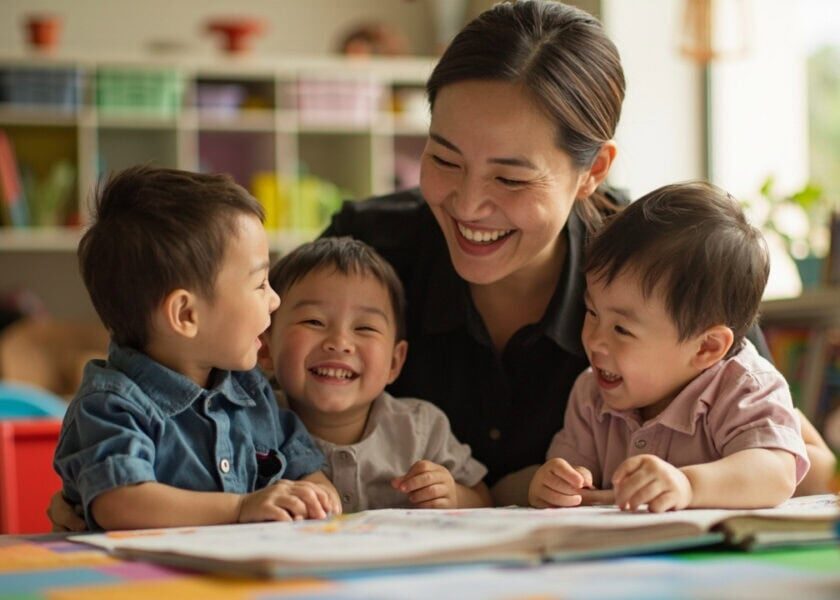
Beyond Supervision How Quality Childcare Builds Your Child’s Capabilities
The Difference That Changes Everything
There is a difference between supervision and development, and it matters more than we often acknowledge.
Supervision keeps a child safe. It ensures they are fed, rested, and protected from harm. Supervision is necessary. Supervision is the baseline that every family deserves.
But supervision alone does not build a child’s capabilities. It does not expand their vocabulary, strengthen their problem-solving, deepen their ability to connect with other children, or help them understand and name their own emotions. These are not things that happen automatically while a child is in someone else’s care. They require intention. They require trained observation. They require an environment designed to support growth at every stage of early development.
Quality childcare does not merely maintain your child while you are away. It actively builds what your child is becoming. This is not wishful thinking. It is the observable outcome of what happens when trained caregivers understand infant and toddler development, when they observe with purpose, when they create environments that invite exploration, when they respond to a child’s curiosity in ways that stretch and challenge without overwhelming.
You can see this difference. We want to show you what it looks like.
What Growth Actually Looks Like: Five Domains of Development
When quality care is at work, you can observe it. Here are five areas where development becomes visible, practical, and real.
Language: Where the Invisible Work Becomes Most Visible
Consider language, because language is where the invisible work becomes most visible.
A child in quality care is not simply hearing words. They are being spoken with, responded to, and engaged in the back-and-forth that neuroscience tells us builds neural pathways faster than almost anything else in the early years. A trained caregiver narrates the moment. They name what the child is touching. They repeat and expand what the child says, even the earliest syllables. They introduce new words in context, connecting language to experience in ways that make meaning stick.
In the weeks after your child has been in quality care, you may notice their vocabulary expanding in ways that feel sudden but are actually the accumulation of hundreds of small language moments you did not witness. They begin to name things they could not name before. They use phrases you have not taught them directly. They start to put words together in ways that surprise you.
Social Confidence: Learning to Be Part of Something
Social confidence develops quietly and then announces itself all at once.
A child who has been in quality care learns, over time, that other children are interesting. That sharing can work. That conflict has a resolution. That another person’s attention is not always on them, and this is okay. They watch trained caregivers model how to comfort a crying peer, how to include someone who is hesitant, how to take turns in a way that feels fair even when it is not easy.
You may notice this at the playground. The child who waves instead of grabbing. The child who watches another child’s distress and moves closer, not away. The child who is beginning to understand that they are part of something larger than themselves.
Motor Development: A Window Into How the Whole Child Is Growing
Motor development sounds simple but is actually a window into how the whole child is growing.
Gross motor skills, fine motor skills, the coordination and body awareness that lets a child climb and pour and manipulate small objects with growing precision. These develop when children have space to move, when they are encouraged to try rather than simply helped to avoid frustration, when caregivers understand the difference between supporting and rescuing.
Watch your child at home after months in quality care. The way they climb onto the couch with new intention. The way they hold a spoon or a cup with greater control. The way their whole body seems more certain of itself, more at home in the world.
Cognitive Curiosity: The Most Important Thing Quality Care Cultivates
Cognitive curiosity is perhaps the most important thing quality care cultivates, and the hardest to define.
Children are born curious. Every infant is a scientist, testing the world with their eyes, their hands, their mouths, their whole bodies. The question is whether that curiosity is nurtured or dulled. Whether the environment says yes, explore that, or no, stop that.
Quality care says yes. Quality care asks questions. It pauses to let a child discover. It brings wonder into ordinary moments. It says, look what happens when we mix these colors, when we drop this ball, when we tear this paper. It is curiosity with a guide, exploration with support.
Emotional Regulation: The Most Profound Gift
Emotional regulation may be the most profound gift quality care offers, and the one that shows up last.
Young children do not have mature prefrontal cortexes. They cannot, on their own, calm themselves when overwhelmed, manage disappointment, or hold big feelings without becoming overtaken by them. These capabilities develop over time, with help. When caregivers consistently name emotions, model calm, provide co-regulation, and hold steady through a child’s storms, they are building something lasting. They are teaching the nervous system that feelings are survivable, that comfort is available, that someone will stay with you through the hard moment.
You may notice this in your child months later. A child who is more easily soothable. Who recovers from frustration faster. Who is beginning to have words for what they feel.
How It Happens: Observation, Ratios, and Environment
None of this is magic. It is trained observation, intentional environment design, and the daily decisions of caregivers who understand what they are doing.
A trained caregiver does not simply watch a child. They observe with purpose. They notice which toys a child returns to repeatedly and what that reveals about their current interests or developmental focus. They notice when a child is in the zone of proximal development, where a task is just challenging enough to stretch but not so difficult it frustrates. They notice social dynamics, language attempts, physical milestones as they emerge. This kind of observation is not casual. It is professional. It informs every interaction, every environment adjustment, every moment of intentional support.
This is why ratios matter. When a caregiver has only one, two, or three infants to attend to, that level of observation becomes possible. When ratios are high, when one caregiver is responsible for many children, observation becomes supervision. The difference is not cosmetic. EduNanny maintains these careful ratios precisely because development requires attention that cannot be divided too thin. This is not a feature we add to our marketing. It is the condition that makes everything else possible.
Environment matters too. Quality care is not just about who is in the room. It is about what the room itself invites. Safe materials at the right developmental stage. Space for movement, for mess, for the kind of play that looks chaotic but is actually deeply purposeful. Order that is not rigidity but calm and predictability, which is what young nervous systems need to feel secure enough to explore. This is intentional design. It is what separates a room that happens to have children in it from a space that actively supports growth.
What You Can Look For at Home
So, as a parent, what can you look for? What are the signals that quality care is doing its work in the hours you cannot see?
These are not guarantees, because children are complex and development is not linear. But they are observable indicators that suggest your child is not just being maintained but is actually growing.
- Language expansion: Notice if your child’s language seems to be expanding in ways that feel faster than you expected. Are they using more words? More phrases? Putting words together in new ways?
- Social behaviors: Notice if they are using more social behaviors with peers, showing interest in other children, beginning to negotiate rather than simply demand.
- Physical confidence: Notice if their physical confidence is growing, if they seem more sure-footed, more coordinated, more willing to try physical challenges.
- Curiosity: Do they ask more questions? Are they more interested in how things work? Do they bring you things to show you, sharing discoveries with evident excitement?
- Emotional resilience: Not perfection. Children still cry. But do they recover more quickly? Do they seem to trust that comfort is coming? Are they beginning to have words for their feelings, even if imperfect?
These are the visible edges of invisible work. They are what quality care produces over time.
If you want to go deeper, here are questions worth asking the caregivers and programs you are considering:
- How do you observe and document development?
- What does a typical day look like in terms of language interaction?
- How do you support children who are struggling emotionally?
- What is your training and understanding of developmental stages?
- What is your approach when a child is not meeting a milestone on schedule?
These are not rude questions. They are the questions of a parent who understands that childcare is not just logistics. They are the questions of a parent who knows that what happens in these early years matters in ways that echo for decades.
Why These Years Matter More Than You Might Think
The years from birth to six are not a warm-up for the real work of education. They are the real work. The brain is building itself at a pace it will never match again. The foundations for language, for reasoning, for emotional regulation, for social capability, for physical coordination, are all being laid in these years with extraordinary speed.
The first thousand days, as researchers have come to call them, represent a window of extraordinary opportunity and extraordinary sensitivity. What happens in these days shapes what is possible for a lifetime.
This is why the choice of childcare is not a logistics decision. It is a developmental decision. It is one of the most consequential choices a family makes in the early years, and it deserves to be made with the gravity it warrants.
We do not say this to create anxiety. We say this to create clarity. Because when you understand what is at stake, you can make a choice that feels right in your bones, not just reasonable on a spreadsheet.
What EduNanny Is Doing for Singapore Families
Through the ECDA Childminding Pilot, we are part of an initiative that is reimagining what infant and toddler care can look like in Singapore. Not as a substitute for centre-based care, but as a complementary pathway. Home-based care, when it is quality care, offers something genuinely different. Smaller ratios. Familiar environments. The kind of individualized attention that can make an extraordinary difference in the earliest years.
This is why we maintain those ratios. This is why we invest in caregiver training. This is why we build observation and documentation into everything we do. Not because it is mandated, but because we understand what is actually required to produce the outcomes we have been describing.
And we want this to be accessible. Quality development should not be only for families with unlimited resources. Through the pilot fee structures, through the usability of CDA and Baby Bonus, we are working to make this possible for more Singapore families. Monday to Friday care blocks that give parents the consistency they need. Transparency measures, including communication practices and where deployed, CCTV access, that give parents visibility into what is happening in the hours they are away.
This is not about surveillance. It is about partnership. When parents can see what is happening, they can reinforce it at home. They can have informed conversations with caregivers. They can track their child’s development with accuracy rather than guessing.
We also know that modern parenting is complex in ways that earlier generations did not experience. The information environment is overwhelming. Every parent is drowning in contradictory advice, in expert opinions that contradict each other, in the pressure to get everything right in a window that feels impossibly short.
This is why we developed Thomas, our AI chatbot, to support parents in navigating the real challenges of infant care and childminding. Not to replace the human expertise that matters most, but to make that expertise more accessible when you have a question at 11pm, when you cannot sleep because you are wondering if your child’s development is on track, when you need quick guidance that is grounded in what actually works.
The Question at the Classroom Door
We want to close by coming back to that moment at the classroom door.
You release your child’s hand. You say the words. You walk away.
But what if, this time, you walked away knowing something different? Not with the absence of care, but with the presence of understanding. Knowing that in those hours, something is being built. That trained eyes are watching your child’s curiosity with intention. That their language is being shaped by hundreds of small responsive moments. That their body is learning what it can do, their heart is learning what it can feel, their mind is learning how the world works.
What if you could trust not just the safety of the environment but the developmental purpose of it?
That is what we are building at EduNanny. Not a place where children are kept. A place where children are growing.
This is what quality childminding makes possible. Not just for parents, though parents deserve this peace of mind. Not just for caregivers, though caregivers deserve to be seen as the skilled professionals they are.
For children. For the children who will carry what happens in these years into every relationship they form, every problem they solve, every challenge they face, every moment of their lives ahead.
That is the weight of this work. And we do not take it lightly.
We know you do not either. That question you ask yourself at the classroom door, the one you do not always voice. It is a good question. It is the question of a parent who cares deeply about what their child is becoming.
We are asking it with you. And we are building the answer, every day, in the way we observe, in the way we respond, in the way we create environments where development is not an afterthought but a purpose.
Your child’s capabilities are unfolding. Right now. In the hours you are away. We are honored to be part of what they are becoming.
If you are ready to learn more about how EduNanny approaches infant care and childminding in Singapore, we invite you to start a conversation with us. We are happy to answer your questions, walk you through our approach, and help you understand whether we might be the right fit for your family.
Because you deserve to walk away from that classroom door with confidence. And your child deserves everything that quality care can help them become.
Learn more about EduNanny and our approach to thoughtful, development-oriented childminding.