Why Quality Childcare Builds Confidence Better Than Enrichment Classes
The Question Singapore Parents Carry Alone
There is a question Singapore parents carry quietly. Usually in the evening. Usually when the house is finally still. It is not a question they voice at playdates or raise at family gatherings. It surfaces when they are weighing childcare options, reading enrollment timelines, or hearing another parent speak confidently about their child’s primary school preparation.
The question sounds something like this: Am I giving my child what they actually need for the years ahead, or am I making a choice that feels right now but falls short when it matters?
This question is more common than you might think. And it deserves a more honest answer than most parents receive.
The Insight Most Parents Miss
Singapore parents investing in quality childcare often feel they must justify that choice—as though they are trading something precious, some academic advantage or developmental edge, for the convenience of returning to work or the restoration of their own wellbeing. At the same time, parents approaching primary school enrollment carry a different but related anxiety: the fear that their child may not be ready in ways that schools actually value.
Here is what most parents do not realize: this tension is built on a false assumption about what school readiness means and where it comes from.
We talk about childcare as though it is about keeping children safe and occupied while parents work. We talk about school readiness as though it begins when a child enters a classroom. But the reality is that readiness for primary school begins the moment a child begins to form attachments—the moment they start learning that the world is predictable, that adults respond when they call, that other children can be partners in play as well as rivals for toys.
When you understand what top primary schools are actually assessing—and how readiness develops—you see that quality childcare is not a compromise between present needs and future success. When done thoughtfully, it is the very foundation on which that future success is built.
What Elite Primary Schools Actually Seek
When Singapore’s top primary schools assess a child for admission—whether through interviews, observation periods, or the assessments that shape cohort placement—they are not primarily looking for academic knowledge. They are not testing whether a child can recite multiplication tables or read ahead of their age.
They are watching for something harder to teach and more valuable to have:
- Confidence—the quiet internal knowledge that they can handle what comes next
- Relational fluency—the way a child navigates a new group, speaks to unfamiliar adults, handles the unexpected
- Emotional regulation—how a child responds when frustrated, recovers from disappointment, modulates reactions in a structured environment
- Independence—whether a child can manage their own belongings, follow multi-step instructions, separate from a caregiver without prolonged distress
These are the capacities that predict school success—not just academic performance, but the experience of thriving versus merely surviving the primary years.
These capacities do not emerge from flashcards or enrichment worksheets. They emerge from relationships. They develop through daily experience. They are built in the moments when a child feels secure enough to explore, challenged enough to grow, and supported enough to fail and try again.
How Quality Childcare Builds School Readiness
The Secure Base: Where Confidence Begins
Consider what actually happens in a quality childcare setting—not the abstract concept, but the daily texture of experience that shapes a child’s developing sense of self and capability.
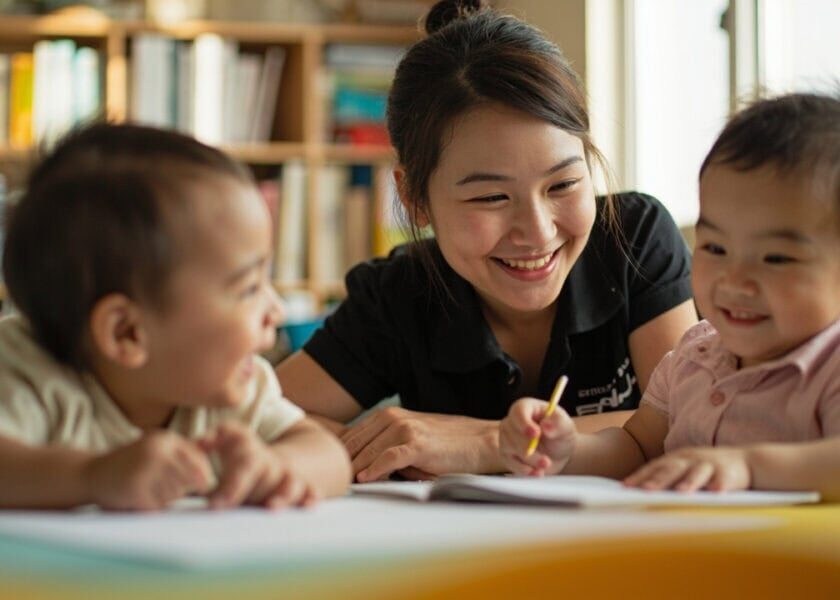
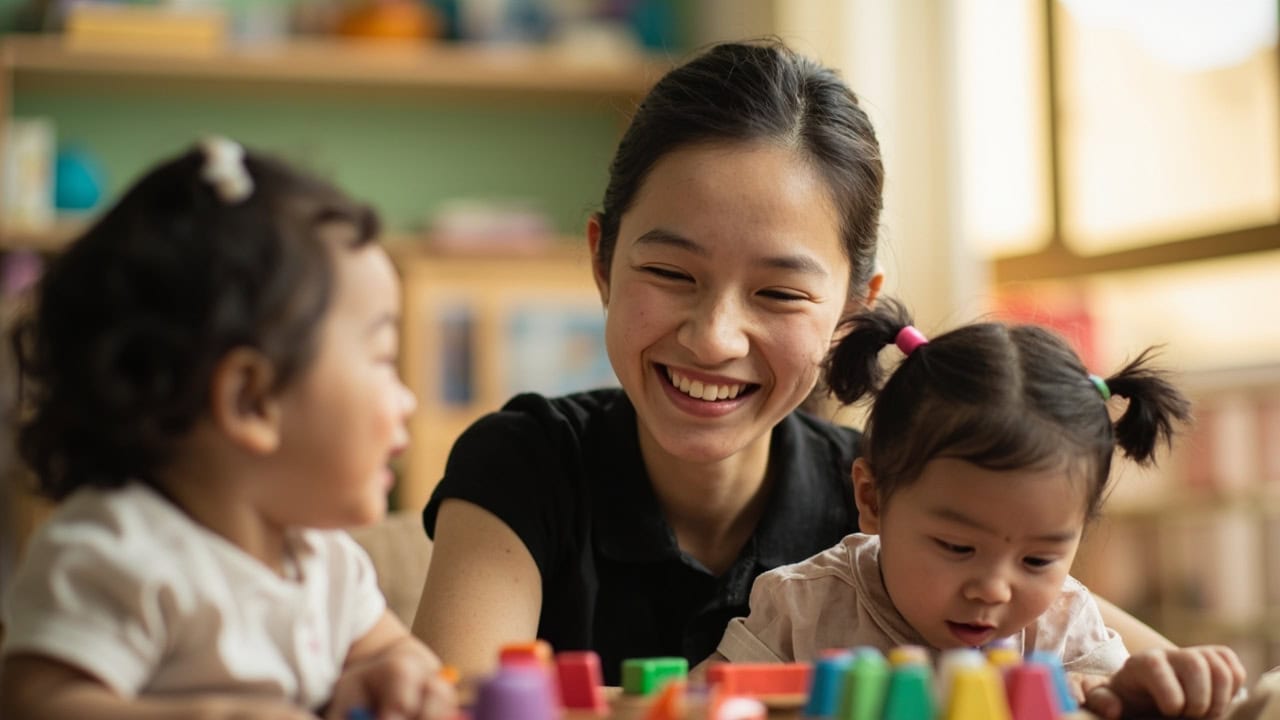
A child in a small group with a responsive caregiver learns something profound about themselves: they matter. When they signal hunger, discomfort, curiosity, or distress, someone notices and responds.
A child who experiences consistent responsiveness develops what psychologists call a secure base—an internal working model that says: the world is reliable, adults can be trusted, and I am capable of affecting my environment positively.
This is not softness or coddling. This is the psychological architecture that allows a child to walk into a primary school classroom and believe, without evidence yet, that they can handle what comes next.
Confidence is not bravado. It is the quiet internal knowledge that you have been handled with care and can therefore handle yourself.
Peer Interaction: The Training Ground for Social Competence
When children play together under the facilitation of an attentive caregiver, they are doing something far more valuable than entertainment. They are learning to negotiate. They are practicing compromise. They are discovering that other children have desires and feelings that may not align with their own—and that these differences can be navigated rather than simply dominated or yielded to.
A caregiver who observes these moments—who steps in at the right moment to name emotions, to model language, to support resolution without removing the learning opportunity—is doing what the best primary school teachers wish all their incoming students had already experienced.
Social competence is not something that can be taught in a single lesson. It is a capacity built through hundreds of small negotiations, and quality childcare provides exactly this training ground.
The Transition Architecture: Building Resilience Before School
There is another dimension worth examining: the daily transitions that quality care provides. Arriving at a new environment. Separating from a familiar caregiver. Adapting to a different routine.
These are not disruptions to be minimized—they are opportunities. A child who has learned to manage the transition from home to care, who has built resilience through the predictable rhythm of departure and reunion, arrives at primary school with a transferable skill.
They know, in their body, that transitions are survivable. That the discomfort of the unfamiliar does not last forever. That there is a reliable pattern of leaving and returning.
This is what allows some children to walk into P1 on their first day with relative calm while others dissolve into distress—not because one is smarter or more prepared academically, but because one has already built the emotional muscles that primary school requires.
Emotional Regulation: A Learned Capacity
Emotional regulation is not a trait you are born with. It is a learned capacity, and it is learned through relationship.
When a caregiver names a child’s emotions aloud—”I can see you’re really frustrated that the tower fell”—the child learns that their feelings are valid and manageable. When a caregiver models calm in the face of a child’s storm, the child begins to internalize that calmness is possible, that overwhelm does not have to be the final word.
This is not touchy-feely theory. This is the concrete work that happens in quality care every day, and it produces children who arrive at primary school able to sit with discomfort, to wait, to recover from setbacks without falling apart.
These are the children teachers notice. These are the children who thrive.
What Quality Care Looks Like in Practice
You may be thinking: this all sounds compelling, but how do I know if my child is actually getting this? How do I know if the care arrangement I’m choosing is building these capacities or simply keeping my child occupied?
Here are the observable signs that care is building school-relevant capacities:
- Your child’s caregiver is genuinely present—not just watching but attuning. Eye contact is frequent. Responses are timely and warm.
- Your child seems to look forward to care—they mention their caregiver with warmth, have begun to develop what looks like a genuine relationship with the adults in their life.
- Conflicts are handled with support, not removal—children are helped to work through disagreements rather than having every frustration solved for them.
- Age-appropriate challenges are offered—opportunities to try things that are slightly hard, to manage small frustrations, to build mastery through effort.
- Your child is becoming more confident, not less—more socially at ease, more willing to try, more willing to persist.
These are not accidental outcomes. They cannot be assumed. They require intentionality in how care is designed and delivered.
The EduNanny Approach
EduNanny by BUTLER exists as something more than a childcare option. As a participant in the ECDA Childminding Pilot, our approach has been shaped by a recognition at the national level that home-based and community-based care pathways deserve quality standards equal to those we expect in centre-based settings.
Our model reflects this belief:
- Intimate ratios of up to one to three for infants, ensuring that every child receives the responsiveness that builds security
- Trained caregivers who are not simply overseers but partners in your child’s development—trained to observe, to attune, to create the daily experiences that build the capacities schools value
- Consistent schedules Monday through Friday, in care blocks that allow the consistency children need to build attachment and the rhythm that makes transitions manageable
- Accessible pathways—utilizing CDA and Baby Bonus where applicable, so that quality care is within reach for families who want it
We believe transparency matters. Where CCTV measures are in place, they exist not because we have anything to hide, but because we understand that parents deserve to feel connected to their child’s daily experience. Our communication practices are designed to give you real insight into what your child is doing, how they are developing, and what moments of growth are unfolding in your absence.
We also know that parenting raises questions between scheduled consultations. Our Thomas AI Chatbot offers quick guidance, practical insight, a second opinion on whether something is developmentally typical—not replacing human judgment, but supplementing the support we offer so that you feel less alone in the journey.
Your Next Step
There is a long view here that deserves honoring. In the pressure of parenting decisions, it is easy to think in terms of months—the next milestone, the next transition, the next deadline. But school readiness is not built in months. It is built in years.
It is the accumulated product of thousands of responsive interactions, hundreds of peer negotiations, dozens of small moments where a child learned that they could handle something hard, that an adult believed in them, that the world was safe enough to explore.
You are making an investment in that long view every day you choose quality care for your child. You are not choosing between now and then. You are choosing a path that serves both.
Your child’s school readiness is not something that begins when school begins. It is being built right now, in the care you are thoughtful enough to seek, in the relationships you are wise enough to prioritize.
That readiness will carry your child further than any enrichment class ever could.
If you are exploring infant care or childminding options in Singapore—if you want a partner who understands that what happens in these early years matters more than most parents realize—we would welcome the conversation.
Get in touch to learn more about how EduNanny supports the foundations of school readiness, one thoughtful day at a time.