The Relationship at the Heart of Quality Childcare
The Most Important Choice Is Not on Any Brochure
Let us say this plainly: what you are choosing is not a program. What you are choosing is a person. And more than that, you are choosing a partnership between that person and your family that will shape your child’s inner world in ways no curriculum can replicate.
This is the conversation that Singapore parents need to have. Not the one about ratios and regulatory compliance—though those matter. Not the one about developmental milestones and enrichment outcomes—though those matter too. The conversation about the human relationship at the center of it all.
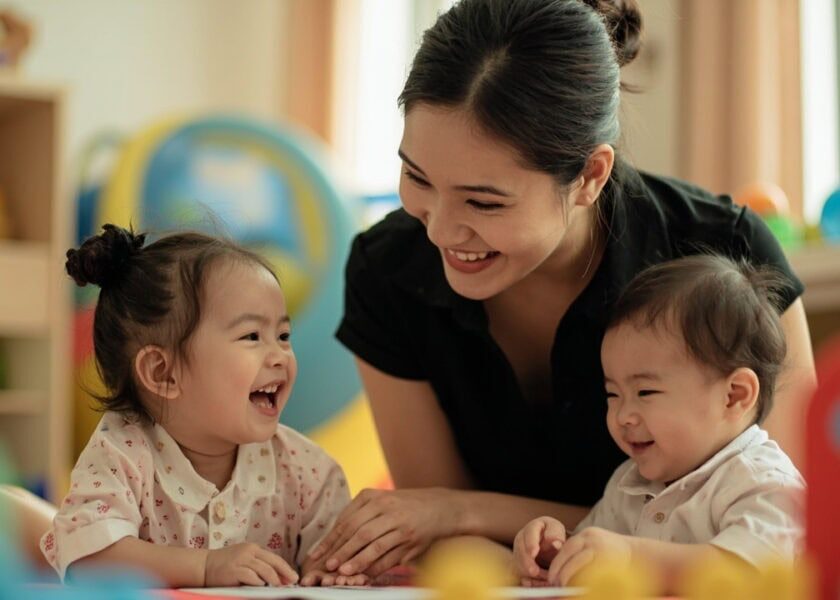
When we think about what children need in their earliest years, most of us reach for concepts like security, stimulation, and routine. These are real needs, and any responsible childcare arrangement must meet them. But children do not experience these needs as abstractions. They experience them through specific people: a warm voice, a consistent presence, a face that responds when they reach out.
The Challenge of Recognizing What Cannot Be Audited
Here is what makes this both urgent and challenging: you must recognize relational quality before you can enroll. The relationship has not yet formed when you are making your decision. You are choosing the potential for relationship. This is the puzzle that no checklist can solve, no tour can fully reveal, and no accreditation can guarantee.
The caregiver who spends five days a week with your child is not simply providing a service. That person is becoming part of your child’s psychological architecture. Over time, specific experiences accumulate into something deeper: an internal working model of what relationships feel like, what trust means, and how the world responds to their needs.
Service Relationship vs. Caregiver Relationship
Understanding the difference between these two types of relationships gives you a framework for discernment when evaluating childcare options in Singapore.
Service Relationship
- Transactional in nature
- Defined by deliverables, response times, and professional competence
- Necessary but insufficient
- Focuses on completing tasks efficiently
Caregiver Relationship
- Relational in nature
- Defined by curiosity, attentiveness, and genuine investment
- Sees your child as a specific, individual human being
- Joins your family’s existing ecosystem rather than creating one from scratch
What to Look for Before You Enroll
When you meet a caregiver—whether at a centre tour, a home visit, or an introductory session—here are the qualities that reveal whether what you are encountering is the potential for genuine relationship.
Curiosity About Your Child as an Individual
Notice whether they ask questions about your child. Not perfunctory questions, but questions that reveal genuine curiosity: What makes your child laugh? What are they working on right now? What does the morning routine look like at home?
A caregiver who asks these questions is not simply gathering information. They are signaling that they understand your child arrives with a history, a temperament, and a personality that matters.
A Different Tone for Your Child
Notice whether they speak to your child differently than they speak to you. The tone should soften. The attention should shift. In a genuinely relational environment, your child is the primary audience, not a secondary concern.
Interest in Your Family’s Values
Notice whether they are curious about your family’s values. How do you handle bedtime? What are the rhythms of your household? What matters most to you in how your child is cared for?
A caregiver who asks these questions is signaling that they understand they are joining an existing ecosystem, not creating one from scratch.
These are the qualities that cannot be audited on a tour. They are not in the brochure. They are not on the curriculum summary. They are in the person.
Signs That Trust Is Deepening
When the relationship is working, you will notice it. Not in grand moments, but in small ones.
- A caregiver who texts you about something your child said today, unprompted
- A report that feels less like a checklist and more like a conversation: “She was so proud of herself this morning when she managed the climbing frame. I think she’s been practicing at home.”
- A caregiver who remembers that your child was excited about something last week and follows up on it
- A rhythm of communication that feels like partnership rather than performance
These are signs that trust is deepening. And as trust deepens, your child feels it. The child whose caregiver has a genuine relationship with the family is a child who is more secure, more curious, and more ready to explore. Not because the program is better, but because the world feels safer.
When You Know, You Know
There is a moment—and every parent who has found the right caregiver eventually describes it—when you realize that the person caring for your child is no longer simply a service provider in your mind. They are part of the village.
You trust them with your child’s welfare not because of what they know, but because of who they are. You can leave for work in the morning and feel, genuinely, that your child is in the care of someone who loves them.
That word is not too strong. It is precisely right.
How EduNanny Makes This Possible
EduNanny by BUTLER has built its approach around something that goes deeper than matching families with childcare providers. Under the ECDA Childminding Pilot, EduNanny has created pathways that allow for both home-based and centre-based care, with infant ratios of up to one to three—ensuring that the conditions for genuine relationship are actually possible.
Structures That Serve the Relationship
| Element | How It Supports Relationship-Building |
|---|---|
| Monday to Friday care blocks | Consistency allows trust to develop over time |
| Low infant ratios | Each child receives meaningful individual attention |
| Communication rhythms | Regular updates create transparency and partnership |
| CCTV measures (where deployed) | Gives families confidence to let trust grow |
| Pilot fee structures | Makes quality relationship-based care accessible across Singapore |
But these are not the differentiator. The differentiator is the recognition that all of these structures exist to serve the relationship, not the other way around.
Answering Common Parent Questions
How do I know if a caregiver is genuinely invested?
Ask yourself: does this person ask about my child’s individual personality, preferences, and history? Do they speak about my child with warmth and specificity, or in generalities? Do they seem curious about our family’s values and routines, or do they present a one-size-fits-all approach?
What if the relationship doesn’t develop?
The structures that support relationship-building—consistency, low ratios, regular communication—also create the conditions where you can evaluate whether the relationship is forming as it should. Open communication rhythms mean you can address concerns early, before small issues become larger ones.
Is relationship-based care affordable for average Singapore families?
Under the ECDA Childminding Pilot, EduNanny has designed fee structures intended to be accessible. CDA and Baby Bonus usability means families across the economic spectrum can participate. The conditions for genuine relationship should not be available only to those who can afford premium boutique arrangements.
The Relationship You Are Really Choosing
When you find a caregiver who is curious about your child, who asks about your family’s values, who communicates not because they must but because they care, who treats your child as a specific person rather than a charge, who becomes part of the village you are building around your child—you will know it.
And when you know it, you will understand that this is what childcare was always supposed to be.
This is not just adequate care. This is not just professional care. This is the kind of care that becomes part of your child’s story.
What EduNanny is here to make possible is this: the relationship that transforms childcare from a service into a partnership. The relationship that gives your child a foundation of trust, security, and genuine warmth. The relationship that lets you leave for work each morning knowing your child is loved.
That is what you are choosing when you choose childcare. That is what EduNanny is here to make possible.
EduNanny by BUTLER operates under the ECDA Childminding Pilot, offering home-based and centre-based care pathways designed to support the caregiver-family relationship at the centre of quality infant care. Speak with our team to explore how our approach makes genuine partnership possible for your family.
Learn more about the EduNanny approach →