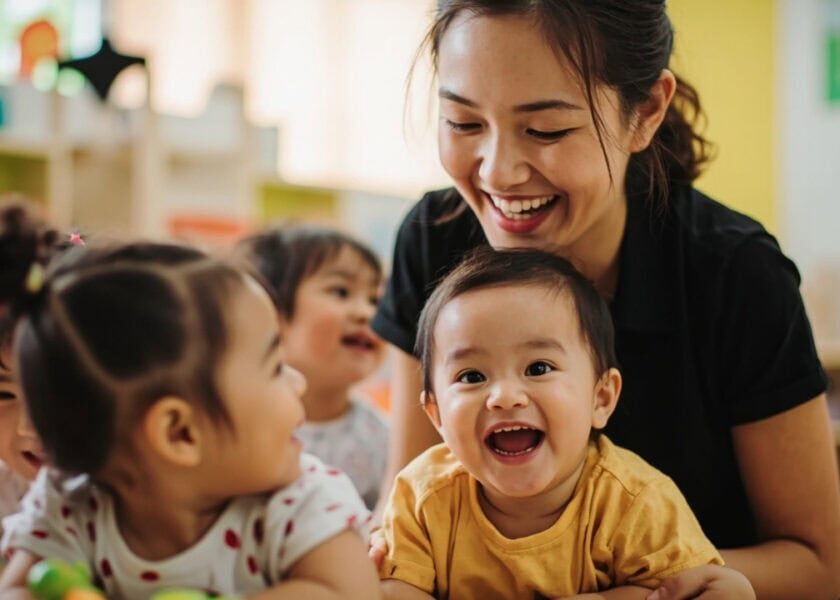
What Singapore Parents Really Look for in a Childcare Caregiver
The Moment Every Singapore Parent Recognizes
There is a moment every parent in Singapore will eventually recognize. It arrives quietly, often at night when the house is finally still, and you find yourself studying the face of a stranger—not on a screen, not in a photograph, but in the careful sentences of a biography, the measured tone of an introductory email, the slight hesitation in a voice during a video call.
You are trying to answer a question that has no fully satisfying answer. You are trying to know a person you cannot fully know—yet.
Choosing childcare is not really about choosing a centre. It is not about square footage, curriculum frameworks, or the colour of the walls. It is about a human being. It is about whether you can trust another person to hold the most precious thing in your life during the hours when you cannot be there.
It is about whether your child will be safe—but also whether they will be seen. Whether someone will notice when they are frustrated before the frustration becomes a meltdown. Whether someone will know that your particular child needs to be held differently when they are tired. Whether someone will understand that what looks like stubbornness is actually persistence, and what looks like indifference is actually overwhelm.
This is the real decision. This is what keeps Singapore parents awake at night, even when they have done all the research, toured all the facilities, and read all the reviews. They are not really asking, “Is this a good centre?” They are asking: “Who will be there with my child? Who will know them the way I know them? Who will love them the right way?”
Why the Right Caregiver Matters More Than the Right Programme
Every parent in Singapore has access to information about childcare options. You know the difference between centre-based and home-based care. You understand regulatory frameworks, licensing requirements, and teacher-to-child ratios. You may have already weighed the options, visited the spaces, and made your calculations.
What we have found, in conversations with thousands of Singapore parents, is that this information is necessary but not sufficient. It answers the structural question—where will my child go?—but it does not answer the human question: who will be there with them?
You can tour a facility and feel impressed by its design. You can review a curriculum and find it comprehensive. But when it comes time to actually leave your child, what you want to know is simpler and harder: Will this person understand my child? Will they notice the things I notice? Will they respond the way I would respond?
These are not questions that square footage or lesson plans can answer. They are questions about a human being—and they deserve an answer that takes the person seriously.
Professional Skills That Make the Difference
A truly exceptional caregiver brings a combination of qualities to every interaction:
- Observational skill: The ability to notice subtle signals—a shift in posture, a change in breathing, a particular quality of cry that means something different than it did yesterday—and respond in a way that meets the child exactly where they are.
- Emotional regulation: The capacity to remain calm when a child is dysregulated, to hold space for difficult emotions without becoming overwhelmed, to be present with distress without abandoning the child to it.
- Professional judgment: The ability to make good decisions in ambiguous situations, to navigate transitions smoothly, to read situations accurately and respond appropriately.
- Genuine curiosity: Not vague or sentimental, but precise and attentive—a genuine interest in noticing things, remembering details, understanding this specific child as an individual.
These are professional skills—not instinct alone, but capacities that can be identified, cultivated, and refined. Exceptional caregivers understand that a child’s distress is not a problem to be solved but a communication to be understood. They know that security is not given through grand gestures but through the reliable, attentive presence that shows up again and again, day after day.
Why the Right Conditions Matter
Here is what Singapore parents often discover: this kind of professional is rare. Not because there are no capable caregivers, but because the conditions that allow caregivers to thrive are not always in place.
A caregiver who is exhausted, undervalued, unsupported, and stretched too thin cannot give what they do not have. The attunement that makes early care transformative requires something from the caregiver—and that something must be replenished. It must be tended to, the same way they tend to the children in their care.
Exceptional caregiving is not just about individual qualities. It is about the ecosystem that supports those qualities—the training, the supervision, the compensation, the professional respect—that allows a caregiver to bring their best self to this work, day after day.
What We Look For—and How We Support
What separates a caregiver from a quality caregiver—the kind of person who becomes, over time, almost a member of your family? The answer is more specific than you might expect.
We look for people who are genuinely curious about children. We look for emotional stability—not in the sense of being unaffected, but in the sense of being regulated. We look for professional judgment that can navigate the unpredictable moments of early childhood. And we look for what we call professional heart—a combination of warmth and professionalism that is difficult to describe but immediately recognizable.
The caregiver who takes their work seriously without taking themselves too seriously. Who can be playful and warm while maintaining appropriate boundaries. Who genuinely enjoys being with children, not as an abstract category but as specific, demanding, delightful, exhausting, wonderful individuals.
These qualities do not always appear on a resume. They cannot always be verified through credentials alone. They must be identified through careful selection processes—through conversations and observations, through the kind of assessment that looks for the whole person, not just their qualifications. The right person matters more than the right credential. Credentials are a starting point, not an ending point.
How We Invest in Our Caregivers
Once we have found caregivers with these qualities, we do not simply hand them an assignment and wish them well. We invest in their development as professionals, because we believe that exceptional caregiving is not a fixed state but an ongoing practice.
- Continuous training in child development, responsive caregiving, and the specific challenges of the Singapore context—thoughtfully developed content that takes Singapore seriously, not generic training pulled from international best practices without adaptation.
- Supervision and mentorship so caregivers are not isolated practitioners left to figure everything out alone. They are part of a community of practice—a professional network, a team that takes collective responsibility for doing this work well.
- Fair compensation because treating caregivers as professionals means paying them professionally. When caregivers are stretched too thin, paid too little, and treated as interchangeable labour, the children suffer.
This is what we mean when we talk about professional standards. It is not just about what we ask of our caregivers. It is about what we provide to them. It is about creating the conditions in which excellence is possible.
The Parent-Caregiver Partnership
There is another dimension to this work that is sometimes overlooked: the relationship between parent and caregiver.
When you entrust your child to another person, you are entering into a relationship that will shape your family’s daily life for as long as you are in care. This is not a transaction. It is not simply a service you purchase and receive. It is a partnership—a collaboration between adults who share a common purpose and a common commitment to your child’s wellbeing.
Some parents find this easy. They are naturally trusting, comfortable with delegation, secure in their own role as parents even when someone else is providing care. But many parents find it difficult. They feel uncertain about what to ask. They worry that expressing concerns will seem like criticism. They are not sure how to build a genuine relationship with someone they hired—someone who is technically an employee but who has become, in effect, a significant figure in their child’s life.
We believe this relationship should be nurtured intentionally, not left to chance.
Transparent Communication
Our caregivers are trained not just in caring for children but in communicating with parents. They understand that transparency is not optional—it is the foundation of trust.
They provide regular updates that go beyond the perfunctory: genuine observations, thoughtful reflections, honest sharing of what the day was actually like. Where deployed, communication systems provide real-time visibility into the care environment. CCTV measures offer an additional layer of transparency, not as surveillance but as assurance.
This is not about distrust. It is about acknowledging that trust must be built, and that building it requires openness.
Working Through Challenges Together
When there are concerns, we want to hear them. When there are questions, we want to answer them. When there are difficulties, we want to work through them together.
The parent-caregiver relationship is not a hierarchy in which one party directs and the other obeys. It is a partnership of equals who bring different expertise and different perspectives but share a common commitment to the child at the centre.
What This Means for Your Child
In the first years of life, your child is not just growing physically. They are building the foundations of everything they will become.
Their sense of security. Their capacity for connection. Their willingness to explore and learn. Their understanding of whether the world is a trustworthy place. These are all being formed in the context of their early care relationships.
The child-caregiver relationship is not peripheral to development. It is central to it. It is the context in which the brain develops its architecture. It is the environment in which emotional regulation capacities are built. It is the foundation on which all later learning rests.
This is not sentiment. This is developmental psychology, confirmed by decades of research. The child-caregiver relationship shapes neural pathways, influences stress response systems, and establishes templates for future relationships.
The Small Moments That Matter
But here is what we have also learned: this is not about grand interventions. It is not about elaborate curricula or sophisticated educational programmes.
It is about the small moments:
- The caregiver who responds to a child’s needs with patience and care, again and again.
- Reading a child’s cues accurately—the subtle shift in mood, the emerging frustration, the moment of curiosity that could be nurtured or missed.
- Being present enough to notice, skilled enough to respond, and committed enough to keep showing up.
A caregiver who can do this is not just providing childcare. They are contributing to your child’s development in ways that will last a lifetime. They are giving your child something precious: a secure base from which to explore the world, a sense of being known and valued, an early experience of relationships as reliable and trustworthy.
EduNanny Singapore: Built on This Understanding
EduNanny Singapore, a service by BUTLER, was built on this understanding. We are part of the ECDA Childminding Pilot, which means our approach has been reviewed and recognized within Singapore’s regulatory framework for early childhood care.
We offer both home-based and community-based pathways, because we know that families have different needs and different preferences. Some children thrive in the intimacy of a home environment. Others benefit from the social dynamics of a group setting. We provide options, not assumptions.
| Feature | What It Means for You |
|---|---|
| Infant ratios up to 1:3 | Young children receive individualized attention. Responses are timely. Observations are careful. Attuned care is possible because caseloads are manageable. |
| CDA and Baby Bonus eligible | Singapore’s family support financial architecture works for you, not against you. Exceptional care is accessible, not just for families with unlimited resources. |
| Monday to Friday care blocks | Reliable, consistent coverage that accommodates the realities of working family life in Singapore. |
| Thomas AI Chatbot | Quick answers and reliable guidance available when questions arise at any hour. Extended support that complements human care, not replacing it. |
Questions to Ask When Evaluating Any Provider
The best philosophy means nothing if it cannot be implemented in the real conditions of Singapore family life. When evaluating your options, ask specifically about:
- The caregiver, not just the centre. Who will be with your child? What is their training? How are they supported? The person matters more than the programme.
- Actual ratios and caseloads. Individualized attention requires manageable numbers. Understand what the real caregiver-to-child ratio is, not just what is legally permitted.
- Communication practices. How will you know what happens during the day? How are concerns addressed? What does transparency look like in practice?
- Support systems for caregivers. Caregivers who are unsupported, undertrained, and underpaid will struggle to provide the quality of care your child deserves.
After the research and visits, pay attention to how you feel. The right provider should feel like a partnership, not a transaction.
The Decision You Are Really Making
There is a moment when you hand your child to someone else. It might happen at a centre entrance, at the door of a home, or in the living room of a caregiver who has become almost family. It is a moment that never becomes routine, no matter how many times it happens.
You look at the person you are trusting, and you make a silent calculation. You assess whether your child is safe. Whether they will be happy. Whether they will be known.
You cannot fully know the answer. No parent can. You can only make the best decision you can with the information available, and then trust that decision, and then hope.
What we want you to know is that we take this responsibility seriously. Not as a marketing claim, but as a daily commitment.
Every caregiver on our team has been selected because we believe they can be trusted with your child’s formative years. Every system we have built exists because we believe exceptional care requires intentional support. Every standard we maintain reflects our understanding that what happens in the early years matters—and that the person who provides that care matters most of all.
When you choose EduNanny Singapore, you are not choosing a building. You are not choosing a programme. You are choosing a relationship—a real, human, fallible, but deeply committed relationship between your child and the person who will care for them.
That relationship will shape your child’s days. It will influence their sense of security, their capacity for connection, their understanding of what the world is like. It will be, in ways both subtle and significant, part of who they become.
We know what that means. We take it seriously.
And we have built everything we do around the understanding that your child deserves to be known—not as a client, not as a case, but as the specific, unique, unrepeatable person that they are.
Begin With a Conversation
The decision about who will care for your child is one of the most important decisions you will make. You deserve to explore your options with care, ask questions freely, and feel confident in what you learn.
We are here for that conversation—not to pressure you, but to help you understand what we offer, what we believe, and why we believe it.
If you are exploring infant care or childminding options in Singapore, we invite you to speak with us. Learn about our approach, meet our caregivers, and ask anything you need to ask. There is no obligation. There is only the beginning of a relationship that could make all the difference.
Because you are not doing this alone. You are bringing in people who will walk beside you. Who will know your child. Who will love them the right way—not as a substitute for your love, but as an extension of it.
That is what EduNanny Singapore offers. That is what we have always been about.
And that is what your child deserves.