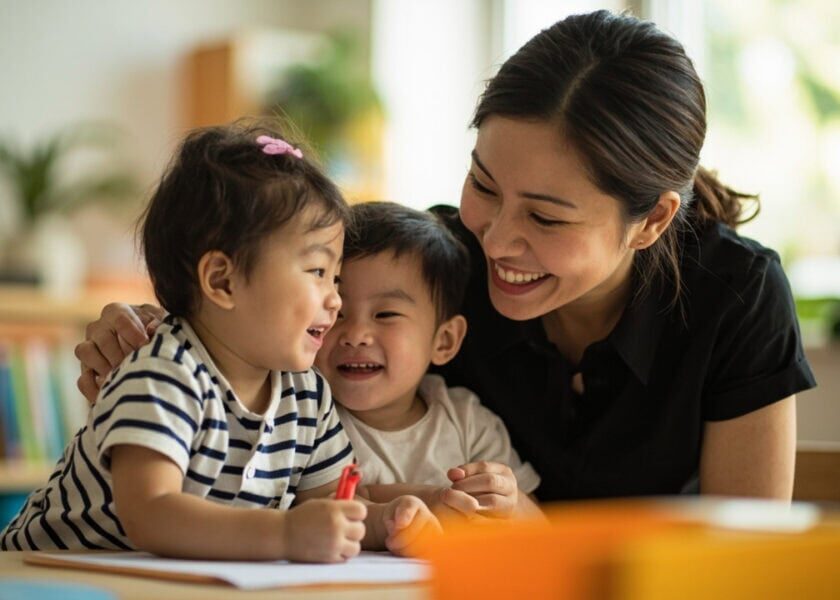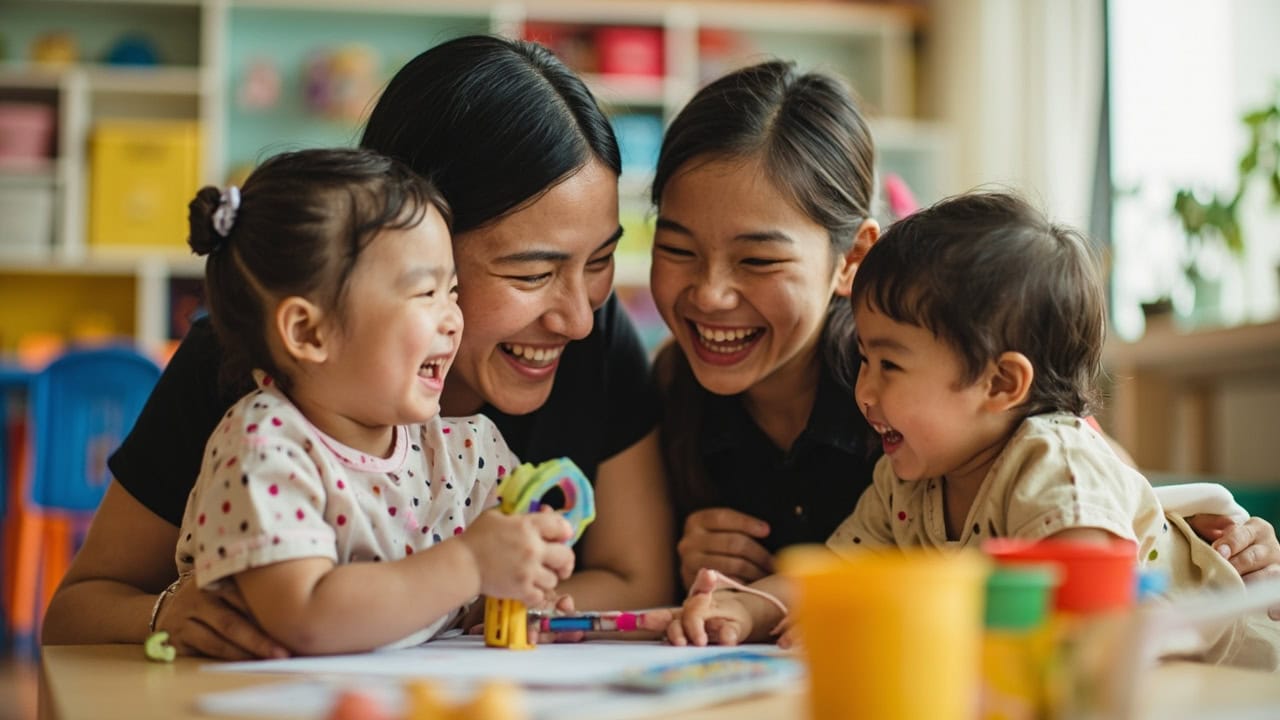
What Quality Childcare Builds in Your Child’s Formative Years
What Quality Childcare Actually Builds
Before we go deeper, here is what research and careful observation tell us about the developmental territory your child enters when they spend their mornings in a quality care environment:
- Peer awareness and social navigation — learning that other children have intentions, preferences, and responses different from their own
- Emotional vocabulary and self-regulation — the scaffolding that teaches children their feelings can be named, held, and moved through
- Curiosity and investigative disposition — building a relationship with learning itself, discovering they are capable discoverers
- Belonging beyond the family — the identity-shaping experience of being part of something outside home
- Emerging selfhood — revealing their temperament, learning style, and who they are beginning to become
These are not abstractions. They are real, observable, documented aspects of child development that unfold in the hours your child spends in quality care. Understanding them does not replace the comfort of seeing your child directly — but it offers something different and perhaps more valuable: a window into what is actually possible in those morning hours.
The First Weeks: Arrival, Observation, and the Beginning of Peer Awareness
Consider a child who has been in a quality childcare setting for perhaps three or four weeks. In the earliest days, this child did what most new children do: they watched. They stayed close to the caregiver, learning the geography of the room through observation. The toys. The light from the windows. The rhythms — the song before snack, the predictable sequence of the day that very young children find so deeply reassuring because it tells them the world is organized, the world is knowable, the world is safe.
And then, gradually, something shifts.
The child begins to venture further from the familiar anchor of the caregiver’s presence. They approach another child. Not to play, not yet — but to be near. To watch. To understand this other small person who also inhabits this space.
This is the beginning of peer awareness. It is one of the most significant developmental thresholds a child crosses in those first weeks and months of childcare enrollment. The child is learning, with their whole sensory and emotional self, that the world contains others. That other children have intentions, preferences, responses. That sharing space with another person is both possible and complicated. That another child might take a toy and that this matters.
The Small Social Discoveries That Shape Development
The social learning happening in quality childcare rooms is subtle but profound. A child learns, through repeated experience, that:
- Other children have wants that differ from their own
- Space must sometimes be shared, sometimes negotiated
- Asking works differently than taking
- The response of another child is not always predictable
- Conflict is not the end of relationship — it is often the beginning of understanding
In quality care environments, there are adults present who understand what is happening in these moments. Adults who do not rush to solve every conflict, who do not swoop in and redistribute every toy, but who are paying attention — who understand that the small frustration of a taken block is also an invitation to learn. To feel. To practice. To discover that emotions, even uncomfortable ones, can be survived, named, and moved through.
Emotional Vocabulary and Self-Regulation: Building Internal Architecture
Children in quality childcare do not simply play. They build. Not just towers of blocks, but internal architectures of feeling and responding that will serve them for the rest of their lives.
Consider a Tuesday morning. A child is building with wooden blocks. Another child approaches and, without understanding the social contract yet, reaches for the base of the tower. It falls. The first child freezes.
Then — depending on many factors, including the temperament that was already visible from infancy, the support they have received in learning to regulate, the quality of the environment around them — the child does something. Cries. Protests. Reaches for the caregiver. Or perhaps, if they have been in this environment long enough and observed enough modeling, perhaps they pause, look at the other child, and say something like “My tower.”
Simple. A claim. A beginning of advocacy. The start of understanding that their own wants and needs have voice and weight.
In a high-quality environment, a caregiver notices this moment. And what happens next matters enormously. The caregiver does not diminish the feeling, does not say “it’s just a tower, don’t worry.” They acknowledge what happened. They help the child put words to what they feel. They create a small, bounded space where the social complexity of the moment can be processed — and where the child learns, implicitly and explicitly, that feelings are not too big, that adults can help, that the world can hold both the frustration and the continuation of the morning.
Self-regulation does not mean a child who never cries or never needs help. It means a child who is developing:
- The ability to tolerate frustration without falling apart
- The understanding that big feelings are survivable
- The habit of reaching for a trusted adult when overwhelmed
- The vocabulary to express what they are experiencing
- The trust that their feelings will be received, not dismissed
These are not skills that can be taught in a single lesson. They are built slowly, through hundreds of small experiences, in environments that have the time and attention to hold them.
Curiosity, Belonging, and Emerging Selfhood
There is another dimension to this environment that deserves attention. It is the dimension of curiosity and discovery — and the conditions that make them possible.
Children are, by nature, investigators. Given an interesting object, a child will spend extraordinary amounts of time examining it. Turning it. Testing its weight, its texture, its sounds. Wondering what happens if it is dropped, thrown, hidden, given to someone else. This is not wasted play. This is cognition in action. This is the infant and toddler brain building models of how the world works.
In a high-quality childcare environment, this curiosity is not interrupted by the need for efficiency or the demands of a large group. Small ratios matter here — the 1-to-3 infant ratio in quality programs means that a caregiver can observe a child’s moment of deep engagement with a shell or a wooden spoon or a piece of fabric and recognize it for what it is: a learning moment. Can let it continue. Can perhaps offer a quiet extension — another object of similar texture, a word for what the child is experiencing — without disrupting the flow.
When children have this kind of environment — predictable rhythms that create security, warm caregivers who serve as reliable home bases, and rich materials that invite investigation — they build something precious. They build a relationship with learning itself. They learn that the world is interesting, that exploring is rewarding, that they are capable investigators of their own reality, that asking questions leads to discovery, and that adults support their curiosity, not just their safety.
Belonging Beyond the Family
Belonging is perhaps the least discussed and most important thing that quality childcare offers. Not belonging in the superficial sense — not just being in a place — but the deep, identity-shaping experience of being part of something beyond the family.
For a child’s first years, the family is the world. Mother, father, grandparents, siblings — these are the humans who exist. And then, for many children, a new world opens. Other children. A caregiver who is not family but who is trusted. A room with particular smells, particular sounds, particular ways of doing things. The beginning of a life outside the home, with its own textures and demands and pleasures.
In quality childcare, a child begins to understand:
- I am a person who can be in a group
- I am a person who can share space with others
- I am a person who has preferences, who can express them, who can negotiate them
- I am a person who belongs in more than one place
The social confidence that grows from this experience is not trivial. It is the beginning of understanding oneself in relation to others — a skill that will be practiced and refined for a lifetime.
Seeing Who Your Child Is Becoming
Children are not blank slates when they enter childcare. They arrive with temperaments — some bold, some cautious, some intensely focused, some easily distracted. And in quality childcare, these individual differences are observed, noted, and supported.
A caregiver who is truly paying attention will notice that one child is an explorer, always seeking the new and novel — and the caregiver ensures there are materials and experiences that honor this tendency. Another child may be a systematizer, wanting to understand how things work, what goes where, the rules of the room — and the caregiver provides the structure and predictability this child needs to feel secure. A third child may be deeply relational, most alive in the moments of connection with another child or an adult — and the caregiver creates opportunities for these moments, facilitates the social engagement this child is reaching for.
This is what quality care means: seeing the child as an individual, not just as a member of a group to be managed. It is the recognition that every child has their own trajectory, their own rhythm, their own way of being in the world — and that a quality environment makes space for all of these.
What children reveal in quality childcare, when given the freedom and safety to do so, is who they are beginning to become. And when parents are given windows into this — through communication, through transparency, through the small daily reports that tell them what their child discovered today — they begin to understand their child more fully. Not as an extension of themselves, not as a project to be optimized, but as a distinct person, with their own inner life, their own way of growing.
What Quality Childminding Looks Like
Understanding what children experience in quality childcare is one thing. Recognizing it when you see it is another. For parents researching options in Singapore, here is what sets genuine quality apart.
The Environment Itself
Quality childminding environments share certain characteristics:
- Predictable rhythms — children thrive when they know what comes next. A consistent daily sequence tells young children that the world is organized and safe
- Rich, open-ended materials — natural objects, blocks, fabric, art supplies that invite investigation rather than dictate outcomes
- Small, manageable spaces — environments where children can move freely without being overwhelmed
- Warm, responsive adults — caregivers who are present, attentive, and emotionally available
The Caregiver’s Role
In quality care, caregivers are observers first, watching to understand each child’s interests and developmental trajectory before intervening. They are co-learners, genuinely curious about what children are discovering and interested in joining their exploration. They are emotional anchors, available for comfort, guidance, and the kind of calm presence that helps children regulate. They are intentional facilitators, creating conditions for learning without hovering or over-directing.
Why Small Ratios Matter
Small ratios are not a luxury — they are a prerequisite for the kind of attention we have been describing. When a caregiver is responsible for fewer children, they can notice the moment of deep engagement and let it continue. They can recognize the beginning of social negotiation and be present without solving. They can respond to distress with full attention rather than divided focus. They can build the kind of consistent, trusting relationship that allows emotional growth.
The EduNanny Approach: Creating Conditions for Growth
EduNanny Singapore operates within the ECDA Childminding Pilot, a framework that recognizes something important: that the early years deserve intentional, structured support, and that quality is not accidental.
The pilot offers pathways — home-based and community or centre-based — that give families options suited to their circumstances. The staffing ratios, with up to 1 to 3 infants, mean that the observational density we have been describing is actually possible. A caregiver in this environment is not stretched across ten children, managing safety, hoping for learning. They are present. They are watching. They are available to the small moment when it arrives.
The fee structures within the pilot are designed to make this access more possible for more families. CDA and Baby Bonus usability means that the financial architecture of Singapore’s family support system can be brought to bear on early care. Monday to Friday care blocks align with the rhythms of working parents, not as an afterthought, but as a recognition of real lives.
Across Singapore, families in the pilot have access to communication and transparency measures — the small daily updates that help parents feel connected to their child’s day. These are the windows we have been describing: the reports that tell you what your child discovered, who they played with, what they reached for.
None of this is the point, exactly. The point is what these structures make possible: the environment in which your child’s story unfolds. The ratios, the training, the communication, the oversight — these are the conditions that allow the moments we have been describing to happen. The tower falling and the child learning to say “my tower.” The curiosity that leads to deep investigation. The peer navigation that teaches other people exist and matter. The belonging that grows from being part of something beyond the family.
Addressing Your Concerns and Choosing Well
Understanding what happens in quality childcare is one thing. Sitting with the feelings of choosing it is another. Let’s address some of the concerns that live quietly in the minds of parents considering this decision.
“Am I abandoning my child?”
The early years are fleeting, and no parent who loves their child takes lightly the decision to share those years with others. This feeling is real and deserves acknowledgment. You are not abandoning your child. You are making a choice — often out of love, responsibility, and the recognition that providing for your family also matters — that opens a door rather than closes one.
“What if my child is unhappy?”
Adjustment takes time. Most children go through a period of settling — sometimes weeks — before they show their true experience in a new environment. What you want to look for is not immediate ease, but genuine engagement over time. Is your child beginning to show interest in the materials? Is there evidence of growing relationships? Is the caregiver attuned to your child’s particular needs? The settling period is information, not verdict.
“How do I know what’s really happening?”
This is why transparency matters. Daily updates, regular communication, opportunities to speak with caregivers — these are not extras. They are essential windows into your child’s experience. Quality programs understand that parents need to know, and they build this communication into their approach. Ask about it. Expect it.
“Can anyone really care for my child the way I do?”
No. And that is not the goal. Quality childcare is not a replacement for family — it is a complement. A supplement. A space where the child’s world expands. The question is not whether caregivers will love your child the way you do. It is whether they will provide something different and valuable: peer interaction, consistent rhythms, rich environments, and the kind of developmental support that family life, however rich, cannot provide in quite the same way.
Questions to Ask on Your Tour
- What is the caregiver-to-child ratio, especially for infants?
- How do caregivers support children during moments of conflict or distress?
- What does a typical day look like — what rhythms and sequences are in place?
- How do you communicate with parents about their child’s day?
- What training do caregivers have in early childhood development?
- How do you help children who are new and still adjusting?
What to Observe
- The ratio of caregivers to children — does it feel manageable?
- The emotional tone — do caregivers seem warm, present, and genuinely engaged?
- The children’s behavior — do they seem comfortable, curious, at ease?
- The environment — is it rich with materials that invite investigation?
- The rhythms — is there a predictable sequence to the day?
Red Flags
- Caregivers who seem rushed, stressed, or disconnected
- Children who appear withdrawn, consistently distressed, or unstimulated
- Environments that feel sparse, chaotic, or unsafe
- Ratios that seem too high for meaningful individual attention
- Resistance to your questions or lack of transparency about daily practices
Reframing the Choice: Not Sacrifice, But Opening
Choosing childcare is often experienced as a sacrifice. A giving up. A necessary absence from your child’s life during hours that feel precious and irreplaceable.
But consider reframing this choice — not as a sacrifice, but as an opening. You are not simply handing your child over to be managed. You are opening a door to a world where your child can encounter peers, explore with support, build emotional vocabulary with attentive adults, and discover aspects of themselves that family life, however rich, cannot provide in quite the same way.
You are giving your child access to the conditions that allow growth — predictable rhythms, warm relationships, rich environments, and small ratios that mean your child is seen, not just supervised.
Quality childcare, in the vision we have been describing, is not a substitute for family. It is a complement. A supplement. A space where the child’s world expands.
And the parent who chooses this — who makes this decision with care and thought and often considerable effort — is not giving something up. They are giving their child something that the child could not get anywhere else: a room in which to grow.
You will not see most of what your child builds in these hours. The social negotiations, the small triumphs, the moments of frustration that become moments of learning — these will happen in rooms you do not enter, in mornings and afternoons that unfold beyond your view.
But perhaps, in knowing what is possible in those hours — in understanding that quality childcare is not just a service but an environment for growth — you can rest in something deeper than reassurance. You can rest in wonder.
Wonder at who your child is becoming. Wonder at the small person inside that child who is navigating, discovering, learning to say “my tower” and “please” and “I want to try.” Wonder at the fact that even in your physical absence, your child is held — by trained and attentive caregivers, by a program designed to support development, by the conditions you chose for them.
Your child is having experiences right now that will shape who they become. Not because childcare is magic, but because the right environment, the right attention, the right conditions — these matter. They have always mattered. And in quality care, they are given the seriousness they deserve.
EduNanny Singapore understands this. Not as a slogan or a marketing position, but as a daily practice. The practice of watching children. Of recognizing what they are building. Of creating the conditions for them to grow into themselves.
That is what childcare can be. And that is what your child is experiencing, in the hours you are not there, when the door closes behind you in the morning.
That is the story worth knowing. That is the story worth telling. And that is the story your child is writing, every day, in the place you have chosen for them.
If you are considering your options for infant care or childminding in Singapore, we invite you to learn more about how EduNanny creates the conditions for your child’s growth — and to discover what your child might reveal about who they are becoming.
Explore the ECDA Childminding Pilot options available through EduNanny Singapore, and take the next step in understanding what quality care can offer your child.
At EduNanny Singapore, we believe that every child deserves to be seen, held, and given the space to grow. If you have questions or would like to explore whether EduNanny is the right fit for your family, we welcome you to reach out to us.