Beyond the Door: What Your Child Really Experiences in Quality Childcare
What Quality Childcare Looks Like
Before we walk through the day together, here is the short version for parents who are comparing options right now:
- Mornings set the emotional tone. The first few minutes of arrival matter more than they appear to. Skilled caregivers read your child’s face, body, and energy and meet them where they are—not where a schedule says they should be.
- Rhythm is not the same as routine. A quality day has predictable structure, but it breathes with your child’s needs. It is felt from the inside, not imposed from the outside.
- Play is teaching. When a one-year-old drops a wooden block into a cup and tips it out, over and over, they are building the foundations of causality, patience, and their own agency in the world. Purposeful play is a curriculum.
- Feeding and rest are relational. How your child is held during feeding, how they are supported into sleep—these are the places where trust is written in small physical acts.
- Caregivers are the architecture. The space matters, but the quality of your child’s day lives in the hands, voices, and presence of the people who hold it.
Now let us walk through the day.
The Morning Transition and the Rhythm of the Day
When a child arrives at quality childcare, what happens in the first few minutes sets a tone that will ripple through the entire day. This is not obvious from the outside. To a parent dropping off, it looks simple: a greeting at the door, perhaps a transition object passed from hand to hand—a small token of home, a familiar face, a familiar smell.
But in a well-designed environment, that arrival window is doing something important. It is translating the child’s emotional state from the chaos of the morning rush into the calmer register of the care space.
The caregiver is reading the child’s face, their body, the way they hold themselves. Are they stiff with anxiety? Giddy with energy? Drowsy from a short night? The caregiver calibrates. They meet the child where the child is, not where the schedule says they should be.
This is what is meant by attunement—not a technique, not a checklist, but a real-time responsiveness to what the child is actually experiencing. In a quality environment, your child is not processed through a routine. They are accompanied through a transition.
The caregiver knows that a child who arrives unsettled cannot simply be deposited into a group activity. Something must be offered first—a quiet moment, a lap, a familiar song, a few minutes of parallel play beside another child while they gather themselves. This takes time. It takes patience. It takes knowing your children well enough to read what they need before they can articulate it.
This is one reason why ratios matter so profoundly in infant care. In environments where caregivers attend to small groups of infants—up to one to three in programmes like the ECDA Childminding Pilot—caregivers have the space to meet each child individually, especially in those critical arrival moments.
Once the morning settles, the day finds its rhythm—and I use that word deliberately, because rhythm is not the same as routine. Routine is what happens on a schedule. Rhythm is what happens in a child’s nervous system. It is the internal sense of predictability that comes not from watching the clock but from feeling held within a sequence of experiences that makes sense.
Wake, eat, play, rest, play, eat, home. The sequence repeats, but it breathes. It adjusts to the children in it.
In quality infant care, this rhythm is not arbitrary. Every transition within it is purposeful. When a child moves from sleep to wakefulness, the caregiver is there—not hovering, but present. The child opens their eyes and sees a familiar face, hears a familiar voice, feels the continuity of being known.
This is profoundly different from waking alone, in a room full of other sleeping children, to a sound that may or may not be welcoming. The quality of that waking moment—whether it is abrupt or gentle, isolated or connected—is part of what a child carries in their body throughout the day.
Play: The Most Misunderstood Element
Here is where I want to slow down, because play is the most misunderstood and underappreciated element of quality childcare.
When you imagine your child at childcare, what do you see them doing? Perhaps you picture them with toys, exploring, having fun. This is not wrong, but it is incomplete.
Play at its best is not entertainment. It is the medium through which your child learns to think, to solve problems, to regulate their emotions, to understand the social world, to make meaning. In the hands of a skilled caregiver, play is a curriculum—though you would never call it that in front of the children, because calling it a curriculum would ruin it.
What Your Child Is Actually Learning
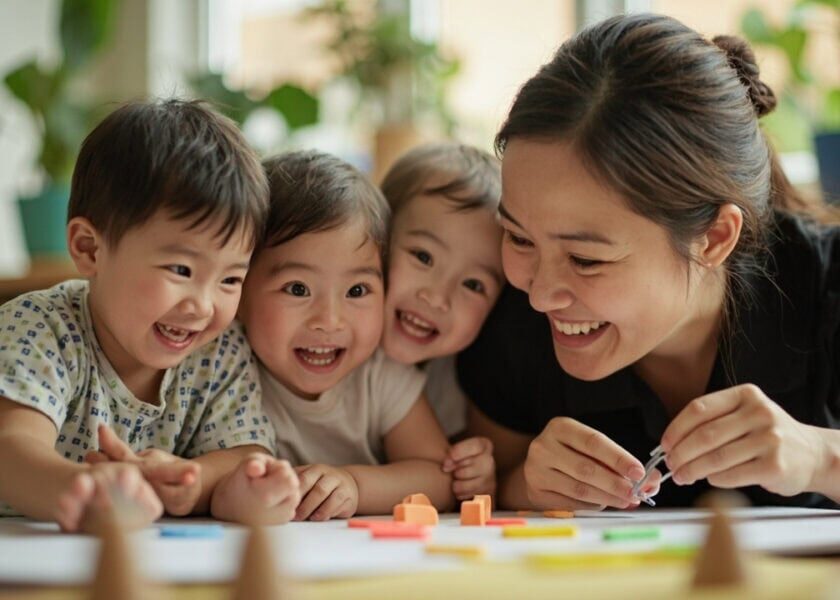
Consider what happens when a one-year-old drops a wooden block into a cup, then tips the cup to watch it fall out, then does it again. And again. And again.
A tired observer might call this repetition boring. A caregiver understands that this child is constructing the foundations of causality, of object permanence, of patience, of their own agency in the world. They are learning that they can make things happen. They are building concentration. They are discovering that the world follows rules, and that those rules are knowable and therefore safe.
Or consider what happens when two toddlers negotiate over a toy truck. The exchange may be loud, may involve grabbing, may seem chaotic. But embedded within that moment are lessons in communication, in empathy, in the recognition that other people have desires too, in the dawning awareness that words and gestures can substitute for force.
This is the social curriculum in its earliest, most raw form. It is happening in every room where children play together, but it is only learning in rooms where adults are present to scaffold it—to step in when needed, to model words, to hold boundaries, to narrate what they see so the children can begin to understand their own experience.
The best caregivers enter the child’s play at just the right moment—not too soon, not too late—to extend it, to deepen it, to offer a challenge or a new perspective that helps the child move to the next stage of their thinking. This is what it means to teach through relationship, which is the only way infants and toddlers truly learn.
Feeding, Sleep, and the Daily Experience as Curriculum
In Singapore, where infant care often begins as early as two months, feeding is not simply nutrition. It is a relationship. It is the place where a child learns that their body is cared for, that their hunger matters, that someone will respond.
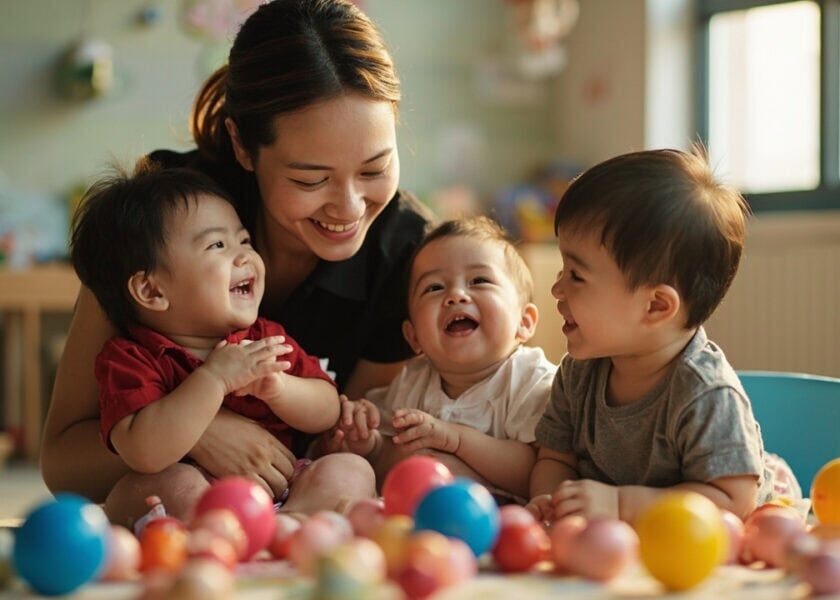
In a home-based childminding environment, this might happen with the child held closely, in a rocking chair, with the caregiver’s full attention. In a centre-based setting, it happens with a small group of children, each at their own pace, each receiving individual attention from a caregiver who moves between them with patience and warmth.
Either way, the principle is the same: feeding is not efficient. It is relational. A child who is fed quickly, perfunctorily, in between other tasks is not being fed in the same way as a child who is held, who is spoken to, who feels the caregiver’s presence as a form of safety.
The same is true of sleep. Rest is not merely biological necessity. It is where a child’s body recovers, where their brain processes the day’s learning, where they are held in the knowledge that they will not be forgotten while they are vulnerable.
In quality care environments, sleep is not managed with stopwatches and strict schedules. It is observed, supported, negotiated with each child’s individual needs in mind. Some infants need to be rocked. Some need white noise. Some need the caregiver to simply sit nearby, hand on their back, for a few minutes until they settle.
These are not luxuries. They are the substance of trust, written in the small physical acts of caregiving.
Quality childcare is not a place where children are kept safe until their parents return. It is a place where children live—fully, richly, with all the complexity and curiosity of their young selves—during the hours they are there.
The days your child spends in quality care are not separate from their life. They are part of it. The friendships forming in the playgroup, the language emerging through the songs, the trust building through the consistent caregiver presence, the physical confidence growing as they climb and balance and explore—all of this is your child’s life, and it is happening whether or not you can see it.
Your child’s daily experience at quality childcare is, in a real sense, a curriculum. Not the wordless, unstructured thing we sometimes imagine when we think of early childhood as mere childcare. But a carefully designed sequence of experiences that teaches your child, in increments too small to measure but too significant to ignore, how to be in the world:
- How to trust
- How to explore
- How to connect
- How to recover from small setbacks
- How to feel safe enough to take risks
These are not skills for school. They are skills for life.
Reading the Evidence: Signs of Quality
Here is what matters most about these moments: they are invisible to you. You will not see them in a photograph. You may read about them in a daily update, but the words cannot convey what it actually felt like for your child to be in that presence.
But there is evidence you can read, if you know how to look for it. It arrives in your child’s body when they come home.
The child who returns from quality care is not necessarily pristine. Some days are hard, as all days with young children are hard. But the child who has spent their day in a well-designed environment carries something particular in their bearing:
- They are tired—tired in the good way that comes from meaningful exertion.
- They may be hungry in a healthy way, ready for the food you offer.
- They may be animated, wanting to share what they discovered.
- They may be quietly content, at ease in their own company.
They have been held in a consistent rhythm. They have been responded to when they needed it. They have learned, in small increments, that the world is organized and that they can navigate it.
This end-of-day state is not a report card. It is not proof that every moment was perfect. But it is a window into the general health of the environment.
- When your child consistently comes home dysregulated, shut down, or distressed, something in the architecture is wrong.
- When they come home tired, hungry, and alive—full of the ordinary residue of a day well spent—you are seeing the signature of quality.
When you understand this, something shifts. The wondering changes. It becomes less anxious and more wondering in the truest sense—a quiet marvel at what your child is living, at the complexity of their inner life, at the improbability and wonder of early childhood itself.
You begin to see quality not as a label you hope applies to your child’s care, but as a set of observable principles you can learn to recognize. You see your child’s tiredness as evidence of meaningful engagement. You see their hunger as the healthy appetite of a day well spent. You see their mood as data—not good or bad, but informative.
You begin to read your child with new eyes, and in doing so, you become a more confident parent.
The Caregivers: The Real Architecture
The physical environment matters—the space must be safe, the materials appropriate, the layout supporting both autonomy and supervision. But the quality of your child’s day lives in the people. It lives in their hands, their voices, their presence.
In the ECDA Childminding Pilot that EduNanny operates, caregivers undergo specific training to work with infants and toddlers. They learn not just the mechanics of care but the philosophy behind it—that infants are not passive recipients of service but active participants in their own development, that their earliest relationships will shape the patterns they carry forward into every future connection.
This is not abstract knowledge. It translates into:
- The way a caregiver speaks to a fussy infant
- The way they position their body during play
- The way they narrate a toddler’s frustration back to them in language the toddler can begin to understand
The best caregivers are not the ones who perform warmth. They are the ones who have internalized a way of being with children that is steady, responsive, and genuinely curious about who each child is becoming.
This is a form of expertise that is undervalued in our society. We speak often about the importance of early childhood education, but we do not always honor the depth of skill required to hold a group of infants with attention and grace throughout a demanding day. This is real work. It is exhausting. It is also profoundly meaningful.
At EduNanny, the commitment to small ratios—up to one to three in the infant programme—creates the conditions in which caregivers can do what they do best: be fully present to the children in their care. It also creates conditions in which you, as a parent, can feel known. Because when a caregiver knows your child well—really knows them, in the way that comes from sustained, unhurried attention—you become partners in your child’s life rather than strangers passing at pickup time.
What Singapore Parents Need to Know
EduNanny’s approach to communication is built on the belief that transparency is not a feature. It is a baseline. Parents deserve to feel connected to their child’s day, even when they are not physically present in it.
Depending on the pathway chosen—whether home-based childminding, community-based care, or centre-based settings—this might include daily updates, open lines of communication with caregivers, and in some cases, measures that provide additional reassurance. These tools do not replace trust. They support it. They close the gap between what you imagine and what is actually true, so that the wondering becomes less anxious and more curious.
There is also something to be said for the practical architecture of how EduNanny’s services are structured:
- Monday to Friday care blocks, designed to align with the rhythms of working family life in Singapore
- Subsidies available within the pilot fee structures, making quality care more accessible
- The usability of CDA and Baby Bonus funds, so that financial planning does not become another layer of stress on top of an already demanding season of life
These are not secondary concerns. In a city where the cost of raising children is real and where the pressure on parents is constant, the ability to access quality care without financial precarity is itself a form of support for your child’s wellbeing. When parents are less anxious about logistics, they are more present for their children. The system can either add to your burden or lighten it. EduNanny has been designed with the Singapore context in mind—its costs, its rhythms, its particular pressures on young families.
Questions Worth Asking
As you evaluate childcare options in Singapore, these are some of the questions that emerge from understanding how quality actually works:
- How does my child feel in the first few minutes of arrival? Is there time and attention for them to settle?
- Do the caregivers seem to know the children as individuals—not just their names, but their rhythms, their preferences, their cues?
- Is there space in the day for unhurried play, or is the schedule always moving children from one activity to the next?
- How are feeding and sleep handled? Is there flexibility for each child’s individual needs, or is it one schedule for everyone?
- What is the caregiver-to-child ratio? Is there room for attunement, or is the numbers game already lost?
- How does the environment feel when you visit? Not just whether it is clean and safe, but whether it feels warm, alive, and unhurried?
- What kind of communication can I expect? Will I be able to feel connected to my child’s day, not just receive a daily report?
These questions will not be answered in brochures. They will be answered by watching, by asking, by trusting your instincts as a parent—and by knowing what to look for.
Trust What You Cannot See
The next time you leave your child at the door, pause for a moment. Not with worry. With something closer to curiosity.
Know that what is happening inside those hours has been designed with your child at its center. Know that there are people there whose job—whose calling—is to meet your child where they are, day after day, with patience and warmth and skill. Know that the rhythm of that day, that quiet architecture of care, is doing its work on your child in ways you may not see but will one day recognize.
And then let that knowledge carry you through your day. Trust what you cannot see, not blindly, but with the informed confidence of someone who finally understands the design.
Your child is in good hands. And now, you know what that means.
If you are exploring infant care or childminding options in Singapore and want to understand how EduNanny approaches the daily rhythm of quality care, we welcome you to reach out or learn more about our programmes and how we support both children and families.