Reading the Signs: How Singapore Parents Can Recognise Quality in Their Child’s Day
The Architecture of a Day: How Rhythm Becomes the Curriculum
A day in quality childcare is not a series of activities loosely strung together. It is a thoughtfully constructed sequence, each element placed with intention.
The rhythm of a young child’s day—arrival, play, meals, rest, exploration, transition—is not arbitrary scheduling. It is the curriculum made visible. Every element serves a developmental purpose, and when that rhythm is designed well, children move through it with a sense of security and momentum that is itself a form of learning.
Rest: An Active Process of Integration
Consider the act of rest. For a young child, rest is not merely the absence of activity. It is an active process of integration. During sleep and quiet moments, the brain is consolidating experiences, processing emotions, and building the neural pathways that will support memory, language, and regulation for years to come.
In quality childcare, rest is understood this way. It is not a logistical necessity to be managed between activities. It is a developmental essential, honoured with the right conditions—a calm environment, soft lighting, perhaps a familiar song or a whispered cue that tells a child’s body it is safe to let go.
When rest is handled this way, a child emerges not groggy or disoriented, but refreshed, recalibrated, ready to re-engage.
Meals: A Learning Environment in Miniature
Now consider meals. In quality childcare, a meal is not simply nutrition delivered on schedule. It is a learning environment in miniature.
- Children sit together and pass food
- They notice what others are eating
- They encounter new tastes in the company of peers, which transforms a potentially anxious encounter into a social, curious one
- They develop fine motor skills as they grasp utensils, manage cups, navigate the physical logic of eating
They are building their earliest relationship with food, and that relationship is shaped by the context in which eating occurs. A warm, unhurried mealtime in a childcare setting teaches children something about nourishment, sociability, and self-regulation that will outlast any single menu.
Transitions: Where Emotional Regulation Is Practiced
And then there are the transitions—the moments between activities, when a child moves from one thing to the next. In high-quality childcare, transitions are not rushed or chaotic. They are given space.
A child learning to manage the shift from free play to circle time is learning something important about patience, anticipation, and emotional regulation. When transitions are rushed or harried, children feel it. When they are given room, children learn that their world is predictable, that there is enough time, that they do not need to fear what comes next.
This is the first layer of what your child is living through: an intentional rhythm that supports their development in ways they cannot yet articulate, but which will shape them profoundly.
The Sensory World: How Environment Becomes Pedagogy
Young children do not experience space the way adults do. They experience it through their entire bodies.
The quality of the light, the level of background sound, the textures available to their fingers, the smells in the air—these are not neutral features of the environment. They are the medium through which learning happens.
A childcare space that is thoughtfully designed for sensory experience:
- Uses natural light where possible
- Manages acoustics so that noise does not accumulate into overwhelm
- Incorporates tactile materials that invite exploration
- Ensures that the space smells clean and natural
In such environments, children feel calm. They feel curious. They feel safe enough to reach out, to touch, to ask questions with their eyes and hands rather than their voices.
In contrast, an environment that is overstimulating—too loud, too bright, too cluttered—triggers a stress response in young children that looks like restlessness, withdrawal, or fussiness. The child is not misbehaving. The child is telling you something about the environment they have been placed in.
This is one of the most underappreciated aspects of quality childcare: the environment itself is pedagogy. When you visit a childcare setting and notice that children seem settled, that they are engaged, that the atmosphere feels calm rather than frenetic—you are witnessing the invisible work of sensory design. You are seeing the readout of a daily world that has been built with your child’s developmental experience in mind.
The People: Caregiver Presence and the Foundation of Trust
In quality childcare, the caregiver-to-child ratio matters enormously, though its importance is not always visible.
When there are enough adults to be truly present—to notice, to respond, to attune—children experience something remarkable: they feel seen.
- A child who struggles to open a container receives patient assistance before frustration builds
- A child who wants to join a group of playing peers receives gentle guidance before exclusion hardens into isolation
- A child who is tired but fighting sleep receives the quiet presence that helps them surrender to rest
In quality childcare, this ratio is designed to make responsiveness possible. When caregivers are not stretched thin, they can do what they are trained to do: connect. And connection, experienced day after day, becomes the foundation of security.
A child who knows that their needs will be met, that an adult will notice them, that they are not alone in navigating the social and emotional complexities of a group environment—this child is building something foundational. They are building trust. Not in childcare as an institution, but in the basic reliability of human relationships.
This will stay with them far longer than any lesson learned at circle time.
The Social World: Learning the Art of Being With Others
Children in group care are not merely individual learners sharing a space. They are members of a miniature community, learning the social arts that will shape their relationships for the rest of their lives.
They learn to negotiate. To share. To read the emotions of peers and respond with something approaching empathy. They learn that others have desires and needs that may conflict with their own, and that conflict does not have to mean the end of connection.
In quality childcare, this social learning is supported, not left to chance. Caregivers scaffold these moments—stepping in when a conflict exceeds a child’s current capacity to resolve, offering language for emotions that children have not yet learned to name, modelling the social behaviours you hope your child will internalize.
The social world of quality childcare is not a lawless jungle. It is a structured setting in which prosocial skills are modelled, guided, and gradually internalized.
Play: The Engine of Early Childhood Development
And then there is play itself—the engine of early childhood development.
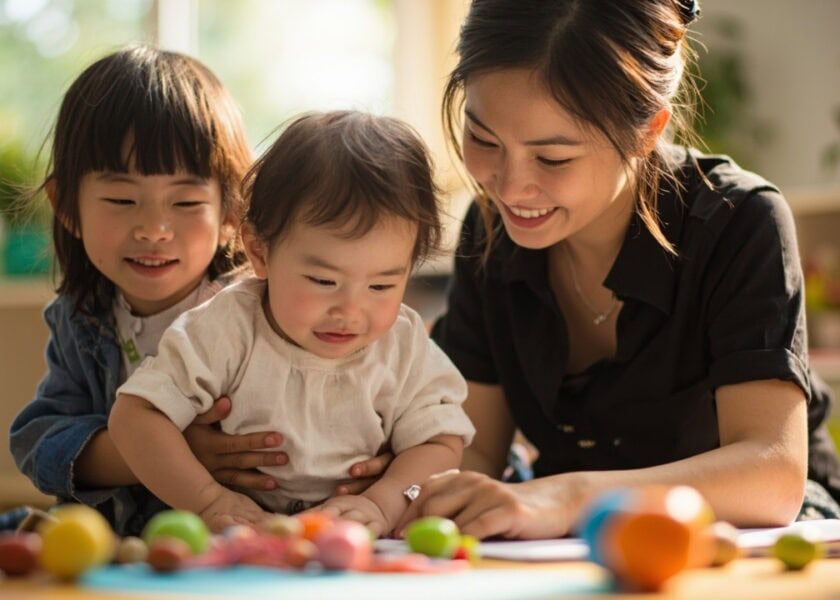
In quality childcare, play is not filler between more serious activities. It is the activity. When children engage in free play—choosing their own materials, directing their own narratives, following their own curiosity—they are exercising agency, building creativity, and constructing understanding of the physical and social world.
In quality childcare, free play is protected. It is given time, space, and materials. It is not rushed by the clock or colonized by adult agendas.
Alongside free play, there are guided exploration and structured activities—moments when caregivers introduce specific concepts, skills, or experiences that children might not discover on their own:
- A guided art activity that introduces new materials and techniques
- A circle time that builds listening skills and early literacy
- A science exploration that provokes wonder
These structured moments are woven into the day with care, so that they complement rather than supplant the self-directed learning that children need.
When you understand this design—free play, guided exploration, and structured activities working together—you begin to see quality childcare not as a service, but as a curriculum made physical. Every element of the day is an opportunity for growth, carefully arranged by people who understand how young children learn.
What Quality Looks Like at Home: Reading Your Child’s Day
After a day in quality childcare, your child comes home carrying something. It may not be articulable yet. It may express itself in moods and behaviours that are not always easy to decode. But a child who has spent the day in a warm, responsive, well-designed environment shows it.
They are calmer. Not perfectly behaved—children are still children—but something in them has been settled. They have been socially fed. They have been curious, and their curiosity has been met. They have rested well.
What to Listen For
When they tell you about their day—in the handful of words of a toddler or the winding narratives of a preschooler—they are giving you a window into the world they have been inhabiting. Listen for:
- Joy — Genuine pleasure in recounting experiences
- References to friends — Names, shared activities, social connections forming
- Caregiver mentions — The teacher who read them a story, helped them build something
- New language — Songs, concepts, words that suggest their environment has been rich in stimulation
- Willingness to return — A child who is genuinely glad to go back is a child whose daily world is working
This is not sentimental thinking. This is observation. Children do not perform for their parents about their childcare experience. What they carry home is authentic. And when you learn to read it, you gain something invaluable: the ability to assess quality not just by what the programme says about itself, but by what your child tells you through their wellbeing, their language, and their behaviour.
What Singapore Parents Actually Worry About
These are the questions beneath the tours and the research:
Can I afford quality care? Financial concern is real for Singapore families. The alignment of quality childcare providers with government schemes—including CDA and Baby Bonus—means that thoughtful, development-oriented care is within reach for more families than ever. The question is not whether you can afford quality. It is whether the pathways to access it are clear. For many families, they are more accessible than they realize.
How do I know what is happening during the hours I am apart? Parents want to feel connected to their child’s daily world even when they cannot be inside it. Where deployed, regular updates and open communication help bridge that gap, giving parents a clearer picture of the rhythms and moments that make up their child’s day. This is not about surveillance. It is about trust—and trust, as we know, is built through visibility.
Is my child safe? Are they happy? Are they growing? These three questions underpin every parent decision about childcare. They cannot be answered by brochures alone. They must be answered through observation, through conversation with caregivers, through watching your child over time—and through choosing a setting where the daily world is designed with these answers in mind.
What to Look For When You Visit
When you visit a childcare setting, here is what matters to observe:
| Observe | What It Tells You |
|---|---|
| The children themselves | Do they seem calm? Engaged? Curious about the space? |
| The caregivers | Are they present and unhurried? Do they kneel to children’s eye level? |
| The environment | Is natural light available? Is noise at a manageable level? Are textures and materials inviting? |
| The rhythm of the day | Does the schedule feel calm and purposeful? Are transitions unhurried? |
| How children move | Do they seem secure enough to explore? Or constrained by overstimulation? |
| Caregiver-child interactions | Are responses warm, patient, and attuned? Or hurried and distracted? |
Then go home and notice your child. Ask about their day. Watch how they feel as evening approaches. Notice whether they carry a quiet sense of wellbeing that tells you something about the world they have been living in.
These observations are not trivial. They are how you read quality. They are how you know.
The Hours Apart Matter
Let us return to where we began: the question of what your child is actually living through each day.
You cannot be inside those doors. But you can understand what happens there. You can learn to read the signals. You can notice whether the daily rhythm feels intentional, whether transitions are calm, whether your child seems settled when they return.
You can listen to what they tell you, and you can observe who they are becoming—curious, confident, socially adept, emotionally regulated.
Quality childcare does not just hold your child during the hours you are apart. It shapes them. The interactions, the environment, the rhythm of their days—these are not background conditions. They are the substance of early childhood. They are the material from which your child’s future is being built.
When you choose childcare, you are not just choosing a service. You are choosing a daily world for your child. And when that world is built with intention—with warm, responsive caregivers, with thoughtful sensory design, with an architecture of play and rest and learning that serves your child’s development—you are giving them something extraordinary.
You are giving them a daily experience that says, in a thousand small ways: you matter, you are safe, you are capable, the world is interesting, and you belong here.
That is what quality childcare looks like on an ordinary day. It may not be dramatic. It may not announce itself. But it is there—in the calm faces of children who feel secure, in the engaged voices of children who are curious, in the growing confidence of children who are learning that they are competent and cared for.
In Singapore, parents now have more pathways to access quality care than ever before. EduNanny, operating as part of the ECDA Childminding Pilot, is designed to make thoughtful, development-oriented infant care and childminding accessible and affordable for families—through home-based care, community pathways, and centre-based options. CDA and Baby Bonus are accepted where families are eligible.
When you are ready to explore what this looks like in practice, we welcome the opportunity to meet with you.