When Your Child Has Another Person Who Truly Loves Them
“`html
The Moment Your Child Runs to Someone Else
There is a moment—perhaps you have lived it—when you realize your child has a relationship with someone who is not you. It does not arrive dramatically. It arrives the way most truths in parenting do: quietly, unexpectedly, while you are doing something ordinary.
Your child hears a car door close outside. She looks up from her blocks. Her face changes. And then she says a name—not yours, not a grandparent’s, not a relative’s—and she runs toward the door with a joy that is entirely her own.
You stand there, still holding the dishes or the morning coffee, and something complicated moves through you. Pride, perhaps. A small sting of something you did not expect. And underneath it, a relief so profound you almost do not trust it: the recognition that your child is known. That someone else, outside the walls of your home, holds a piece of her that you cannot hold.
This is the moment I want to name today. Because it is not small. It is not incidental. It is, I would argue, one of the most important experiences of early parenthood—and yet we rarely speak about it with the honesty it deserves.
Why the Caregiver Relationship Matters More Than You Think
In Singapore, we have built an extraordinary system of childcare options. Frameworks and quality indicators. Regulatory standards. We talk about school readiness and developmental milestones and caregiver ratios. All of this matters.
But beneath all of it, invisible and essential, runs a thread that determines whether any of it actually works: the relationship between your child and the person who cares for them.
When you chose your child’s caregiver, what were you actually looking for? Certifications, yes. Experience, certainly. A clean environment, proper ratios, transparent communication. These are the things we list. These are the things we ask about in interviews and on tours.
But beneath all of that, you were looking for something harder to name. You were looking for someone your child would feel safe with. Someone whose presence would feel like a continuation of home rather than an interruption of it. Someone who would notice your child—not just supervise them, not just keep them fed and changed and safe, but actually notice them. Know their rhythms. Remember their fears. Recognize when they are tired before they begin to fuss. Celebrate their small victories as though those victories matter.
This is not a service expectation. This is a relational hope. And here is what makes it so tender: you cannot be there to witness it.
You drop your child at seven in the morning. You pick them up at six or seven at night. In between, hours of their day unfold in someone else’s care.
What you want—desperately, quietly, sometimes without even admitting it to yourself—is for those hours to be filled with more than competent supervision. You want them to be filled with love. With genuine connection. With a relationship that matters to your child in the way that relationships matter to all of us: as the invisible architecture of who we become.
This is not an unreasonable hope. It is, in fact, exactly what developmental science tells us children need.
What Secure Attachment Looks Like in Practice
The research on this is not new, but it deserves repeating because we so often forget it in our practical conversations about childcare. Children do not simply need to be cared for. They need to be cared for by people who are consistent, responsive, and emotionally attuned.
They need someone who becomes a secure base—the psychologist John Bowlby called it that, and the name captures something essential. A secure base is a place a child can push away from and return to. A place that makes exploration possible because it makes return feel safe.
When a child has this kind of relationship with a caregiver, something remarkable happens:
- They cry less at drop-off—not because they do not miss you, but because they trust the person you are leaving them with.
- They explore more freely—the playground, the sensory table, the new activity—because they know someone is watching who will respond if something goes wrong.
- They begin to use language in new ways, modeling themselves on the person who speaks to them with patience and interest throughout the day.
- They learn, in the deepest sense of the word, what trust feels like.
And this trust, this early understanding that the world contains people who will catch you, shapes everything that follows. Emotional regulation. Social confidence. The willingness to try new things. The ability to form healthy relationships later in life. All of this begins in the caregiver-child bond.
Signs Your Child Has a Secure Attachment with Their Caregiver
- They show excitement or calm recognition when arriving at their care setting.
- They can be comforted by their caregiver when upset—not just by you.
- They explore toys and spaces freely, checking back occasionally for reassurance.
- They mention their caregiver in everyday conversation with warmth.
- They show less separation distress over time, not more.
The Parent’s Side of the Bond
But here is what I want you to hear, because this is where our conversation must go beyond the developmental frame and into something more human: this is not only about what the caregiver relationship gives your child. It is about what it gives you.
There is a transformation that happens—sometimes slowly, sometimes all at once—when a parent realizes that their child’s caregiver is not just a service provider but a genuine partner in the most important work of their lives.
It begins with trust, yes. But it deepens into something more.
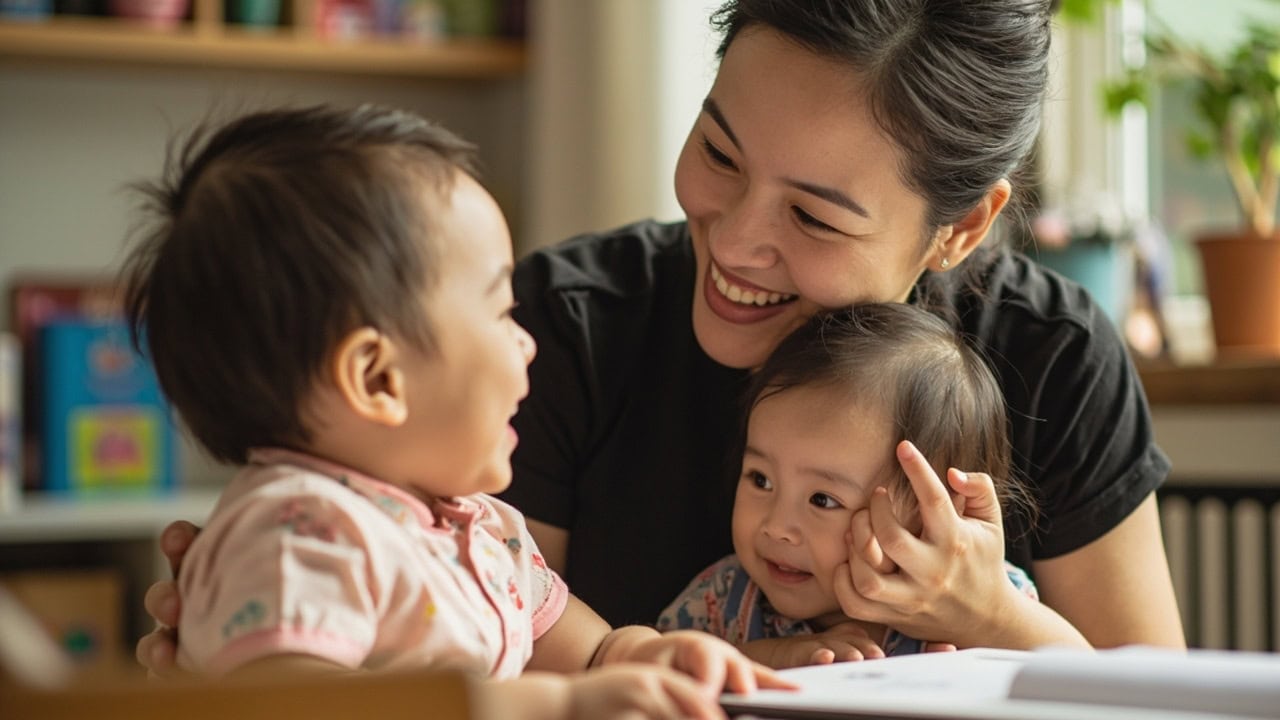
It begins when you start to have real conversations with your caregiver about your child’s day—not just logistics, but observations. When your caregiver tells you that your son finally mastered the shape-sorter this afternoon, and you can hear in her voice that she was genuinely delighted. When your caregiver asks about a change in routine before you thought to mention it, because she has been paying attention so closely that she knows what is normal for your daughter and what is not.
It deepens when you realize you are not navigating this alone. That someone else is invested in your child’s wellbeing with an investment that mirrors your own. That you can text a quick question at lunch and receive a thoughtful response. That when something goes wrong—a fall, a fever, a hard morning—your caregiver does not just inform you but partners with you in figuring out what it means and what to do.
This is what I mean by the caregiver bond becoming part of your family’s emotional architecture. It is not just your child who has a relationship with this person. You do, too. And that relationship—the mutual respect, the honest communication, the shared investment in the same small human—changes how you experience parenthood.
It gives you a kind of peace that is not just the absence of worry but the presence of confidence. The knowledge that someone who knows your child as well as you do is watching out for them. The relief of being truly heard by another adult when you describe something that worried you, and receiving not dismissal but attention. The unexpected comfort of having someone else who treasures your child’s small achievements, who has seen them struggle and succeed, who holds memories of your child’s day that you were not there to see.
What Quality Childminding Actually Looks Like
When you visit a childcare arrangement—whether a centre or a home-based programme—there are questions worth asking beyond the checklist of certifications and ratios. You are trying to sense something: whether the relationships between caregivers and children are real.
Here are some practical markers of genuine relational care:
- Caregivers speak about your child as an individual. Not “the babies” or “the infants,” but your child’s name, their preferences, their rhythms, their small victories.
- The environment feels warm, not just clean. You can sense whether children are relaxed and curious, or merely contained.
- Communication is bidirectional. You receive updates that feel observational, not templated. You feel heard when you share concerns.
- Caregivers ask questions about your child. They want to know about sleep routines, feeding preferences, family changes. They are building a picture, not filling out a form.
- Transitions are handled with care. When you arrive, there is a handover moment—not a rushed exchange but a brief conversation about how the day has been.
- Children show recognition and comfort. Not every child will run to greet their caregiver with obvious joy—some are more reserved—but there is a familiarity, a willingness to be soothed, an ease in the caregiver’s presence.
When Caregiver Relationships Must Change
And here is what we must speak about honestly, because parents feel it even when they do not say it: this relationship also makes you vulnerable.
Because the caregiver bond, when it is real, has stakes. And the thing parents in Singapore rarely say out loud is this: we are afraid of change. Not just the practical disruption—finding a new caregiver, managing the transition, adjusting schedules. But something more fundamental.
We are afraid of losing the relationship. Our children are afraid of losing it, and we are afraid on their behalf, and we wonder: if this person leaves, what happens to the bond? What happens to the security my child has built? What happens to the language they have learned to trust?
This fear is not irrational. Caregiver turnover is one of the most disruptive experiences in early childhood. It is not the disruption of logistics or the headache of paperwork. It is the disruption of attachment.
Children form real bonds with their caregivers, and when those bonds are severed—whether gently or abruptly—children grieve. The research on this is clear, and the experience of parents confirms it. You know when your child has lost someone they loved. You see it in the confusion, the regression, the search for a familiar face.
And this is precisely why caregiver continuity must be a defining quality marker for any childcare arrangement worth the name. Not just an aspiration, not just a nice-to-have, but a core commitment—one that shapes hiring decisions, scheduling practices, and organizational culture.
When transitions must happen, they should be handled with the gravity they deserve. Children should be prepared gradually. Families should receive transparency about what is coming and why. The new relationship should be built on the same foundations of consistency and attentiveness that made the previous one matter.
EduNanny’s Approach: Building Around the Bond
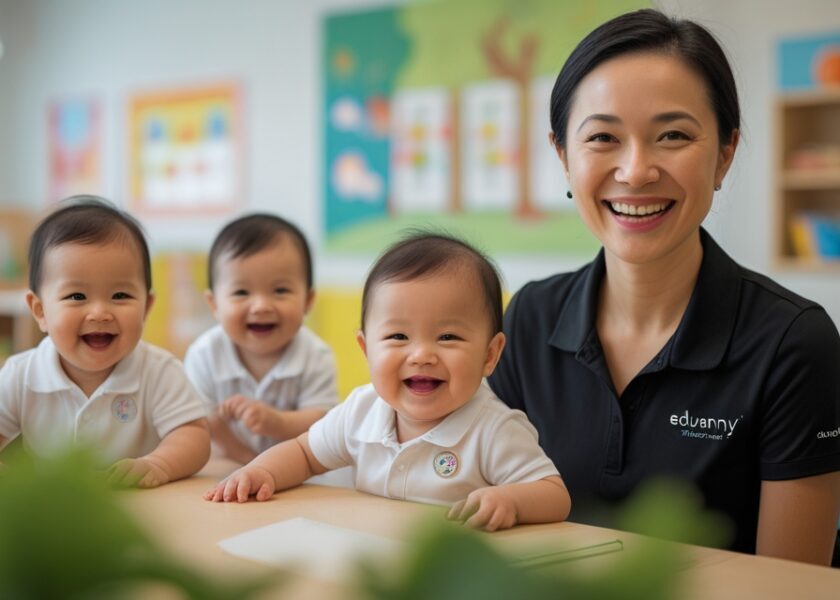
EduNanny Singapore is part of the BUTLER family, and we participate in the ECDA Childminding Pilot because we believe that home-based and community-based childcare, when done with genuine care and professional rigor, offers something that institutional settings often cannot: the intimacy of small ratios, the continuity of consistent caregivers, and the flexibility to build real relationships over time.
In our programme, the ratio of caregivers to infants is kept deliberately low—up to one to three in our infant spaces. This is not an accident. It is an architectural choice, designed to ensure that each caregiver can truly know each child. Can notice what the research says needs noticing. Can be present in a way that matters, not just physically but relationally.
We structure our care around Monday to Friday blocks because families in Singapore need reliability, and because children need predictability to develop trust. We make our programme accessible within the pilot fee structures, because we believe that quality caregiver relationships should not be a privilege reserved for families who can pay premium rates. The Baby Bonus CDA is usable with us, because we want to make this accessible to the families who need it most.
Beyond the specifications, we are not just running a childcare service. We are cultivating relationships. And we have built our programme around the understanding that those relationships require protection.
That protection looks like deliberate caregiver selection and retention—finding people who are not just qualified but vocationally suited, who understand that this work is relational before it is logistical. It looks like communication practices that keep parents informed without creating anxiety. It looks like technology like CCTV that serves trust rather than surveillance. It looks like a culture that values the caregiver role as a profession of dignity, not a stopgap.
This is what it means to take the caregiver bond seriously. Not just to celebrate it when it exists, but to engineer conditions for it, protect it, and mourn it appropriately when it ends.
Reframing What It Means to Share Your Child’s Care
I want to circle back now to something I mentioned at the beginning, because I think it is the most important thing in this conversation.
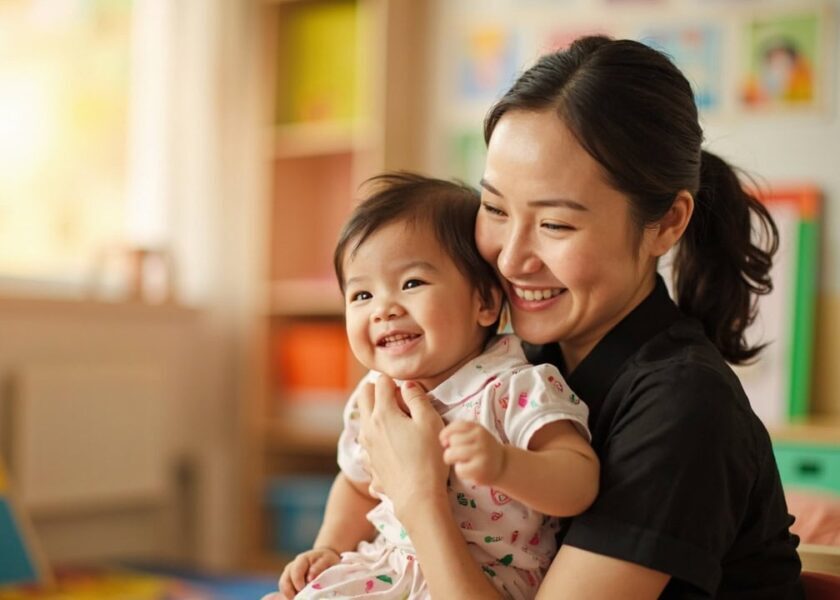
The caregiver relationship does not replace your bond with your child. It extends it. It gives your child a second anchor, a second person who is wholly devoted to their wellbeing during hours you cannot be present. It gives your child the gift of learning that love is not scarce, that care can come from more than one source, that the world contains adults who will show up for them.
And it gives you something I have not heard anyone name directly: it gives you permission. Permission to work, to pursue your career, to be the adult you need to be in the world—without guilt, without the constant anxious wondering about whether your child is okay. Not because you do not love them, but precisely because you love them enough to want them to have more than you alone can provide.
The caregiver your child loves is not a substitute for you. She is a complement to you. A colleague in the most important work there is.
So the next time your child runs toward the door when the car pulls up, when they say a name that is not yours and their face lights up with joy at someone else’s arrival—let yourself feel the full weight of that moment. The complexity of it. The love it contains.
You have not failed as a parent. You have succeeded in finding someone worthy of the trust you extended.
Your child has been given a gift: another person in this world who loves them.
And you have been given something too—the deep, quiet peace of knowing that when you cannot be there, someone who truly cares is.
Where Every Child Is Known, Not Just Minded
If you are a parent in Singapore exploring infant care or childminding options, we invite you to learn more about how EduNanny approaches the caregiver bond as the foundation of everything we do. Because your child’s hours matter. The relationships they contain matter. And the person who fills those hours—who greets your child with warmth every morning, who sings the songs they have come to love, who holds them when they are tired and celebrates when they triumph—deserves to be chosen with the same care you bring to every other decision in your child’s life.
Reach out to learn more about our ECDA Childminding Pilot programme. We would be honored to be part of your family’s story.
About EduNanny Singapore · Contact Us
“`