The Sibling Effect: How Singapore Families Build Bonds That Last
The Weight Singapore Parents Carry
Singapore is a remarkable place to raise a family. It is also, by any honest measure, one of the most demanding. The cost of living. The demands of dual-income households. The distance from extended family. The sheer logistics of coordinating two small lives across different schedules, different needs, different stages of development.
Parents here carry a weight that is rarely named in the cheerful language of parenting discourse. And when you have more than one child, that weight multiplies in ways that no one fully prepares you for.
You know this already. You live it every day. But beneath the surface of all that effort is something that matters more than most parents realise until they see it working: the relationship between your children.
Not the relationship as you manage it. Not the relationship as you mediate it, referee it, negotiate it, or wish it were different. The relationship between your children themselves. The bond that exists independent of you, that belongs to them, that will shape how they move through the world long after you are no longer the centre of their lives.
What No One Tells You About Siblings
When parents enrol a second child in care, they often describe a feeling of relief, but also a new kind of anxiety. The first child was hard enough to figure out. But with two, the question shifts. How do I make sure they do not just exist in parallel? How do I help them actually become siblings in the way I hoped they would? How do I build a family, not just manage two children?
These are not trivial questions. Research consistently shows that sibling relationships are among the most enduring a person will ever have. More enduring than friendships, more daily than the parent-child bond in later years, more complicated and more potentially transformative than almost any other human connection.
The sibling relationship is the one that runs the longest. And it is built, in large part, in childhood. In shared environments. In the ordinary friction and joy of growing up alongside someone who did not choose you but will stay with you anyway.
And yet, almost no one in the childcare industry talks about this. Walk through marketing materials from most childcare providers and you will see the same frames. Your child’s development. Your child’s milestones. Your child’s individual journey. All important. All true. But none of it captures what is actually at stake for a family with two or more children.
The Fear Parents Rarely Say Out Loud
There is an unspoken fear that many parents with multiple children carry, one that rarely makes it into the conversations they have with childcare providers or even with each other. It is the fear that their children will not like each other. That they will grow up in the same house and feel like strangers. That all the effort of raising them together will result in adults who are polite to each other at holidays and nothing more.
This fear is not irrational. Sibling relationships are complex. They contain rivalry and resentment alongside love and loyalty. They are shaped by parental dynamics, by birth order, by the uneven distribution of attention that even the most attentive parents cannot fully avoid.
And in an environment where children are largely separate, managed by separate caregivers, shuttled between separate activities, the path of least resistance is parallel development. Two children growing up in proximity but not in connection.
How Quality Childcare Builds Sibling Bonds
Let us be specific about what this looks like in practice, because philosophy without implementation is just sentiment.
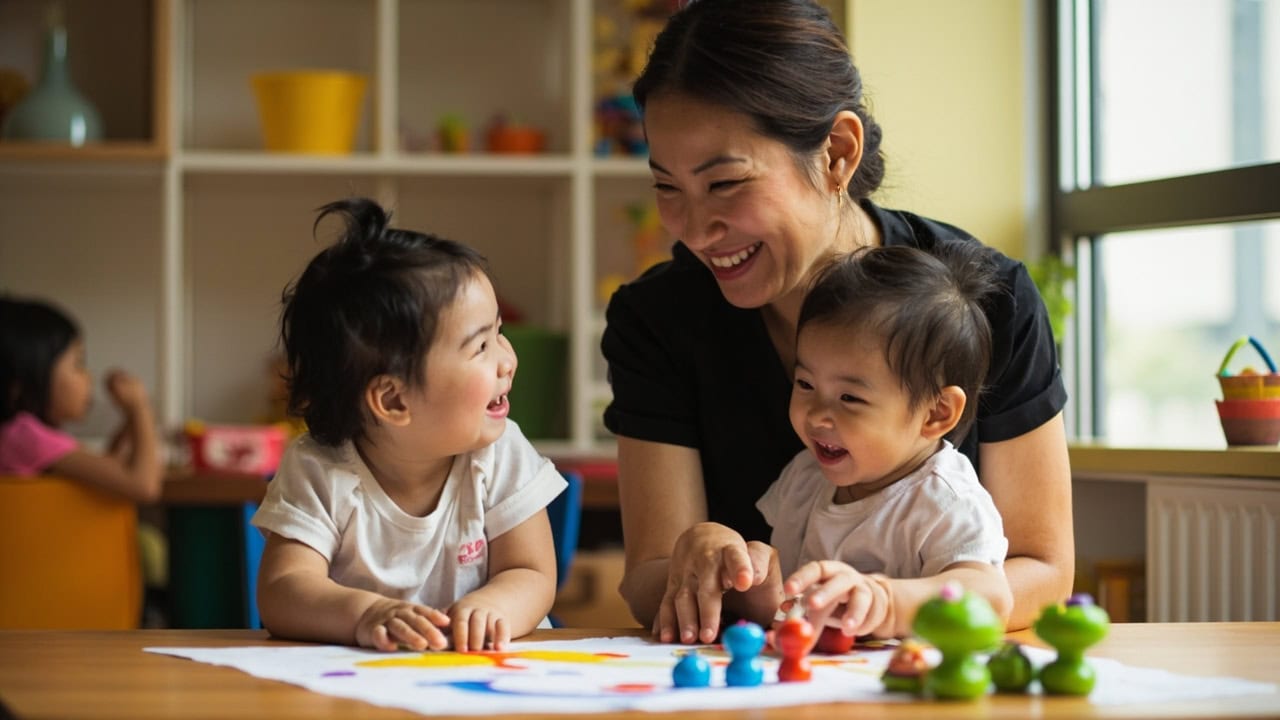
In a quality childcare environment, children do not just play near each other. They collaborate. They negotiate. They encounter challenges that require two sets of hands, rules that only work if everyone agrees, moments of frustration that, with a peer’s steady presence, become lessons in self-regulation that no adult could teach as effectively.
Consider what this looks like in a typical day:
- A block structure that requires cooperation to complete. One child holds, the other stacks. Communication happens without being taught.
- A board game with rules that demand agreement. Disagreement arises. A caregiver observes but does not intervene unless necessary. Resolution happens.
- A shared material that both children want. Negotiation occurs. Sometimes successfully, sometimes not. Either way, emotional learning takes place.
- A moment where one child is frustrated and another offers comfort. This is not directed. It emerges from repeated proximity and shared experience.
These are not accidents. They are engineered into the design of a well-run environment, and they happen repeatedly, across a full day of care.
When Siblings Are in the Same Environment
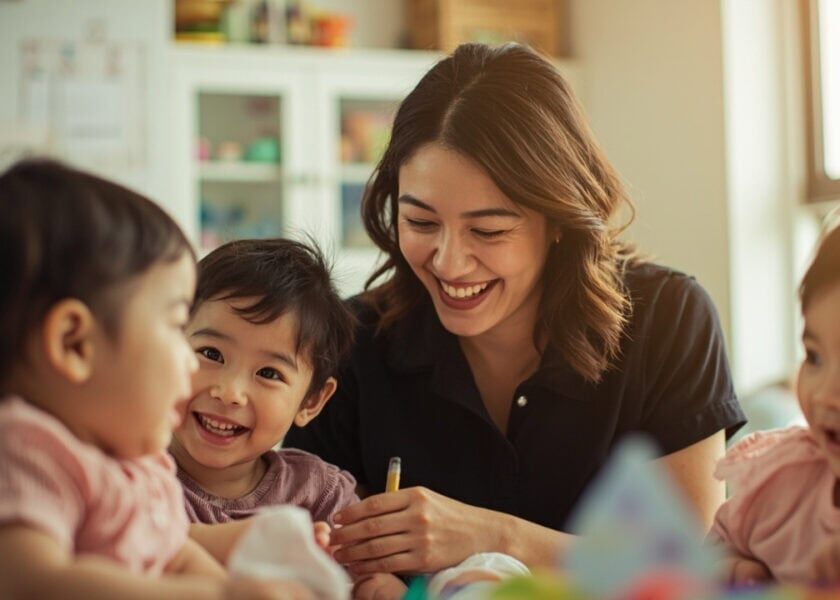
When siblings are in the same childcare environment, these moments multiply. Your children learn each other’s rhythms. They learn what makes their brother laugh, what frustrates their sister, when to push and when to yield. They practice being a team. They practice being a family in miniature.
The caregiver’s role is not to resolve every conflict but to create conditions where resolution becomes possible. Where siblings discover each other as collaborators, as playmates, as the first friends they will ever have.
The Sibling Co-Learning Effect
What parents consistently describe after enrolment is something they did not expect. The children come home different. Not just tired, or fed, or occupied. Different in how they relate to each other.
There is a familiarity that has deepened. A comfort with each other that makes the transition home smoother, not harder. Parents tell us they expected to pick up the work of managing their children’s relationship the moment they walked through the door. Instead, they find their children already in a rhythm of togetherness that they have been building all day.
This is the sibling co-learning effect, and it is one of the most underappreciated benefits of quality childcare for families with multiple children. Two children in the right environment do not simply each develop individually. They develop together. And the benefits of that development are greater than the sum of what each would have gained alone.
What Parents Notice After Enrollment
The families who come to us often arrive with a specific hope. They want their children to have what they themselves had with their siblings, or what they wished they had. They want the laughter that comes from a shared history. The security of knowing someone exists in the world who has known you since before you had words.
After a few months of quality care, here is what parents tell us:
- The mornings feel lighter. Not because the logistics have changed, but because they know what is waiting for their children during the day.
- Their children fight differently. Not less, but differently. With more awareness of each other, more capacity to work through it, more of the emotional vocabulary that comes from seeing conflict resolved in a supportive environment.
- They feel, for the first time since having more than one child, like they have a partner in the work of raising their family.
These are not promises we make. These are observations from families who have lived it. The sibling bond is not something you can force. But it is something you can create conditions for. And those conditions, repeated day after day, build something that becomes visible even to the parents who were most worried about it.
How EduNanny Approaches Sibling Care
EduNanny operates as part of the ECDA Childminding Pilot, which means we work within a framework designed to make quality childminding accessible to more Singapore families. This is not a marketing position. It is a regulatory framework that shapes how we operate, including our approach to ratios, training, and the environment we create for siblings.
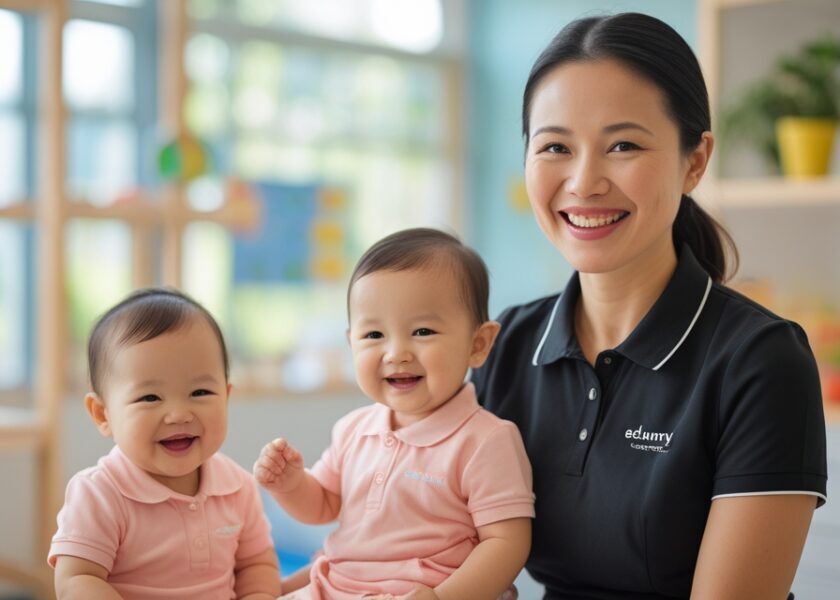
In our infant and childminding programme, caregiver ratios allow for something that becomes difficult when one adult is managing multiple children alongside household demands: the bandwidth to notice the moments between children. To step in when stepping in serves growth, and to step back when stepping back does the same.
This is not babysitting. Babysitting keeps children safe and occupied. Quality childcare keeps children safe, occupied, and in the process of becoming the people they are meant to be, together.
How We Compare to Other Options
We are sometimes asked about the difference between what we offer and what a family might find with a domestic helper or a relative caring for two children. There is no judgment in that question. Every family finds their own path.
But the distinction matters. When two children are cared for by one adult who is managing the logistics of the household alongside their development, the relationship between those children is largely reactive. It is mediated when there is conflict. It is facilitated when there is time. It is present but not actively nurtured.
In a structured childcare environment with appropriate ratios, the relationship between the children becomes part of the daily experience. Skilled caregivers understand that peer interaction is not a distraction from development but a primary vehicle of it.
What We Offer Families
Our pilot fee structures are designed with affordability in mind, and we make it straightforward to use CDA and Baby Bonus funds for care payments. We offer Monday to Friday care blocks that align with the rhythms of working families across Singapore, whether you are in the east, the north, or anywhere in between.
We provide home-based pathways for families who prefer their children to be cared for in familiar surroundings, and community or centre-based pathways where that better suits your circumstances. Communication and transparency are built into how we operate, with regular updates that let you know what your children are experiencing throughout the day.
Practical Guidance for Choosing Childcare with Multiple Children
If you are researching childcare for two or more children, here are questions worth asking that go beyond the standard developmental milestones:
- How does the environment handle conflict between children who know each other well?
- Are siblings placed in the same group or room, and how much of the day do they spend together?
- What does a typical day look like for collaborative play versus parallel play?
- What is the caregiver-to-child ratio, particularly for infants and toddlers?
- How do caregivers support siblings in negotiating, sharing, and resolving disagreement?
- What communication can I expect about how my children are interacting together?
- Are there structured activities designed for pairs or groups of siblings?
The answers to these questions will tell you whether a provider sees your children as individuals to be developed, or as siblings to be nurtured in their relationship with each other.
What We Believe About Families
Every choice you make as a parent shapes the adults your children will become. The food they eat. The books you read them. The values you model. The time you give them. But some choices ripple further than others. Some choices touch not just who your children become individually, but who they become together.
Choosing a childcare environment that understands siblings is one of those choices. It is an investment in a relationship that will outlast your own lifetime. It is a statement that you believe your children’s bond with each other matters as much as their individual development.
You are already doing the work. The early mornings, the negotiating, the carrying of one child while helping another with a shoelace, the quiet prayers in the shower that today will be a good day. You are doing all of it, and you are doing it in a city that does not always make it easy.
We want to walk part of that road with you. Not as a service provider you hire and forget. But as a partner who sees what you see, worries about what you worry about, and celebrates what you celebrate when your children come home from a day of care and you can hear them laughing together in the back seat, building a world you will never fully know but will love more than anything you have ever loved.
If you are a parent in Singapore researching infant care or childminding for two or more children, we invite you to have a conversation with us. Not about our programmes, not about our pricing, but about your family. About what you are hoping for. About what you are worried about. About the sibling relationship you want your children to have.
We cannot promise outcomes. No honest childcare provider can. But we can promise attention. Observation. A daily commitment to creating the conditions for your children to become siblings in the truest sense.
That is what EduNanny is for. That is why we exist. And that is what we will keep doing, one sibling bond at a time, for every family that trusts us with the most important work there is.
Learn more about who we are or explore our ECDA-registered childminding programme for families across Singapore.