The Architecture of Learning Hidden in Every Childcare Room
The Moment Every Singapore Parent Knows
There is a moment, familiar to every parent in Singapore, that happens at the threshold of a childcare door. It is the moment just after the morning drop-off, when you have handed your child to someone else, when you have walked back through the gate, and when the quiet of your car or your walk to the MRT station finally settles around you.
In that silence, a question rises. It is not a question of worry, not exactly. It is deeper than that. It is a question of curiosity. A question of wondering.
What is my child learning right now, while I am not there?
You have chosen this path. You have made a decision that thousands of parents in Singapore make every year, that the hours your child spends in the care of others are hours that matter. But knowing that intellectually and understanding it practically are two different things.
You know that quality matters. You know that the right environment shapes development. But when you try to picture what is actually happening inside that room during the hours you are apart, the picture blurs. You imagine toys, and children, and a teacher whose name you have learned. You imagine nap time, and snack time, and perhaps some version of play.
But what is the curriculum of that day? What is the room itself teaching your child? And how would you know, if you could not see it?
This is the question we want to sit with today. Not because the answer is complicated, but because it is hidden in plain sight, and because understanding it changes everything about how you choose, how you evaluate, and how you trust.
The Environment Is Not Neutral
Let us begin with a simple truth that we rarely articulate: the environment your child enters each day is not a neutral space. It is not a room that simply contains children while time passes.
It is an active teacher. It has its own curriculum, its own architecture of learning.
That curriculum is written not in books or lesson plans, but in the design of the space, the rhythm of the day, the quality of the light, the sounds that fill the room, the social structure that emerges, and the thousand small decisions about how things are arranged and when they happen.
Supervision says: Your child is safe here.
Intentional environment design says: Your child is learning, growing, and developing here, and here is how.
Understanding this distinction is not an academic exercise. It is a practical skill—the skill of reading the room, of understanding what the visible environment reveals about the invisible curriculum, of moving from wondering to knowing.
How Infants and Toddlers Actually Learn
Consider what we know about how infants and toddlers learn. They learn through sensory experience. They learn through repetition. They learn through the safety of predictability. They learn by watching, by touching, by moving through space, by observing how others respond to them.
A room that is thoughtfully designed for infant and toddler development is not a room that has been decorated. It is a room that has been engineered for learning.
Every surface, every material, every distance between a changing station and a play area, every sight line that a child can follow with their eyes, every acoustic consideration that determines whether a room is calming or overstimulating, every decision about whether natural light enters the space or whether children live under fluorescent tubes all day—these are pedagogical choices. These are curriculum decisions.
The best childcare environments make these choices deliberately, with an understanding of child development that rivals the intentionality of any primary school classroom.
Rhythm as Curriculum
Let us talk about rhythm, because rhythm is where the curriculum of childcare becomes most visible, and most powerful.
The day in a quality childcare environment has a shape. It has an architecture of time.
- Arrival, with its particular choreography of greeting and settling.
- Transitions into activities, and the shifting from one kind of play to another.
- Meals, shared at a table or on a mat, with the social learning that happens when children eat together.
- Rest, and the particular emotional work that a child does when they allow themselves to fall asleep in a place that is not their own bed, trusting that they will wake to the same faces and the same environment.
- Departure, when the day’s curriculum is complete and parents return to collect what they have entrusted.
Every one of these moments is a learning moment.
When a child arrives and is greeted by name, they learn that they are recognized, that they matter, that this is a place that knows them.
When a child moves from free play to circle time, they learn the skill of transition, the capacity to shift their attention and body from one state to another—a skill that will serve them in every classroom and every workplace for the rest of their lives.
When a child lies down for rest in a room that smells and sounds different from home, and yet trusts that they will be okay, they build the emotional regulation that is the foundation of every skill they will ever learn.
The rhythm of the day is not a convenience for the adults. It is a curriculum for the children. The quality of that curriculum can be read in the calmness of the room, in the ease of transitions, in the way children move through the day with a sense of security that comes from knowing what comes next.
Space as Teacher
Space is where the environment becomes physical, tangible, something you can see and evaluate when you visit a childcare centre.
A quality environment for infants and toddlers is designed to be navigated. It is designed with the understanding that a child who can move freely through a space, who can choose where to go and what to engage with, who can find quiet corners and active zones, who can watch other children from a safe distance or join them in collaborative play, is a child who is learning through every choice.
What to Look For in a Space
- Where can a child go? What can they reach? Are the materials on shelves that they can access, or are they locked away, available only when an adult distributes them?
- Is there variety? Soft space for quiet moments, and open space for movement.
- Is the room organized logically? Can a child predict where things are and develop the spatial cognition that underlies all later learning?
- What materials are present? Natural materials like real wood, metal, and fabric, or hard plastics and bright colors designed for cleaning rather than learning?
These are not aesthetic questions. They are pedagogical questions about what the environment teaches a child about the world.
- Wood blocks teach weight and balance and mathematical thinking in a way that plastic blocks never can.
- Real fabric teaches texture and temperature and the softness of being wrapped.
- Natural light teaches time of day, seasonal change, the relationship between outside and inside.
The Social Architecture of Learning
How many children are in the room? What is the ratio of children to adults? How are the children arranged in terms of age and developmental stage?
These questions matter because they determine what social learning is possible.
In a room that is overcrowded, where one adult is responsible for too many children, the social curriculum collapses. There is no time for the individual interactions that build language. There is no space for the adult to respond to a child’s exploratory play with the verbal richness that builds vocabulary. There is no capacity to notice when a child’s frustration is building and to intervene with the calm guidance that teaches emotional regulation.
In a room with a small group of children and a high ratio of attentive adults, something different happens.
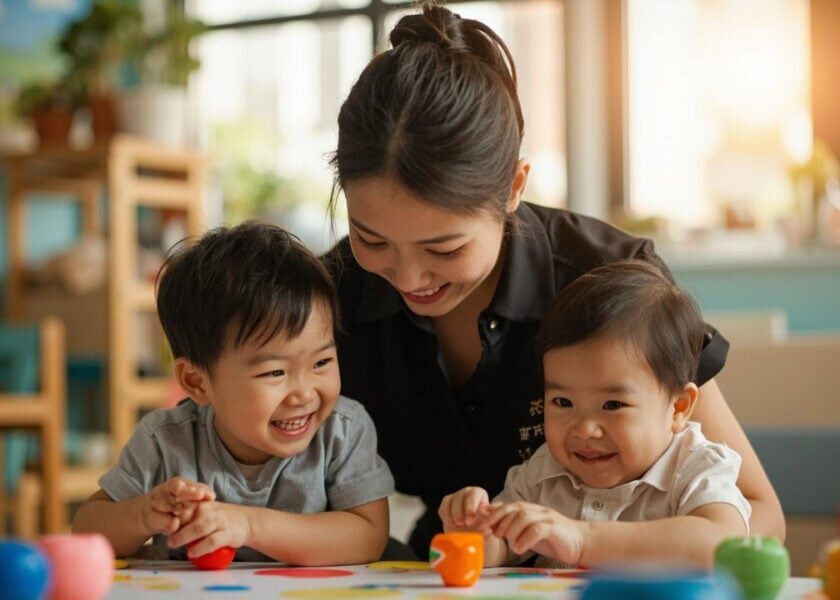
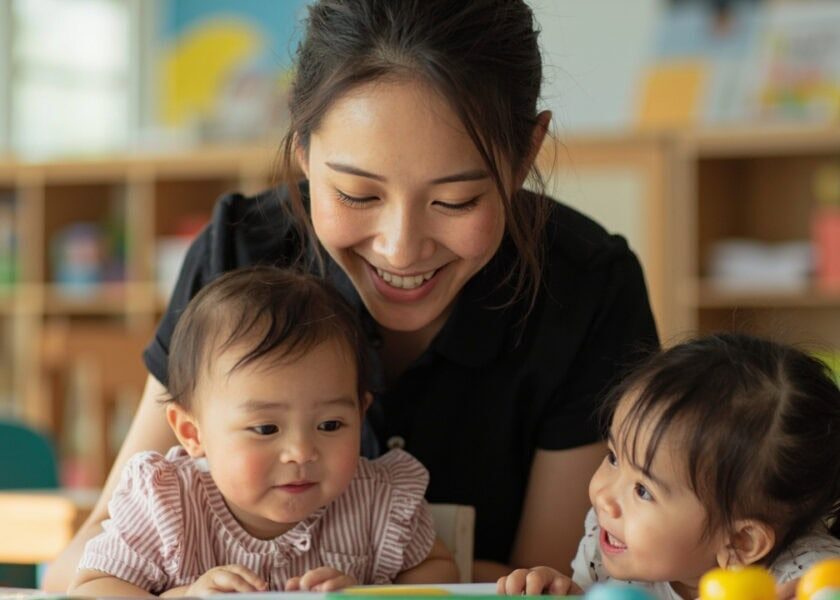
The adult can be present in a way that is genuinely educational. They narrate what a child is doing, adding language to experience. They model the social behavior they want the child to learn. They create what developmental psychologists call a “scaffolding” environment, where the child is supported just enough to stretch toward the next skill, but not so much that they never learn to do things for themselves.
Reading the Room: A Parent’s Guide
What does this mean for Singapore parents who are making decisions about childcare? It means that the tour you take of a childcare centre is not just a visual inspection. It is an opportunity to read the curriculum of the room.
What Your Senses Tell You
When you walk through the door, notice what your senses tell you.
- Is the room calm or chaotic?
- Is the light natural or harsh?
- What can you hear? The sounds of a quality environment are distinctive: the soft murmur of an adult talking to a child, the focused sounds of purposeful play, the predictable rhythms of routine. If a room sounds like a television, loud and undifferentiated, that is information.
What to Observe in the Children
- Are they engaged, or are they waiting?
- Are they moving through the space with purpose, or confined to a limited area?
- Do they look relaxed, or stressed?
- Do they show the signs of secure attachment: the ease of exploration, the willingness to try new things, the ability to separate from parents without distress?
What to Observe in the Adults
- Are they present with the children, or are they doing something else?
- Do they speak to the children in rich, responsive language, or is their interaction minimal?
- Do they seem to know each child as an individual, or are they managing a group?
These observations are not difficult. You do not need a degree in early childhood education to read a quality environment. What you need is an understanding that the environment has a curriculum, and that curriculum is visible if you know what to look for.
Why This Matters Permanently
What we are describing is not a luxury add-on. It is not the kind of childcare that only wealthy families can access. It is a standard, and that standard should be available to every child in Singapore.
The reason this matters is not sentimental. It is developmental.
The first thousand days of a child’s life are not a period that can be revisited or remade.
- The neural pathways that support language are formed in these early years.
- The emotional regulation systems that determine whether a child can manage frustration and delay gratification are established in these early years.
- The social skills that allow a child to navigate relationships, to cooperate, to communicate, to understand others, are built in these early years.
What happens in the environment a child spends their days in during these thousand days matters in a way that no later intervention can fully replicate.
When you choose a childcare environment, you are not just choosing where your child will spend their days. You are choosing what those days will teach them. You are choosing whether the environment will be a silent teacher of curiosity and capability, or simply a place where time passes.
What EduNanny Offers
This is what EduNanny by BUTLER offers, and this is why the approach matters.
EduNanny operates within the ECDA Childminding Pilot, a framework designed to expand the options available to Singapore families—to create pathways that are both accessible and high-quality, that recognize the real pressures parents face and the genuine developmental needs of infants and young children.
The pilot offers both home-based and centre-based pathways, because families are not all the same, and the curriculum of care must be flexible enough to meet different needs while maintaining the standards that make quality possible.
Within the EduNanny model, the ratios matter. With up to one to three for infants, the environment is designed to allow for the kind of individual attention that makes intentional learning possible.
This is not a logistical preference. It is a pedagogical requirement.
When you have a small number of children and a high ratio of knowledgeable, responsive adults, you can create the conditions for genuine development. When those conditions are present, children learn. They develop language, and social skills, and emotional regulation, and the curiosity that will carry them through school and beyond.
The fee structures within the pilot are designed to be affordable, recognizing that quality care should not be available only to families with significant resources. The use of CDA and Baby Bonus funds where applicable makes the financial architecture of care more accessible for Singapore families.
And the commitment to communication and transparency, including CCTV measures where deployed, reflects a deeper truth: that parents who understand what is happening in their child’s environment can trust more fully, and trust is the foundation of everything.
An Environment That Extends Your Family
A quality childcare environment does not replace the family. It extends it.
When a child spends their day in an environment designed for their development, they are not being taken from their parents. They are being given something that complements what parents provide.
The emotional security that a child develops in a quality childcare environment is not in competition with the attachment they have to their parents. It is built on that attachment.
A child who trusts their parents can trust the world. And a child who trusts a quality childcare environment can take that trust with them into school, into friendships, into all of the relationships that will shape their lives.
This is the deepest promise of what quality childcare offers. Not just school readiness, though that matters. Not just language development, though that matters. But the foundation of a person who is curious, and confident, and capable of building relationships, and ready to learn.
Your Checklist for Evaluating Childcare
When you visit any childcare environment, ask yourself these questions:
| Dimension | Look For |
|---|---|
| Sound | A calm murmur of engagement, not loud, undifferentiated noise |
| Light | Natural light, not harsh artificial lighting |
| Movement | Children can move freely and choose their activities |
| Materials | Natural materials present, not only plastic |
| Rhythm | The day has a visible structure and predictable flow |
| Adults | Caregivers are present and responsive, not distracted and transactional |
| Children | They look engaged and secure, not restless and waiting |
If you can answer these questions with confidence after a visit, you have the framework to evaluate any childcare environment. You have moved from wondering to knowing.
The Question Answered
Let us return to the moment we described at the beginning. The moment after the drop-off, when you are walking back through the gate, when the question rises: what is my child learning while I am not there?
Now you have a different relationship to that question.
You know that the answer is not hidden. It is written in the room, in the rhythm of the day, in the quality of the light and the sound and the space, in the knowledge and responsiveness of the adults who are present.
You know that you can read that curriculum. You know what questions to ask when you visit. You know what to look for. You know the difference between supervision and intentional design.
And you know that EduNanny by BUTLER is not offering a service. It is offering an environment. A carefully designed, developmentally informed, deliberately constructed environment that has its own curriculum—a curriculum that teaches through space and rhythm and relationship, a curriculum that prepares your child not just for school but for life.
The decision you make about childcare is one of the most important decisions you will make in these early years. And now you have the framework to make it with clarity.
Walk through the door of any childcare centre and read the room. Listen to the sounds. Watch the children. Watch the adults. Notice the rhythm. Notice the space. Notice whether the environment feels like it is teaching, or simply containing.
You will know.
And when you find the environment that meets this standard, you will know something else as well. You will know that the question you have been carrying—the question about what your child is learning while you are not there—has been answered not with words but with the quality of every moment your child spends in that space.
You will know that your child’s environment is actively teaching, not just babysitting. You will know that your child is in the curriculum, and the curriculum is good.
That is what quality childcare offers. That is what EduNanny by BUTLER provides. And that is what your child deserves.
If you would like to learn more about EduNanny’s approach to thoughtful, development-oriented childminding in Singapore, visit our About Us page or get in touch with our team.