Learning to Know Your Child Better After the Hours Apart
What Separation Teaches You About Your Child
Watching parents and children move through the early years together in Singapore, I have noticed something that may surprise you: the parents who emerge from the childcare years with the deepest, most confident relationship with their child are not the parents who never felt the distance. They are the parents who learned to close that distance in new ways.
They are the parents who understood that separation, though it costs something, also gives something back. It gives you back to your child as an observer. It gives your child back to you as a mystery worth solving. And it teaches you, if you let it, to listen more carefully than you ever thought you would need to.
The Gift of Contrast
When you are with your child all day, every day, you see only one version of them. You see the child at home, in the familiar, in the low-stimulation environment where they know every corner and every person.
You do not see the child who navigates a group of peers for the first time, who has to share a caregiver’s attention, who discovers that they are someone different in a room full of other small people than they are in your arms. You do not see the child who is learning, in real time, what it means to be part of a social world.
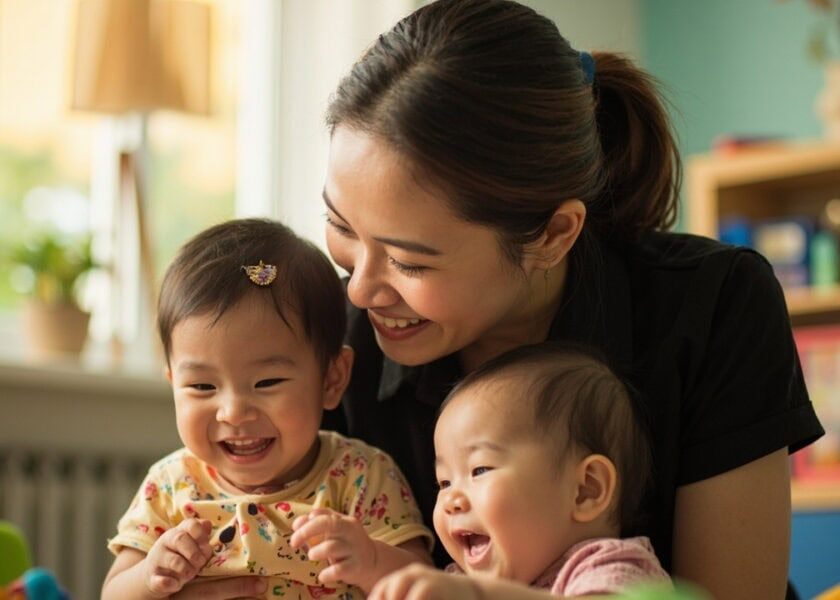
Quality childcare gives you access to that other child. It gives you, through the reports and the photos and the conversations with your child’s caregiver, a window into the person your child is becoming outside your direct gaze.
And here is the beautiful, counterintuitive truth: this window does not make you feel more distant. When you learn to use it well, it makes you feel closer. Because now you know something new about your child. Now you have a piece of them that you could not have had any other way.
The Art of Attunement: Reading Your Child Across the Distance
Attunement is the practice of reading your child’s emotional signals. It is what researchers and early childhood specialists call by this name, and what parents have always known by a simpler one: the ability to read your child.
Let me tell you what it looks like in practice, because the philosophy matters only if it can live inside your ordinary days.
You come home from work. Your child runs to you, or hangs back shyly, or screams with joy in that way that makes you laugh even when you are exhausted. What do you do in the first five minutes?
This is where attunement begins, and where most of us, without meaning to, let it slip away. We check our phones. We ask the caregiver a dozen logistical questions about food and sleep. We start dinner. We move into the machinery of the evening.
But the parent who is learning to stay close will do something different in that first moment. She will kneel down. She will look. She will take one full breath before she says anything, and she will let her child’s face tell her something.
The Signals Worth Noticing
When you choose that breath and look at your child with your full attention, you begin to read them. You notice the patterns that tell you about their inner state. You understand that the way your child holds their body when you pick them up from childcare is information, not just behaviour.
These are the signals worth noticing:
- The quality of their aliveness: Are their eyes bright and searching, or dim and heavy?
- Physical tension: Is there tightness in their shoulders, a clenched jaw, a relaxed posture?
- Attachment objects: Is there a particular toy they are holding close, a story they are eager to act out?
- Expression: Is there something in their face that says, “I need to show you something I learned today”?
- Their breath: The particular rhythm of their breathing tells you about their nervous system state.
- Their greeting: The pitch of their hello, the intensity of their need to be held or their desire to run free—these are messages.
They are your child telling you, across the hours you were apart, what it was like to be them today.
A Story: Pickup Time Becomes an Unveiling
I think about a mother I spoke with recently, a professional in her late thirties, who told me she used to dread pickup time. She would arrive at her child’s centre and feel a wave of guilt wash over her, seeing the caregiver as a reminder of her own absence. She would scoop up her daughter and feel, in some wordless way, that she was failing. That she was a stranger to her own child.
What changed for her was not a change in her circumstances. It was a change in her attention.
Her daughter’s caregiver began sharing small observations—not just that she had eaten well, but that she had chosen to sit beside a particular child at lunch, and that she had a way of smoothing the hair of the child next to her when they were upset, a gesture no adult had taught her.
The caregiver noticed this. The caregiver told the mother. And the mother, hearing it, felt something shift. She had not known her daughter was someone who cared for others in this particular, tender way. She had not known this was in her child.
And suddenly, pickup time became a kind of unveiling. Every day, something new was revealed.
This is what quality childcare offers your relationship with your child: it expands what you know. It fills in the portrait. It gives you a fuller picture of the whole person your child is, precisely because it shows you your child in context, in relationship with others, in the hours when you are not there to shape the scene.
Building the Partnership: Two Witnesses to Your Child’s Life
But this requires something from you. It requires that you ask the right questions. It requires that you cultivate a partnership with the people caring for your child—not just a transactional arrangement where you hand over your child in the morning and receive them back in the evening, but a real exchange of insight and observation.
The best childcare relationships are bidirectional. Your child’s caregiver learns from you; you learn from your child’s caregiver. Together, you build a picture of your child that neither of you could build alone.
The caregiver is not just a guardian. The caregiver is a witness—a professional witness to your child’s inner life in the hours you are apart. And the parent is the primary witness, the one who holds the longest view, the one who knows the history and the hopes.
When these two witnesses work in partnership—when the caregiver shares what they see with curiosity and care, and the parent receives it with openness rather than anxiety—a remarkable thing happens. The child is held by understanding from both sides. The child knows, in some way they cannot articulate, that the adults in their life are talking about them, are interested in them, are watching them with love.
There is a phrase that comes from infant mental health: the child needs a continuous other—someone who is consistently present, who consistently notices, who consistently responds.
That continuous other does not have to be the same person, in the same room, every single moment. It can be a network. It can be a web of caring, attentive relationships that hold your child from multiple angles.
What matters is not the singularity of the caretaker. What matters is the quality of the attention. What matters is that your child feels, across all the hours, that they are known.
What This Means for Your Child
For a child in the first thousand days of life, and in the years that immediately follow, this sense of being seen and known is the foundation of everything:
- The foundation of security—the sense that the world is a trustworthy place
- The foundation of the capacity to trust—that relationships are safe and rewarding
- The foundation of healthy relationships later in life—because the child has learned, through daily experience, that people can be trusted to pay attention to them, to notice them, to respond to their needs with care
The Benefits You May Not Have Expected
When you choose infant care or childminding carefully, when you choose a place that values observation and communication, when you build a real partnership with the people who are caring for your child, you are not creating a substitute for yourself. You are creating an extension of your care.
You are multiplying the attention your child receives. You are, in a very real sense, bringing more love into your child’s world, not less.
Something else happens when you build this partnership, something that surprises many parents. As you learn to share the watching, you also learn to share the worrying—and the noticing.
Your child’s caregiver notices things. They have training, experience, a fresh pair of eyes. They see:
- The rash before it spreads
- The ear infection before the fever spikes
- The developmental leap before you would have caught it at home
- The social dynamics, the friendships forming
- The child who is struggling to fit in
They become your partner in the profound, everyday work of raising a small human being. And this partnership, when it is built on trust and transparency, lightens your load rather than replacing your role.
Addressing the Real Pressures Singapore Parents Face
There is real pressure on parents in Singapore. The cost of living. The expectations of the workplace. The cultural weight of achievement. The hours of commuting. The landscape of modern parenthood here is not gentle.
The decision to place your child in infant care or childminding is rarely made lightly. It is made in the space between what you want for your family and what your family needs, and that space is often tight and painful.
I do not want to minimise that pain. I do not want to tell you that separation is a gift when you are crying in the bathroom at work, wishing you were home.
What I want to tell you is this: the pain is real, and the love behind it is also real, and that love does not have to be diminished by the arrangement. It can be different. It can be a love that is expressed through attention, through the quality of your listening at the end of the day, through the questions you ask and the observations you share and the way you hold your child’s story as something precious.
Your Five-Minute Practice: Closing the Distance
There is a practice I want to share with you, one that I have seen transform the experience of parents in the childcare years. It is not complicated. It does not require extra time. It requires only that you decide, in advance, what you will do with the first five minutes.
How to Practice the Five Minutes
Every day, when you pick up your child or when they come home, give them your complete attention:
- Put away the phone. This is not about willpower. It is about making a decision before you arrive.
- Kneel to their level. Come down to where they are. Let your face be at theirs.
- Breathe. Take one full breath before you say anything.
- Wait. Let them lead. Let them show you something from their day.
- Receive without agenda. Do not immediately correct, steer, or redirect. Just receive what they offer.
What This Practice Builds
This practice sounds small, and it is small, and the smallness is the point. Because what happens over months and years of this practice is not small at all.
What happens is that your child learns that you are interested. That you care about their inner world. That the hours you were apart did not diminish your attention; they refined it.
Your child learns that they can tell you things, not because you were there to witness them, but because you asked, because you waited, because you made space.
This is attunement. This is the practice that bridges the gap between the parent who is physically absent and the parent who is emotionally present.
Choosing Quality Infant Care in Singapore
If you are currently researching infant care or childminding options, here are the questions worth asking:
Questions to Ask Potential Caregivers
- How do you communicate with parents about their child’s day—not just the logistics, but the emotional highlights?
- What is your caregiver-to-infant ratio?
- How do you observe and track my child’s development and social interactions?
- What training do your caregivers have in early childhood development and attunement?
- How do you handle the transition when a child first joins your programme?
Signs of Quality Care
| Look For | Ask About |
|---|---|
| Individual attention | Ratio of caregivers to children |
| Communication beyond logistics | How do they share observations about your child’s emotional and social development? |
| Partnership approach | How do they invite your insights about your child? |
| Trained observation | What training do caregivers have in reading infant and toddler cues? |
| Transparent practices | What updates can you expect, and how often? |
Start Your Journey with EduNanny
At EduNanny, we understand the weight of the trust you are placing in us. We do not take lightly the role of being the witness in your child’s day. We know that the hours we spend with your child are hours that belong to your family, hours that you have chosen to share with us, hours that we will fill with attention and care and a genuine delight in the person your child is becoming.
EduNanny is part of the ECDA Childminding Pilot, and we have built our programme around the understanding that home-based care, when it is done with intention and skill, can be exactly what modern families need.
Our caregiver-to-infant ratios are designed to allow for real attention, real observation, real attunement—not just supervision, but care in the deepest sense. We offer both home-based pathways and connections to community and centre-based options, so that families can find the arrangement that fits their lives and their child.
Through pilot fee structures, through the usability of CDA and Baby Bonus, through careful attention to the real economics of raising a child in Singapore, we have worked to make quality infant care and childminding accessible to families across this city. Because every child deserves to be known. Every parent deserves the tools to stay close.
Next Steps
- Explore our home-based childminding services as part of the ECDA Childminding Pilot
- Learn about our transparent communication practices that go beyond daily updates
- Discover how we support parent-caregiver partnership in understanding your child’s development
- Enquire about fees and subsidies, including CDA and Baby Bonus usability
The Answer Is You
The question you carry—how do I stay close to my child when I am not there?—is a worthy question. It is the question of a good parent.
And the answer is not a place or a programme or a service, though these things can help. The answer is you. It is the quality of your attention. It is the courage of your curiosity. It is the five minutes at pickup time, the question you ask, the breath you take before you speak.
Separation taught you to listen more carefully. That is not a loss. That is a gift that the hours apart have given you, and that your child will carry with them into every relationship they ever form: the knowledge that they are worth listening to. That their inner world matters. That someone, every day, was paying attention.
You are that someone. You are becoming that someone in ways that this hard, beautiful season of parenthood is teaching you.
The childcare years will change you. They will change the parent you are, the person you are, the relationship you have with your child.
If you approach these years with curiosity rather than guilt, with attention rather than anxiety, with partnership rather than control, you will emerge from them as a parent who knows her child in a way that parents who never experienced separation often do not.
There is a particular kind of parent that emerges from the early childcare years. She has learned to read the signals. She has learned to ask the questions that matter. She has learned that her child is a whole person with an inner life that exists even when she is not in the room, and she has made it her practice to know that inner life, to tend to it, to honour it.
She has learned that love is not diminished by distance when the distance is filled with attention.
We would be honoured to walk this path with you.
The childcare years are not a gap to be endured. They are a school to be attended. And you are already learning the most important lesson: how to love your child across the distance, with your whole heart and your full attention.
That is something worth celebrating.