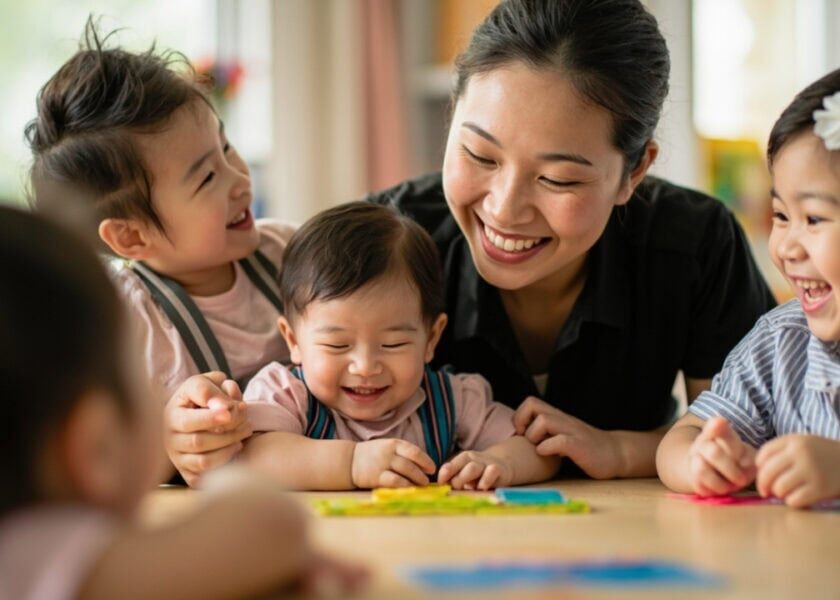
The Courage to Trust What Singapore Working Parents Need to Know
What You Feel Is Not Weakness
What you feel is not evidence that you are making the wrong choice. What you feel is love. It is the ache of love, which is always, in the end, the ache of attachment.
You feel grief because you are attached to your child. You feel guilt because you love them enough to want to be enough for them. You feel fear because you have read the articles, heard the warnings, absorbed the cultural whisper that says a mother’s place is beside her child, that presence is the currency of parenthood, that leaving is the price of something you will have to pay for later.
Here is what that cultural whisper gets wrong: it mistakes abandonment for entrusting. It conflates presence with love, as though love were a substance that depletes with distance, as though your child could run out of it while you are at work.
This lie has cost generations of parents their peace. And it has cost countless children the gift of watching their parents model something vital and beautiful — something they will carry with them long after they have forgotten the shape of their first classroom.
Entrusting Is Not Abandoning
Let us be precise, because precision matters here.
Abandonment is the failure to return. Abandonment is the silence on the other end of the phone, the forgotten appointment, the pattern of choosing your own ease over your child’s need.
That is not what you are doing.
You are not abandoning your child. You are entrusting your child to hands you have chosen carefully, thoughtfully, with every intention of returning. You are extending your love through the work of capable, loving people who will hold your child the way you would hold your child if you were there.
The difference is not small. The difference is everything.
The parent who hesitates at the door of a childcare centre is not the parent who does not care. The parent who cries in the car after the first drop-off is not the parent who has failed. That hesitation, that grief, that guilt you carry — it is proof that you understand what you are doing. It is proof that this choice costs you something, and that you are paying the cost willingly because you believe, despite your fears, that this is what your family needs right now.
That is not the profile of a parent who is leaving. That is the profile of a parent who loves so fiercely that the thought of imperfection is unbearable.
What Quality Care Actually Gives Your Child
The voices you hear are not lying exactly — they are exaggerating. They are collapsing a complex truth into a simple one.
The complex truth is this: the early years matter. Relationships shape development. Love is formative. These things are true.
But the simple version — that you must be the one providing all of it, always, without help, without rest, without a single moment of distance — that is where the truth ends and the pressure begins.
Here is the fuller truth that research supports: what matters most in the early years is not who provides the care. It is the quality of the care.
It is the consistency. The attunement. The warmth. The responsiveness. It is whether your child feels known and loved and safe in the environment they spend their days in.
The attachment your child forms with a caregiver who loves them well — who holds them with patience, who celebrates their discoveries and soothes their distress — this attachment does not replace yours. It grows from the same soil. Your child is not a vessel with a fixed capacity for connection. They are a human being whose capacity for love expands with every secure relationship they enter.
There is a kind of parent that our culture quietly worships — the parent who never works, who never rests, who is present at every milestone, who never shows a child what it looks like to need someone else, to trust someone else, to let go and come back.
This parent is a fiction.
And the children of this fictional parent learn something troubling without ever knowing it: they learn that dependency is safety, that the world is small enough to be contained by one person’s attention, that asking for help is weakness.
Meanwhile, the children of real parents — the ones who work, who rest, who choose, who grieve, who trust — learn that the world is large and full of capable hands. They learn that love can travel across distances. They learn that they are worthy of care from many sources and not just one.
What to Look for in Quality Childminding
For parents in Singapore exploring their options, knowing what to look for matters. Here is what quality care provides, whether in a centre or a home-based setting:
- Intimate ratios — in quality home-based care, your infant is not one face in a crowd. Smaller caregiver-to-child ratios mean your child is known, seen, and held
- Chosen caregivers — not just trained, but selected for their capacity to hold what parents hold: the tenderness, the protectiveness, the fierce wish for a child’s wellbeing
- Transparent communication — open updates about your child’s day, their moods, their discoveries. You should never have to wonder what is happening while you are apart
- Consistent presence — routines that your child can rely on, faces that become familiar and trusted over time
- Responsive warmth — caregivers who notice when your child is tired, hungry, curious, or upset — and who respond with attunement, not routine
If you are beginning to explore infant care or childminding in Singapore, here are questions that can help you find the right fit:
- What is the caregiver-to-child ratio? Smaller ratios mean more individual attention and responsiveness
- How are caregivers selected and trained? Look beyond credentials to understand what values guide their approach
- What does communication look like? Will you receive regular updates about your child’s day?
- What is the environment like? Does it feel warm, safe, and stimulating — a place a child could flourish?
- How is the schedule structured? Does it serve working parents with care blocks that align with your work life?
- What happens in an emergency or illness? Understanding protocols in advance reduces anxiety for everyone
- Can you observe before committing? Quality providers welcome visits and offer trial periods — this is how trust begins
These are not luxuries. They are the minimum your child deserves. And they are the minimum you deserve to expect.
EduNanny: Built for This Moment
EduNanny exists because someone looked at the landscape of childcare in Singapore and saw not just a practical need but a human one.
They saw that parents were not looking for a service that would simply watch their children. They were looking for someone who would understand what it meant to hand over the most precious thing in your life and trust that it would be safe. They were looking for partners who would extend their love rather than replace it.
And so EduNanny was built, slowly, carefully, with ECDA’s Childminding Pilot as its foundation — an initiative that took the best of what home-based and community-based care could offer and wove it into something Singapore parents could trust.
This is what that trust looks like in practice:
- Ratios that ensure your infant is known — in EduNanny’s care, the ratio of caregiver to infant can be as intimate as one to three
- Caregivers chosen for their heart — not just trained but selected for their capacity to hold what parents hold
- Transparent communication — daily updates that tell you your child ate well, slept well, reached for a toy with new intention today, laughed at something unexpected
- Accessible fees — structured to be within reach for families committed to making this work, with Baby Bonus CDA funds usable for this purpose
- Monday to Friday care blocks — designed to serve working parents rather than work around them
But let us be clear about what EduNanny is really offering, because it is not infrastructure or convenience. It is something harder to name but easier to feel.
EduNanny is offering to hold your love while you are apart. To be the trustworthy extension of everything you want for your child. To understand that when a parent walks through our doors, they are not just dropping off a child — they are handing over a piece of their heart and asking us to protect it.
We take that seriously.
A Moment You May Recognise
There is a moment — some of you have lived it, and some of you will — when your child runs to their caregiver with the same joy they once reserved only for you.
And in that moment, something cracks open. Not something broken. Something growing.
You realise that your child has learned to trust beyond you, and that this trust has not made your bond weaker. It has made it stronger. It has made it real in a way that nothing else could.
Your child is not choosing the caregiver over you. Your child is choosing the world you have shown them is safe.
And you showed them that by choosing it. By walking through the door. By grieving the goodbye and coming back anyway.
Permission to Be Whole
You are allowed to work. You are allowed to rest. You are allowed to need something beyond parenthood, because you are a whole person who happened to become a parent, not a parent who happened to become a person.
And your child needs to see you as whole. They need to see you live, to see you struggle, to see you make impossible choices and live with them gracefully.
This is what resilience looks like when it is modelled. This is what a full life looks like from a child’s perspective.
What children learn when parents model trust:
- That the people who love them can be imperfect and still worthy of love
- That leaving is not the same as leaving forever
- That their own hearts are large enough to hold many people, and that this is a gift, not a loss
- That their parents are human — strong enough to work, wise enough to rest, brave enough to ask for help, and secure enough in their love to let it travel beyond what they alone can provide
The parent who stands at the door of a childcare centre feeling everything — the grief, the guilt, the fear, the love — the parent who walks through that door anyway, who has done the research, who has asked the questions, who has found people worthy of trust — that parent is not lesser.
That parent is extraordinary.
That parent has looked at the impossible weight of raising a child in this city, with its costs and its expectations and its relentless pace, and has said: I will find a way. I will find help. I will not do this at the expense of my own humanity. I will not pretend that I am enough on my own, because no one is enough on their own, and that is not a flaw. That is the condition of being human.
You are not leaving your child.
You are extending your love.
And that is one of the most generous things a parent can do.
If you are ready to explore what quality childminding can look like for your family in Singapore — care that honours what you feel and holds what you trust — EduNanny is here to walk this path with you.
Begin with a conversation. Ask your questions. Let us show you what trust looks like when it is built into the foundations of care.
Because you have already shown such courage in choosing. Now let someone show you what it looks like when that choice is held well.