Why Play Is Your Child’s Most Important Work
The Architecture of Learning: Why Play Is the Work of Childhood
We have spent decades treating play and learning as opposites—as if the mind works in one mode when children are “just playing” and another, more serious mode when they are actually learning something. This separation is a mistake. And a costly one.
When neuroscientists and developmental psychologists observe young children at play, they are watching the most intensive period of brain construction that any human being will ever experience. Not a warm-up. Not a prelude. The main event.
Consider what is actually happening when your child chooses to pour water from one container to another. They are running experiments. Testing hypotheses about capacity, about gravity, about what happens to liquid when the container tips too far. They are building the cognitive architecture that will, in a few years, help them understand why a full cup weighs more than an empty one, why some things sink and others float, why the world behaves in consistent and predictable ways.
When your child builds a tower and then knocks it down—not once but repeatedly, each collapse a new data point—they are learning about stability and collapse, about cause and effect, about the relationship between height and the force required to topple something. They are building intuitions about physics that will later become the bedrock of scientific thinking.
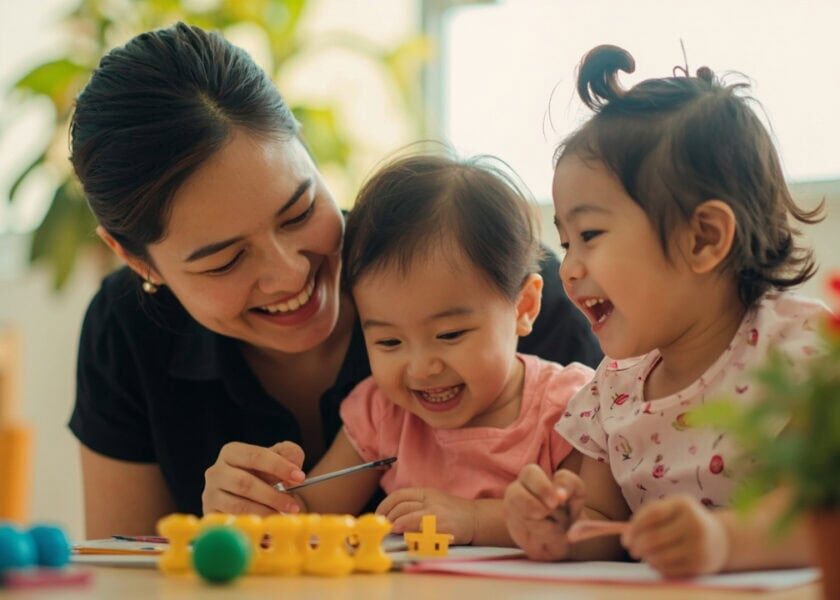
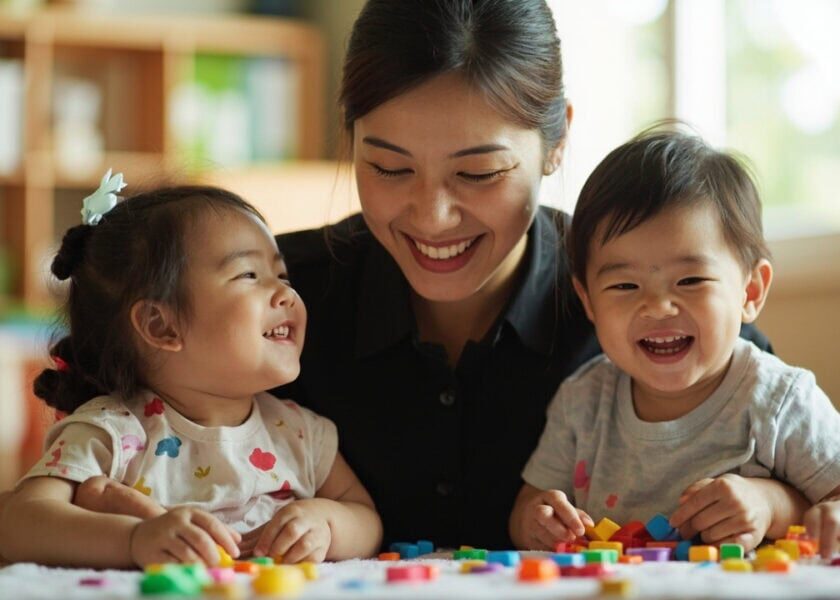
And when your child sits with two other children and negotiates who gets the blue block—the most coveted block in the room—they are not engaging in something trivial. They are practicing the most complex skill set humans possess. They are reading facial expressions and inferring intentions. Managing frustration, delaying gratification, proposing alternatives, accepting compromise. Learning that other people have desires that differ from their own and that relationships require navigation.
These are executive functions—the cognitive capacities that predict academic success, emotional resilience, and even long-term health outcomes more reliably than any IQ score. When your three-year-old tries to build a tower with blocks and it keeps falling down, and she tries again, and again, and finally tries a different approach—she is practicing executive function. She is building the capacity to regulate her emotions, to persist through difficulty, to think flexibly when one strategy fails.
A simple game of shape-sorting—where the shapes look similar but one is just slightly different—requires your child to hold multiple categories in mind, to inhibit the impulse to force the shape into the wrong hole, to persist until the solution is found. This is brain-building. These capacities are not innate. They are constructed, neuron by neuron, through repeated practice in environments that offer the right challenges at the right time.
What Quality Actually Looks Like
In a quality childcare setting, nothing happens by accident. That sounds like a strong claim, but it is the difference that most parents cannot see when they are standing at the doorway in the afternoon, looking at what appears to be beautiful chaos.
When an infant care teacher arranges a play activity, she has made decisions about developmental domains she wants to address. She has considered whether the materials challenge your child at the right level—not so easy that nothing is learned, not so difficult that frustration overwhelms curiosity. She has thought about how the activity scaffolds across language, motor development, and social cognition, sometimes simultaneously.
Consider a seemingly simple activity: a basket of fabric squares of different textures—smooth cotton, rough burlap, soft fleece, silky satin—placed on a low table where infants can reach them.
At first glance, this looks like sensory exploration. Your child is touching things. Pleasant. Maybe calming. But watch what is actually happening.
The teacher placed squares of different textures together for a reason. She is giving your child the opportunity to compare, to notice that this one feels different from that one. Building the neural pathways that will later allow your child to categorize, to sort, to recognize patterns. Introducing vocabulary—not through instruction, but through the natural moments when a caregiver says, “That one is smooth, isn’t it? Feel how smooth it is.”
But the teacher also placed the squares at a table rather than in a basket on the floor. She has designed a standing or supported-sitting activity, which means your child’s core muscles are engaged. Balance is being practiced. Motor development is happening alongside cognitive development, alongside language acquisition.
And if you watch a little longer, you might see the teacher notice that your child has been focused on one texture for several minutes. She might quietly introduce a new element—a small mirror propped against the wall, or a simple sound made by crinkling a nearby square. She is extending the learning, nudging your child toward a new challenge at precisely the moment when the current challenge is almost mastered.
This is scaffolding. This is what it means to teach through play. This is what quality looks like when you know what you are seeing.
Ratio is the architecture beneath this attention. When a caregiver is responsible for one, two, or at most three infants at a time, she can notice the moment when your child’s interest shifts, the moment when frustration is building, the moment when a social interaction is about to become a conflict or a collaboration. She can intervene with just the right word, the right material, the right physical support to extend the learning or protect the experience.
When that ratio stretches to five, six, or seven infants per caregiver, something essential is lost. Not warmth—perhaps not even love. But attention. The cognitive bandwidth required to notice, interpret, and respond to the learning happening in real time.
EduNanny operates within the ECDA Childminding Pilot framework, which maintains ratios of up to one to three infants at key developmental stages. This reflects a recognition that in the early years, the quality of attention a child receives matters more than almost any other variable in predicting developmental trajectories.
How Learning Changes as Your Child Grows
The learning architecture I have been describing is not static. It evolves. A three-month-old and a three-year-old are both playing, but they are building entirely different things.
The Infant Stage
In the infant stage, play is about sensory exploration and motor discovery. It is about the profound satisfaction of grasping an object, of feeling texture, of discovering that their hands are connected to their intentions. The brain is building its understanding of cause and effect, of object permanence, of the relationship between self and world.
The Toddler Stage
As children move into toddlerhood, play becomes increasingly social and symbolic. A cardboard box is not a cardboard box; it is a spaceship, a house, a hat. Children begin to engage in pretend play, which requires them to hold two realities in mind simultaneously—the real world and the imagined one. This capacity for symbolic thinking is foundational to later academic learning, to understanding metaphors, to the kind of abstract reasoning that mathematics and science require.
The Preschool Stage
By the time children reach preschool age, play is the medium through which they practice every adult skill they will eventually need. They negotiate, they collaborate, they manage conflict, they create rules and then agree to follow them. They engage in complex narratives that require memory, sequencing, and emotional intelligence. They are, in the most meaningful sense, practicing for life.
Quality childcare does not deliver the same experience across all of these stages. It designs for each stage, understanding what the child is ready to build and ensuring that the environment, the materials, and the adult guidance support that building.
From Uncertainty to Partnership
Once you understand what is happening beneath the surface of play, you become a different kind of parent at pickup time. You stop asking only, “Did they have a good day?” You start asking, “What were they working on? What did you notice about how they approached the water table today? Did they try anything new with the blocks?”
And when your childcare provider can answer these questions—when they can tell you that your child spent forty minutes working on a tall tower and tried seven different configurations, or that they noticed your child was practicing parallel play today, sitting near other children but not yet collaborating, which is developmentally exactly where they should be at this age—then something shifts. You become a partner in your child’s learning.
You carry the framework home with you. You find yourself noticing what your child is building at the playground, in the bathtub, with a cardboard box and a wooden spoon. You start to see the learning everywhere.
Is home-based care less structured?
Many parents in Singapore choose home-based or community-based care because it feels closer to family. The idea of a large centre, with dozens of children and rotating staff, can feel impersonal even when the credentials are impeccable. There is nothing wrong with this instinct. In the early years, continuity of relationship matters enormously to a child’s sense of security.
What matters equally is that the relationship is not just warm, but informed. That the person caring for your child understands the science of how they learn. That your child’s caregivers can tell you not just what they did today, but what they were working on—physically, cognitively, linguistically, socially—and why it matters.
How do I evaluate whether care is actually good?
The difference between quality childcare and commodified care is not always visible to the untrained eye. But once you understand the framework, you can start to ask the right questions:
- Can the caregiver describe what your child was working on today?
- Do the activities seem to have a purpose beyond keeping children occupied?
- Is there evidence of scaffolding—activities that build on each other over days and weeks?
- Are the ratios sufficient for genuine observation and responsive care?
- Does communication flow both ways—can you share what your child is interested in at home?
Why This Matters: What Your Child Is Building
The question I posed at the beginning assumes that play and learning are separate things—that children are either playing or preparing for life. This assumption misunderstands both childhood and learning.
In the earliest years, your child is not preparing for learning. Your child is learning. Every moment of purposeful play is building the brain they will carry into school, into work, into relationships, into the full complexity of adult life.
The choices you make about the quality of that play—the intentionality of the adults who guide it, the design of the environments that contain it, the ratio of attention that can notice and extend it—these choices are not secondary to your child’s education. They are the education itself.
When you leave your child in the care of someone else, you are making a profound act of trust. But trust alone is not enough to build a life on. You deserve more than trust. You deserve understanding. You deserve to know what is happening in those hours—not just that your child was safe and happy, but what they were building, what they were discovering, what capacities were developing.
Quality childcare gives you this. It gives you a partner in your child’s learning, someone who can help you see what you are seeing, who can translate the chaos of play into the architecture of development.
Your child is building something every time they play. The only question is whether the environment around them is designed to help them build well.
We believe that every family in Singapore deserves access to this kind of care. Not because it is a luxury, but because the early years are not a luxury. They are the foundation. And foundations deserve the best we can give them.
To learn more about how EduNanny designs learning into every moment of your child’s day, reach out to our team. We welcome conversations with parents who want to understand more—not just what we offer, but why it matters.
Discover more about who we are or explore our approach to thoughtful, development-oriented childcare in Singapore.